









Key Takeaways
-
Field service software for office managers removes double entry by connecting scheduling, dispatch, job records, customer communication, invoicing, and accounting into one current set of information.
-
The most common daily breakdowns, including message fragmentation, scheduling chaos, duplicate data entry, visibility gaps, and chasing the last ticket, come from disconnected systems rather than from paper.
-
Two-way QuickBooks Online sync ends duplicate entry because corrections in either system flow back into the other instead of being overwritten.
-
ClearPath workflows, role permissions, and automated customer messages cut down on interruptions and re-entry, so you can answer questions without calling techs.
What Your Day Actually Looks Like
It is 7 PM. The last technician finished a job three hours ago, but the ticket never made it back to the office. You need the parts list and labor notes to build the invoice. The only way to get them is to call the tech directly, who is already home. The invoice waits until tomorrow. The cash waits longer.
That is a fragmentation problem, not a paper problem. A fully digital business running on manual handoffs has exactly the same failure. The enemy is disconnection, regardless of the medium.
You run the day: taking calls, building the schedule, handling the emergency requests that come in at 10 AM, chasing techs for job details, building invoices, and doing the books. Because all of that depends on information moving between people, the breakdowns that eat your time follow a predictable pattern:
-
Message fragmentation, with calls, texts, voicemails, and emails scattered across channels so details get dropped and nobody else can see the thread
-
Scheduling chaos, with a schedule living in a spreadsheet plus side conversations, and no live view of where anyone is
-
The double-job tax, where every job gets done twice: the tech does it once in the field, then you re-create it at the office, retyping parts and labor, re-entering the customer into accounting, and filing photos somewhere findable
-
Visibility gaps, where you cannot answer a customer’s question without interrupting a tech mid-job
-
The last ticket of the day, where you chase it so an invoice can go out before the week closes
The tool you choose has to reduce your workload. That is the standard that matters.
Book a demo to see how FieldPulse cuts duplicate entry for your office team.
Not sure where your admin workload is heaviest? Take the three-minute Admin Workload Assessment to find out where your admin workload is heaviest.
What Field Service Software Actually Handles For Your Office
Most content about FSM software lists features. You care about what each capability takes off your plate. The four categories most buyers hear about are scheduling and dispatch, work orders, customer communication, and invoicing. Two more, accounting integration and dashboard metrics, decide whether your workload truly shrinks.
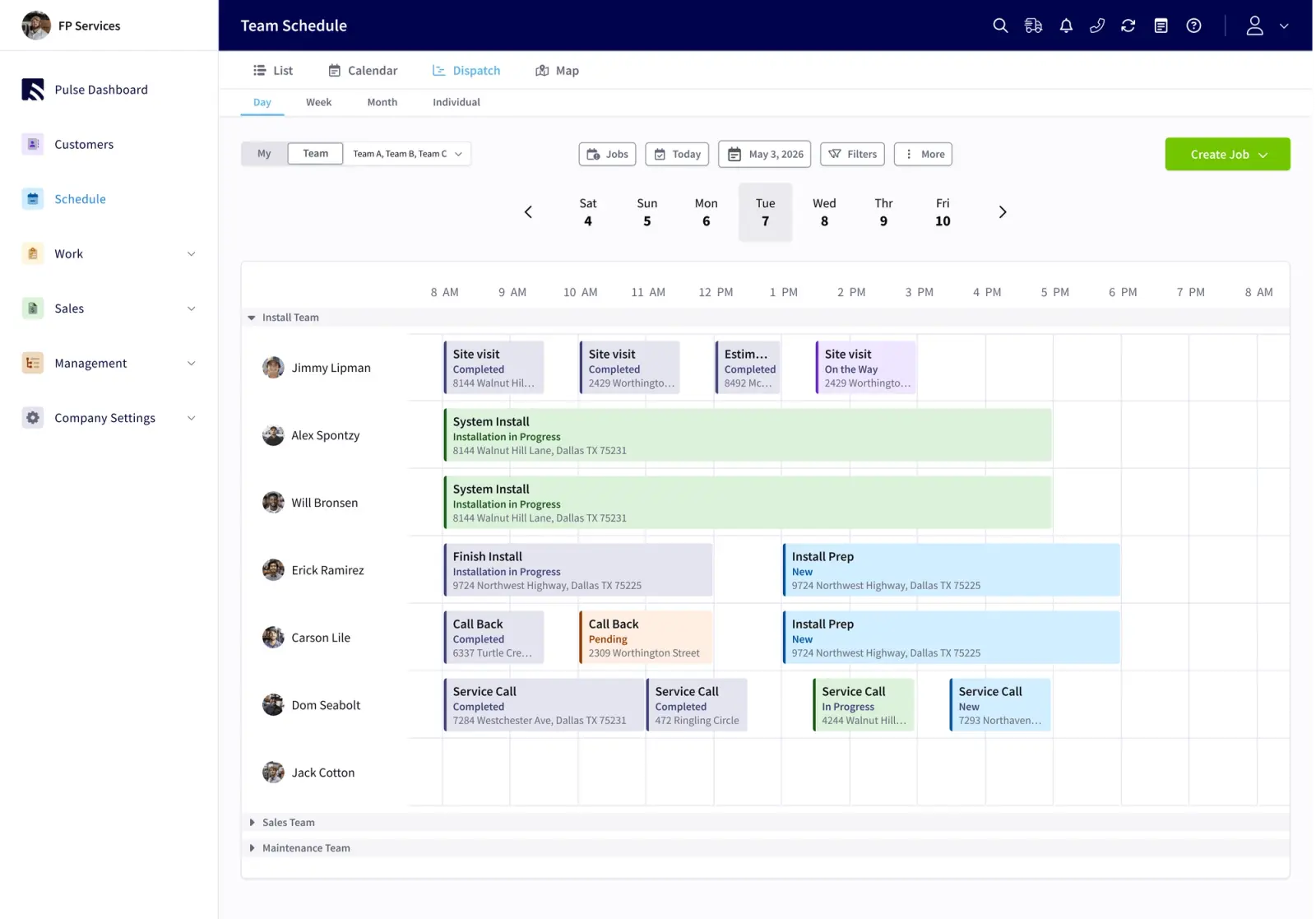
Here is what each capability removes from your plate:
-
Scheduling and dispatch, with a live board you control, drag-and-drop rescheduling, and a current view of where every tech is. You own the board, and your techs see their own day.
-
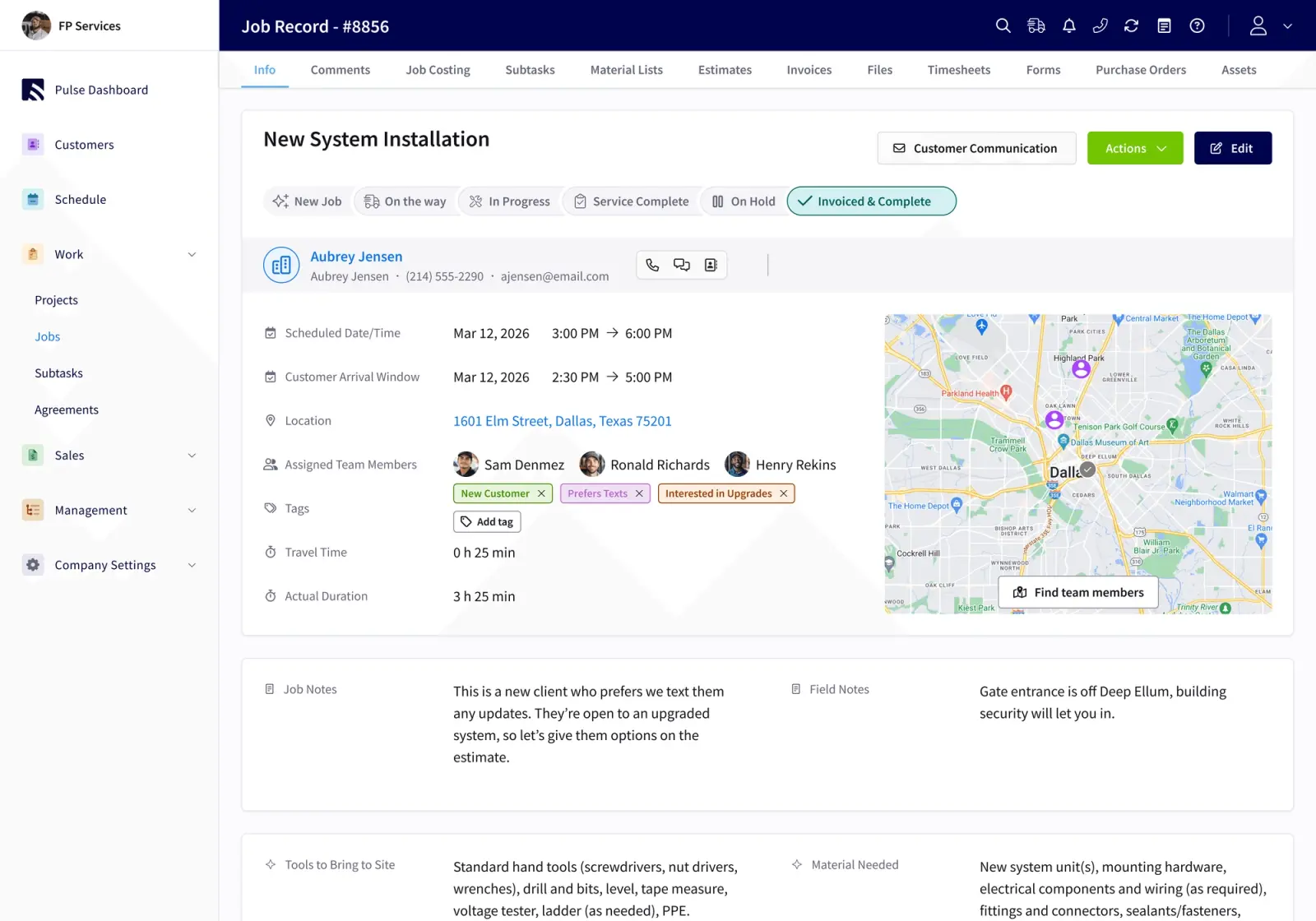
Work orders, with one job record that carries the customer, the site, the customer’s history, the assigned crew, the stage, the notes, the photos, the forms, the materials, and the financials. The tech updates it in the field, and you read it without calling.
-
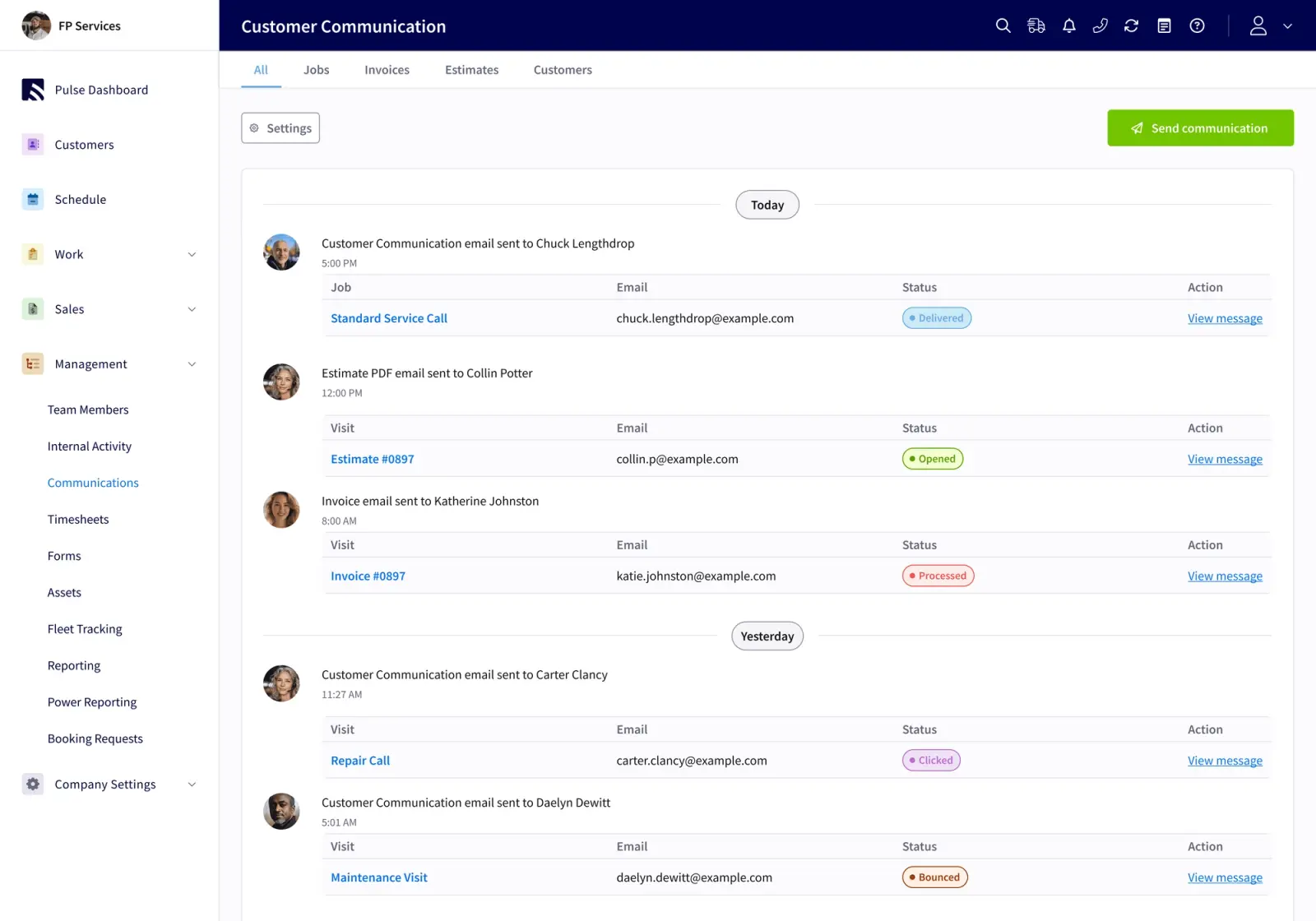
Customer communication, with automated appointment reminders, on-the-way texts, and completion notices triggered by job status changes. The system sends them, and you handle exceptions.
-
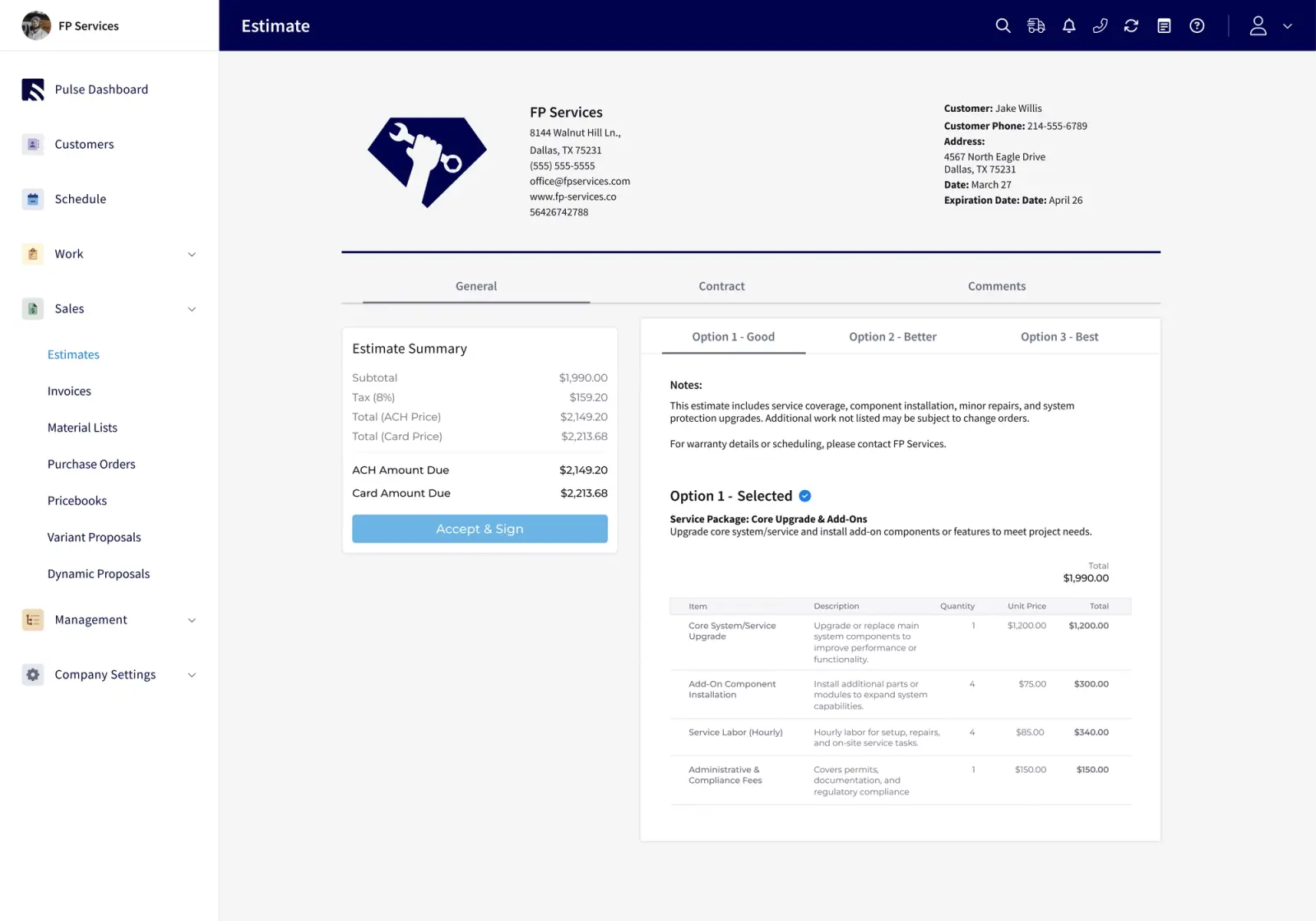
Invoicing, where the job record converts to an invoice without re-entry, and payment can be collected on site. You stop rebuilding invoices from tickets.
-
Accounting integration, where your field service software and your books stay in agreement in both directions. This is the category that decides whether the double-job tax actually ends.
-
Dashboard metrics, such as jobs completed per tech, unpaid invoices, callback rate, and service agreement renewals, all pullable without asking anyone.
How You Stop Entering The Same Job Twice
The double-job tax works like this. Your tech finishes the job, writes the notes, records the parts and labor, takes the photos, and gets the signature. Then you do it again at the office. You read the ticket, retype the parts and labor into an invoice, re-enter the customer into the accounting system, and file the photos somewhere findable. The work is finished, but it is not done until you have re-created it in a second place.
That second pass is invisible on any job sheet. A July 2025 survey of 500 U.S. professionals found that work orders were the most commonly cited document type driving manual data entry, and 50.4% of those surveyed admitted manual data entry leads to costly errors, delays, or lost opportunities. It scales with volume rather than with revenue. It is often the first thing that breaks operationally when your business adds crews, which is why the office becomes the bottleneck long before the field does.
When the job record carries parts, labor, notes, photos, and signatures from the field to the office as the work happens, and converts to an invoice without re-entry, the second pass disappears.
FieldPulse is built around this problem. One customer and job record serves the whole team, so you can answer a customer’s question without calling a truck. That single record is the foundation everything else runs on.
The capability that makes this work in practice is ClearPath, included in the core platform. You define the stages a job moves through, so installs, maintenance calls, repairs, and emergencies each get their own sequence. Inside each stage, you define exactly what has to happen before the job moves forward, such as a photo, a form, a signature, or a checklist. ClearPath’s Mobile Focus View shows your tech only what the current stage requires, with single-tap Action Buttons for common tasks. Job progress reaches your office automatically instead of by phone call. Customer messages like an “On the Way” text fire at the right stage without anyone remembering to send them.
Roles and permissions give your team the access they need without everything routing back through you. Edit rights stay deliberate and do not sit open to the whole team.
Schedule a demo to see how ClearPath and a single job record remove double entry for your office.
The Accounting Question: What Two-Way QuickBooks Online Sync Actually Changes
Even with a single job record, your books can still fall out of sync if the accounting connection only works one way. Most field service software pushes data into QuickBooks Online and stops listening. FieldPulse syncs both ways, so a change made in either system shows up in the other.
Here is why that distinction matters. Your bookkeeper corrects a customer’s billing address in QuickBooks. With a one-way sync, that fix gets overwritten the next time the field service software pushes an update. With a two-way sync, the correction carries back into FieldPulse. The fix stays in both systems. A one-way sync only sends data in one direction, so office staff must still double-check entries in both systems, which keeps the double-job tax in place instead of removing it.
Here is what syncs in both directions with FieldPulse:
-
Purchase orders, with full line-item detail
-
Vendors
Timesheets flow into QuickBooks Online when a tech clocks out. Your existing QuickBooks Online customers and records come with you when you connect, so you are not rebuilding a customer list from scratch. Tax rates come from QuickBooks Online. Invoice numbering can follow your existing sequence. It works with QuickBooks Online Essentials, Plus, and Advanced in the US, Canada, and Australia.
The diagnostic question worth asking every platform you evaluate is simple: when your admin corrects something in QuickBooks Online, that fix should carry back into your field service software automatically.
Book a QuickBooks-focused demo to see how two-way sync removes rekeying for your office.
FSM Vs. CRM: What Your Office Actually Needs
You are the person who has to reconcile two systems when they disagree, so this choice has a practical answer. A CRM holds the customer relationship, including contact details, communication history, and sales pipeline. FSM software carries the job from first call to final payment, including scheduling, dispatch, work orders, invoicing, and accounting.
FieldPulse’s customer record does both. It holds contact details, service locations, your customer’s full job history, equipment and asset records, warranty documents, photos, files, invoices, and every logged communication. On a repeat visit, your tech arrives with the customer’s history, the equipment record, and the photos from last time already in hand, without calling the office to ask.
For a 7-to-50-technician residential service business, the right answer is a platform that handles both without asking you to keep two separate systems in sync manually.
Is There Free Field Service Management Software And What It Costs Later
Once you know what the office needs, the next question is often whether a free tool can deliver it. Free and low-cost tools exist, and some are genuinely functional for very small operations. Free field service tools are reasonable in exactly one situation: a brand-new solo operator doing fewer than 10 jobs per week who has more time than money. That is very different from a 7-to-50-technician residential service team.
The breaking points are predictable. Six signals that a field service business has outgrown free tools include losing track of estimates, invoicing taking more than 15 minutes a day, uncollected invoices over 30 days old, customers calling to ask when their appointment is, being about to hire, and being unable to tell which jobs are profitable. Inventory, permissions, multi-stage workflows, and real job costing are the usual breaking points as your team grows.
The best way to see FieldPulse is a demo with your team. The platform gets configured to the way your business already operates, including your job types, your stages, and your pricing. An unguided look at a generic setup shows the least useful version of it. In a demo you can walk your own scenarios, bring your office manager and a tech, and see each role in its actual interface.
Book a team demo to compare FieldPulse to free tools in your real workflows.
The Metrics You Should Be Able To Pull Without Asking Anyone
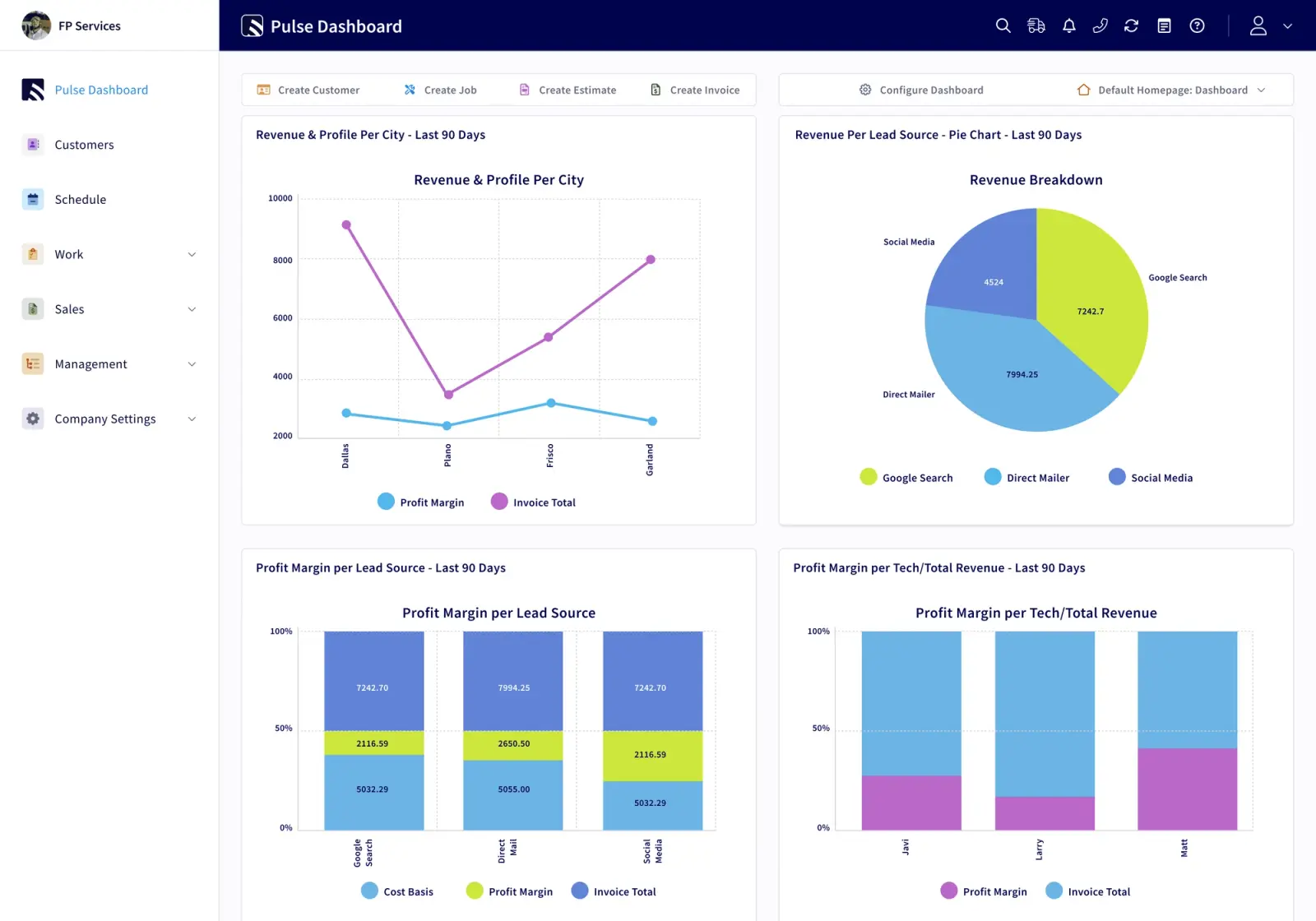
If answering “how many jobs did each tech complete this week?” requires a phone call or a spreadsheet, your reporting is working against you. The metrics that matter most to the office are also the ones that are hardest to pull from disconnected systems:
-
Jobs completed per tech, for visibility into field output without interrupting anyone
-
Unpaid invoices, for a live view of what has been earned but not collected
-
Callback rate, as an early signal of job quality and first-visit completion
-
Service agreement renewals, showing contracts approaching renewal that need action
FieldPulse includes 60+ prebuilt reports plus custom reports and dashboards. Because your techs clock in against the job itself, labor hours tie to specific work rather than to a weekly total. That is what makes job costing and job-level profit margin visible at all. These are visibility tools, not surveillance tools. The point is that you can answer a question without interrupting anyone in the field.
What Rollout Actually Asks Of Your Team
Your biggest concern about a new platform is probably this: it will add a rollout project to your workload instead of removing work from it. That concern is legitimate, and it deserves a direct answer.
Onboarding typically runs two to six weeks, depending on your team size, which capabilities you enable, how much data has to migrate, and how your accounting setup is handled. The sequence runs like this:
-
Scope the work, including capabilities, data, accounting requirements, and your business complexity
-
Begin recurring working sessions with an implementation manager after you sign
-
Configure the foundation, including preferences, templates, permissions, ClearPath, and the mobile workflow
-
Move data and connect QuickBooks Online
-
Enable each role through working sessions, live classes, and self-service resources
-
Transition to ongoing support
RDI, a commercial installation business that came from pen, paper, and Excel, put the approach plainly: “We ripped band-aids off one at a time, instead of all at once.” They started with scheduling, then invoicing, then time tracking, then ClearPath. Their field crew had used paper time cards for thirty years. The team expected six months to get adoption on the time-tracking rollout and was running payroll off the app in two weeks.
Nobody will tell you switching requires no work. FieldPulse’s implementation assumes your owner probably runs a truck all day and is not an IT person. The rollout gets sequenced into phases with small tasks between sessions, instead of landing on you all at once.
Frequently Asked Questions
What Do Field Service Tools for Office Managers Actually Do?
They connect scheduling, dispatch, job records, customer communication, invoicing, and accounting so your office and your field work from one current set of information instead of retyping the same job twice. A job completed in the field becomes an invoice without re-entry. Your schedule updates without a phone tree, and your books stay in agreement with your field service software automatically.
Who Are These Tools Built For?
The right tool depends on your team size and trade. FieldPulse is built for established, team-based residential service businesses, with HVAC, plumbing, and garage door service first, then electrical, appliance repair, and locksmith. The sweet spot is roughly 7 to 20 technicians. It supports commercial work as well, though its depth skews residential. It is not built for solo operators, and one-person operations often have better alternatives on the market.
How Much Implementation Effort Should We Expect?
Two to six weeks is the typical window for FieldPulse. The variables are your team size, which capabilities you enable, how much data migrates, and how your accounting setup is handled. The rollout is sequenced in phases, with configuration first, then data migration and QuickBooks connection, then role-by-role enablement. An implementation manager runs recurring working sessions throughout. Your team will have homework between sessions, which is what makes it stick.
Will Techs Actually Use It?
ClearPath’s Mobile Focus View shows a tech only what the current job stage requires, with checklists and single-tap Action Buttons. There is no full application to navigate, just a short, ordered list of what the current step needs. As RDI showed, adoption can happen much faster than expected, and their crew was running payroll off the app in two weeks. Techs also benefit directly because they arrive at repeat visits with the customer’s history, equipment records, and prior job photos already in hand, without calling the office.
What Does Accounting Integration Actually Change?
A two-way QuickBooks Online sync means a correction made in your books carries back into your field service software instead of being overwritten. Customers, line items, estimates, invoices, payments, purchase orders, and vendors sync both ways. Timesheets flow into QuickBooks Online when a tech clocks out. Your existing QuickBooks Online customers and records come with you when you connect. Tax rates come from QuickBooks Online, and invoice numbering can follow your existing sequence. The practical result is no rekeying and no month-end reconciliation project.
What Are The Common Limitations Or Trade-Offs?
As mentioned earlier, free tools tend to break at inventory, permissions, multi-stage workflows, and real job costing as your team grows. FieldPulse supports commercial work but is built primarily for residential teams. Onboarding takes real work, usually two to six weeks, sequenced in phases. The Pricebook, Custom Forms, Engage, Operator AI, Chat AI, and Fleet Tracking are add-ons priced separately from the core platform. Anyone who claims switching requires no effort is not being straight with you.
The Bottom Line
You are the person who actually runs the day. The tool you choose has to reduce your workload. It should not add a rollout project, require you to maintain two systems, or leave your books and field service software disagreeing after a correction.
FieldPulse connects your office and your field on one workflow. ClearPath is included in the core platform, QuickBooks Online sync works both ways, role permissions keep edit rights deliberate, and offline caching lets your techs complete most of a job without cell signal and sync everything the moment they are back in range. On average, FieldPulse customers experience 25% gains in efficiency, with office teams saving more than 40 hours per month.
See what happens to duplicate entry when your books and your field service software finally agree. Book a demo and invite your office manager. Or call sales at +1 (817) 635-2218.