








Key Takeaways
- One-way QuickBooks connections push data from field service software into QuickBooks and never pull corrections back, which creates month-end reconciliation headaches.
- Two-way QuickBooks sync moves customers, estimates, invoices, payments, purchase orders with full line-item detail, and vendors in both directions so both systems stay consistent.
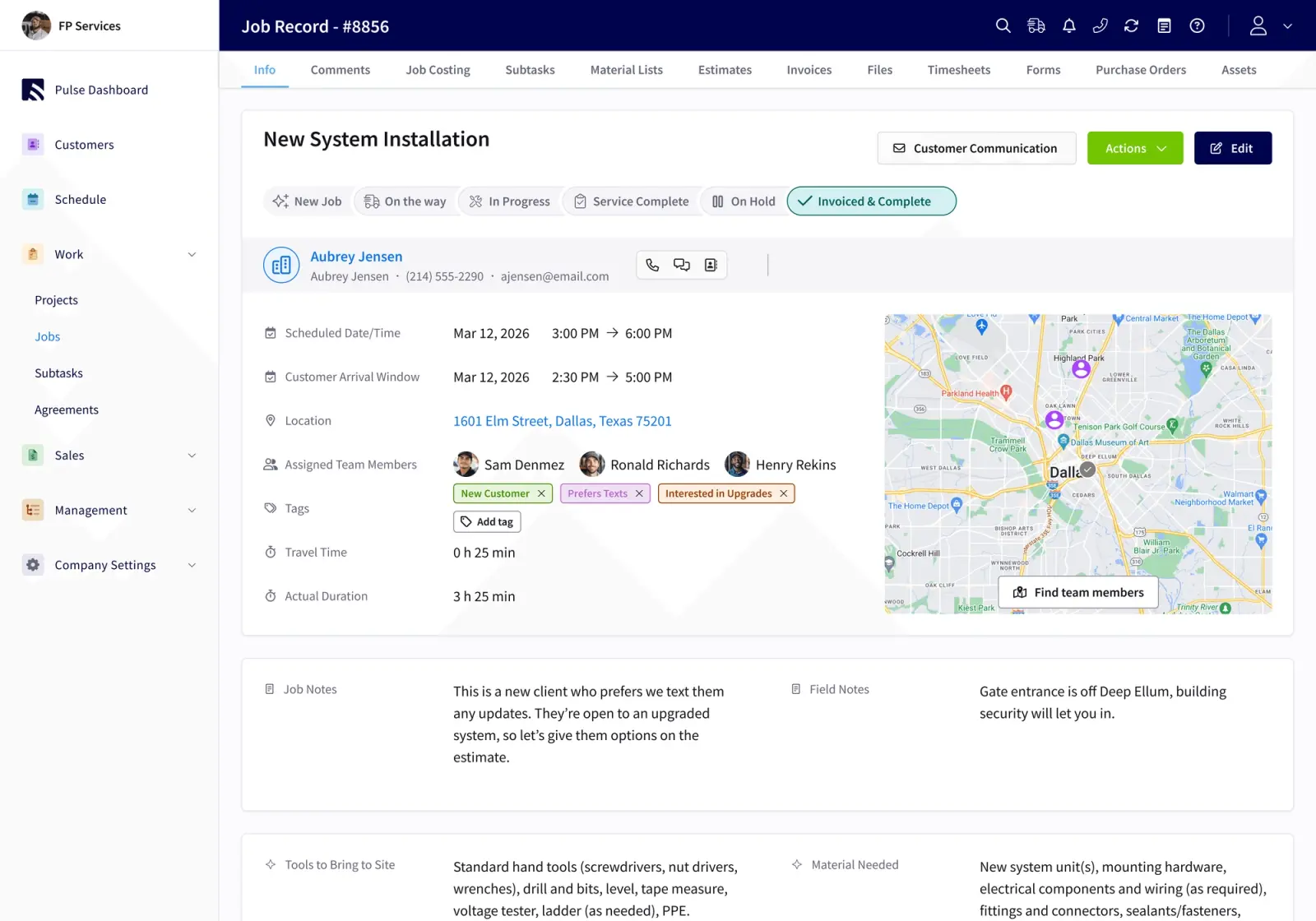
- Timesheets flow automatically into QuickBooks Online when a tech clocks out, so labor hours tie to specific jobs for accurate job costing and profit margin visibility.
- Double-entry work disappears when a tech invoices from the truck and the job posts to QuickBooks without anyone in the office re-keying the same data.
- FieldPulse delivers two-way QuickBooks sync and ClearPath workflows that keep your office and field working from one current set of records.
What Actually Syncs Between Garage Door Software And QuickBooks
QuickBooks integrations do not all move the same data, and that difference shows up in your books. FieldPulse’s view is simple: most field service software pushes data into QuickBooks Online and stops listening, which turns the connection into a one-way push that ignores corrections and updates in QuickBooks. A true two-way sync keeps both systems aligned so your office does not chase errors later.
Here is the key distinction for two-way sync: these records move in both directions, so a change in either system updates the other.
- Customers and line items, so a spring replacement invoiced in the field creates the customer record and line items in QuickBooks, and a correction made in QuickBooks carries back into FieldPulse.
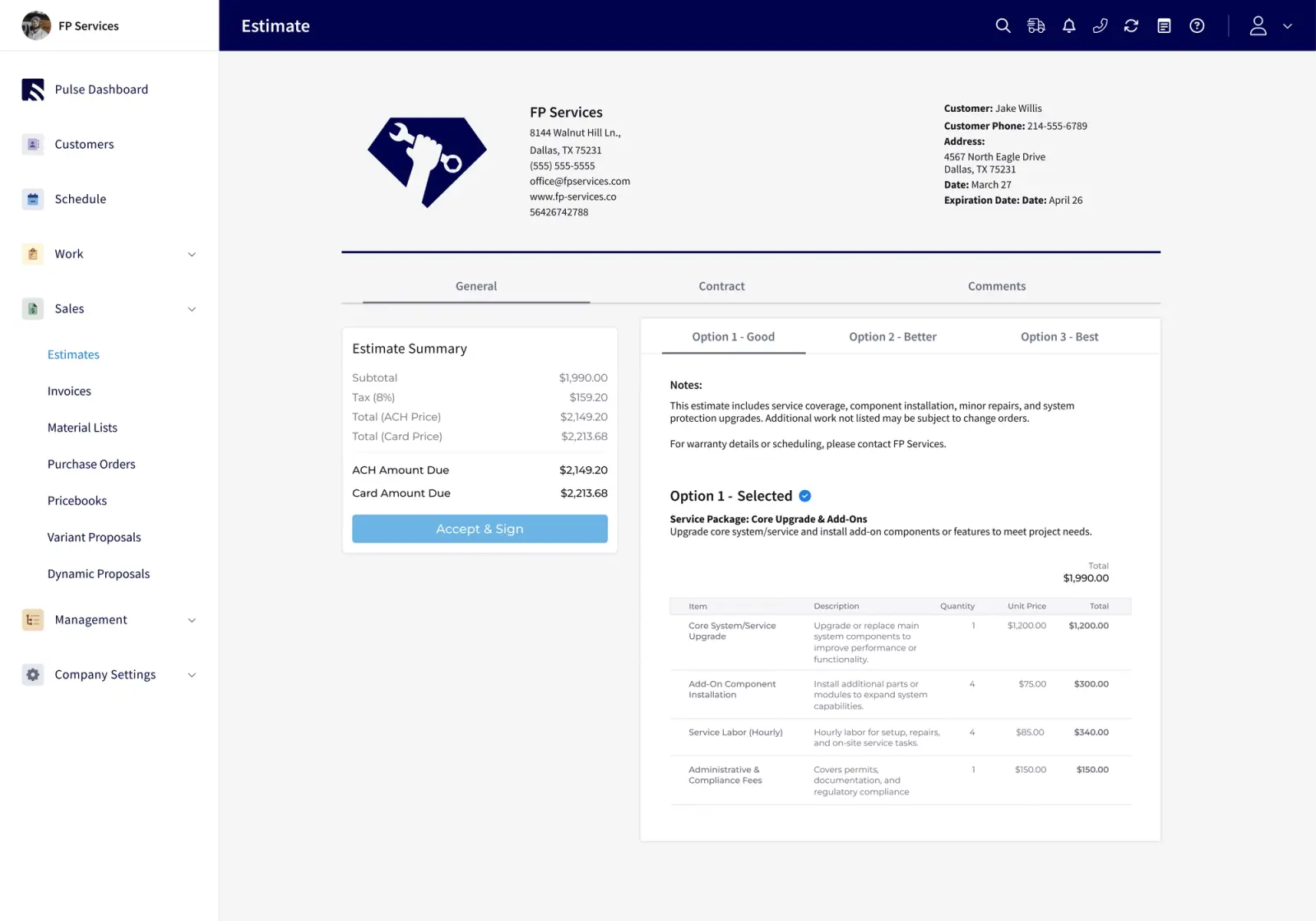
- Estimates and invoices, so an estimate built in the field converts to an invoice, goes to the customer, and appears in QuickBooks Online.
- Payments, which follow the standard QuickBooks flow of invoice, payment, and undeposited funds, so your bookkeeper’s deposit workflow stays intact.
- Purchase orders with full line-item detail, so parts ordered for a commercial door repair sync with every line item instead of only the total.
- Vendors, so vendor records stay consistent across both systems.
Some records only need to move into QuickBooks, and FieldPulse handles those as a one-way feed that still supports clean books.
- Timesheets, which trigger automatically when a tech clocks out so labor hours tie to specific jobs instead of a weekly total.
- Existing QuickBooks Online data, which imports when you first connect so you keep your customer list instead of rebuilding it.
Tax rates come from QuickBooks Online, and invoice numbering can follow your existing sequence, so your accounting conventions stay intact. FieldPulse’s two-way QuickBooks Online sync works with QuickBooks Online Essentials, Plus, and Advanced in the US, Canada, and Australia. QuickBooks Desktop is also supported for businesses whose books have not moved to the cloud.
For more on how FieldPulse handles garage door invoicing end to end, see Garage Door Invoicing Software: A Workflow-First Guide.
One-Way Vs. Two-Way QuickBooks Sync: Why It Matters
One-way sync pushes data from your field service software into QuickBooks and stops there. Two-way sync means a change made in either system shows up in the other, which keeps your job records and your books aligned.
Consider a real garage door scenario. Your tech replaces two torsion springs and a belt-drive opener on a same-day call. He invoices from the driveway for parts, labor, and a service fee, and the job closes in your field software. The invoice pushes into QuickBooks, so both approaches look the same at that point.
Later, your office finds the labor line was wrong. The tech logged 1.5 hours, but the job took 2.5. Your bookkeeper corrects the invoice in QuickBooks.
- Under one-way sync: the correction stays in QuickBooks, your field software still shows the original labor figure, the tech’s job history is wrong, the next estimate for a similar job pulls from bad data, and month-end reconciliation turns into detective work.
- Under two-way sync: the correction carries back into your field software, the job record updates, the tech’s history reflects what actually happened, and the next estimate starts from accurate data.
FieldPulse gives buyers a simple test to use with any vendor: ask how a correction in QuickBooks Online makes its way back into the field service software. A clear answer points to a two-way sync. A vague answer usually means a one-way push.
Talk through your QuickBooks setup.
The Double-Entry Tax In A Garage Door Business
Double entry hides in your day-to-day work, but it drains time and attention. Your tech closes a spring replacement in the field, notes the parts, logs the labor, and gets the signature. Then your office re-keys the same parts, labor, and customer details into QuickBooks. The job feels finished, yet it is not complete until someone in the office recreates it in a second place.
That second pass grows with job volume instead of revenue. When you add a crew, you add another full loop of re-entry.
Fragmentation is the real problem here, whether your team runs on access files or fully digital tools. A fully digital garage door business that relies on manual handoffs has the same failure as one running on clipboards. The data exists in two places, and someone has to move it.
A two-way QuickBooks Online sync ends the double entry. Your tech invoices from the truck, the job posts to QuickBooks, and corrections made in either system carry back to the other. Because ClearPath status workflows push job progress to your office automatically instead of by phone call, your office knows where every job stands without chasing anyone.
Garage Door Job Economics And The Books
The QuickBooks connection does more than reduce admin work. It makes per-job profit margin visible. Because your techs clock in against the job itself, labor hours tie to specific work instead of a weekly total. That foundation lets you see whether a same-day spring replacement made money and whether a two-visit commercial door install actually hit your target profit margin.
Job costing in FieldPulse estimates your profit margin upfront and confirms actual profit after completion. You get line-item cost, price, and profit breakdowns for every job. You know a job’s expected profit margin before you dispatch it, and you can confirm what actually happened after the tech leaves the driveway.
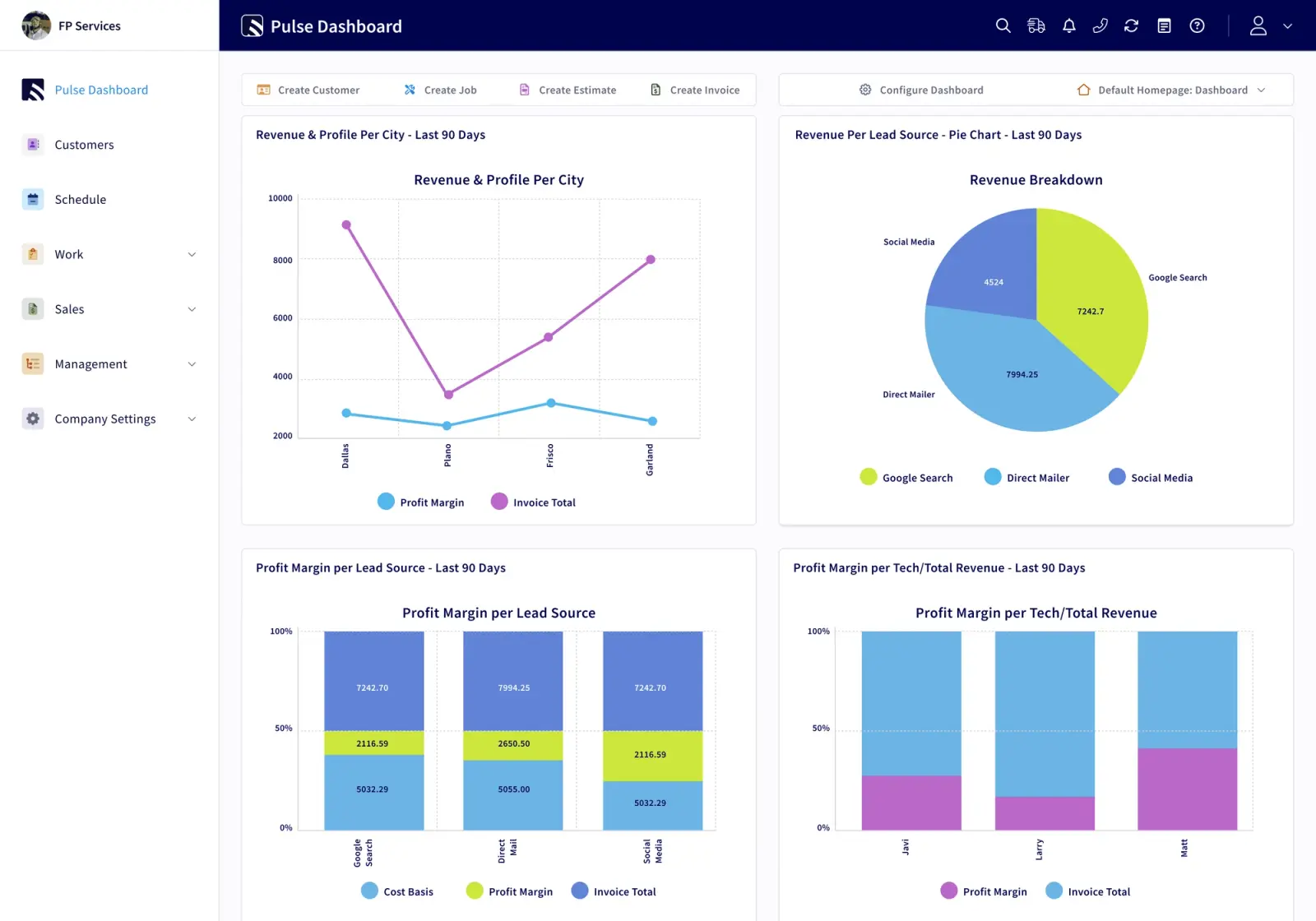
For a garage door business, this changes which work you chase. A same-day spring replacement and a two-visit commercial install have very different labor profiles. If your books show only weekly labor totals, you cannot see which job type carries your profit margin and which one erodes it. With job-level data flowing cleanly through a two-way QuickBooks sync, that picture becomes clear.
FieldPulse includes more than 60 prebuilt reports plus custom ones, so your office can track profit margin by job type, by tech, or by customer without rebuilding everything in spreadsheets at month-end.
What Software Is Best For Managing A Garage Door Business?
The strongest fit is a field service platform built for team-based residential trades that keeps your office and your field on one current set of records and syncs both ways with QuickBooks Online. Before you sign with any platform, walk through these questions with the vendor.
- When your admin corrects something in QuickBooks Online, how does that fix get back into your field software?
- Does the sync move purchase orders with full line-item detail, or only invoices?
- Do timesheets flow into QuickBooks Online when a tech clocks out?
- Do tax rates come from QuickBooks Online, and can invoice numbering follow your existing sequence?
- Which QuickBooks editions are supported, and is QuickBooks Desktop supported too?
- What happens to a job record when your bookkeeper edits the invoice?
- How long does onboarding take, and who runs the working sessions?
FieldPulse is the answer for this reader. It is all-in-one FSM software for growing service teams, with particular strength in residential trades including garage door service. Its two-way QuickBooks Online sync keeps your office and your books aligned instead of arguing.
FieldPulse holds a 4.8 out of 5 aggregate rating across G2, Capterra, the App Store, the Google Play Store, and other software-review sites.
For a broader look at the software landscape, see Best Garage Door Business Software For Growing Teams.
Compare FieldPulse to your current tools.
How Long It Takes To Connect QuickBooks To Garage Door Software
Onboarding typically runs two to six weeks, depending on your company size, which capabilities you enable, how much data you migrate, and how your accounting setup works today. Any vendor who claims it requires no work is overselling.
Here is the usual sequence FieldPulse follows with new teams.
- Scope the work, including capabilities, data, accounting requirements, and your business complexity.
- Assign an implementation manager who starts recurring working sessions after signing.
- Configure the foundation, including system preferences, templates, permissions, ClearPath, and the mobile workflow.
- Move data and connect QuickBooks Online, which can extend the schedule when data volume is high.
- Enable each role through working sessions, live classes, and self-service resources.
- Transition to ongoing support.
Your existing QuickBooks Online customers and records come with you when you connect, so you keep your customer list instead of rebuilding it. The implementation assumes you run a garage door business, not an IT department.
Plan your rollout with an expert.
A Short Fit-Based Comparison
FieldPulse fits growing garage door teams in the 7-to-50-tech range that need more than a basic scheduling tool but do not want enterprise-level complexity. When your workflows, inventory, accounting, permissions, or job economics outgrow what a simpler platform can handle, FieldPulse becomes a strong option. Simpler platforms reach their limits when you need purchase orders with full line-item detail syncing to QuickBooks, per-job profit margin visibility, ClearPath-guided workflows for each job type, and a two-way sync that carries bookkeeper corrections back into your field service software.
For businesses whose needs have grown to that point, FieldPulse connects your office and your field in one operating system, with a QuickBooks integration built around accounting integrity. See how it compares in Dispatch Software With QuickBooks: What Actually Syncs.
See if FieldPulse fits your team.
Frequently Asked Questions
Does FieldPulse Work With QuickBooks Desktop As Well As QuickBooks Online?
Yes. FieldPulse supports QuickBooks Desktop in addition to QuickBooks Online. The two-way sync with QuickBooks Online works with Essentials, Plus, and Advanced editions in the US, Canada, and Australia. If your books have not moved to the cloud yet, QuickBooks Desktop support means you can still connect your field operations to your accounting system.
What Happens To My Existing QuickBooks Customers When I Connect?
Your existing QuickBooks Online customers and records import when you first connect FieldPulse, so you keep your customer list instead of rebuilding it in a second system. From that point forward, customer records sync in both directions, and a correction or update in either system carries to the other.
Can I Invoice From The Field And Have It Land In QuickBooks?
Yes. A tech can build an estimate from the truck, convert it to an invoice, collect payment on site, and have the invoice post to QuickBooks without anyone in your office re-keying it. Payments follow the standard QuickBooks flow of invoice, payment, and undeposited funds, so your bookkeeper’s deposit workflow stays intact. Tax rates come from QuickBooks Online, and invoice numbering can follow your existing sequence.
Does FieldPulse Work For A Garage Door Company That Does Both Repairs And Full Installs?
Yes. FieldPulse supports multiple job types with their own ClearPath workflows, so a same-day spring replacement and a multi-visit commercial door install each follow a distinct process your office defines. Your office can set required actions at each stage for each job type, and your techs see only what the current step needs. Job costing tracks labor, materials, and overhead against each job separately, so you can see profit margin by job type instead of only by week or month.
What Happens To A Job Record When My Bookkeeper Edits The Invoice In QuickBooks?
With FieldPulse’s two-way QuickBooks Online sync, a correction made in QuickBooks carries back into FieldPulse instead of getting lost. That behavior is the core accounting-integrity difference between a one-way push and a true two-way sync. Under a one-way connection, the fix stays in QuickBooks while your field service software keeps the original, and the two systems drift apart until someone manually reconciles them. Under two-way sync, both systems stay current from the same correction.
Conclusion: Why Two-Way Sync Changes Your Day-To-Day
A garage door company can run fully digital workflows and still lose money when the QuickBooks connection only pushes data one way. The real evaluation criteria stay simple: what syncs, in which direction, what happens to a correction, and whether labor hours tie to specific jobs. When a vendor cannot answer those points clearly, you are likely looking at a one-way connection and a month-end reconciliation problem waiting to surface.
FieldPulse’s two-way QuickBooks Online sync and ClearPath workflows keep your office and your field working from one current set of records. Corrections made in the books carry back into your field service software. Labor hours tie to the jobs that generated them. Your office stops doing the same work twice.
Schedule your FieldPulse walkthrough.