









Key Takeaways
-
Technician permissions in locksmith software must scope key-code and bitting access strictly to assigned work orders so sensitive data stays in your business.
-
Role-based controls keep wholesale costs, markups, and profit margins in the office while still letting techs quote customer-facing prices.
-
1099 subcontractors need isolated logins with assigned-jobs-only visibility so they cannot view other techs’ schedules or the full price book.
-
Edit and deletion rights for jobs and prices should go only to specific roles, never to every user on the account.
-
FieldPulse provides Roles & Permissions, ClearPath, and the Pricebook to enforce these controls across your entire workflow.
The Problem: A Former Tech Whose App Still Worked
A technician leaves your company on a Friday. By Monday morning, his login still opens the app. He can still see every customer’s key history, every job on the board, and the full price book, including your markup. A 1099 sub you brought in for a callback scrolls through your entire price book while waiting on a customer. A job disappears from the record after a price was edited in the field, and you have no way to reconstruct what happened.
These scenarios happen regularly. The level of access a person has, more than their character, determines how much loss is possible.
Permissions sit inside your workflow, not off to the side. This article maps four internal-risk moments locksmiths face, such as key-code and bitting history leaving with a former tech, a subcontractor seeing your full price book, a price change nobody approved, and a job deleted from the record, to the permission structure that prevents each one.
See how FieldPulse scopes access by role
Key-Code And Bitting Access: Protecting Your Most Sensitive Records
Key codes, bitting specifications, and master-key charts are more sensitive than your customer list. The bitting list is the locksmith’s property and the asset that keeps the client coming back to you. A wrong bitting can create more risk than having no bitting at all.
A master key chart shows how a master key system is structured: which change keys operate which locks and how master keys fit the hierarchy. Many facilities keep these charts as searchable digital databases that link keys to locks, locks to areas, and areas to authorized personnel. That chart becomes the reference document for key control, auditing, and maintenance across a client’s entire facility.
FieldPulse’s Roles & Permissions restrict financial and billing information by role while techs still get everything they need for the job they are on. The core rule stays simple.
Can a locksmith tech see key codes for jobs they are not assigned? No. Access scopes to the assigned work order. A tech sees the job they are dispatched to, not the full customer’s history, not other techs’ assigned jobs, and not bitting records for accounts they do not service.
Price Book And Financial Visibility: Controlling What Techs See
Key codes are the most sensitive records, but they are not the only ones. Your price book holds more than prices. It holds your markup, your wholesale cost, and the structure of how you make money on every service line. A tech who can see your full price book, including what you pay for hardware and what you charge, has everything they need to undercut you if they leave or to quote a customer a different number than you intended.
The permission structure that prevents this separates what a tech sees from what the office manages. In FieldPulse, the Pricebook (an add-on) holds standard pricing for services, materials, and labor and updates in real time across every user and location. Because it pairs with Roles & Permissions, profit margin data stays in the office. Techs see the price the customer pays, not the wholesale cost or markup behind it. That separation only holds if edit rights are deliberate and granted to specific roles instead of the whole team.
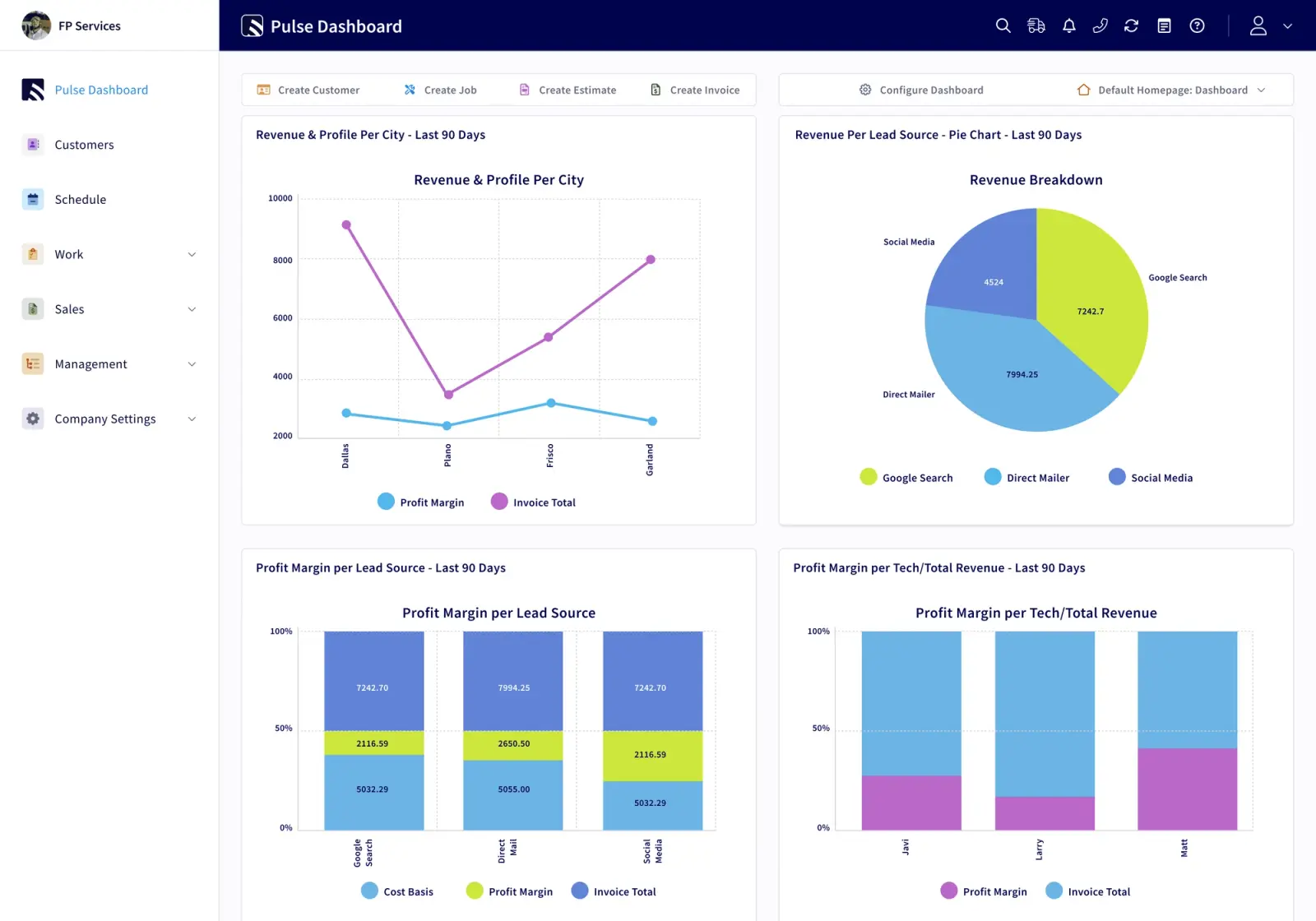
The explicit answers stay straightforward:
-
Techs cannot see payment or wholesale pricing.
-
Techs cannot change prices on a job.
-
Price edits require a role with deliberate edit access.
This matters operationally as well as financially. When two techs quote the same job at different prices because one of them edited a line item in the field, your customer notices. Your profit margin takes the hit before you even know it happened.
The 1099 Subcontractor Problem: Scoping Access For Subs
1099 subcontractors create one of the highest-risk access scenarios your business faces. A sub brought in for a callback is a separate business with their own interests. Giving them the same access as a full-time tech creates risk for your profit margin and your customer relationships, not only for your data.
A security-focused locksmith documentation model treats key codes, bitting data, master key chart references, and key blank numbers as sensitive assets that need role-based access controls. A 1099 sub who can scroll your full price book on a callback knows your markup. A sub who can see other techs’ schedules knows your customer density and service areas. Neither piece of information is required to complete the job they were hired for.
The right permission structure for a 1099 locksmith subcontractor looks like this:
-
An isolated login scoped to their own work.
-
Assigned-jobs-only visibility so they see only the job they are dispatched to.
-
No access to the full price book or wholesale pricing.
-
No visibility into other techs’ schedules or customer histories.
In FieldPulse, a 1099 sub can use an isolated login scoped to their own work. They operate inside your workflow and under your permission structure, with access limited to exactly what they need for the job.
See how FieldPulse handles 1099 access
Job Visibility And Deletion Controls: Protecting The Record
A job that disappears from the record after a price was edited in the field creates both accounting and liability problems. If a customer disputes a charge or a commercial client asks for a service history and the job record has been altered or deleted, you lose your documented trail.
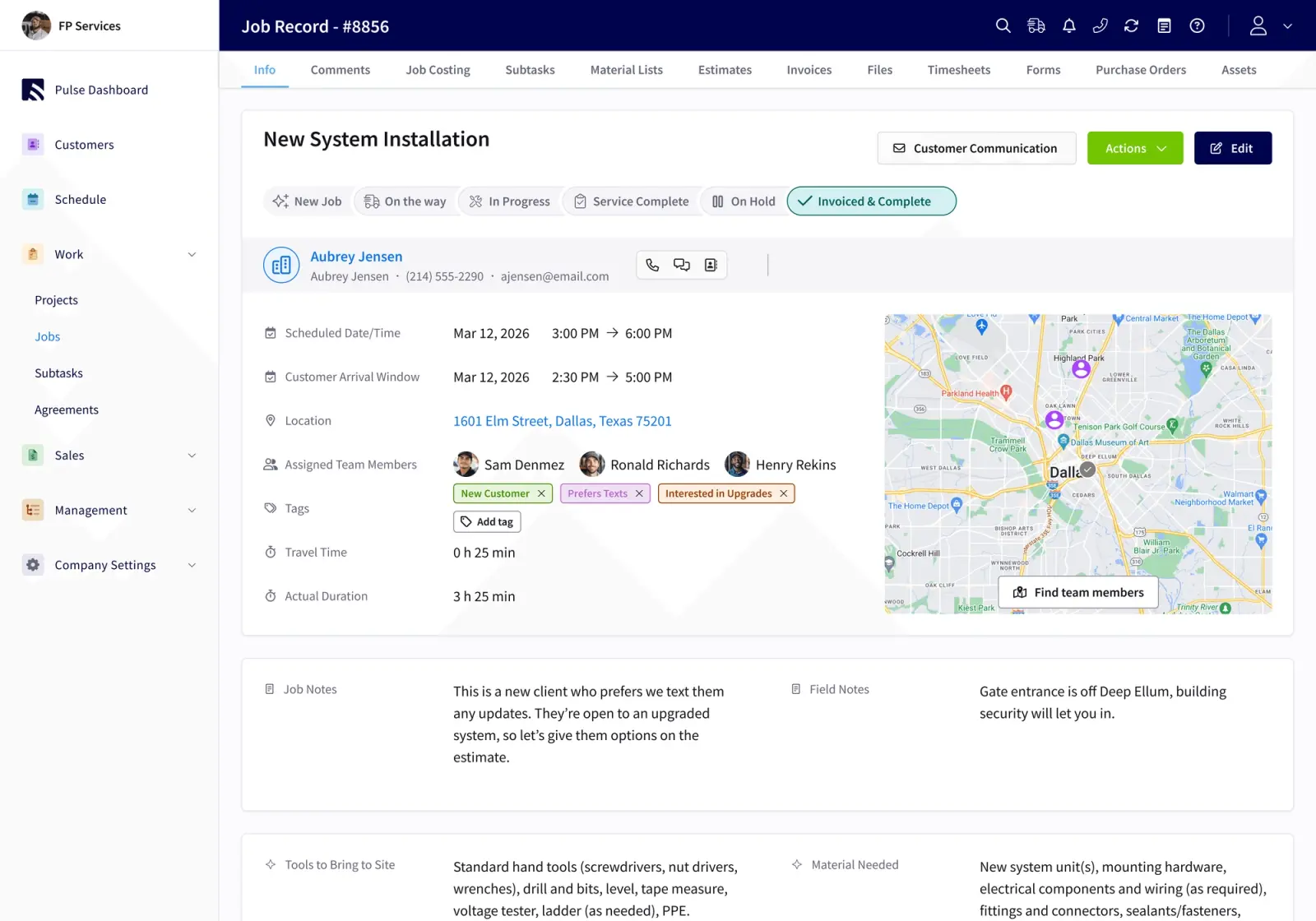
FieldPulse’s Roles & Permissions treat edit rights as deliberate. Only roles that you explicitly choose receive those rights. The explicit answers:
-
Techs see only their assigned jobs, not the full job board.
-
Techs cannot delete jobs from the record.
-
Techs cannot view other techs’ schedules.
-
Price changes on a job require a role with edit access.
This structure protects the record and supports your team. GPS, fleet tracking, and timesheets in FieldPulse give techs a documented record of their time on site, their location for dispatch support, and a clock-in tied to the job so their hours stay accurate. That documentation protects them as much as it protects you.

Clock-In And Location Context As Part Of Recordkeeping
Clock-in behavior and location context follow the same recordkeeping logic as job visibility. Techs clock in and out by job or by shift in FieldPulse. That time flows directly into job costing and into QuickBooks Online at clock-out. Labor hours tie to specific jobs instead of a weekly total, so you can see job-level profitability.
Location context supports dispatch and job documentation. When a tech marks themselves en route, ClearPath can trigger an automated “On the Way” text to the customer, so no one in the office has to remember to send it. When a job is complete, the record holds the time, the location, the photos, and the notes from the field.
ClearPath’s Mobile Focus View requires connectivity to display. For jobs in areas with limited signal, such as rural service areas, basements, or commercial mechanical rooms, FieldPulse’s caching behavior keeps the last week of jobs, notes, photos, and status updates available on the device. Sync runs when signal returns, so techs can complete a majority of the job without a cell signal.
Permission Review As A Recurring Workflow Step
Leaving permissions untouched after the first setup is how a former tech’s login still works three months after he left. Permission review becomes a recurring workflow step that specific operational changes trigger.
-
When a tech leaves: Deactivate the login immediately. Reassign their open jobs before deactivating so nothing falls off the board.
-
When a 1099 sub is added: Create an isolated login with assigned-jobs-only access. Avoid reusing a former tech’s credentials.
-
When a service line is added: Review which roles need access to the new job type, the new pricing, and any new bitting or key records tied to it.
FieldPulse’s ClearPath, included in the core platform, ties permission review to your workflow. ClearPath turns your process into job stages with required actions at each stage. Each stage specifies which role is responsible for the required action. The office approves before a job moves forward. The tech completes the required checklist before marking a stage done. The record reflects every step.
When a tech leaves or a sub is added, the workflow itself shows where access needs to change because the stages and required actions already map to roles.
What To Ask Any Field Service Software Vendor
Before signing with any FSM software platform, ask the vendor these questions directly:
-
Can you scope key-code and bitting access to the assigned work order instead of the whole account?
-
Can you keep wholesale and profit margin figures out of the field entirely?
-
Can a tech delete a job or change a price without a role that has been deliberately granted that right?
-
Can a 1099 sub see only their own dispatches instead of other techs’ schedules or the full price book?
-
Which role is responsible for each required action at each job stage?
-
What happens to a tech’s login when you deactivate them, and how fast does it take effect?
The answers to these questions show whether permissions in that platform sit inside your workflow or live as a settings page nobody reviews.
Conclusion: Treat Permissions As Part Of Your Workflow
Locksmith businesses that protect key-code data, profit margin, and the job record decide in advance who can see, price, change, and delete what. They also review those decisions when a tech leaves, a sub is added, or a service line changes. Permissions are a workflow decision. Treat them like your job stages, your dispatch process, and your price book, and review them regularly instead of leaving them in a settings page.
FieldPulse connects your office and your field on one workflow, with Roles & Permissions, ClearPath, and the Pricebook controlling access by role. South Shore Lock and Key, a locksmith customer on FieldPulse, put it directly: “We like how the system is all in one. We have been able to get rid of 3 different apps so that everything is in one place… We especially like the ClearPath and custom statuses.”
If you are running 7 to 50 techs, including 1099 subs, and you cannot answer with confidence who can see your key records, who can change a price, or who can delete a job, that gap is the problem permissions are built to close.