









Key Takeaways
- Most field service CRM free trials use generic sandbox data and pre-built job types. You end up configuring the software instead of testing your real workflows.
- The seven workflows that matter most in a growing service business are job completion to invoice, schedule changes, pricing consistency, customer context on repeat visits, administrative load, offline behavior, and reporting and job costing.
- A structured two-week evaluation should test your actual job lifecycle with real customers, real pricing, and real accounting sync rather than vendor demo scenarios.
- Key evaluation criteria include whether a tech can complete a job and invoice it without office re-entry, handle schedule changes without phone calls, maintain pricing consistency, access complete customer history, reduce administrative work, work in low-signal areas, and see job-level profit margin.
- FieldPulse offers configured demos instead of free trials because the platform is customized to your specific job types, stages, and pricing so you can evaluate real workflows.
Who This Guide Is For and What to Have Ready Before Day One
This guide is for owners, operations leads, and office administrators at established residential service businesses with roughly 7 to 50 technicians in HVAC, plumbing, garage door service, electrical, appliance repair, and locksmith work.
If you have outgrown spreadsheets or a simpler tool and you are evaluating FSM software, you already know the pain. You are wary of annual contracts. You may have sat through demos that looked great and then discovered the software does not handle your job types the way you actually run them.
Here are a few terms to align on before you start:
- Field service CRM: The customer record for a service business, including contacts, service history, equipment, and communication history in one place. The service history matters more than a sales pipeline.
- FSM software: The broader operating system for your team, including scheduling, dispatch, work orders, mobile tech access, invoicing, and reporting. Many platforms combine CRM and FSM in one product.
- Work order: A documented service request with job details, the assigned tech, parts needed, and expected completion.
- Job costing: Tracking labor, materials, and overhead per job so you know which jobs actually made money.
- Pricebook: A standardized list of services, materials, and labor rates so every estimate starts from the same numbers.
- ClearPath: FieldPulse’s workflow engine with custom job stages, required actions at each stage, and ClearPath’s Mobile Focus View that shows your techs only what the current step needs.
Growth turns workflow problems into business risk. The key breakdowns are job completion that never becomes an invoice, schedule changes that create a call tree, pricing that varies by person, customer context that fragments, and administrative work that eats personal time. Your trial should test these specific workflows, not just feature checkboxes.
Before day one, write down four things:
- Your decisive question (for example, “Can a tech complete a job and invoice it without calling the office?”)
- Your pass and fail criteria for each workflow test
- The names of the people participating, such as owner, dispatcher, and at least one tech
- The real jobs you will run through the system
See your workflows in a configured demo
Step 1: Test Job Completion to Invoice (Day 1–2)
This is the most important test. A tech finishes a job and the invoice should go out without anyone retyping the job.
Who is involved: One tech and one office administrator.
What to test: Have the tech complete a job in the field. They log parts, labor, notes, and photos and collect a signature. Then the office generates an invoice from that record without re-entering anything.
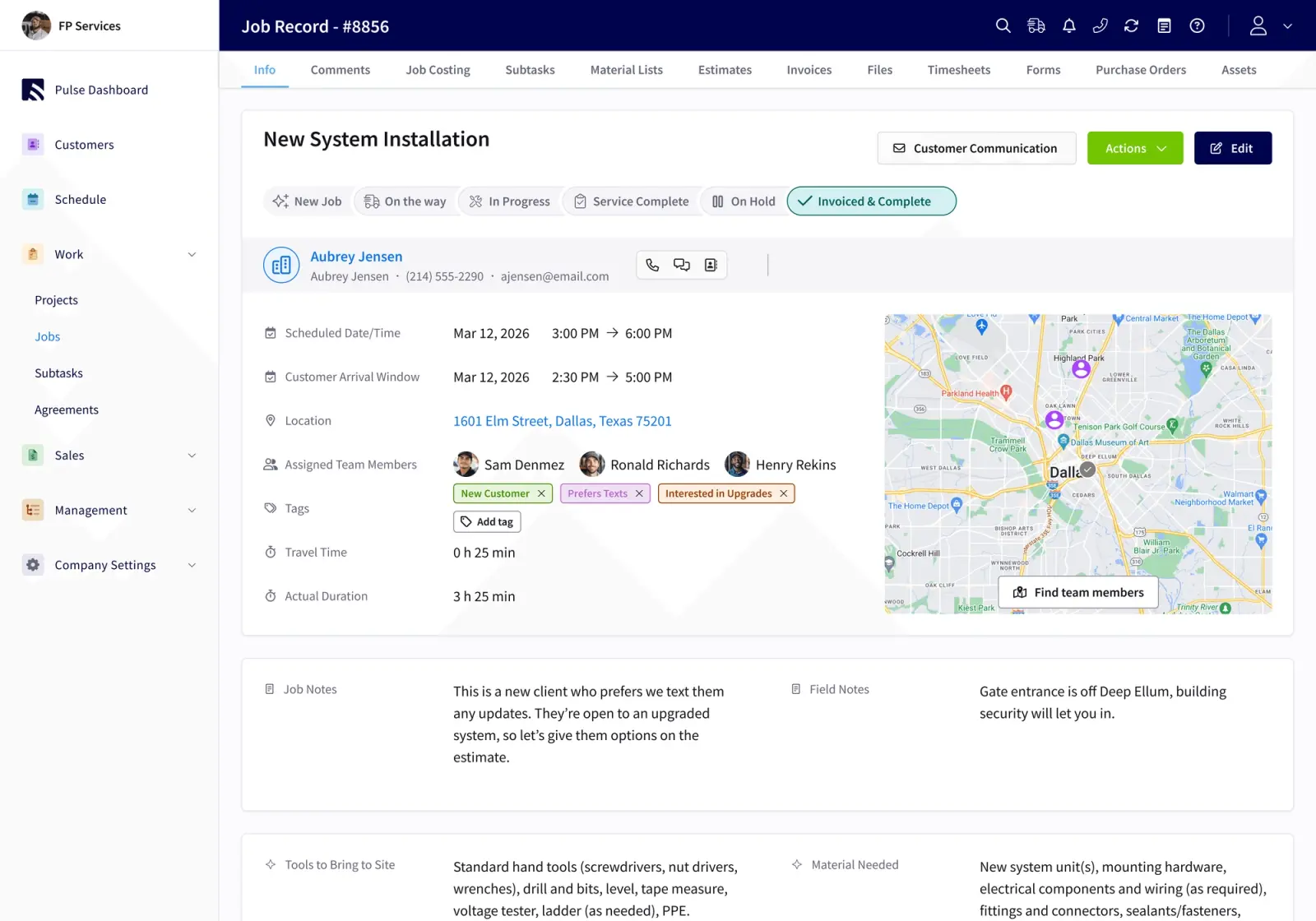
Pass: Parts, labor, notes, photos, and signature carry from the field to the office automatically. The invoice goes out without the administrator retyping the job. This matters because invoice lag, the gap between job completion and invoice sent, is a common and costly workflow failure in field service businesses, particularly those relying on manual or physical processes. Industry observers highlight how post-completion invoicing delays can freeze significant cash for growing contractors.
Fail: The office has to call the tech for details, retype parts or labor, or rebuild the invoice from scratch.
Step 2: Test Schedule Changes (Day 2–3)
Once you know the invoice path works, the next common failure point is the schedule. Emergency requests come in and customers reschedule, and your software needs to keep up.
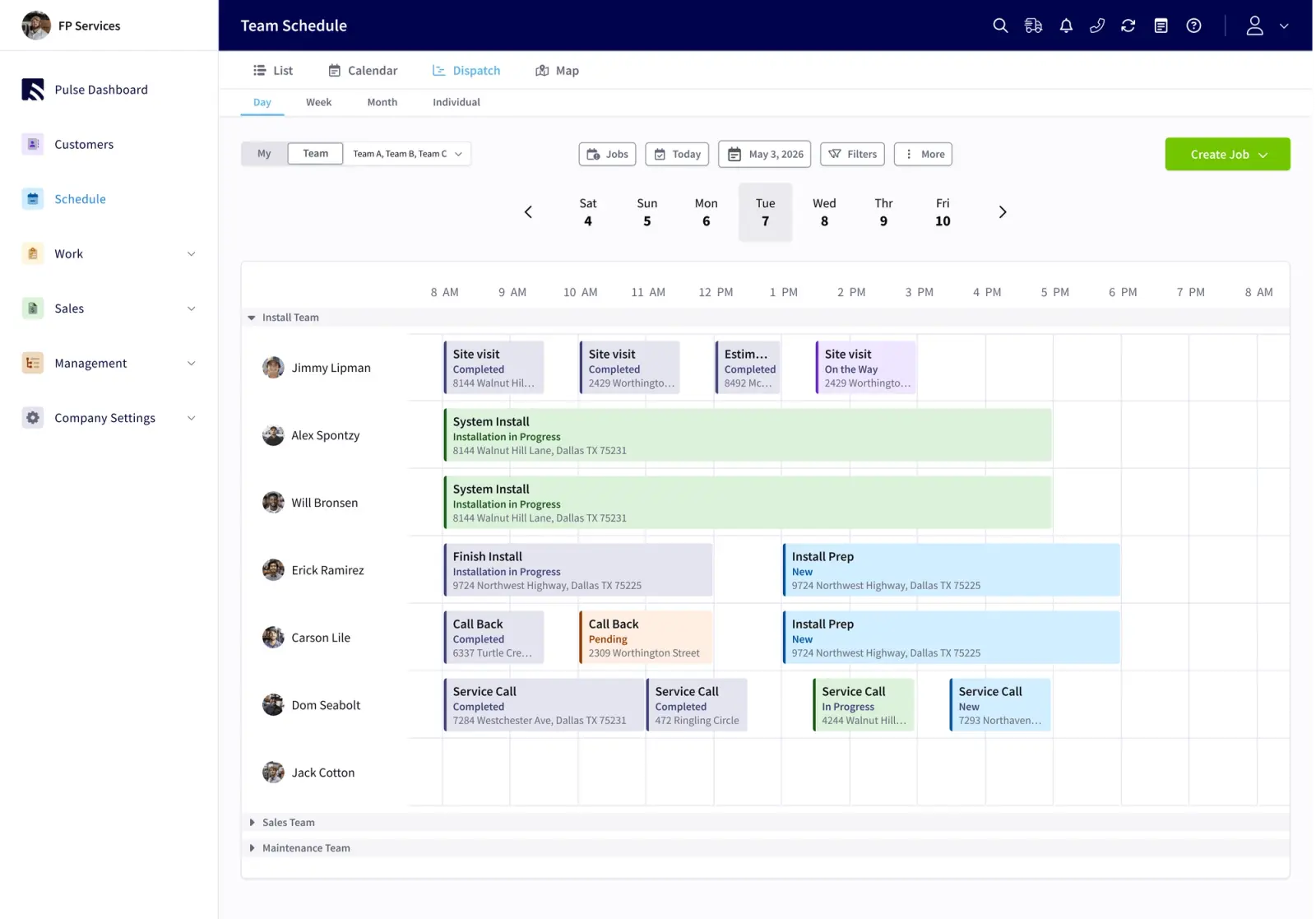
Who is involved: Dispatcher, one tech, and one customer or a test customer record.
What to test: Move a job from one tech to another mid-day. Notify the affected customer. Update the tech’s schedule.
Pass: The dispatcher drags and drops the job, the customer gets notified automatically, and the tech sees the updated schedule without a phone call. Industry data shows that nearly half of US field service appointments do not go according to schedule, so dynamic rescheduling is a daily requirement.
Fail: The dispatcher has to call the tech, manually notify the customer, and update the schedule in a separate step.
Step 3: Test Pricing Consistency (Day 3–4)
Pricing should stay consistent across estimators so the same job produces the same number every time.
Who is involved: Owner and two estimators, or the owner and another person who builds quotes.
What to test: Have both people build a quote for the same job independently using the software’s pricebook.
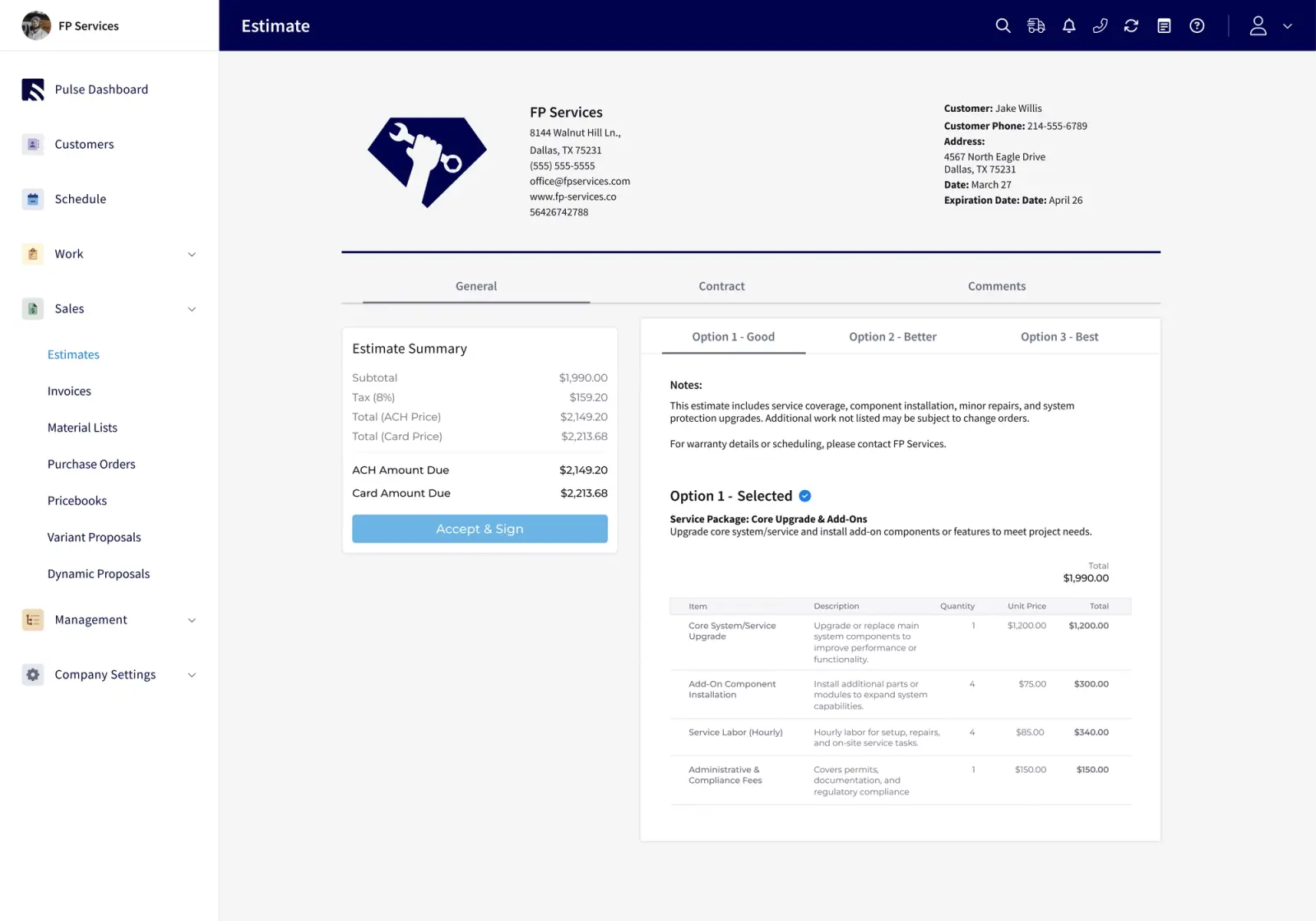
Pass: Preset pricing for services, materials, and labor produces the same estimate regardless of who builds it. Good-better-best options are available without manual calculation.
Fail: The estimates differ because pricing is not standardized, or building a quote requires looking up prices manually.
Step 4: Test Customer Context on a Repeat Visit (Day 4–5)
On a repeat visit, your tech should arrive already knowing the customer’s history before they knock.
Who is involved: One tech and one office administrator.
What to test: Pull up a customer record for a repeat visit. The tech should see the customer’s history, including prior job notes, equipment records, warranty documents, gate codes, and photos from the last visit, in one place.
Pass: The tech arrives with the customer’s history already in hand. No calls to the office are needed to reconstruct what happened last time.
Fail: The tech has to call the office, or the history is split across multiple places and incomplete.
Step 5: Test Administrative Load (Day 5–7)
The office administrator often decides whether new software sticks. If the software makes their day harder, the rollout will stall.
Who is involved: Office administrator and bookkeeper.
What to test: See whether the office can answer a customer question without interrupting a tech. Then correct something in QuickBooks and check whether that correction carries back into the field service software.
Pass: The office can answer a customer question without calling a truck, and a correction made in QuickBooks carries back into the field service software instead of being overwritten. Both reduce the administrative load that pulls your office team away from higher-value work. QuickBooks integrations vary significantly, so test this behavior directly.
Fail: The office has to call the tech to answer a customer question, or accounting corrections do not sync back and create double entry.
Walk through this admin workflow in a demo
Step 6: Test Offline Behavior (Day 7–9)
Low-signal environments such as crawlspaces, basements, and rural areas expose how the mobile app really behaves.
Who is involved: One tech.
What to test: Have the tech work in a low-signal area. They should view cached jobs, add notes and photos, change job status, and clock in and out. Then confirm that everything syncs when signal returns.
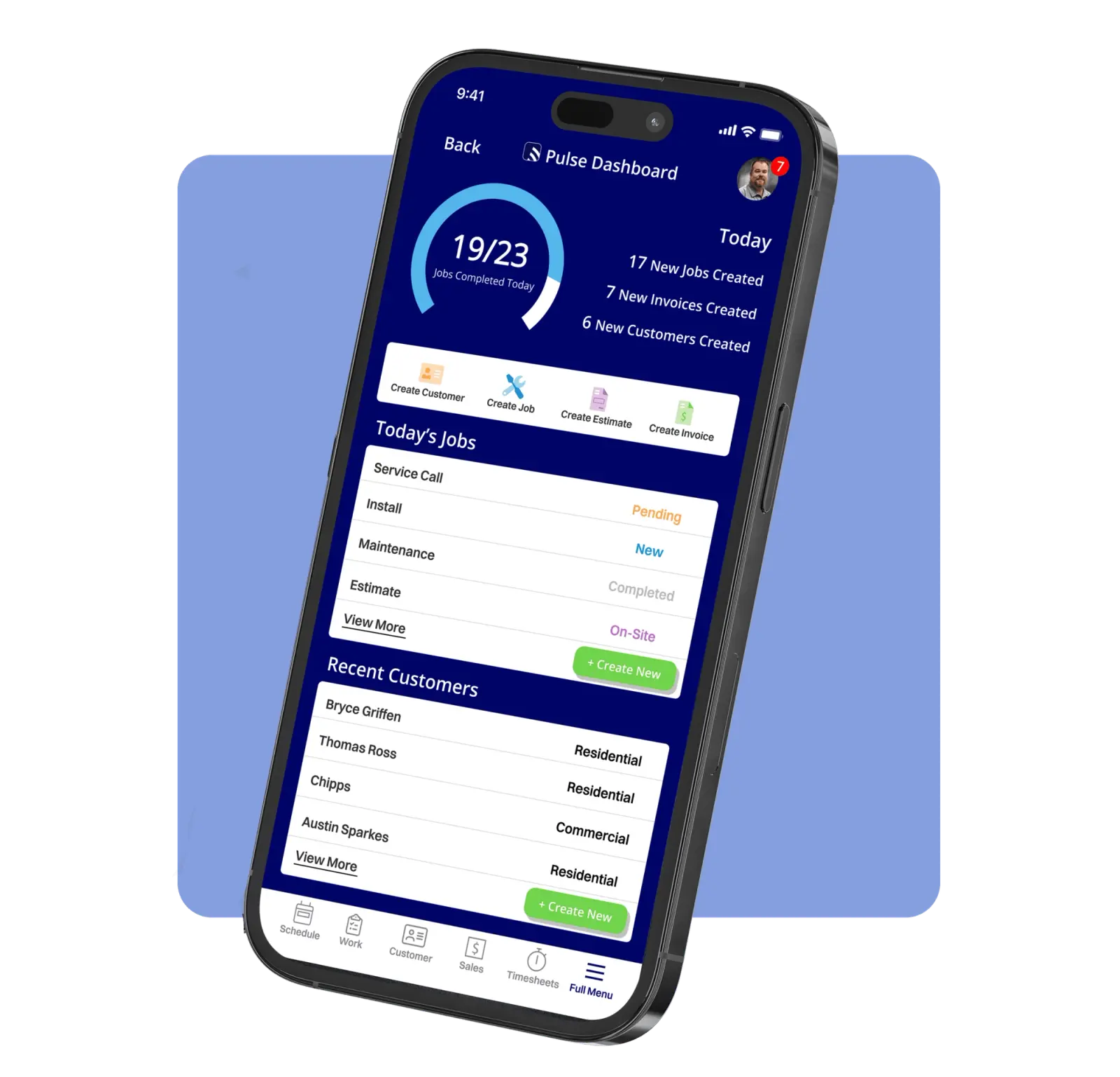
Pass: The tech can complete most of the job without cell signal, including viewing cached job details, adding notes and photos, updating status, and clocking in and out. Everything syncs automatically when signal returns. Industry analysts recommend testing offline capability in a real low-signal environment instead of relying only on a vendor description.
Fail: The app stops working without signal, or the tech has to redo the closeout when they are back in range.
Step 7: Test Reporting and Job Costing (Day 9–10)
Reporting and job costing show whether your pricing and jobs actually support your goals.
Who is involved: Owner and operations lead.
What to test: Pull a report showing per-job job costing and profit margin, with labor hours tied to specific jobs rather than a weekly total.
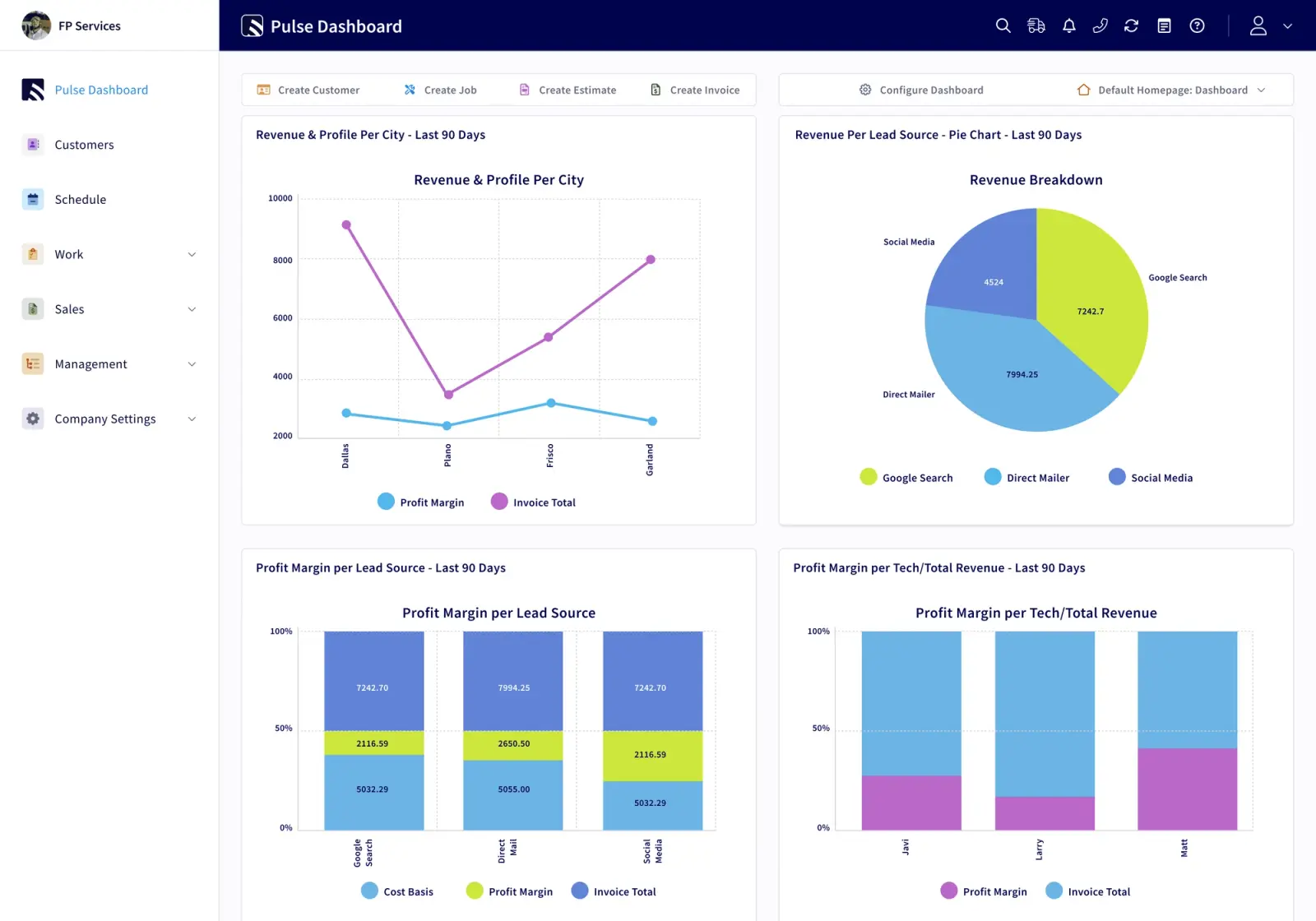
Pass: You can see which jobs, job types, or customers actually make money, with labor tied to the job itself.
Fail: Labor hours are tracked by week rather than by job, or profit margin is only visible at the company level, not per job.
See reporting and job costing in action
How to Run the Two-Week Trial
You have seven workflow tests to run. Here is how to fit them into two weeks of real work rather than a feature tour.
Week One: Setup and Basic Workflows
- Load a handful of real customers instead of demo data.
- Create your actual job types and a simple pricebook.
- Run one or two test jobs end to end, including job creation, dispatch, field completion, and invoice.
- Test the QuickBooks sync with a real transaction. Do this early in the week, because sync errors are much easier to untangle before dozens of invoices are affected.
- Hold a 10-minute debrief each day to review what worked, what broke, and what required a phone call.
Week Two: Stress-Test With Live Jobs
- Use the software on real jobs with actual techs and office staff.
- Test a schedule change mid-day.
- Test invoicing and payment collection in the field.
- Test customer communication and confirm the customer gets notified at the right stages automatically.
- Pull a job costing report at the end of the week.
Keep these decision points in mind as you move through the two weeks:
- Bring your office administrator into the trial from the start. They are the adoption gatekeeper, and their buy-in keeps the rollout stable.
- Get a tech using the mobile app on a real job early in the first week. Their reaction in the first week tells you more than any demo.
- If a FSM software trial cannot run one real job end to end within the trial window, stop the trial. A real job means create customer, quote, dispatch, complete, invoice, payment, and accounting sync. Most trials run 7 to 14 days, so you should know by around day ten. More time will not fix a fit problem. If any step breaks down or takes significantly longer than your current process, you are looking at a fit issue, not a training issue.
Walk through your own two-week plan
Common Challenges and How to Work Around Them
Most trial failures come from the trial being set up poorly, not from the software being bad. These four challenges show up often, along with simple ways to handle them.
Challenge 1: The Trial Does Not Let You Test Your Own Job Stages
Warning sign: You can only use pre-built templates and cannot configure custom job stages.
Correction: Ask the vendor directly whether you can configure your own job stages during the trial. If the answer is no, you are evaluating a sandbox instead of your business.
Challenge 2: The Trial Expires Before You Have Tested Invoicing or Payments
Warning sign: The trial window is short and there is no extension option. For field service software that requires multiple job cycles, a two- to four-week trial is more realistic than a very short default window.
Correction: Prioritize the workflows that matter most, especially job completion to invoice, in week one. Do not spend the first week only on configuration.
Challenge 3: No QuickBooks Integration in the Trial
Warning sign: Accounting sync is disabled or requires a paid plan upgrade.
Correction: Ask specifically how the trial handles accounting sync and whether you can test it. A two-way sync, where corrections made in QuickBooks carry back into the field service software, is what ends double entry. A one-way push does not solve that problem.
Challenge 4: Your Office Team Cannot Adopt It
Warning sign: Your dispatcher or office administrator finds the software harder than your current process.
Correction: Bring them into the trial on day one and test their actual daily workload, including scheduling, customer communication, and invoicing. A trial roster should include the primary daily users doing real work, not only the decision owner exploring features. If the person who runs your day is not convinced, the rollout will struggle.
Invite your office team to a live demo
How to Know the Evaluation Is Working
You need clear signals that the trial or demo is helping your team. Track these indicators across the two weeks.
- Time from job completion to invoice sent: Check whether this is faster than your current process. For context, days from job completion to invoice sent is a standard cash-flow benchmark for residential service businesses.
- Schedule changes handled without a phone call: Count how many rescheduling events required a manual call versus how many the software handled automatically.
- Pricing consistency: Confirm that two estimators produced the same number from the same pricebook.
- Duplicate entry: Note any time the office had to retype something the tech already logged in the field.
- Job-level profit margin visibility: Confirm that you can see which jobs made money, with labor tied to the specific job.
Use a simple daily debrief and a scorecard for each workflow test. Separate early wins, such as faster invoicing in week one, from improvements you expect to sustain over time, such as a steady reduction in administrative load.
Review these metrics in a FieldPulse demo
What Comes After the Evaluation
Once the trial or demo shows the software can handle your core job lifecycle, you move into planning implementation and data migration.
Plan these areas so your team can manage operations smoothly:
- Standardizing workflows across your team: ClearPath lets you define job stages and required actions per job type so every tech follows the same process regardless of experience level.
- Role handoffs between office and field: Map out who owns each step, including job creation, dispatch, field completion, and invoicing. Confirm the software supports those handoffs without manual calls.
- Data migration: Your existing QuickBooks Online customers and records come with you when you connect FieldPulse, so you are not rebuilding a customer list from scratch.
- Phased implementation: Test improvements in controlled phases rather than all at once. FieldPulse’s typical onboarding window runs two to six weeks, depending on your team size, which capabilities you enable, and your accounting setup. The work gets sequenced into phases with small tasks between sessions.
RDI, a commercial interiors business that came from pen, paper, and Excel, described their rollout this way: “We ripped band-aids off one at a time, instead of all at once.” They rolled out scheduling first, then invoicing, then time tracking, then ClearPath. Within three years, they grew from 15 to 50 employees and saw job-level profitability for the first time in 50 years. For more on what a structured implementation looks like, see Field Service CRM Implementation: A Guide for Small Teams.
Plan your rollout with the FieldPulse team
Frequently Asked Questions
How Long Are Field Service CRM Free Trials?
Across B2B software, 14 days is the most common free trial length, used by 62% of products, and many field service platforms follow this default. Some platforms offer shorter windows of 7 days or longer windows of 30 days. For field service businesses, 14 days is rarely enough time to run multiple real job cycles, configure your job types, test accounting sync, and get meaningful feedback from your office team and techs. If a platform offers a trial, ask whether you can extend it and prioritize your most critical workflows in the first week.
Do You Need a Credit Card for a Field Service CRM Free Trial?
Requirements vary by platform. Some require a credit card upfront and auto-charge at the end of the trial period (opt-out trials). Others require no card and let you enter billing information when you are ready to continue (opt-in trials). If a platform requires a card upfront, set a cancellation reminder at least 48 hours before the trial ends. Always confirm the trial terms before signing up so you are not surprised by an automatic charge.
Is There a Truly Free Field Service CRM?
Some platforms offer free tiers with limited features, often capping users or jobs per month or locking key capabilities like invoicing or reporting behind a paid plan. These can help very small operations test basic usability, but they rarely include accounting sync, job costing, or workflow configuration for a growing residential service business. FieldPulse does not offer a free trial or a free tier. See the configured demo section above for how to evaluate the platform with your own workflows.
What Is the Difference Between a Field Service CRM and FSM Software?
A CRM manages customer relationships, including contacts, communication history, and account records. FSM software manages field operations, including scheduling, dispatch, work orders, mobile tech access, invoicing, and reporting. In practice, many platforms built for residential service businesses combine both in one product so the customer record and the job lifecycle live in the same system. The distinction matters because a generic sales CRM was not built for dispatch-to-invoice workflows, and a standalone scheduling tool will not give your tech the customer history they need on a repeat visit. For a deeper look at how these categories differ, see What Is Field Service Management? A Complete Guide.
What Should I Look for in a Field Service CRM Free Trial?
Focus on your actual job lifecycle instead of the vendor’s demo scenarios. The five workflows listed in the Key Takeaways are the ones that matter most, plus offline behavior and two-way QuickBooks sync. If the trial does not let you configure your own job stages or test accounting sync, you are evaluating a sandbox instead of your business. For a broader look at what to evaluate, see Field Service Software: A Workflow-Fit Guide for Teams.
What Happens When the Trial Ends?
Many field service CRM platforms retain your data for a period after a trial expires. Retention periods vary widely:
- Vtiger: 12 days
- Blob CRM and CrawlSpace CRM: 30 days
- OnePageCRM: 1 year
Most platforms allow you to subscribe to restore or continue access, though some platforms such as HubSpot may provide no access after termination. Some delete data after a set period, so confirm the platform’s data retention policy before you start. If you have loaded real customer records during the trial, also confirm that you can export your data if you decide not to continue. Your customer list, job history, photos, and signatures should be exportable without a support ticket.
How Do I Migrate Data If I Switch?
The most important record to migrate is your customer list. Job history can start from today, and most businesses do not look back further than six months in practice. When connecting FieldPulse to QuickBooks Online, your existing QuickBooks customers and records come with you, so you are not rebuilding a customer list from scratch. Plan for data cleanup before migration, because inconsistent naming, duplicate records, and incomplete addresses are easier to fix before they are in a new system. Your implementation manager will help sequence this work.
How Long Does Implementation Take?
For FieldPulse, the typical onboarding window is two to six weeks. See the implementation section above for what affects the timeline.
Talk through your implementation timeline
The Two Weeks That Tell You the Truth
A field service CRM free trial is worth your time only when it tests your full job lifecycle. Generic sandbox data, pre-built job types, and a feature tour will not show whether the software fits. Real jobs, real stages, real pricing, and a real accounting sync will.
Run the evaluation like an operator. Before day one, define your decisive question and name your participants. Then load real customers and test the seven workflows: job completion to invoice, schedule changes, pricing consistency, customer context, administrative load, offline behavior, and job costing. Hold a daily debrief and score each workflow against your pass and fail criteria. If the software cannot handle your job lifecycle by day ten, stop, because more time will not fix a fit problem.
If the vendor will not let you test your own job stages, or if a generic trial is not the right format for what you need to evaluate, a configured demo will show you more. You see your workflows, your job stages, and your pricing instead of a sandbox. You can bring your office manager and a tech and see each role in its actual interface.
For more on building a field service operation that scales, see 11 Field Service CRM Best Practices by Job Lifecycle and Field Service Software for Residential Technician Teams.
See FieldPulse with your own workflows