








Key Takeaways
-
Plumbing job costing software tracks labor hours and material expenses against each job in real time so you can see per-job profit margin while the job is still open.
-
Real job costing requires three core capabilities: tracking labor and materials per job, producing detailed per-job profit and loss, and showing estimated-vs-actual variance before the job closes.
-
Effective labor tracking means techs clock in against specific job records, including travel time and phase-based hours for multi-day work, instead of only using daily timesheets.
-
Material costs stay accurate when techs record parts used from truck stock or warehouse pulls directly against the job ticket, which prevents unbilled inventory losses.
-
FieldPulse provides the job costing, inventory management, and two-way QuickBooks sync that growing plumbing teams use to protect their profit margin.
What Plumbing Job Costing Software Actually Does
Job costing only works when the software handles specific tasks, not just a label on a feature list. Real job costing software does three things:
-
Tracks labor hours and material costs against each individual job in real time
-
Produces per-job profit and loss with line-item detail
-
Shows estimated-vs-actual variance while the job is still open
Most platforms skip that third point. Labor and material cost tracking that only appears at month-end functions as historical accounting. You need to see a job going over budget while your crew is still on site so you can react. Ask every vendor if their platform shows estimated labor hours and cost versus actual, and estimated material cost versus actual, while the job is still active. If they need to run a special report or ask you to wait a week, move on.
For a deeper look at how job costing fits into a growing plumbing business, see Plumbing Job Costing Software: A Guide for Growing Teams.
How To Track Labor Hours Per Plumbing Job
Job-level labor tracking shows which jobs make money. A weekly timesheet only shows what payroll cost. Labor hours tied to specific jobs create job-level profitability, and that requires a different kind of clock-in.
Here is how that process should work:
-
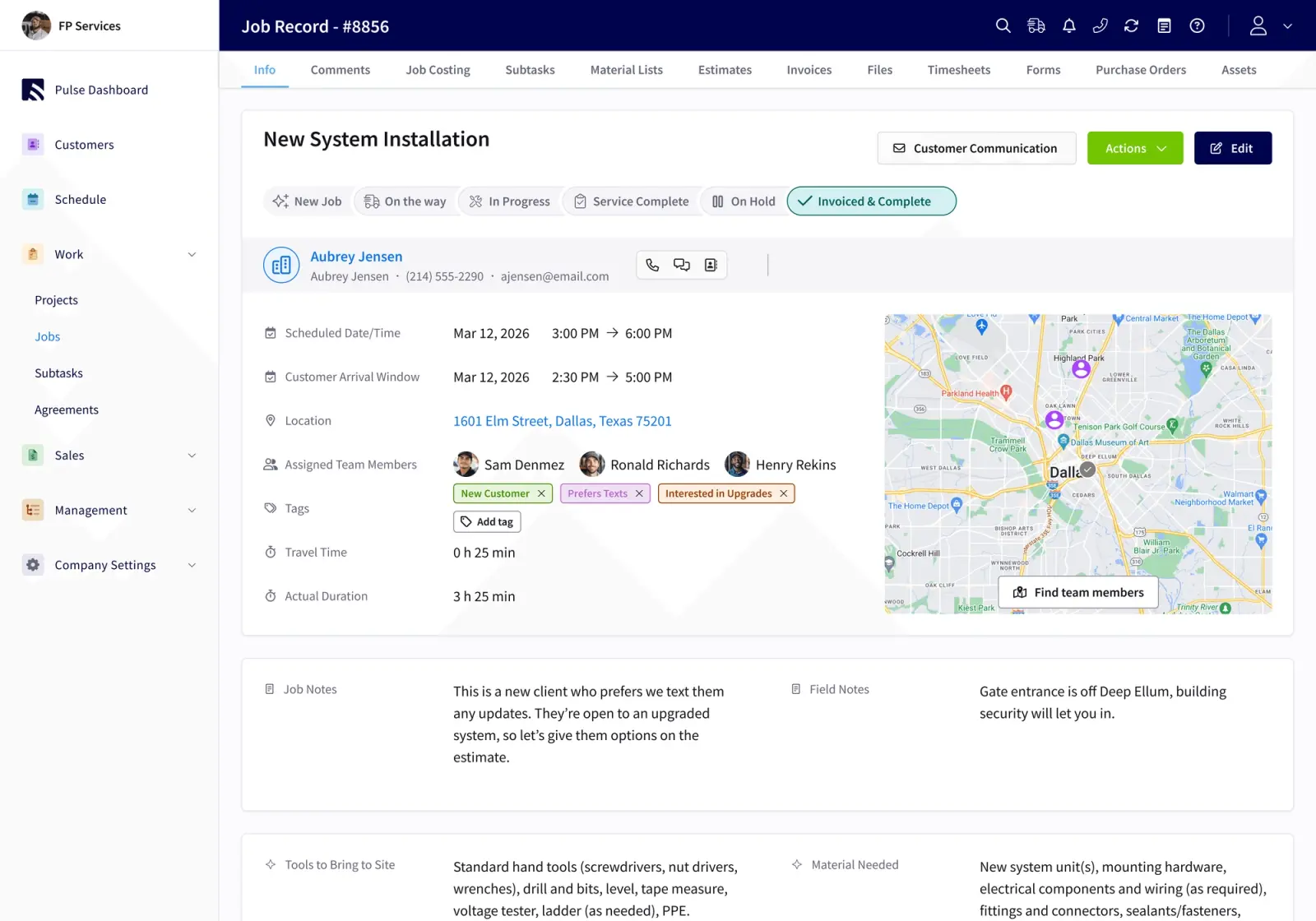
The tech clocks in against the job itself. They do not clock in against the day or the shift. When a tech arrives at a service call, they clock in to that job record. When they leave, they clock out. The hours land on the job, not in a weekly pile.
-
Travel time is handled explicitly. Drive time typically represents 20–30% of labor cost on a service job and is rarely tracked. A platform that separates travel time from on-site time gives you a complete picture of what a job actually cost to deliver.
-
Multi-day work uses phase-based hours. On a repipe or remodel, hours attach to the phase such as rough-in, top-out, or trim. Phase-level tracking shows where a job is expanding before the whole project goes over budget.
The office sees hours land on the job record automatically. No one chases a manual timesheet at the end of the week. No one reconstructs labor from memory. The data appears because the tech clocked in to the right place.
Real-Time Job Costing for Your Plumbing Business covers how this visibility changes what your office can act on.
How To Assign Material Costs To A Plumbing Job Ticket
Truck stock often hides real material costs. A tech pulls a wax ring, a shutoff valve, and a supply line from the truck. Nothing gets logged. The invoice goes out without those parts. The system allowed that gap.
Here is how material tracking should work:
-
Truck stock decrements onto the job ticket. When a tech uses a part, they record it against the job by selecting it from a catalog or scanning a barcode. The part leaves the truck’s inventory count and lands on the job record at the same time.
-
Warehouse pulls follow the same logic. Parts pulled from a central location for a larger job tie to that job’s ticket instead of disappearing into general overhead.
-
Supplier pricebook catalogs keep part prices current. A quote built from last year’s copper prices often loses money. Pre-built supplier catalogs, like the Reece Plumbing and Reece HVAC pricebook catalogs available in FieldPulse, keep your pricing aligned with what parts actually cost today. Catalog and package details are still being confirmed.
Inventory management that supports this flow includes barcode scanning, low-stock alerts, and serialized inventory for major equipment like water heaters and tankless units.
The tech records what was used. The office sees it on the job ticket. Nothing gets rebuilt after the fact.
Plumbing Job Costing: Fix Your Profit Margin Leaks goes deeper on where material costs typically disappear.
Estimated vs Actual: The Deciding Capability
Estimated vs actual job costing separates a real job costing platform from a platform that only produces a weekly labor total and calls it job costing. Timing creates that difference.
Discovering that a job ran 40% over on labor after the invoice has gone out gives you nothing to change. Seeing that variance on day two of a three-day repipe gives you options. You can adjust the crew, have a scope conversation with the customer, or at least know what your actual profit margin will be before you close the job.
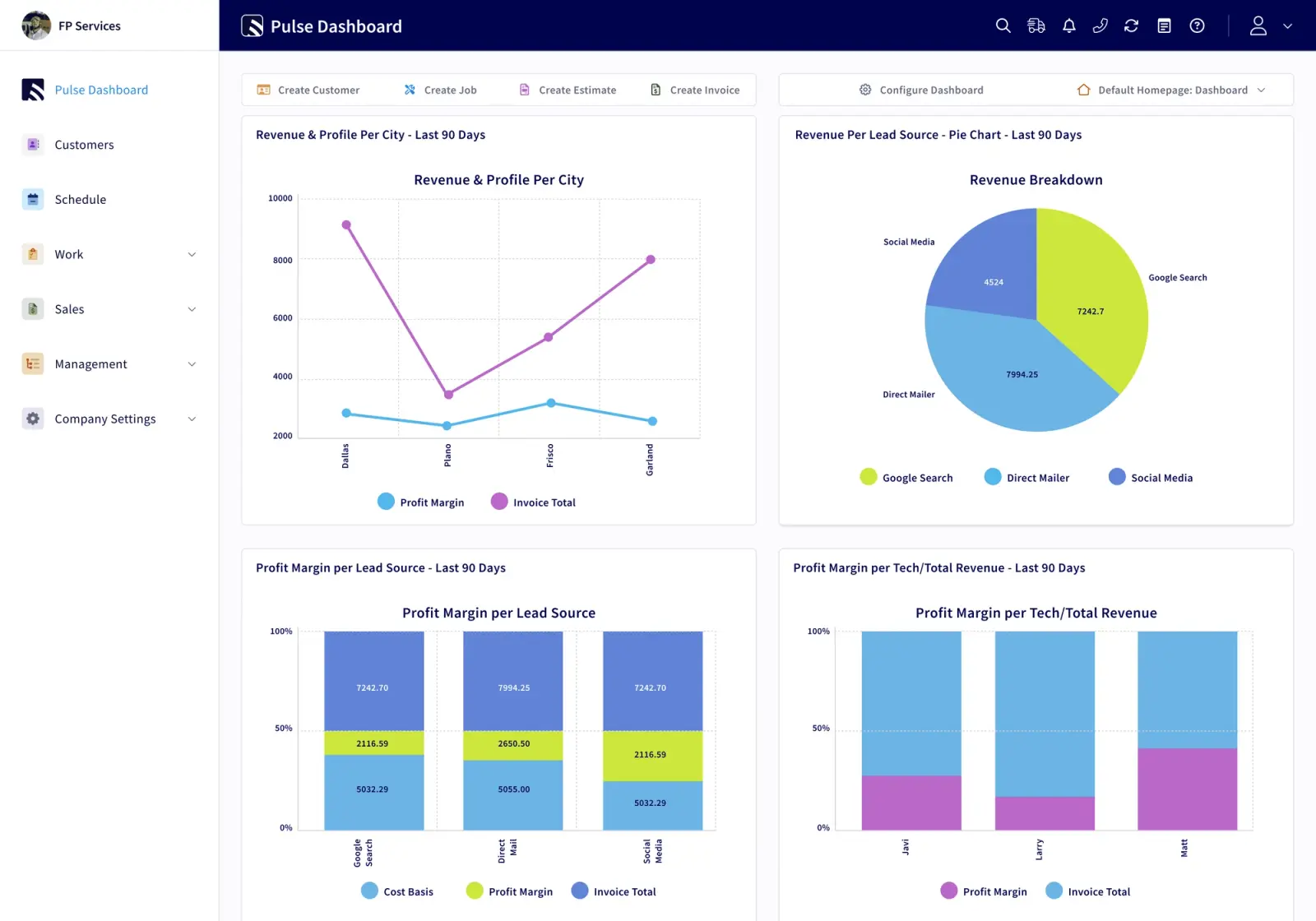
FieldPulse job costing prices a job with an expected profit margin upfront, then tracks labor, materials, and overhead as the work happens. At job close, it shows estimated vs. actual material costs alongside labor hours. You see a basic view of job-level profitability with per-job profit and loss and a line-item breakdown of cost, price, and profit by category.
Job Profitability Software for Residential Service covers how this reporting connects to day-to-day decisions.
How To Estimate Plumbing Materials And Markup
Accurate estimates keep your job costing honest. If your estimates rely on stale supplier prices or flat markup percentages that ignore what small parts cost to carry, your job costing will always show variance because the estimate started off wrong.
A practical approach to estimating plumbing materials starts with current supplier pricing, not memory. Material costs shift constantly. A quote based on last quarter’s prices can quickly erode your profit margin. Pull prices from your supplier account or a pre-built catalog before every estimate.
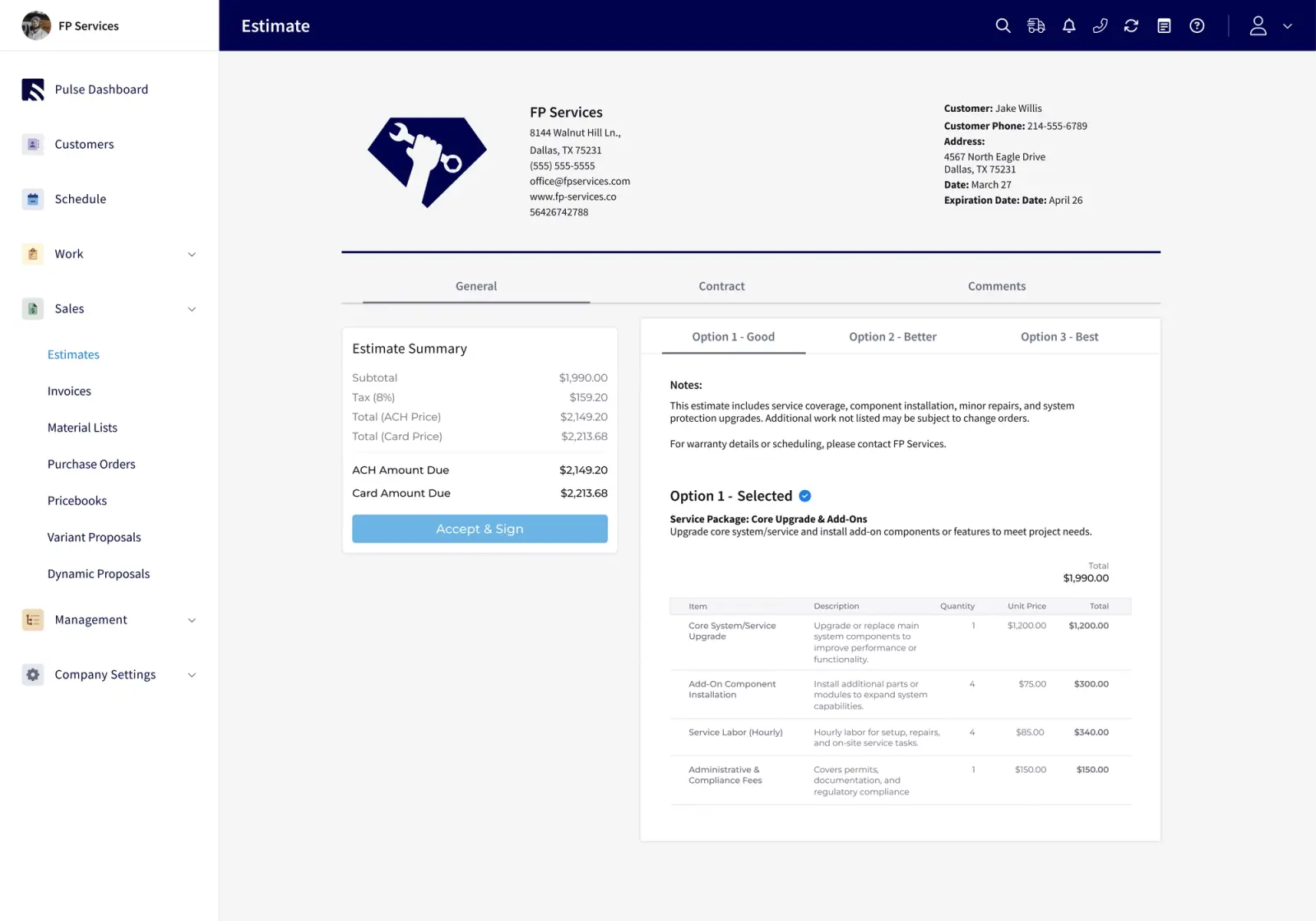
Common plumbing parts markup is tiered by cost. Small consumables and fittings are typically marked up more than major equipment. That higher markup covers truck stock carrying costs, supply house trips, and warranty risk on installed parts. A flat markup on a two-dollar fitting nets almost nothing and fails to cover handling time.
Your software should store a cost price and a selling price for every part so markup stays consistent by default instead of being recalculated manually each time. When a tech builds an estimate in the field, they pull from preset pricing. The markup is already built in. The estimate stays consistent regardless of who wrote it. For specific markup guidance appropriate to your market and cost structure, consult your accountant or financial advisor.
Segment By Plumbing Business Shape
How you apply labor tracking, material capture, and estimating depends on the shape of your plumbing business. The same trade looks different across these three common models:
-
Service and repair: Short jobs, high volume, and heavy truck stock. Your techs clock in by job, record parts used from the truck, and close out fast. The office needs to see labor and materials land on the job ticket before the tech leaves the driveway so an invoice can go out the same day. The priority is speed and completeness so nothing stays unbilled or rebuilt later.
-
Repipe and remodel: Multi-day work, phase-based hours, and staged material pulls. Labor attaches to the phase, not just the job. Material pulls happen across multiple days and sometimes multiple suppliers. Progress billing may apply where the project calls for it. The priority is phase-level visibility so you see where hours are running over before the whole job is over budget.
-
New construction and commercial: Longer cycles, purchase orders with line-item detail, and layered customer relationships. The party paying the invoice is often a general contractor, property management company, or developer instead of the person on site. Your platform needs to handle parent-child customer relationships so the paying customer and the job-site contact stay linked but separate. Purchase order tracking and cost-code-level reporting matter here in ways they do not on a service call.
What To Look For In Plumbing Job Costing Software
A clear checklist makes vendor demos easier to compare. Use these questions with every platform you evaluate:
-
Does it track labor hours against specific jobs instead of only shifts or days? Ask the vendor to show you a tech clocking in to a job record, not a timesheet.
-
Does it decrement truck stock onto the job ticket when a part is used? Ask how material costs land on the job record and whether that happens in real time or after the fact.
-
Does it show estimated-vs-actual variance while the job is still open? Ask to see a live job with hours running against an estimate. If they need to close the job first, you have your answer.
-
Does it integrate with QuickBooks Online in both directions? Ask what happens when your bookkeeper corrects something in QuickBooks Online and how that fix gets back into your field service software. A one-way push means your books and your field data will eventually disagree. FieldPulse supports a two-way QuickBooks Online sync with QuickBooks Online Essentials, Plus, and Advanced in the US, Canada, and Australia.
-
Does it fit your business size and job mix? A platform built for enterprise operations will feel heavy for a 15-tech residential team. A platform built for solo operators will not carry inventory, permissions, or multi-stage workflows.
Why FieldPulse Fits The Growing Plumbing Team
FieldPulse is built for established residential plumbing teams in the 7-to-50-technician range that have outgrown a simpler tool. The platform focuses on the mechanics that protect your profit margin.
-
ClearPath’s Mobile Focus View is included in the core platform. It turns your process into job stages with required actions at each stage. It also ties labor hours to specific jobs because techs clock in against the job stage instead of the day. That structure supports accurate job-level profitability.
-
Job costing estimates your profit margin upfront and confirms actual profit at completion. You see per-job profit and loss and line-item cost, price, and profit breakdowns. Estimated vs actual material costs and labor hours appear at job close so you always have a clear view of job-level profitability.
-
Inventory management tracks parts and materials with barcode scanning, low-stock alerts, and serialized inventory. When a tech records a part used on a job, the system automatically deducts that material from the technician’s assigned inventory hub (truck stock) and links the used quantity to the job and invoice. The Reece Plumbing and Reece HVAC pricebook catalogs are available in FieldPulse, with catalog and package details to be confirmed, so your estimates can reflect current supplier pricing without manual lookups.
-
The Pricebook (available as an add-on) holds standard pricing for services, materials, and labor so estimates stop varying by person. Techs build estimates in the field from preset pricing and convert them to invoices without re-entry.
-
The two-way QuickBooks Online sync means a correction made in QuickBooks carries back into FieldPulse instead of being overwritten. You avoid double entry and month-end reconciliation projects.
-
The mobile app is available in Spanish, enabled per user by the FieldPulse team, so Spanish-speaking techs can follow the same job stages and workflow as the rest of your crew in the language they use most comfortably.
FieldPulse supports commercial work but focuses primarily on residential teams. Onboarding typically runs two to six weeks depending on team size, which capabilities you enable, and how your accounting setup is handled.
Common Pitfalls
These mistakes show up consistently in plumbing businesses that try to track job costs without the right system. They reflect growth outpacing process, with more manual information tracking and missed handoffs as the team scales.
-
Treating job costing as a checkbox. Some platforms list job costing as a feature but only produce a weekly labor total. Ask to see estimated-vs-actual variance on a live job before you commit.
-
Relying on weekly labor totals. A weekly total tells you what payroll cost. It cannot show which jobs made money. Job-level profitability requires job-level clock-ins.
-
Letting truck stock go unbilled. Parts pulled from the truck and not recorded against the job are parts your business paid for and did not charge for. This happens when the system makes it easier to skip the step than to take it. The fix is a system where recording the part becomes part of closing the job.
-
Quoting from stale supplier prices. Copper prices have moved 15–35% in a single year multiple times. An estimate built from last quarter’s prices may already be losing money before the job starts. Pre-built supplier catalogs reduce that risk.
-
Discovering your profit margin after the invoice has gone out. At that point, your leverage is gone. The goal is visibility while the job is still open, not a closeout report that only confirms what you already suspected.
Frequently Asked Questions
What Is Job Costing in Plumbing?
Job costing in plumbing means tracking the actual cost of every job, including labor hours, materials used, and overhead allocation, then comparing those costs to what you estimated and what you charged. The goal is to know whether each individual job made money, not just whether the business as a whole was profitable at month-end. Without job costing, a plumbing business can stay busy and still lose money on a significant portion of its work without knowing which jobs or job types cause the problem.
How Do I Know If a Plumbing Job Made Money?
You need four numbers per job at minimum: estimated labor hours, actual labor hours, estimated material cost, and actual material cost. Compare those against what you charged. If your actual costs exceeded your estimate and you did not adjust the invoice, the job lost money relative to your target profit margin. A job costing platform surfaces this comparison automatically as the job progresses so you can see the variance while you still have time to act.
How Do I Track Labor Hours per Job?
Techs should clock in against the specific job record instead of the day or the shift. When a tech clocks in to a job, those hours land on that job’s cost record. When they clock out, the office sees the updated labor total without chasing a timesheet. For multi-day work, phase-based clock-ins tied to rough-in, top-out, or trim give you phase-level visibility instead of only a whole-job total. Travel time should be tracked separately from on-site time because it is a real labor cost that affects job profitability.
How Do Material Costs Get Assigned to a Job?
The most reliable method records parts at the point of use. When a tech uses a part from the truck, they record it against the job by selecting it from a catalog or scanning a barcode. That part decrements from the truck’s inventory count and lands on the job ticket at the same time. For larger jobs, warehouse pulls follow the same logic. The part leaves inventory and lands on the job record when it is pulled, not when the invoice is built. Pre-built supplier pricebook catalogs keep part prices current so the cost that lands on the job reflects what you actually paid.
What Should I Ask A Vendor In A Demo?
Ask the vendor to show you five things with a live demonstration instead of a slide deck. First, a tech clocking in to a specific job record. Second, a part being recorded against a job ticket and the inventory count updating. Third, estimated-vs-actual labor and material variance on a job that is still open. Fourth, what happens when your bookkeeper corrects something in QuickBooks and whether the fix carries back into the field service software. Fifth, the mobile view a tech sees on a job, including what happens when signal drops in a basement or crawlspace.
How Does Job Costing Connect to QuickBooks?
The connection should be two-way. A one-way push from your field service software into QuickBooks means that when your bookkeeper corrects something in QuickBooks, that correction does not carry back into your field service software. The next sync overwrites it. A two-way sync means corrections made in either system show up in the other. Timesheets should flow into QuickBooks when a tech clocks out. Tax rates should come from QuickBooks so what the customer is charged matches what the books expect. Invoice numbering should be able to follow your existing QuickBooks sequence so your books keep their own conventions.
Conclusion: Evaluate Based On How The Work Actually Flows
The evaluation framework stays simple. Labor must tie to the job. Materials must land on the job ticket as parts are used. Estimated-vs-actual variance must stay visible while the job is still open.
Before your next demo, document how a job currently moves from dispatch to invoice. Identify where labor hours get lost and where material costs go unbilled. Bring the criteria checklist from this guide and test every vendor against it. The platform that can answer all five demo questions with a live demonstration deserves a closer look.