







Key Takeaways For Plumbing Software Costs
- Plumbing software pricing spans $29–$500+ per user monthly, with flat-rate unlimited-user plans typically running $200–$650 per month for SMBs.
- Four pricing models exist: per-user subscriptions, flat-rate or tiered packages, quote-based pricing, and standalone pricebook tools that solve different problems than full field service platforms.
- Real costs extend beyond subscription fees to add-on modules, payment processing markups, onboarding time, and productivity dips during rollout.
- Cost drivers like seat count, enabled modules, payment processing rates, job volume, and integrations determine what a growing plumbing company actually pays.
- FieldPulse offers seat-based pricing with two seat types, three packages, and add-ons like Pricebook and Custom Forms for team-based plumbing companies in the 7-to-50-technician range.
See what a normalized quote looks like for your team.
The Four Pricing Models In Plumbing Software
Each pricing model charges for something slightly different, so you want to know what you are actually paying for before you compare quotes.
Per-user subscription pricing charges by seat, so your bill scales directly with how many people use the system. This model aligns what you pay with how many people actually use the platform. Many platforms offer lower-priced field-only seats for techs who only need the mobile app, which keeps the bill from ballooning as your field crew grows. Per-user pricing at $60 per seat costs a 5-tech shop $300 per month, a 10-tech shop $600, and a 20-tech shop $1,200, before add-ons or office seats.
Flat-rate or tiered packages charge a fixed monthly fee per tier, with capabilities gated by which tier you are on. The entry price looks low, but the features you actually need, such as job costing, QuickBooks sync, and advanced reporting, often live on a higher tier. Flat-rate unlimited-user plans in the SMB market typically run $200–$650 per month, with implementation often included.
Quote-based pricing means the vendor gives you a number only after a demo. The quote reflects your team size, your trade, and which capabilities you turn on. This model is common among platforms built for established, team-based businesses where a generic price list would not match what you actually use.
Pricebook-tool pricing is where the biggest confusion shows up. A flat-rate pricebook tool holds standard pricing for services, materials, and labor. It helps your techs quote consistently and present good-better-best options on a tablet. Standalone flat-rate platforms run $129–$229 per technician per month in 2026. A full field service platform carries a job from first call to final payment, including scheduling, dispatch, job management, invoicing, payments, the customer’s history, and reporting. These are different products. Many plumbing companies price one while actually needing the other, and that confusion leads to buying a tool that fixes pricing while leaving the rest of the workflow unchanged.
What Drives The Price Up As Your Plumbing Company Grows
You can use a simple cost-driver model to evaluate any quote, including FieldPulse’s, and ask better questions before you sign.
- Seat count. Decide how many full-access seats versus field-only seats you need, and ask how the bill changes when you add a tech. On per-user platforms, every new hire is a new line item. On flat-rate platforms, the tier decision matters more than headcount.
- Modules enabled. The capabilities a growing plumbing company relies on, such as job costing, a pricebook, custom forms, VoIP, AI call answering, and fleet tracking, are commonly sold separately, so the base subscription price rarely reflects what a fully operational business actually uses.
- Payment processing. Ask what the platform charges per card transaction and per ACH transaction. Field service platforms typically add 0.5%–1.0% on top of standard processing rates, which translates to $3,000–$6,000 per year for a shop processing $50,000 in monthly card volume. That cost never appears on the software invoice.
- Job volume. Some platforms gate reporting, invoicing volume, or automation runs by tier. As your job count grows, you may hit limits that force a tier upgrade even if your team size has not changed.
- Integrations. Ask what it costs to connect your accounting system. Confirm whether QuickBooks sync is included in the base package or locked behind a higher tier, and whether it is one-way or two-way. The answer changes how much manual reconciliation your office carries every month.
A Step-By-Step Pricing Calculator For Plumbing Software
You can build a defensible annual number for any platform by walking through a short checklist.
- Count your full-access seats, such as owner, office, and dispatchers, and your field-only seats for techs who only need the mobile app. Price each category separately if the platform offers two seat types.
- List the capabilities you need on day one, such as job costing, a pricebook, QuickBooks sync, custom forms, and VoIP. Confirm which are included in the package and which are add-ons, then add the add-on costs to your monthly total.
- Estimate your monthly card volume and multiply by the platform’s card processing rate. Compare that to what you would pay through a standalone processor, and note any gap you may want to recover.
- Add any onboarding fee, spread over 12 months, to get a true Year 1 monthly equivalent.
- Project your team size 12–18 months out and re-run the math. On per-user platforms, adding three techs changes the number significantly. On flat-rate platforms, it may not change until you cross a tier line.
Once you have that annual number, the next step is checking what the quote leaves out so you are not surprised later.
What Shows Up After You Sign
The costs that surprise plumbing companies most sit outside the subscription price and show up during rollout and daily use.
Onboarding and data migration time. A realistic onboarding window for a team-based plumbing company is 2 to 6 weeks, depending on company size, which capabilities are enabled, how much data has to migrate, and how the accounting setup is handled. For a 10–25 user shop with a clean data set and a dedicated system owner, a well-run implementation takes 60–90 days; shops that skip the data audit or delay training routinely take 5–7 months. That gap shows why the onboarding window is worth planning for before you sign, not after.
Add-on modules. Several capabilities that a growing plumbing company actually needs, such as a pricebook, custom digital forms, VoIP and messaging, AI call answering, and fleet tracking, often sit outside the core package and are priced separately. The base subscription price does not represent your full operating cost.
Payment processing rates. Every platform that processes payments charges a rate per card transaction and per ACH transaction. Ask whether the platform supports a compliant dual pricing program that lets you recover that cost from the customer upfront, with both prices shown on the invoice before they choose.
The productivity dip during rollout. In the first 30 days post-go-live on a new platform, admin teams typically see a 15–25% productivity drop. This dip is normal and manageable when you plan for it. A phased rollout, where you bring capabilities online one at a time instead of switching everything overnight, reduces the dip significantly. The businesses that get through implementation fastest do three things: they assign small tasks between sessions, run parallel systems for the first week or two, and designate internal champions before go-live.
How To Compare Two Plumbing Software Quotes
When you have two quotes in front of you, normalize them against the same line items before you compare the totals.
- Per-seat versus unlimited users. Check whether you are comparing a per-user price to a flat-rate price. Run both at your current headcount and at your projected headcount 18 months from now.
- Included versus add-on modules. List every capability you need and confirm which package it lives in for each vendor. A lower base price with several add-ons may cost more than a higher base price with everything included.
- Payment processing rates. Get the card rate and the ACH rate from each vendor, multiply by your monthly card volume, and add that number to the monthly total.
- Contract length and exit terms. Confirm whether the contract is month-to-month or annual, and what it costs to export your customer list if you leave.
- Onboarding support. Ask whether onboarding is included or a separate fee, and whether you get a dedicated implementation manager or only documentation and a chatbot.
- What happens when you add a tech. Ask each vendor exactly how the bill changes when you hire your next technician. On per-user platforms, the answer is immediate and specific. On flat-rate platforms, it may not change until you hit a tier ceiling.
A Worked Example At 5, 15, And 30 Technicians
The same per-seat rate produces a very different annual number depending on your team size, so it helps to picture how the shape of the cost changes.
At 5 technicians, a per-user platform at a mid-market rate produces a manageable monthly subscription. Add two office seats, one add-on module, and payment processing on $20,000 in monthly card volume, and the real monthly cost lands well above the per-seat headline. Year 1 also includes onboarding, which averages $1,400 as a one-time fee across home service contractors, equivalent to roughly $117 per month when spread across the first year.
At 15 technicians, the per-seat math compounds. If your platform charges the same rate for office seats and field-only seats, you pay full price for techs who only need the mobile app. A platform that offers a lower-priced field-only seat type changes the math significantly at this size. Add-ons that felt optional at 5 techs, such as a pricebook, custom forms, and VoIP, become operationally necessary at 15, and each one adds to the monthly total.
At 30 technicians, the difference between a per-user platform and a flat-rate platform can be substantial. A per-user platform charging $150 per seat costs $4,500 per month at that headcount, before add-ons or office seats. A flat-rate platform at the same capability level often costs a fraction of that. Payment processing at this volume also becomes a material line item that you want to negotiate and, when possible, recover through a compliant dual pricing program.
The core takeaway is that the same per-seat rate produces a very different annual number at each size, and the cheapest plan at 5 techs often becomes a higher-cost choice at 15 or 30.
Why FieldPulse Is The Best Fit For A Team-Based Plumbing Company
FieldPulse fits established, team-based residential plumbing companies in the 7-to-50-technician range that have outgrown a simpler tool but do not want an enterprise platform.
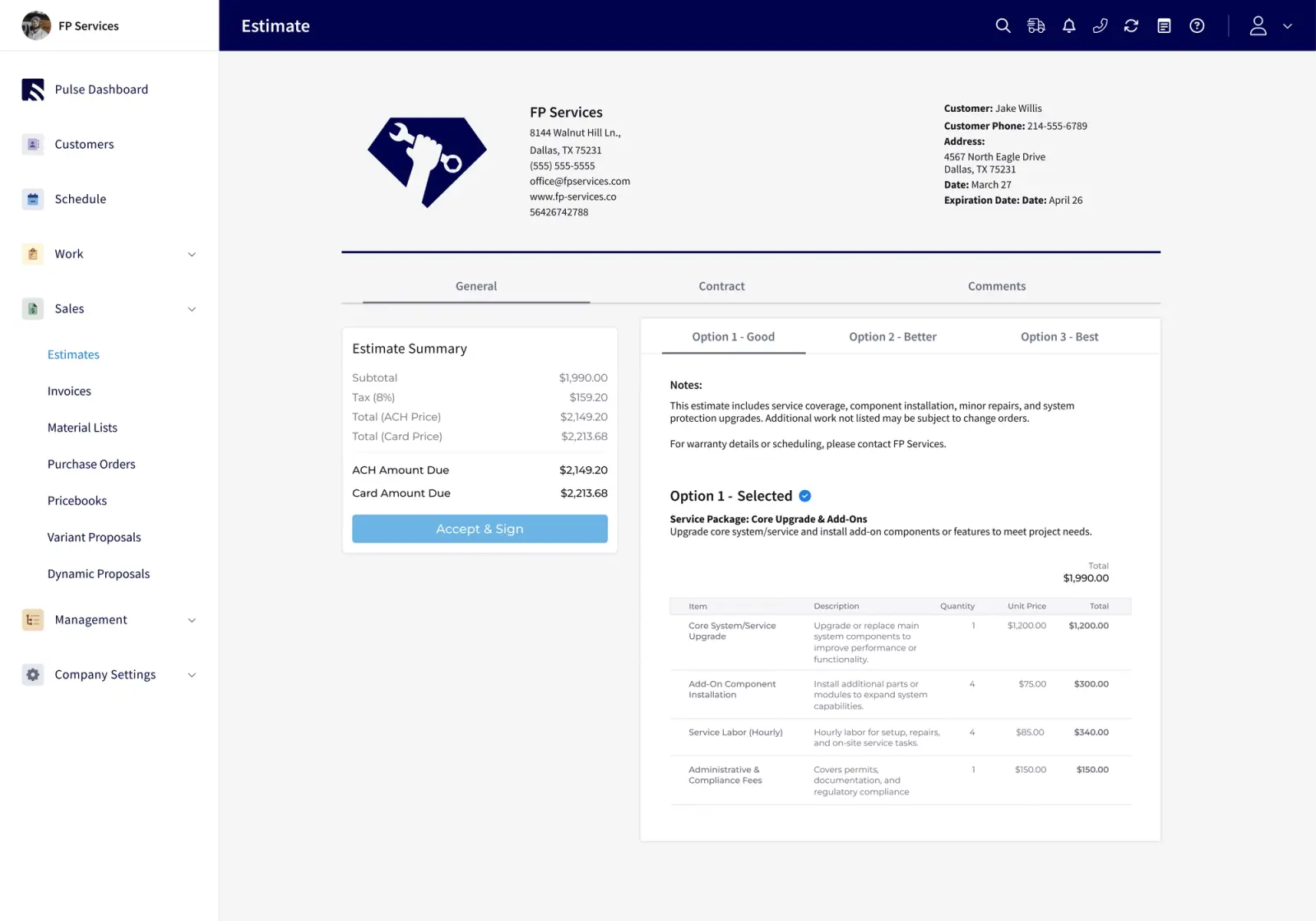
Seat-based pricing with two seat types. FieldPulse offers full-access seats for people who work across the whole platform and lower-priced field-only seats for techs who only need the mobile app. This setup aligns what you pay with how many people actually use the system and keeps the bill from compounding unnecessarily as your field crew grows.
Three packages. Essentials, Professional, and Enterprise are each quoted per business after a demo, based on your team size, trade, and which capabilities you need running on day one.
Add-ons priced separately. The Pricebook, Custom Forms, Engage (VoIP and messaging), Operator AI, Chat AI, and Fleet Tracking are priced as add-ons on top of the core platform. ClearPath’s workflow spine is included in the core platform: it turns your process into office-defined job stages, required actions at each stage, and a mobile view that shows your techs only what the current step needs.
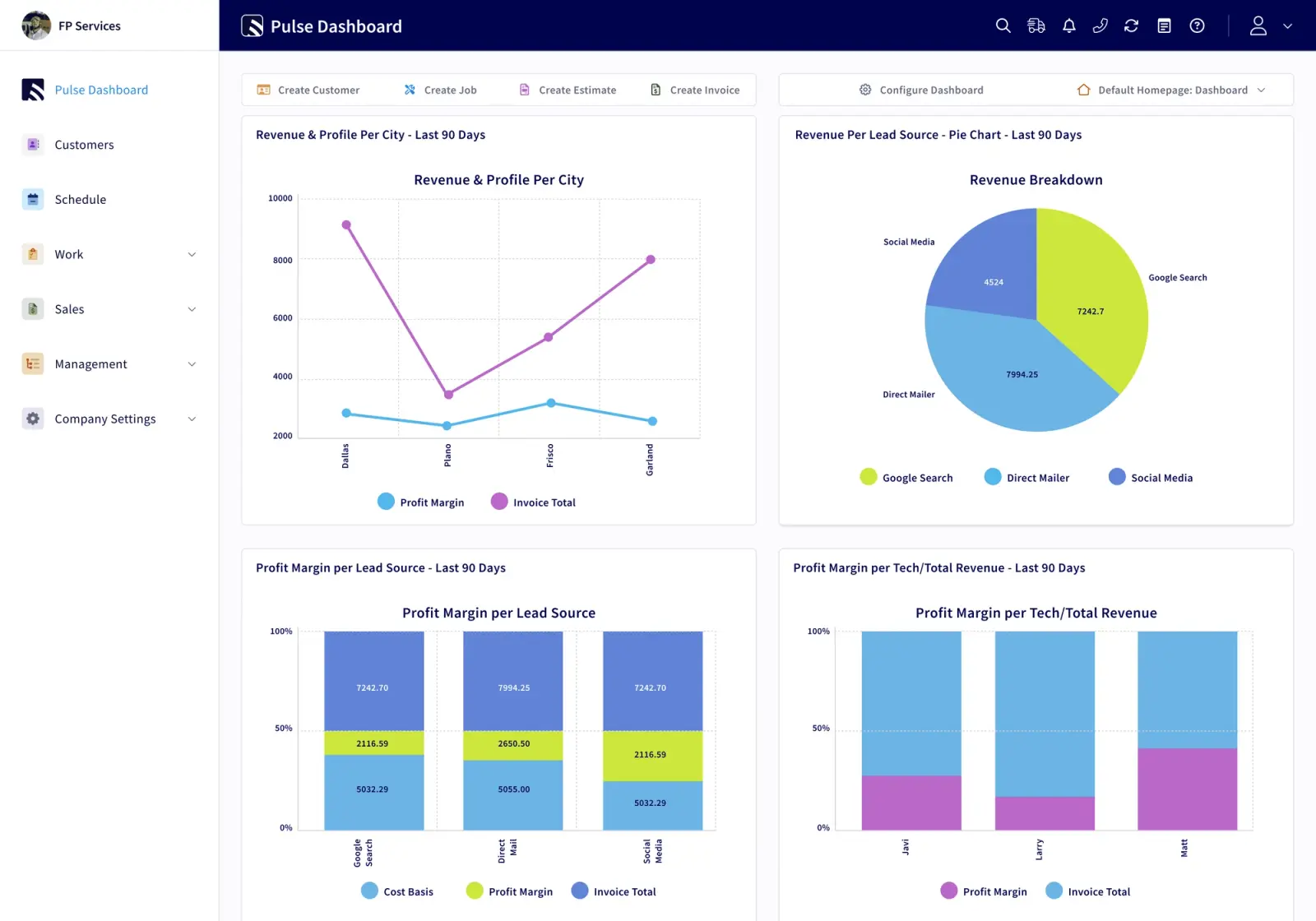
Job costing built in. FieldPulse estimates your profit margin upfront and confirms actual profit after completion. You get per-job profit and loss, plus line-item cost, price, and profit breakdowns. Because techs clock in against the job itself, labor hours tie to specific work, which is what makes job-level profitability visible at all. Qualified Plumbing LLC in Hawaii saved 7–9 hours per week and increased revenue 23% after switching to FieldPulse.
Two-way QuickBooks Online sync. Customers, line items, estimates, invoices, payments, and purchase orders with full line-item detail, plus vendors, sync both ways. Timesheets flow into QuickBooks Online when a tech clocks out. A correction made in QuickBooks carries back into FieldPulse instead of being overwritten, which is what actually ends double data entry. This works with QuickBooks Online Essentials, Plus, and Advanced in the US, Canada, and Australia.
Payments built in. FieldPulse Payments handles card and ACH collection in the field and online, with Next-Day Funding that puts money in your account the next business day. Card Fee Recovery is a compliant dual pricing program, legal in all 50 states, that shows a lower cash or ACH price and a higher card price on the invoice upfront so the customer chooses before paying. It reduces your processing cost without a surprise fee at checkout. FieldPulse Financing lets customers check payment plan options with no impact to their credit score, and your business receives payment immediately.
Onboarding that reflects real work. Onboarding typically runs 2 to 6 weeks, depending on your size, which capabilities are enabled, how much data has to migrate, and how your accounting setup is handled. An implementation manager runs recurring working sessions with your team. RDI, a commercial interiors business that came from pen, paper, and Excel, put it plainly: “We ripped band-aids off one at a time, instead of all at once.” Their time-tracking rollout, with a long-tenured field crew that had used paper time cards for thirty years, was running payroll off the app within two weeks.
Support that customers name in reviews. FieldPulse’s support team is U.S.-based in Dallas, Texas, and holds a 4.8 out of 5 aggregate rating across G2, Capterra, the App Store, the Google Play Store, and other software-review sites. Danielle Burton, Operations Manager at Premium Plumbing and Septic, described it as “outstanding, absolutely amazing support.”
See what your jobs are actually earning with FieldPulse.
What To Ask Before You Sign
You can bring a short list of questions into your next vendor conversation to surface costs and constraints early.
- How does the bill change when you add a technician?
- Which capabilities are in the package and which are add-ons?
- What do you pay per card transaction and per ACH transaction?
- What does onboarding actually involve, and how long does it take for a team your size?
- What happens to your books when you switch, and how do corrections in QuickBooks flow back into the field service software?
- Is the contract month-to-month or annual, and what does it cost to export your customer list if you leave?
Conclusion: Build The Number Before You Sign
Plumbing software pricing works like a model, not a single number. The per-user-per-month range you see on a pricing page is the starting point. What your business actually pays in Year 1 comes from seat count, modules enabled, payment processing, onboarding, and how the bill changes as your team grows.
You get the clearest picture when you document your current workflows, spot where your office re-enters work that already happened in the field, and build a normalized cost comparison using the checklist above. That gives you a defensible number for your budget meeting and a focused set of questions that reveal more about a platform than any slide deck.
If you run a team-based residential plumbing company in the 7-to-50-technician range and you have outgrown a simpler tool, FieldPulse is worth a conversation. The demo covers your team size, your trade, and what you actually need running on day one, so you leave with a real number instead of a range.
Talk with FieldPulse about pricing for your team.