







Key Takeaways For Plumbing Job Costing
-
Plumbing job costing software connects labor hours, materials, truck stock, permits, and change orders to specific jobs so your team can see estimated versus actual gross profit margin in real time.
-
Job costing leaks show up differently on service calls (truck stock, diagnostic time, flat-rate mismatches, warranty callbacks) versus repipes (permits, change orders, labor drift, purchase orders).
-
Growing plumbing businesses often struggle with late invoicing, schedule miscommunication, inconsistent pricing, fragmented customer data, and after-hours administrative work.
-
When you evaluate platforms, confirm that labor clocks to the job, truck stock charges at time of use, and QuickBooks syncs both ways so corrections flow back into your field service software.
-
FieldPulse helps plumbing teams of 7–50 techs track real-time job costs, sync two-way with QuickBooks Online, and improve profit margins by catching issues before jobs close.
How Job Costing Works On Real Plumbing Jobs
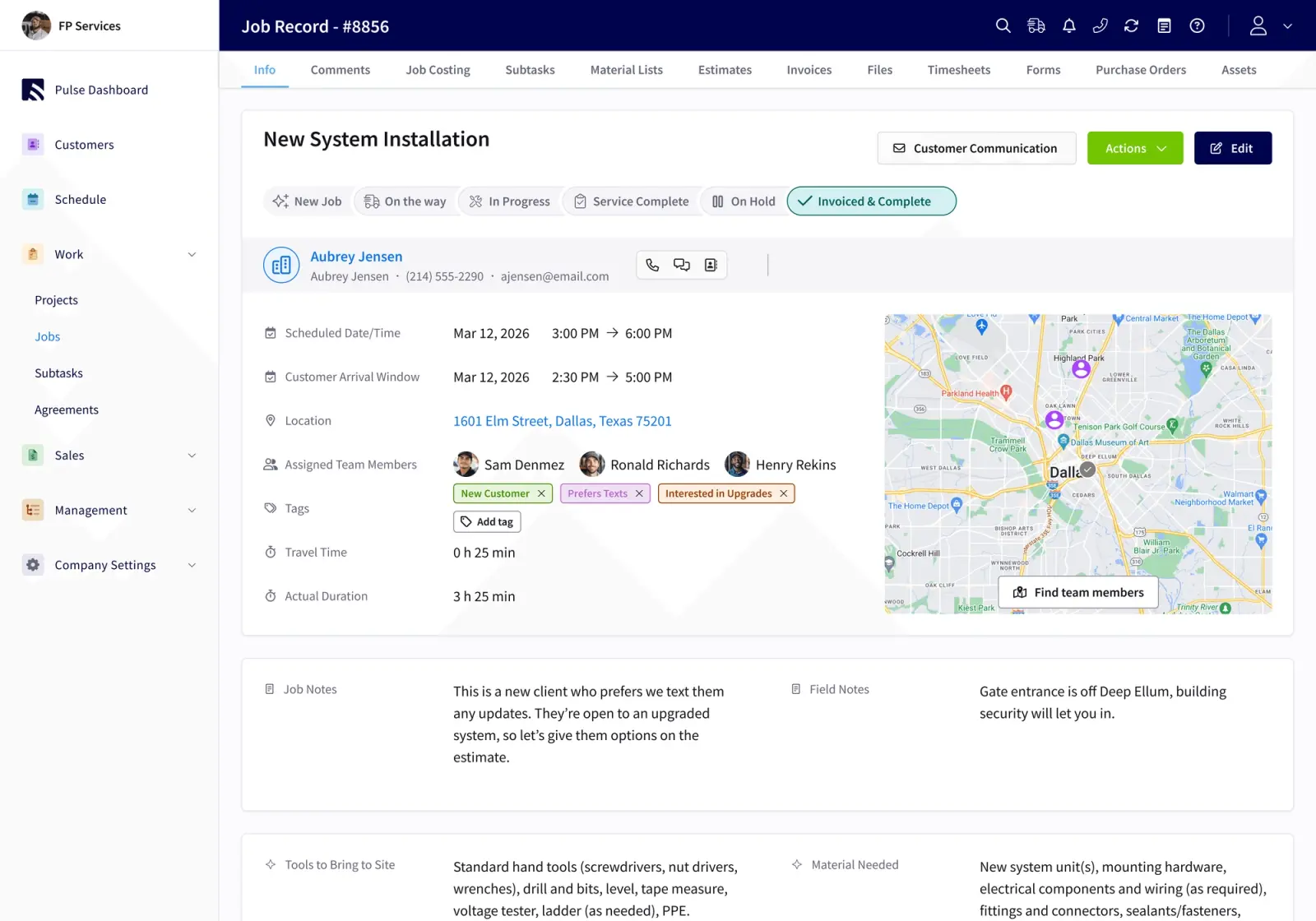
A service call and a repipe use different cost models. Software that costs them the same way was adapted for plumbing rather than built for it. Here is where job costing leaks at each handoff for each job type.
Service Call
On a flat-rate service call, your revenue is fixed the moment you quote the job. Every cost that runs over comes straight out of your profit margin. The main leaks show up in four places:
-
Truck stock that never gets charged to the job. Every service van carries thousands of dollars in fittings, valves, and connectors. Physical truck stock reconciliation typically reveals $1,200–$3,000 in untracked job costs per truck per quarter. The tech used the parts, but the job never got charged. To close that gap, the tech needs to record parts at the time of use, not at the end of the week.
-
Diagnostic time that is not billable. Your service call fee should cover the truck, the drive, and the diagnosis. If it falls short, you absorb that time as overhead on every call. The owner sets the service call fee from actual visit cost, based on real numbers instead of competitor pricing.
-
Flat-rate versus time-and-materials mismatch. Flat-rate pricing decouples revenue from time on repeatable work, but only when you build the flat rate from a fully loaded labor rate. Most contractors underestimate labor costs because they use the hourly wage rather than the fully loaded cost, which includes payroll taxes, workers’ comp, benefits, and vehicle costs.
-
Warranty callback labor that quietly erases profit. If a tech spends four hours on a warranty callback, that cost belongs against the original job. In many plumbing businesses, it disappears into overhead. The office administrator needs to log callback labor against the original job record instead of creating a new job.
Repipe
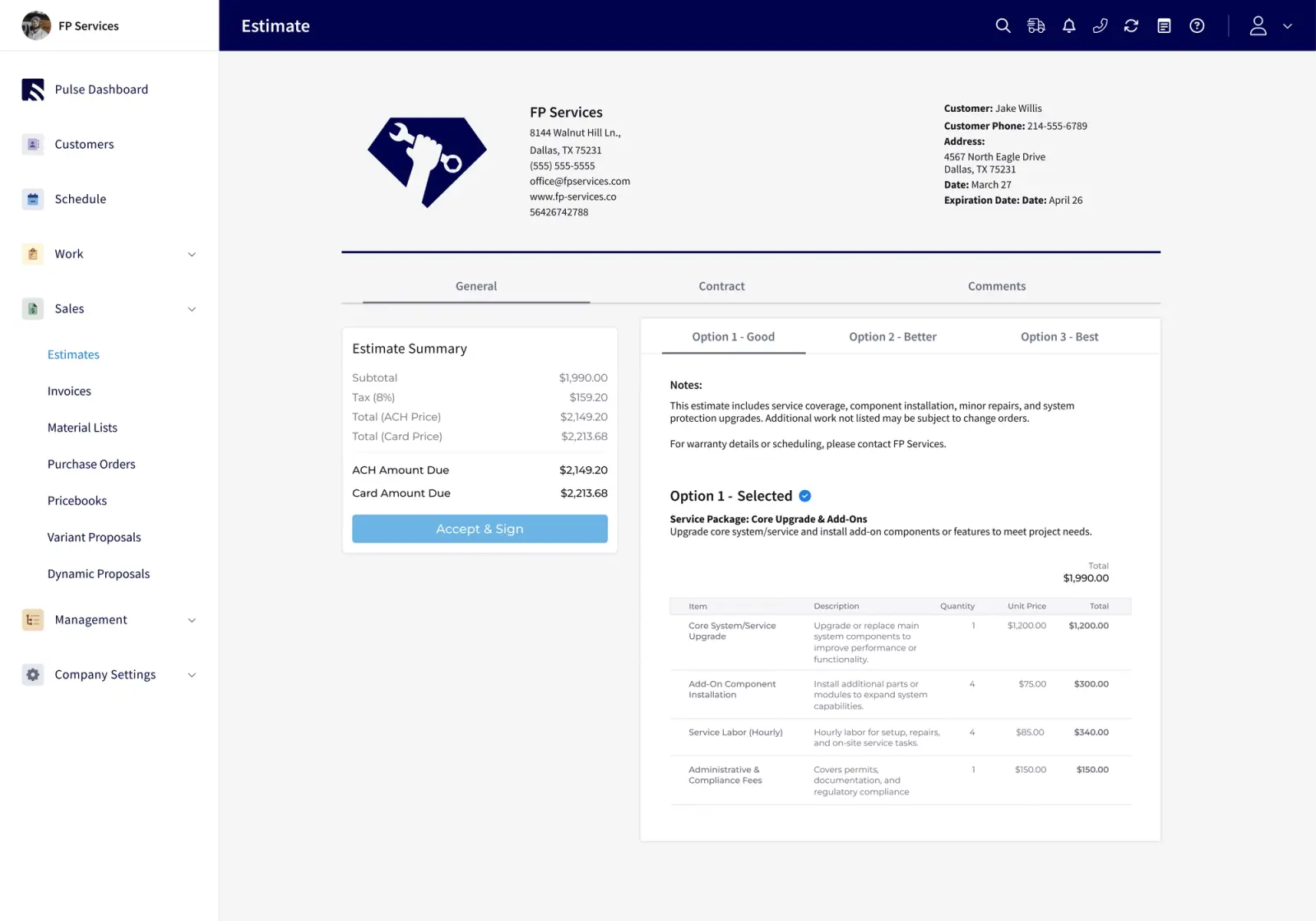
On a repipe, your revenue can change as scope changes, inspections fail, or walls open up. The leaks show up in different spots:
-
Permit and inspection costs absorbed into labor. Permit fees should be a separate line item at cost plus an admin fee for the time spent managing the application, scheduling the inspection, and documenting compliance. When you bury them in a labor estimate, you cannot see whether permits are eating your profit margin. The office administrator tracks permit costs as a separate cost line on the job.
-
Change orders done verbally and never logged. Industry data shows contractors lose an average of 24 days between when a change order is verbally agreed to and when it is formally documented. On a repipe, that delay often means work performed but never billed. The tech documents scope changes in the field, and the office administrator converts them to a formal change order before the next day’s work begins.
-
Multi-day labor drift. A repipe estimated at three days can quietly become four. Without labor hours tied to the specific job instead of a weekly timesheet total, you do not see the drift until the job closes. Techs need to clock in and out against the job itself, not just against a shift.
-
Subcontractor and material purchase orders. Drywall restoration and specialty fittings ordered for the job should hit the job budget the moment the purchase order is issued. Waiting until the invoice arrives hides real costs. The office administrator creates purchase orders tied to the job before materials are ordered.
Commercial Bid
Commercial plumbing work adds a third cost model. Prevailing wage and certified payroll requirements change your loaded labor rate. Retainage means you finance part of every invoice until project completion. Submittals and inspection hold-points add non-billable coordination time. Progress billing requires tracking percent complete by phase, not just total hours. FieldPulse supports commercial work but focuses on residential teams, so you should evaluate carefully if your work is mostly commercial.
Why Job Costing Breaks In Growing Plumbing Teams
Job costing usually breaks because growth outpaces process development. As your team grows, you track more information manually and miss more handoffs. Five breakdowns show up repeatedly:
-
Job completion that never becomes an invoice. The tech holds the parts list, labor hours, and details of what happened on site. The office waits, then chases. Invoices go out late or never go out.
-
Schedule changes that turn into a call tree. An emergency request comes in and the dispatcher rebuilds the day by phone, finding the right tech, moving jobs, and notifying customers. One missed handoff becomes a truck that never shows up.
-
Pricing that varies by tech. Without a standard pricebook and job costing discipline, two techs quote the same work differently. You only see the impact on profit margin after the fact.
-
Customer context that fragments. Service history, equipment details, gate codes, and prior notes split across access files, text threads, and separate systems. Pulling up a customer’s history takes too long, and follow-up often gets missed.
-
Administrative work that eats evenings. The owner and the office finish paperwork after the operational day ends because the system depends on manual re-entry and follow-up.
The problem is structural. When information moves through people instead of through a shared system, every new crew adds another place where work breaks operationally.
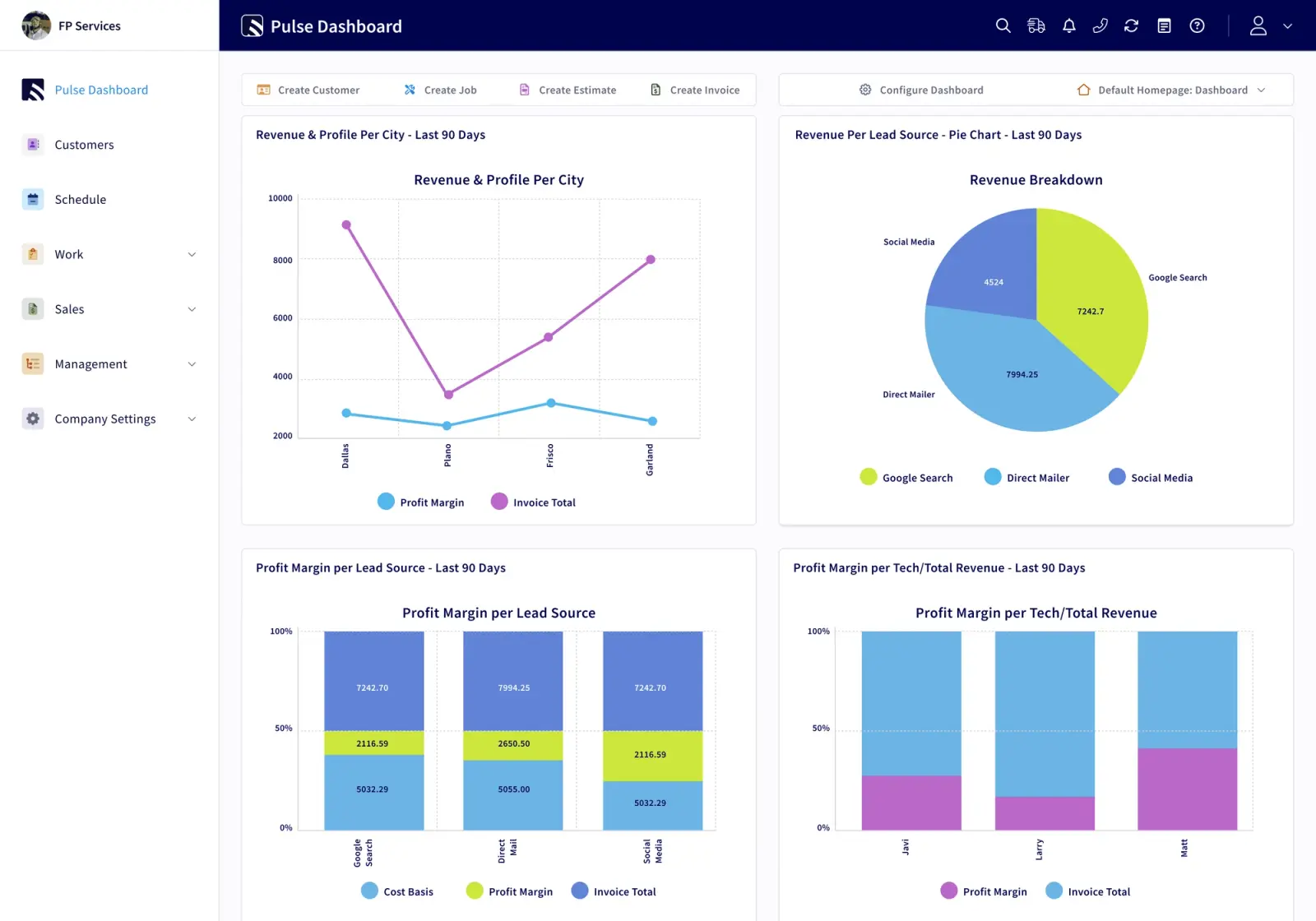
See How FieldPulse Reduces Duplicate Entry Between Your Office And Field
Buyer’s Checklist For Plumbing Job Costing Software
Use these questions in every demo. The answers show whether the platform was built for plumbing or simply adapted to it.
-
Does labor clock against the job or against a weekly total? If techs clock in against a shift and someone in the office allocates hours later, your labor costs are reconstructed instead of tracked.
-
Does the platform use a loaded labor cost, not just the hourly wage? Labor burden, including payroll taxes, workers’ comp, health insurance, PTO, and vehicle costs, typically adds 30–60% on top of base wages for specialty trades. A platform that uses only the wage rate undercounts your labor cost on every job.
-
Are materials and truck stock charged to the job at the time of use? Costs should hit the job when the tech uses the part, before the invoice is built.
-
Does the platform support purchase orders tied to a specific job? Committed costs need to appear against the job budget the moment the PO is issued.
-
Are subcontractor costs tracked as a separate cost line? Rolling sub costs into materials or labor hides how much of each job’s cost you control directly.
-
Can you log and bill change orders from the field? Verbal change orders usually become unbilled work. The platform needs to capture them before the next day’s work begins.
-
Can you see gross profit margin by job type, such as service call, repipe, and commercial bid? A blended average hides both your strongest and weakest performers.
-
Does the platform cost service calls and projects differently? Flat-rate service work and multi-day project work use different cost models. A platform that treats them the same will not give you clear job costing.
-
Does the accounting sync go both ways? Ask directly how a correction in QuickBooks Online flows back into your field service software.
How QuickBooks And Field Service Software Work Together
QuickBooks tracks transactions and can produce a job profitability report. It cannot capture labor hours at the job level, track what came off the truck, or compare actual costs against an estimate in real time. QuickBooks Online also lacks cost-code-level estimate-versus-actual reporting, job-tied time tracking, and committed cost reporting. It depends on someone re-entering field data after the fact, which creates the double data entry you want to remove.
QuickBooks is where your books live. Field service software is where your jobs live. The two need a true two-way sync. A one-way push means corrections made in QuickBooks get overwritten the next time your field service software exports.
FieldPulse syncs customers, line items, estimates, invoices, payments, purchase orders with full line-item detail, and vendors in both directions with QuickBooks Online. Timesheets flow into QuickBooks Online when a tech clocks out. FieldPulse works with QuickBooks Online Essentials, Plus, and Advanced in the US, Canada, and Australia. QuickBooks Desktop is also supported.
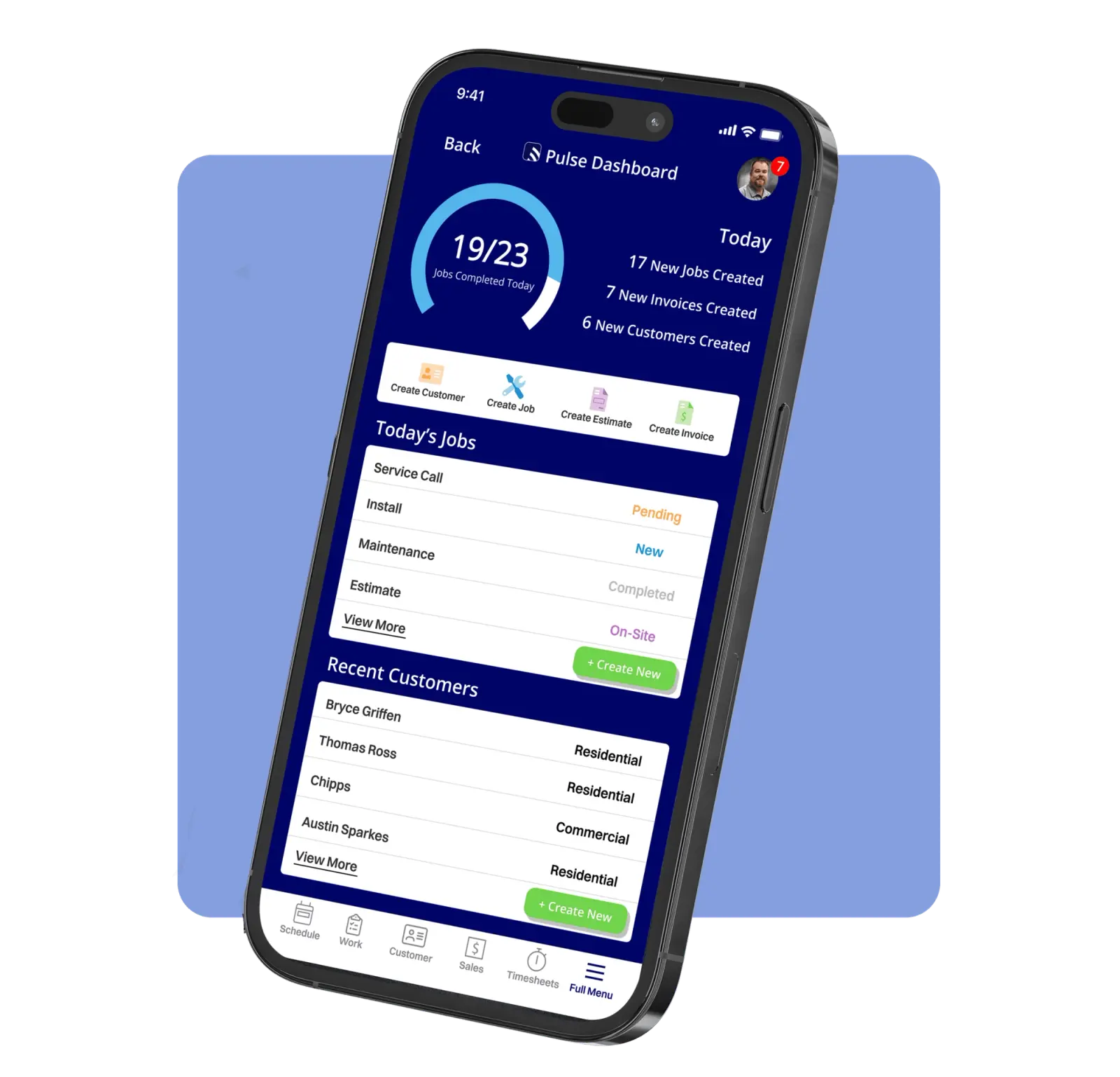
What Plumbers Say About Job Costing Software
Plumbers in forums and peer groups focus on two questions about job costing software: whether labor hours actually tie to a job, and whether the books and the field service software agree. Vendor pages describe features. Working teams describe whether those features hold up on real jobs.
Heather Aila, office secretary at Qualified Plumbing LLC in Keaau, Hawaii, an 11-to-25-tech plumbing business, summed up her experience after evaluating multiple platforms and choosing FieldPulse:
“The online platform has helped us tremendously with everything from reporting to communication, and we love the easy-to-use CRM system. You folks had everything in one bundle for a great price. Competitors wanted you to add items à la carte for an additional price.”
Qualified Plumbing saved 7–9 hours per week and increased revenue 23% after moving to FieldPulse.
The pattern stays consistent. Working plumbing teams care most about whether the information that determines job profit margin travels from the field to the office without someone rebuilding it by hand.
How To Evaluate A Platform In A Demo
Bring three specific questions to every vendor demo so you can see how the system behaves on real jobs:
-
Does labor clock against the job or against a weekly total? Ask the vendor to show a tech clocking in on a specific job and the labor cost appearing on that job’s cost summary. It should not land on a timesheet that someone allocates later.
-
Does truck stock get charged to the job it was used on? Ask the vendor to show a tech pulling a part from truck stock in the field and that cost appearing on the job record before the invoice is built.
-
When your bookkeeper corrects something in QuickBooks, does the fix carry back into the field service software? This question separates a one-way push from a true two-way sync. If the answer sounds like “the field software is the source of truth after the first import,” your bookkeeper’s corrections will be overwritten.
On implementation, most 7-to-50-tech plumbing teams complete onboarding in two to six weeks. Timing depends on your team size, which capabilities you enable, how much data you migrate, and how your accounting is set up. Plan for real work, broken into phases, so your team can adopt the new process.
Frequently Asked Questions (FAQ)
What Does Plumbing Job Costing Software Do?
Plumbing job costing software ties every cost on a plumbing job, including labor hours, materials, truck stock, permits, subcontractors, and change orders, to that specific job record. It then compares those actual costs against the original estimate. You get a per-job profit and loss view that shows whether a job made money, which job types are most profitable, and which customers cost more to serve than they generate in revenue.
How Do I Price A Plumbing Job So It Makes Money?
Start with your fully loaded labor rate instead of your hourly wage. Your real labor cost includes payroll taxes, workers’ comp, general liability, vehicle costs, and benefits. Divide your total annual labor cost by your actual billable hours to get your true cost per billable hour. Then build your flat-rate prices from that number. Add materials at a markup that covers purchasing, handling, and stock costs. Add permits as a separate line item, and apply your target gross profit margin on top.
Review your pricebook at least every six months. A pricebook that is 12 months out of date can erase several points of profit margin without you noticing. To test your current pricing, cost out five real jobs from last month and compare what you estimated against what you actually spent.
How Do I Calculate Job Costing On A Service Call Versus A Repipe?
Service calls and repipes use different inputs. On a service call, your revenue is fixed by the flat rate, so job costing tracks whether your actual labor time, truck stock used, and overhead allocation stayed within the cost you built the flat rate around. The key inputs are which tech was dispatched and their loaded labor rate, how long they were on site, what came off the truck, and whether any warranty callback labor needs to be logged against this job.
On a repipe, your revenue can change as scope changes. Job costing tracks estimated versus actual labor by day, permit and inspection costs as separate line items, change orders as they are approved, subcontractor costs by vendor, and material purchase orders from the moment they are issued. The profit calculation is still revenue minus all costs, but the cost categories and timing differ by job type.
Can QuickBooks Do Job Costing For A Plumbing Business?
As covered above, QuickBooks tracks transactions and can show what you spent, but it cannot capture job-level labor or truck stock in real time. The practical fix is a field service software layer that captures costs as work happens and syncs both ways with QuickBooks so corrections carry back into the field.
What Is The Difference Between Job Costing And Estimating Software?
Estimating software helps you build a price before the job starts by calculating labor, materials, and overhead to produce a quote. Job costing software tracks what actually happens during and after the job and compares it to that estimate. Estimating is the input. Job costing is the feedback loop. Many platforms offer both in one system so the estimate becomes the cost baseline and actual costs track against it as the job progresses.
How Long Does Implementation Take?
For a plumbing team in the 7-to-50-tech range, onboarding usually runs two to six weeks. The main variables are your team size, which capabilities you turn on, how much data you migrate, and how your accounting is set up. Typical steps include scoping the work, configuring job types and workflows, setting permissions and mobile setup, moving data and connecting QuickBooks Online, training each role, and then shifting into ongoing support.
How Do I Tell A Scheduling Tool From A True Job Costing System?
Ask the vendor to show a tech clocking in on a specific job and that labor cost appearing on the job’s cost summary in real time instead of on a weekly timesheet that gets allocated later. Then ask what happens when the tech clocks out and whether the labor cost updates the job’s estimated versus actual comparison automatically. Finally, ask how a correction in QuickBooks Online flows back into the field service software. A scheduling tool with a costing report usually struggles with that last question.
Conclusion: Three Tests For Plumbing Job Costing Software
Every plumbing job costing evaluation comes down to three tests. Apply them to any platform you consider:
-
Do labor hours tie to the job itself at the time the work happens? Hours should not live only on a weekly timesheet.
-
Does truck stock get charged to the job at the time of use? The cost should appear on the job record before you build the invoice.
-
Do the books and the field service software agree when your bookkeeper makes a correction in QuickBooks? A two-way sync should carry that fix back into the field.
Before your next demo, cost out one real plumbing job from last month. Write down where every number came from, including labor hours, truck stock, permits, change orders, and the invoice date. If it takes more than twenty minutes or you cannot find some of the numbers, that gap shows where your process needs help. Bring your office manager and a tech to any demo you schedule so you can see how the platform supports every role.
See How FieldPulse Connects Your Office And Field On One Workflow