







Key Takeaways
-
Job costing tracks every cost, including labor, materials, drive time, consumables, permits, and overhead, against a specific job so you see true per-job profit margin instead of relying on instinct.
-
Plumbing-specific costs like drive time between calls, consumables that leave the truck, permit fees, equipment depreciation, and warranty callback labor often get missed and distort your profit picture.
-
Residential service plumbing needs software that ties tech clock-in to individual service calls for high-volume, short-duration jobs, while commercial project work needs project-level cost tracking, change orders, and progress billing.
-
Accurate job costing starts when techs clock in against the specific work order in a mobile app, capturing labor hours, materials, and photos on site so your office receives complete data without manual reconstruction.
-
FieldPulse provides job costing that gives you upfront profit margin estimates and post-job actuals for established residential plumbing teams.
What Makes Job Costing Different in Plumbing
Most search results for job costing software for plumbing companies focus on estimating and takeoff tools. That solves a different problem. Estimating projects costs before work begins, while job costing confirms actual costs after completion and checks whether the two align.
A plumbing company can be fully digital and still not know which jobs made money. The reason is that costs move through people rather than through a record. The information exists, but it is scattered across a timesheet, a supply house receipt, and a technician’s memory.
The cost categories that get missed most often in plumbing job costing include:
-
Drive time between calls: A technician paid for eight hours a day typically bills only five to six of them once drive time and gaps between calls are subtracted, so drive time belongs on the job record.
-
Consumables: Solder, fittings, tape, and other small parts leave the truck but never hit a purchase order.
-
Permit fees: These are direct costs that belong to the job but often get absorbed into overhead.
-
Equipment depreciation: Drain machines, jetters, and cameras wear out, and that cost belongs on the jobs that use them.
-
Warranty callback labor: Four hours a technician spends on a warranty callback are costs against the original job.
If you miss any of these costs, your profit margin numbers will be wrong, and your pricing decisions will be based on faulty data. Before you can fix that, you need to know which business model you run, because residential service and commercial project work have different cost structures.

Residential Service vs. Commercial Project Work
The most important factor when choosing job costing software for plumbing companies is your business model. Residential service and commercial project work have different cost structures, different billing rhythms, and different software needs.
Residential service plumbing runs on high job volume, short duration, one or two techs per job, and flat-rate pricing. Your software has to tie a tech clock-in to a specific service call and make per-job profit margins visible without the office reconstructing them later. When your team completes 8 to 15 calls a day, you cannot afford to reconcile labor hours manually at the end of the week.
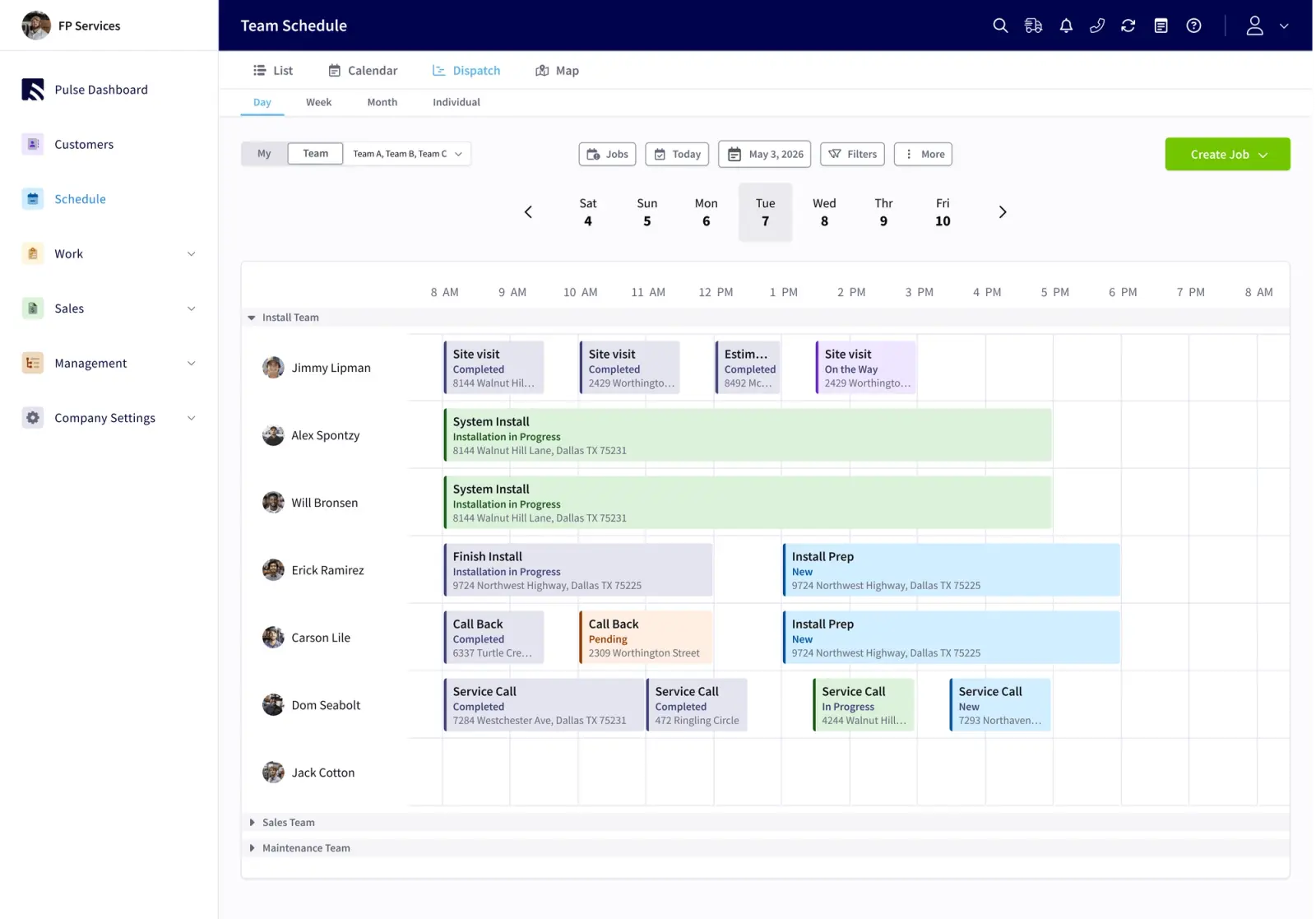
Gross margins on residential plumbing service work commonly fall in the 45% to 65% range, though reported benchmarks vary by source (roughly 40% to 70%), with flat-rate shops running efficient dispatch often hitting the upper end of that range. That profit margin is only visible if your software captures it at the job level.
Commercial project plumbing involves multi-visit jobs, progress billing, change orders, submittals, and longer cost tails. A drain camera inspection can turn into a $4,500 excavation repair. A subcontractor invoice can arrive weeks after the job is marked complete. Your software has to handle project-level cost tracking and change order capture, or your profit margin report is fiction before the month closes.
A service-oriented plumbing company at 52% gross profit margin and 17% EBITDA margin looks very different from a project-oriented company at 31% gross profit margin and 9% EBITDA margin even at the same revenue. Your business model drives those numbers.
FieldPulse fits established residential plumbing teams, with support for commercial work where your office and field must stay in sync across multiple job types. The product depth leans residential, and commercial capabilities continue to develop.
See how FieldPulse fits residential plumbing teams
How Plumbing Companies Track Labor and Materials Against a Job
Accurate job costing in plumbing depends on how you tie labor and materials to each job. Labor hours tie to a job when a tech clocks in against that job in a mobile app, not when the office totals a weekly timesheet. That distinction makes job-level profitability possible.
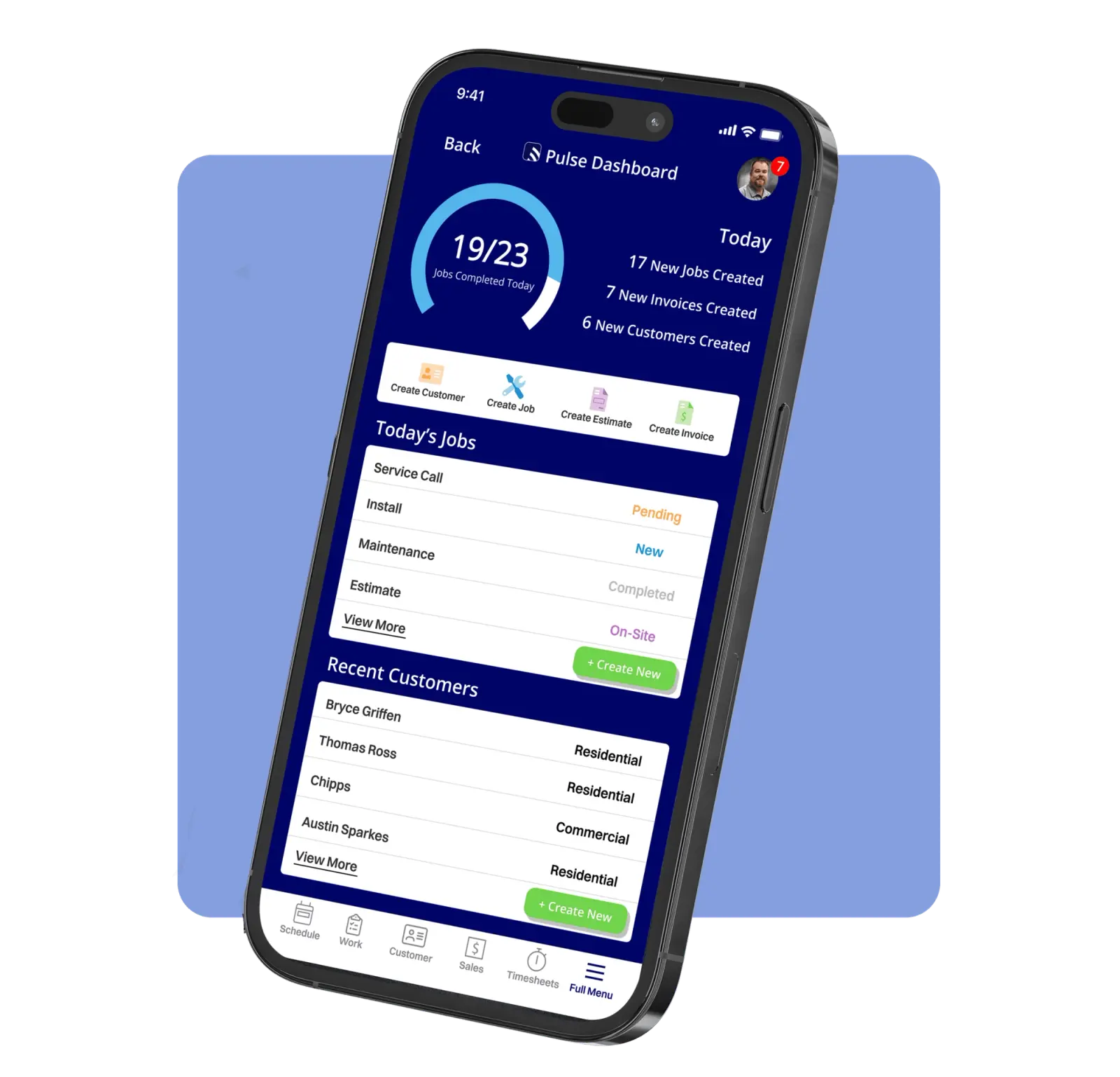
The sequence usually works like this:
-
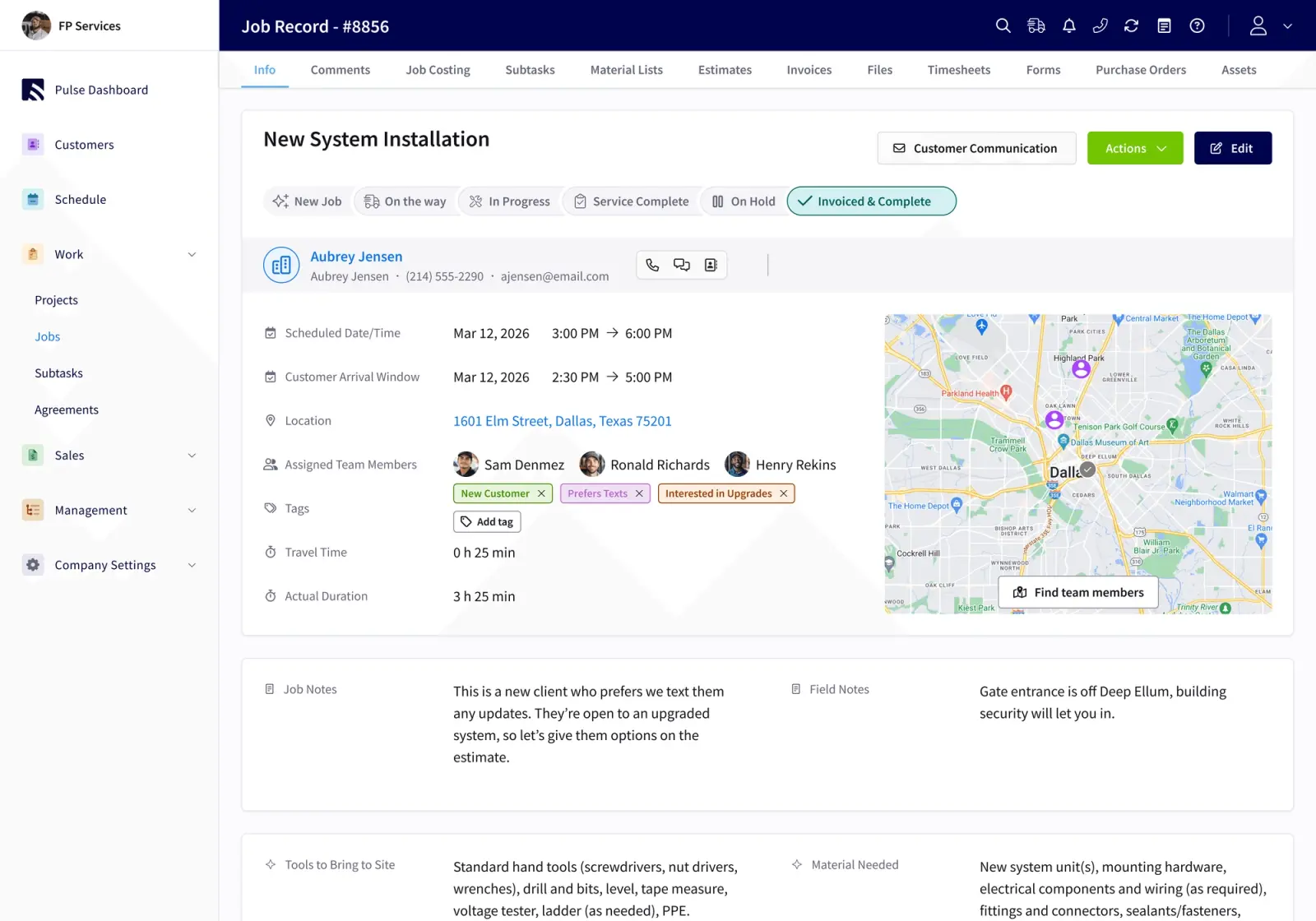
The tech arrives at the job and clocks in against that specific work order in the mobile app.
-
As the work happens, the tech records parts used and labor time directly on the job ticket.
-
Photos and a customer signature are captured on site.
-
The job record carries all of that detail to your office without re-entry.
-
Materials tie to the job through the parts recorded on the ticket and through a pricebook that holds standard pricing for services, materials, and labor.
When the job closes, you have actual labor hours, actual materials, and actual costs all tied to that specific job. That produces a real per-job profit margin.
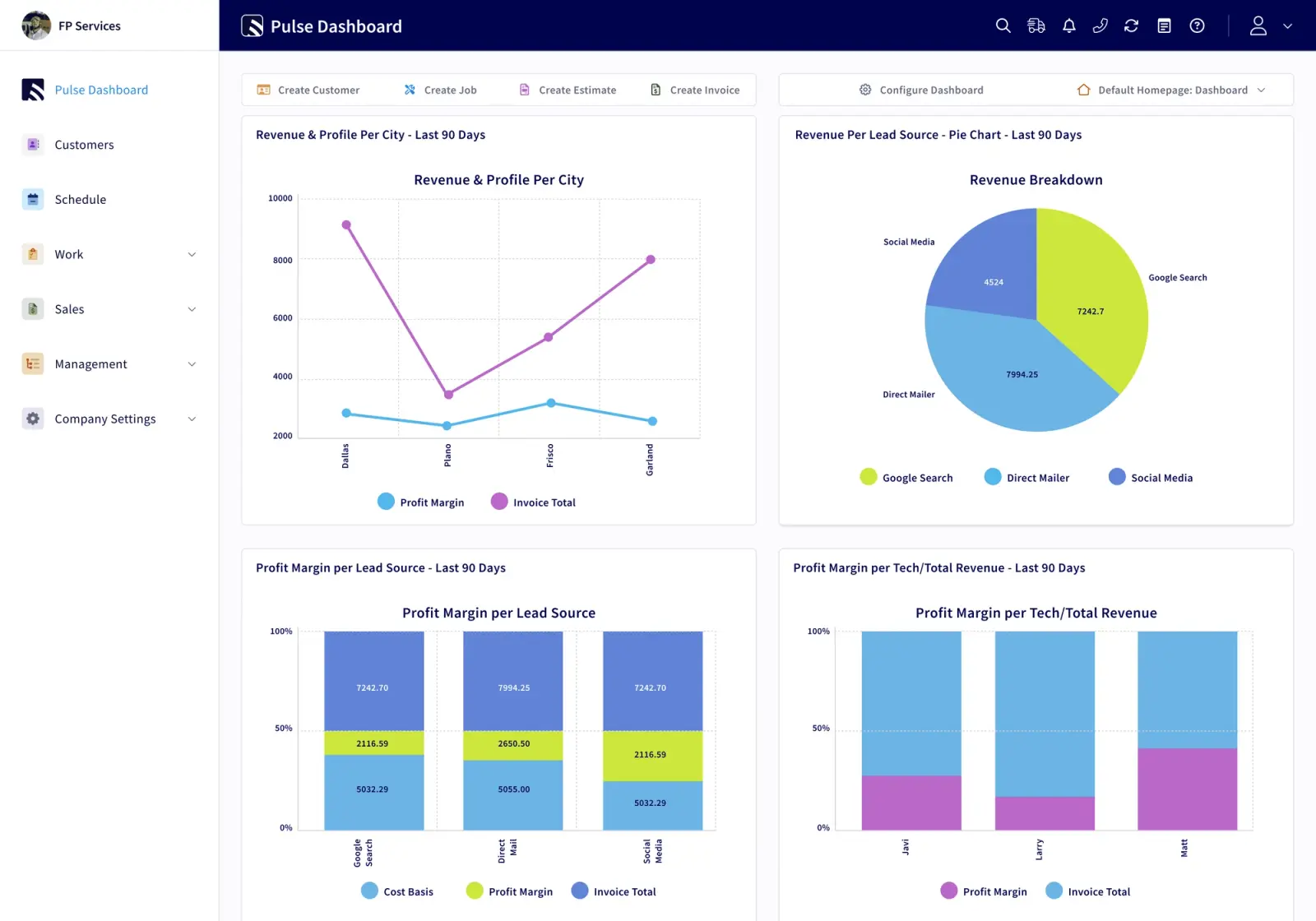
In FieldPulse, ClearPath included in the core platform turns your process into office-defined job stages with required actions at each stage. Because your techs clock in against the job itself, labor hours tie to specific work rather than to a weekly total. Job costing in FieldPulse gives you upfront profit margin estimates and post-job actuals, with per-job profit and loss and line-item cost, price, and profit breakdowns.
What to Look For in Job Costing Software for Plumbing Companies
When you evaluate job costing software, focus on these criteria to see whether a platform will work for your plumbing business.
-
Labor tied to the job, not to a weekly timesheet. If your techs clock in against a shift instead of a specific work order, you will not have accurate per-job labor costs.
-
A pricebook that holds standard pricing for services, materials, and labor. This keeps estimates consistent across your team.
-
Change order handling for commercial work. Approved scope changes need to be captured before the work happens so you do not give away profit margin.
-
Two-way QuickBooks Online sync. A correction made in your books should carry back into your field service software instead of being overwritten. FieldPulse syncs customers, line items, estimates, invoices, payments, purchase orders with full line-item detail, and vendors both ways. Timesheets flow into QuickBooks Online when a tech clocks out. FieldPulse works with QuickBooks Online Essentials, Plus, and Advanced in the US, Canada, and Australia.
-
Reporting that shows profitability by job, job type, and customer. FieldPulse includes 60+ prebuilt reports plus custom ones, so you can see which service lines actually carry your business.
-
Mobile usability for your techs, including a Spanish-language option. The FieldPulse mobile app is available in Spanish, enabled per user by the FieldPulse team, and translates the entire mobile interface. The web app is not available in Spanish.
-
Implementation effort and support. FieldPulse onboarding typically runs two to six weeks depending on your team size, which capabilities you enable, how much data needs to migrate, and how your accounting is set up.
If you also feel administrative burden from managing your team workload, take three minutes to score where it is heaviest: Admin Workload Assessment.
How Job Costing Informs Plumbing Pricing
Per-job profit margin visibility lets you price from data instead of instinct. That changes three parts of your business.
First, you can identify which job types carry the best profit margins. Service-call gross profit margins run 45% to 55%, maintenance agreements 45% to 60%, residential remodel work 20% to 28%, and new construction 12% to 18%. If you do not know which category each of your jobs falls into, you cannot price them correctly.
Second, you can identify which customers are worth more work. A single general contractor representing 20% or more of a plumbing company’s revenue is a concentration risk that triggers earnout structures and cash-at-close haircuts in a sale, with most platform buyers passing outright above 40%. A residential customer base of 1,000+ small accounts does not create that same risk. Job costing makes that difference visible.
Third, you can adjust your flat-rate pricebook based on actual data. A plumbing price book is a perishable document. Parts pricing moves and labor costs change. Running last year’s book in this year’s market is a common slow leak in a flat-rate shop. Job costing shows where the book is wrong before the losses build up.
See how FieldPulse supports data-driven pricing
How FieldPulse Fits Different Plumbing Businesses
The right job costing software for your plumbing company depends on your business model and your stage of growth. FieldPulse focuses on established residential plumbing teams that want clear job-level numbers and tighter office-to-field coordination.
FieldPulse is a strong fit for established residential plumbing teams. Job costing gives you upfront profit margin estimates and post-job actuals. ClearPath ties labor hours to specific jobs at the moment of clock-in. The Pricebook add-on holds standard pricing so estimates stop varying by person. Two-way QuickBooks Online sync keeps your office and your books aligned. The mobile app is available in Spanish for bilingual crews, enabled per user by the FieldPulse team. FieldPulse holds a 4.8 out of 5 aggregate rating across G2, Capterra, the App Store, the Google Play Store, and other software-review sites.
What to Do If Your Current Tool Cannot Do Job Costing
Several turning points push plumbing owners to search for new software. Common triggers include a growth step that exposes how much lives in one person’s head, a job that lost money and nobody caught it in time, an incumbent platform that no longer fits, or enough daily workflow problems that your team is ready to change.
If your current tool cannot tie labor to a specific job, cannot capture plumbing-specific costs like drive time and consumables, or cannot show you a per-job profit margin while the job is still open, you face a structural problem instead of a settings problem.
Switching takes real work. FieldPulse onboarding typically runs two to six weeks. An implementation manager runs recurring working sessions with your team. Your existing QuickBooks Online customers and records come with you rather than being rebuilt from scratch. The work gets sequenced into phases with tasks between sessions so the rollout sticks.
A practical first step is to take one real job you completed last month and cost it out. Include parts, labor, drive time, the change order nobody logged, and the invoice that went out late. If you cannot do that without an afternoon of reconstruction, that gap shows why your current setup breaks operationally.
See how job costing connects to profit margin leaks in plumbing businesses.
Frequently Asked Questions
What Is Job Costing in Plumbing?
Job costing in plumbing means tracking every cost, including labor, materials, drive time, consumables, permit fees, equipment use, and overhead, against a specific job, then comparing those actual costs to what you quoted. The result is a per-job profit margin that tells you whether that job made money. Estimating projects costs before the work starts, while job costing confirms what the work actually cost after it is done. Without job costing, you may be fully booked and still not know which jobs are profitable.
How Do Plumbing Companies Track Labor Against a Job?
The most accurate method uses mobile clock-in against the specific job, not against a shift or a weekly timesheet. When a tech clocks in against a work order in a mobile app, those hours tie to that job from the start. At the end of the job, the labor cost is already recorded, so you avoid reconstruction. The alternative is collecting weekly timesheets and manually allocating hours to jobs after the fact, which introduces errors and delays. By the time you catch a labor overrun using weekly timesheets, the job is often already closed.
What Software Do Plumbing Companies Use for Job Costing?
The right software depends on your business model. Residential service plumbing teams with high job volume, flat-rate pricing, and one or two techs per job need software that ties clock-in to a specific service call and makes per-job profit margins visible without manual reconstruction. Commercial plumbing contractors need project-level cost tracking, change order capture, and progress billing. FieldPulse is built for established residential plumbing teams, with job costing that gives you upfront profit margin estimates and post-job actuals, plus a two-way QuickBooks Online sync so your office and your books stay aligned.
How Long Does It Take to Switch Job Costing Software?
For most plumbing companies, switching to a new platform takes two to six weeks from kickoff to go-live. The variables are your team size, which capabilities you enable, how much data needs to migrate, and how your accounting is set up. The process typically runs in phases: scoping the work, configuring the platform to your job types and workflows, migrating data and connecting QuickBooks Online, training each role, and then transitioning to ongoing support. Faster launches happen, but they are exceptions, so plan against the real window and expect your team to have homework between sessions.
Conclusion: Matching Job Costing Software to Your Plumbing Business
Two factors determine which job costing software for plumbing companies fits your business: your business model and your labor-tracking mechanic.
If you run residential service work with high volume, flat-rate pricing, and one or two techs per job, you need software that ties clock-in to the job at the moment it happens and makes per-job profit margins visible without your office rebuilding them later. If you run commercial project work, you need project-level cost tracking, change order capture, and progress billing.
Before you evaluate options, do three things: document your current workflows by job type, cost out one real job from last month using actual labor hours and materials, and compare what you find against the evaluation criteria in this guide. That exercise will tell you more than any feature comparison.
FieldPulse connects your office and your field in one workflow, including job costing, ClearPath, mobile clock-in against the job, the Pricebook add-on, and two-way QuickBooks Online sync, built for established residential plumbing teams.
See how FieldPulse connects your office and your field in one workflow. Schedule a personalized walkthrough, or call sales at +1 (817) 635-2218.