








Key Takeaways
- Job lifecycle management software connects quoting, scheduling, field execution, and invoicing in one record so your team does not rebuild details at each handoff.
- Standard pricing and templates remove inconsistent quotes and cut estimate creation time dramatically, as shown by HVAC businesses reducing hours to minutes.
- Drag-and-drop scheduling with live tech locations and automatic customer notifications prevents missed handoffs and keeps the day manageable.
- Offline-capable field service software and ClearPath workflows capture parts, labor, notes, and photos on site so the office never pays the double-job tax described later.
- FieldPulse streamlines the entire job lifecycle for residential service teams of 7–50 technicians by keeping your office and field on the same connected record.
Stage 1: Quoting and Estimates — Where Pricing Stops Varying by Person
The quoting stage is the handoff from a customer’s request to a priced, presentable quote. When this stage works, the customer gets a professional proposal quickly and your team knows the expected profit margin before you dispatch the job. When it breaks operationally, the problem usually comes from inconsistent pricing.
A quote built by hand means looking up current equipment prices, writing out labor, and checking that the final number is fair to both sides. That can take an afternoon and still produce a different answer depending on who built it. When pricing varies by person, your profit margin becomes unpredictable. You find out what a job actually earned after the fact, if at all.
A connected record changes this pattern. Standard pricing held in one place means estimates stop varying by estimator. Good-better-best options get built in minutes rather than hours. Sal Gutierrez, owner of Fair Comfort Solutions, an HVAC business he founded in 2021, described the shift directly. Before FieldPulse, a quote took him four to eight hours. With the Reece HVAC pricebook already built into the platform, that dropped to four to eight minutes, a 98% reduction in estimate creation time.
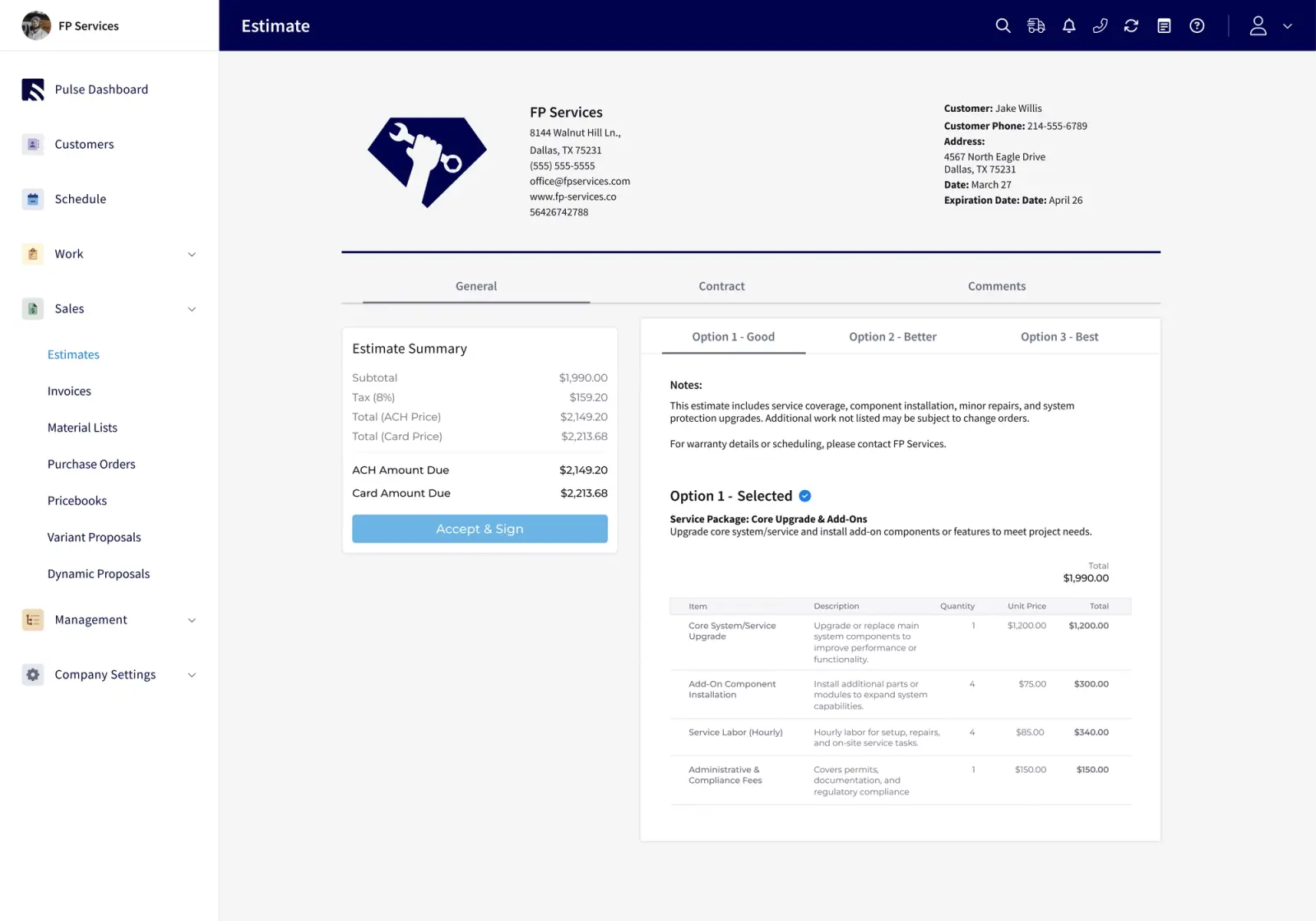
FieldPulse’s Pricebook is an add-on that holds standard pricing for services, materials, and labor, updating in real time across every user and location. Supplier catalogs like the Reece HVAC pricebook come pre-built, so equipment pricing does not have to be looked up and retyped for every quote.
See how standard pricing works in FieldPulse
Stage 2: Scheduling and Dispatch — Where One Missed Handoff Becomes a Customer Waiting
Once the quote is accepted, the job moves to scheduling, the handoff from a sold job to a scheduled visit. The office administrator or dispatcher owns this step. They assign the right tech, confirm the time window, and make sure the customer knows when to expect someone.
The breakdown often happens when emergency requests come in mid-day. The dispatcher has to find the right tech, move existing jobs around them, call affected customers, and update everyone manually. One missed handoff in that chain becomes a customer sitting at home waiting for a truck that is not coming. The office absorbs the emergency, and the customer absorbs the consequence.
A connected record changes the shape of that problem. Drag-and-drop scheduling with live tech locations means the dispatcher can see the whole day at once and reassign without rebuilding it by phone. ClearPath status workflows push job progress to the office automatically. When a tech marks themselves en route, the customer notification fires without anyone remembering to send it.
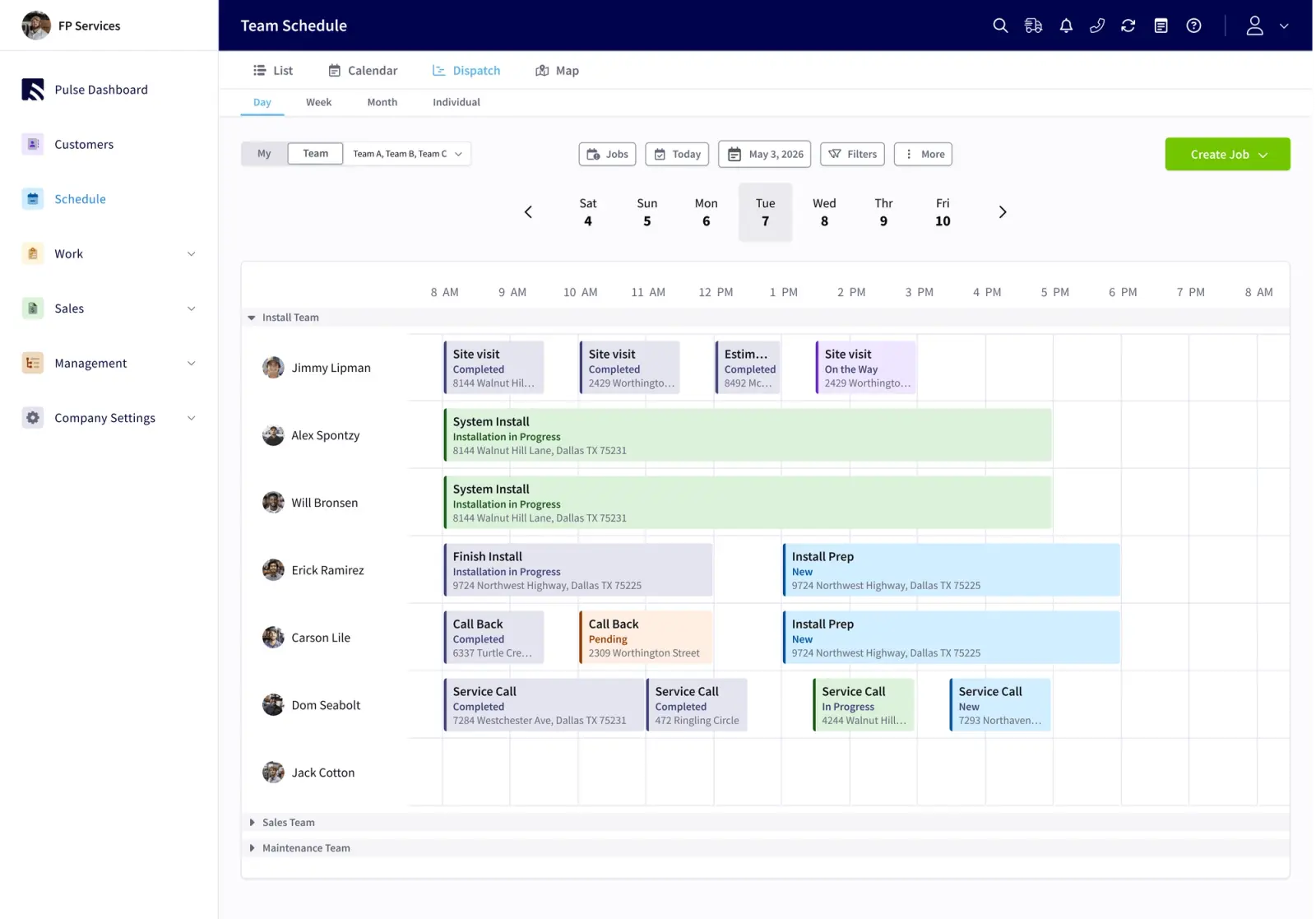
The roles and responsibilities at each step work together. The office administrator or dispatcher assigns jobs and handles reschedules, while the tech marks en route, which automatically triggers the customer notification. Because the record carries each update, the office sees the status change without a phone call, and every step has a clear owner.
For teams running residential service routes across HVAC, plumbing, or garage door work, this kind of visibility separates a manageable day from a reactive one.
Stage 3: Field Execution and Tracking — Where the Double-Job Tax Happens
The field execution stage is the handoff from the schedule to the tech on site. This is where the actual work happens, and where the office most often loses the thread.
The breakdown is the double-job tax. The tech holds the parts, labor, and details of what actually happened on site. The office has to chase them for it. The job is finished, but it is not done until someone in the office re-creates it in a second place. That second pass is invisible on any job sheet, and it scales with volume rather than with revenue.
Signal drops make this worse. Crawlspaces, basements, mechanical rooms, and rural service areas are exactly where residential techs spend their time, and exactly where connectivity disappears. FieldPulse’s caching behavior addresses this directly. The last week of jobs, projects, customers, estimates, and invoices ride along on the device. Techs can complete a majority of the job without cell signal, including adding job notes, uploading batches of photos, updating statuses, and clocking in and out. If signal drops mid-edit, the active draft transitions automatically to an offline draft. Everything entered offline saves locally and syncs when the device is back in signal.
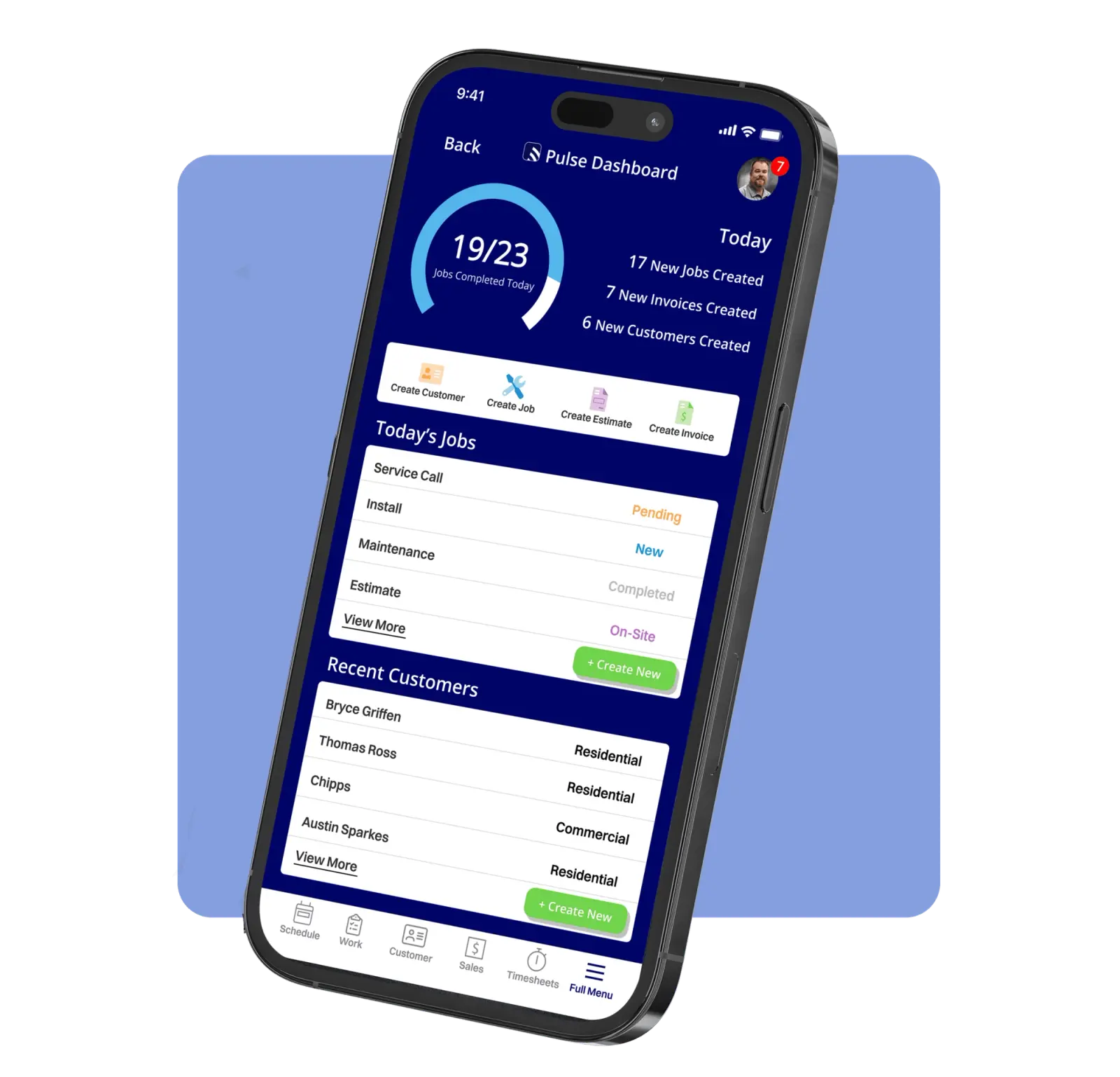
ClearPath, included in the core platform, is the spine that connects field execution to office visibility. Your team defines the job stages and the required actions inside each stage, such as a photo, a checklist item, or a signature, before the job moves forward. ClearPath’s Mobile Focus View shows a tech only what the current step requires, so there is less to remember and less to miss. New hires ramp faster because the process lives in the workflow instead of in someone’s head.
For the tech, the job is simple. They follow the stage, complete the required actions, and the record updates in real time, so the office already knows where the job stands.
See how ClearPath keeps the office in sync
Stage 4: Invoicing and Payment — Where Earned Cash Sits Uncollected
The invoicing stage is the handoff from completed work to money in the account. It is the last stage of the lifecycle and, for many residential service teams, the most consistently broken one.
The breakdown is structural. Job completion does not automatically become an invoice. The office waits, then chases. Cash that has already been earned sits uncollected. When invoicing is rebuilt by hand at the end of a week or month, the lag becomes permanent. The longer the invoice takes to go out, the longer the cash takes to come in.
RDI, a 50-year-old family business, was running on pen, paper, and Excel when Scott Bertram and his wife came into it. Their time-to-invoice was three weeks. After connecting their job records through FieldPulse, it dropped to five days. The improvement came from the workflow, not the billing, and it showed up in cash flow.
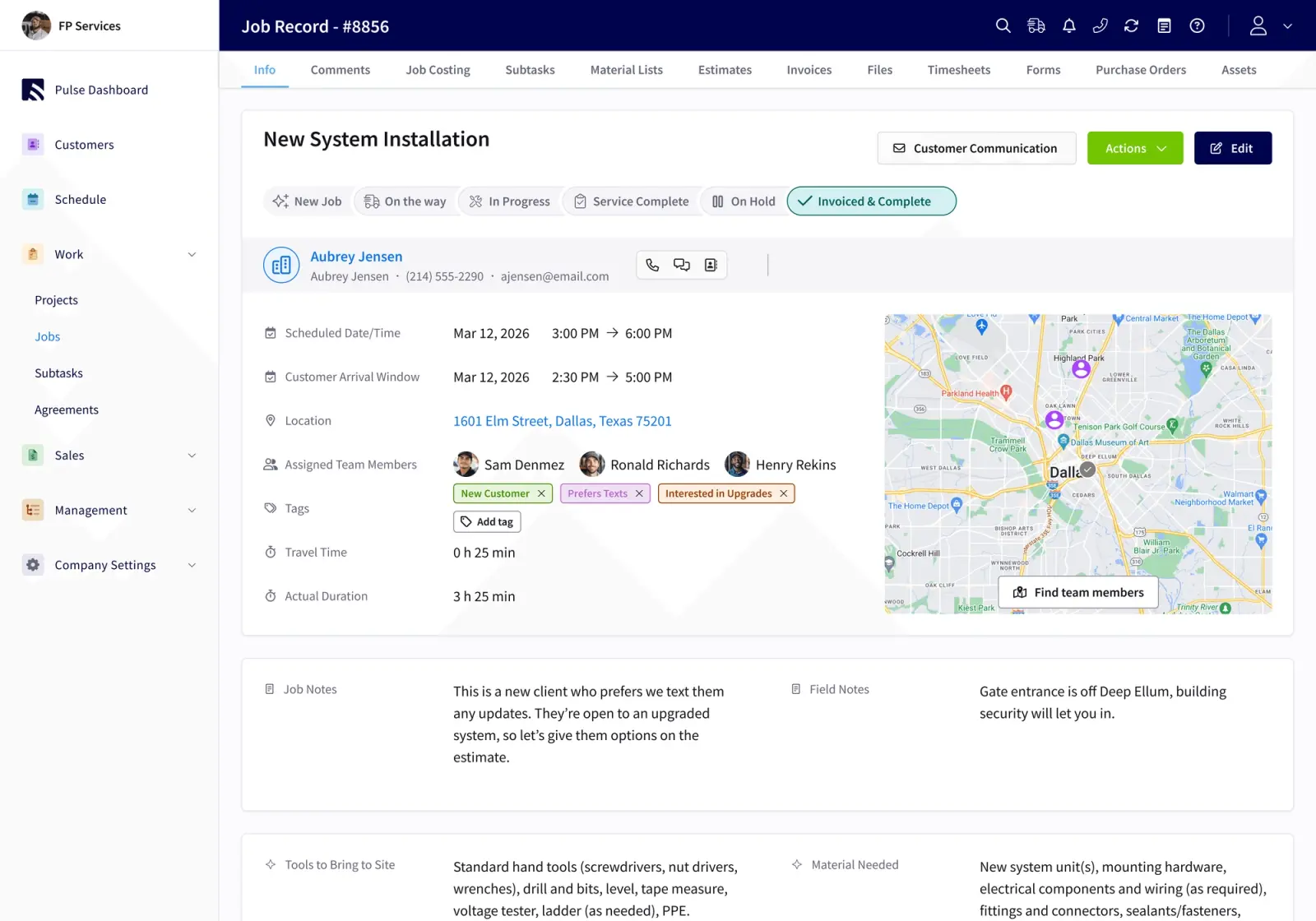
A connected record changes the invoicing stage by removing the re-entry step entirely. The job record carries parts, labor, notes, photos, and signatures from the field to the office as the work happens. It converts to an invoice without anyone rebuilding it. Techs can invoice and collect card or ACH payment on site, and “Pay Now” links go out by text or email for customers who prefer to pay later. Next-Day Funding puts card and validated ACH money in the account the next business day. Card Fee Recovery is a dual pricing program, not a surcharge. It shows a lower cash/ACH price and a higher card price upfront, so the customer chooses and your processing cost drops. It is legal in all 50 states.
The office administrator’s role at this stage is review and exception handling, not reconstruction. When the job record is complete, the invoice is already most of the way there.
What To Look For — Matching Software to Your Residential Service Team
You have now seen all four stages and where each one breaks. The next step is deciding whether your current tool can hold those stages together. The category splits in a way that leaves many established residential service teams without a clean fit. At one end sit enterprise platforms built for large operations, priced and implemented accordingly. At the other sit simpler tools that work well until a business needs inventory, permissions, multi-stage workflows, or real job costing. The middle is where most growing residential teams live, and it is where the evaluation gets specific.
When evaluating whether your current setup still fits, run through these five questions:
- Team size. A tool that works at five techs does not automatically work at fifteen. As your team grows, manual information tracking and missed handoffs multiply faster than revenue.
- Number of job types. If you run installs, maintenance visits, and emergency repairs under the same roof, each job type may need its own workflow. A single-status system stops working when the stages differ by job type.
- Whether your office and field work from the same record. If your office is rebuilding job details that your techs already captured, you are paying the double-job tax described earlier. A shared record removes that second round of work.
- Whether inventory, permissions, and job economics have become real requirements. These usually arrive together when a business adds crews. If you cannot tell which jobs made money, or if everyone has access to everything, the tool has likely been outgrown.
- How your accounting is handled. A one-way push to QuickBooks means corrections made in the books get overwritten. A two-way sync keeps the books and the field service software in agreement without manual reconciliation.
FieldPulse is built for established, team-based residential service businesses. If your office and field need to stay in sync across multiple job types, the fit question is worth a direct conversation.
Job Management Software vs. Field Service Management Software
Before you evaluate tools, it helps to clear up a naming confusion. FSM software and job management software are often used interchangeably, and the distinction matters less than the practical question underneath it.
Job management software describes the work-order side of the lifecycle, such as creating jobs, scheduling them, dispatching techs, capturing field updates, and turning completed work into invoices. Field service management software covers the whole operation around it: scheduling and dispatch, customer and equipment records, pricing, job costing, payments, and reporting.
The terms overlap considerably, and most platforms that call themselves job management software cover the full lifecycle in practice. The practical question stays simple. Does the tool carry a job from first quote to final payment in one connected record? If it does, the label matters less than the workflow it supports.
Frequently Asked Questions
What Is Job Lifecycle Management Software?
Job lifecycle management software is a platform that carries a service job from the first customer request through quoting, scheduling, field execution, and final payment in one connected record. The goal is to make sure information captured at each stage, such as parts, labor, notes, photos, and signatures, travels with the job rather than being rebuilt at the next step. For residential service teams, this means your office and your field work from the same current record instead of chasing each other for details.
What Are the Stages of a Job Lifecycle?
Most residential service jobs move through four stages: quoting and estimates, scheduling and dispatch, field execution and tracking, and invoicing and payment. Each stage is a handoff. The job moves from the customer’s request to a priced quote, from a sold job to a scheduled visit, from the schedule to the tech on site, and from completed work to money in the account. The handoffs are where information gets lost, re-entered, or chased, and where connected software makes the most difference.
Where Do Jobs Typically Break Between the Field and the Office?
The most common breaks happen at two handoffs. The first is between field execution and invoicing. The tech finishes the job, but the parts, labor, and job details stay with them rather than flowing automatically to the office. The office waits, then chases, and the invoice goes out late or not at all. The second is between scheduling and field execution. A schedule change happens in the office but does not reach the tech or the customer in time, and someone ends up waiting. Both breaks share the same root cause, information moving through people rather than through a shared record.
How Does Job Lifecycle Management Differ from Project Management?
Project management software is built around multi-phase work with defined milestones, budgets, and timelines, the kind of work that unfolds over weeks or months. Job lifecycle management is built around service work that completes in a single visit or a short sequence of visits, where the priority is moving a job quickly from request to invoice without losing information at each handoff. For residential service teams running HVAC, plumbing, or garage door work, the job lifecycle model fits the actual shape of the work. Project management tools are better suited to construction or installation work with longer timelines and more complex billing structures.
How Do I Know If My Business Has Outgrown Its Current Tool?
A few patterns show up consistently. Your office is rebuilding job details that your techs already captured in the field. Invoices go out days after jobs are completed, or some never go out at all. Two techs quote the same job differently, and you find out about the profit margin difference after the fact. Schedule changes require a round of phone calls to update everyone. You cannot tell which job types or customers are actually profitable without an afternoon of reconstruction. Any one of these is a signal. All of them together mean the tool has stopped fitting the business, and the gap is costing money.
Conclusion: One Connected Record From First Quote To Final Payment
The job lifecycle is a workflow problem. Every stage is a handoff, and every handoff is a place where information gets lost, re-entered, or chased. The quote that took an afternoon. The schedule change that never reached the customer. The job that finished on Tuesday and got invoiced the following week. These are structural problems that grow with the business, not effort problems.
FieldPulse connects your office and your field around one current record so those handoffs stop costing money. It is built for the same 7-to-50 technician teams described earlier, including HVAC, plumbing, garage door, and the trades that run alongside them.
The spine is ClearPath, included in the core platform. It turns your process into your team’s workflow: your job stages, your required actions at each stage, and a mobile view that shows a tech only what the current step needs. Around it sits the full lifecycle, including scheduling and dispatch, job costing, estimates and invoices, payments, and reporting, plus a two-way QuickBooks Online sync so your office and your books stay in agreement.
Teams that make this switch see the difference in the numbers. They spend less time rebuilding job details, send fewer late invoices, and complete more jobs on schedule.
If your current setup is leaking revenue between the field and the office, the place to start is seeing exactly where it breaks and what a connected record would change.