








Key Takeaways
-
Many appliance repair jobs that look profitable on the invoice lose money once you factor in drive time, callbacks, parts cost, and labor.
-
Job profitability depends on six cost layers: revenue collected, technician labor including drive time, parts at cost, vehicle expenses, return visits, and payment processing fees.
-
First-visit completion rates above 85% protect profit, while unlinked return visits quietly erase profit.
-
Effective profitability software needs diagnosis-to-invoice continuity, flat-rate pricebooks, parts cost tracking, two-way accounting sync, and per-job profit-and-loss visibility.
-
See what your jobs are actually earning and book a walkthrough with our team.
What Is Appliance Repair Job Profitability?
Appliance repair job profitability is what is left from a single service call after you subtract every cost tied to that visit. That includes technician labor, parts cost, drive time, the diagnostic fee, and any callback or warranty return. The invoice total is revenue, not profit.
Most appliance repair businesses can see total revenue but not the numbers that determine whether a job actually made money. To understand where your business stands, you need visibility into these metrics for every job:
-
Profit per service call
-
Gross profit margin percentage by job
-
Profit by technician
-
Profit by appliance type or brand
-
First-visit versus return-visit profitability
-
Parts cost and markup per job
-
Diagnostic fee revenue tracked separately
-
Callback and warranty cost attached to the original job
Very few teams can see all of these without an afternoon of reconstruction across multiple systems.
How Do You Calculate Profit On An Appliance Repair Job?
True job profit comes from working through six cost layers in order.
-
Start with revenue actually collected. Add the diagnostic fee and the repair price, including any parts markup billed to the customer. The diagnostic fee is earned the moment the visit happens, even if the customer declines the repair, so it belongs in job revenue either way.
-
Subtract technician labor for the full time on the job. Do not stop at wrench time. Drive time, diagnosis, waiting for the customer, and any return visits all count. Non-billable time like driving and ordering parts should be excluded from billable capacity calculations, but it is still a cost that belongs in job costing.
-
Subtract parts cost at what your business paid. Ignore what you charged. An installed part should post at its purchase price as cost against the billed part price as revenue. The gap between the two is your true parts profit margin.
-
Subtract drive time and vehicle cost. A base service fee formula should include average travel time multiplied by labor rate plus overhead per job, so travel is covered even when a customer declines the repair. Without that per-job capture, travel cost disappears into overhead and distorts every profit margin calculation you run.
-
Subtract the cost of any return visit, callback, or warranty repair on the same job. This is the step most tools skip. Every callback is a job done twice for one payment. The second trip earns no additional revenue while consuming labor, fuel, and a schedule slot another paying job could have filled.
-
Subtract payment processing and administrative cost attributable to the job. Include processing fees, any time spent chasing payment, and the overhead share allocated to that job. These costs are small on a single call, but they compound across every job and are easy to overlook when you focus only on labor and parts.
The central point is simple. In appliance repair, the second trip kills profit, and most tools never attach it to the original job. A job becomes profitable only after you price in callback risk. On the thin net profit margins many trades operate on, a steady stream of unpaid return visits can wipe profit out entirely.
First-Visit Vs. Return-Visit Profitability
First-visit and return-visit performance often decide whether your appliance repair business makes money. Most scheduling-and-invoicing tools cannot show this clearly.
A first visit carrying a diagnostic fee can look healthy. For example, you collected $95 to $130 for showing up and diagnosing the problem. Top-performing appliance repair businesses maintain first-time fix rates above 85%, meaning they complete the repair on the first visit. The return visit that completes the repair for the same customer and appliance often erases the profit on the original call. You drove out twice, paid your tech for both trips, and collected once.
For your business to see this clearly, three things have to be true:
-
Labor hours tie to the specific job, not to a weekly total
-
Parts attach to the job record at cost, not just at the billed price
-
The return visit links back to the original job, not as a separate ticket
A spreadsheet or an invoicing-only tool records two separate transactions and never shows the combined economics. You see a $130 diagnostic invoice and a $220 repair invoice, but you do not see that the two trips together cost $195 to deliver. The combined profit is $155, not the $220 the repair ticket suggested.
If your first-time fix rate is 80%, one in five jobs requires a second visit. On a team completing 1,000 jobs per year, that is 200 additional visits not priced into the original job. That cost has to live somewhere in your numbers. If it is not attached to the original job record, it hides in your overhead and makes every job look more profitable than it is.
How The 50 Rule Fits Appliance Repair Profitability
Profitability is not the only question a repair decision raises. Customers also weigh whether the repair is worth approving at all, and that is where the 50 rule comes in. The 50 rule states that if a repair costs more than half the price of a comparable new appliance and the unit is past 50% of its expected lifespan, the unit should be replaced. It is a customer-facing guideline that helps you advise homeowners.
The 50 rule tells you whether the customer will likely say yes. Whether the job makes money for you is a separate question, and only job costing answers that.
A $300 repair that clears the 50 rule threshold and gets approved can still lose money if the tech drove 45 minutes each way, ordered the wrong part first, and came back twice. The 50 rule works as a sales tool. Job costing works as a management tool. You need both because they answer different questions.
What To Look For In Appliance Repair Profitability Software
When you evaluate any platform, measure it against the profit calculation above. A tool that only handles scheduling and invoicing cannot answer the profitability question, no matter how polished it looks. The software needs to support these specific capabilities.
Diagnosis-To-Invoice Continuity
The diagnostic finding, the parts used, and the labor need to travel from the field to the invoice without re-entry. If your tech diagnoses a faulty control board in the field and that information has to be retyped at the office, the job record is incomplete before the profit math even starts. A part is an asset until a technician installs it. The software should capture that change automatically through the workflow, not through a manual re-entry step.
Flat-Rate Pricebooks
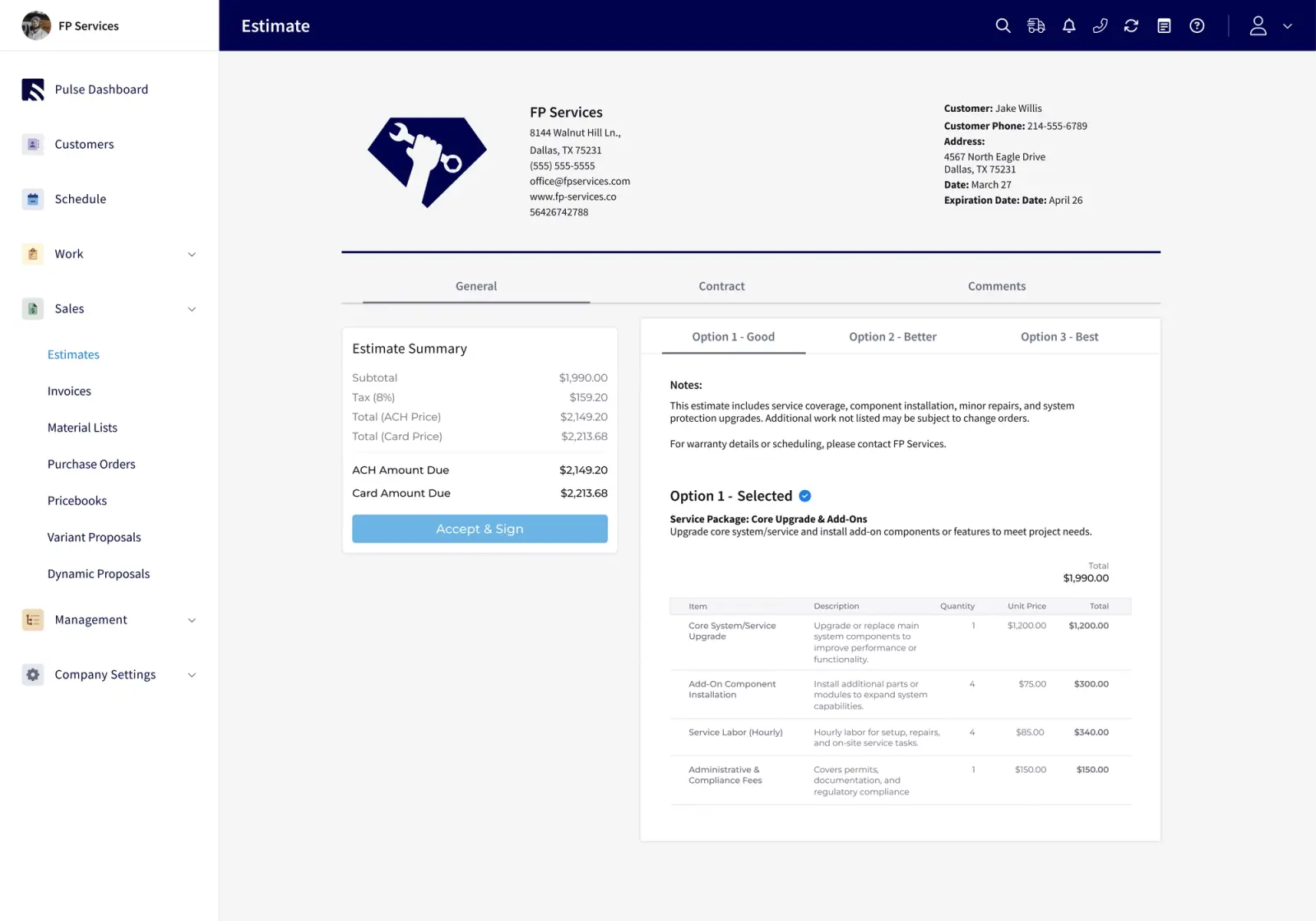
Without a repair price book, two appliance repair technicians can quote the same job at $180 and $260. A flat-rate pricebook holds standard pricing for common repairs across every technician, so your profit margin is consistent before the job even starts.
Parts And Inventory Expense Tracking
Parts cost needs to attach to the job at what you paid, with markup visible, so parts do not quietly eat your profit margin. Appliance repair shops should track parts profit margin by part category, because a $9 door switch billed at $28 and a $180 control board billed at $215 tell very different pricing stories.
Two-Way Accounting Sync
A one-way push into QuickBooks is not enough. When your bookkeeper corrects something in the books, that fix needs to carry back into your field service software, not get overwritten the next time data pushes through. Two-way sync is what ends double entry. One-way sync only moves the problem downstream.
Job-Level Profit And Loss
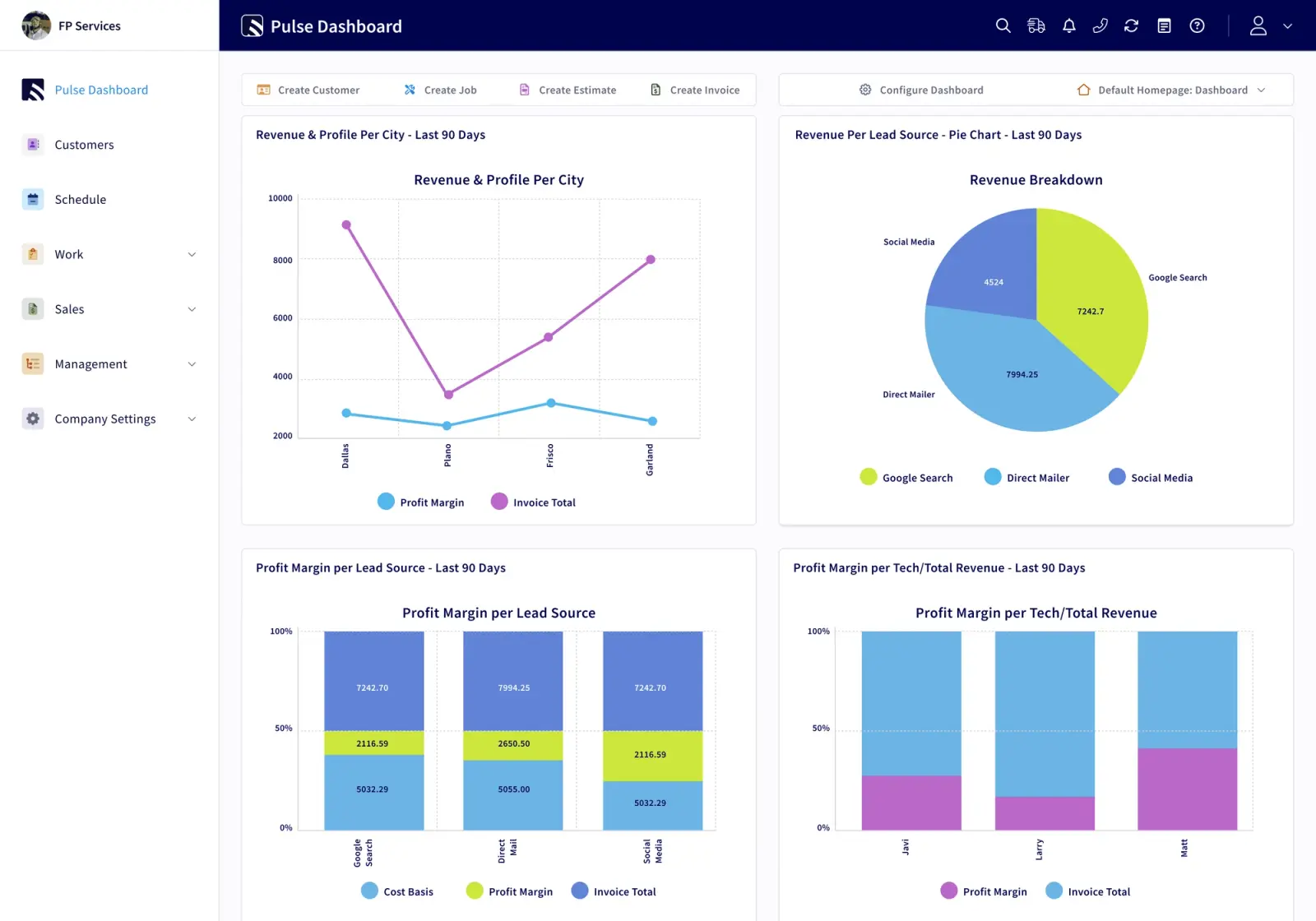
You need per-job profit and loss with line-item cost, price, and profit breakdowns, and labor hours tied to the specific job. A useful job record requires five numbers: revenue earned by the job, actual labor hours tracked against the job, internal labor cost per hour, direct materials and travel expenses, and a consistent share of business overhead. If your software cannot show you all five on one screen, it cannot answer the profitability question.
How To Evaluate A Platform Against Your Own Numbers
Whichever platform you evaluate, the best test is your own data. Before you sit through any vendor demo, run this exercise with one real job from last month and cost it out completely.
Use parts at what you paid. Include labor for every hour your tech touched that job, including drive time. Add the diagnostic fee, any return visit, and the gap between the job completion date and the invoice date.
Most owners cannot do this without an afternoon of reconstruction. That gap is your answer. If you cannot cost one job without digging through three systems and calling your tech to reconstruct what happened, your current tool is not showing you your business.
When you evaluate any platform, ask these specific questions:
-
Can I see profit per service call, per technician, and per appliance type?
-
Does a return visit attach to the original job record, or does it open as a separate ticket?
-
Do labor hours tie to the specific job or to a weekly total?
-
When my bookkeeper corrects something in QuickBooks Online, how does that fix get back into the field service software?
-
Can I see parts cost at what I paid versus what I charged on the same job record?
These are tests you run, not claims a vendor makes. Any platform worth your time should walk you through all five in a demo using your own job type as the example.
Where FieldPulse Fits
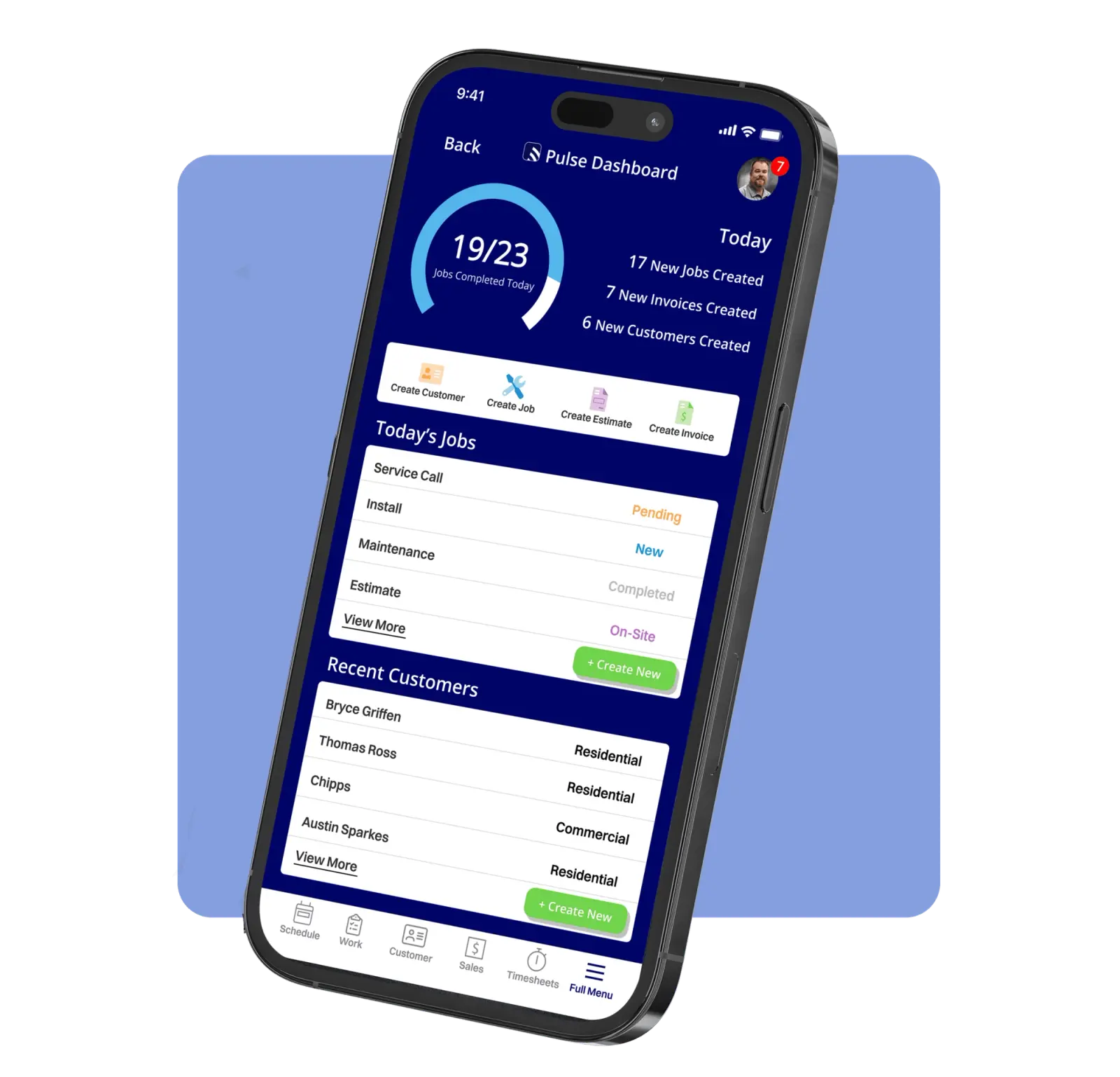
FieldPulse is built for the appliance repair team in the 7-to-50-technician range that has outgrown a simpler tool and needs real job economics. The platform tackles the profitability problem in the same order as the math: it captures job data correctly, then turns that data into per-job profit and loss.
Job costing in FieldPulse estimates your expected profit margin upfront before you dispatch the job, then confirms actual profit after completion with per-job profit and loss and line-item cost, price, and profit breakdowns. You know a job’s expected profit margin before the tech leaves the shop, and you see what actually happened once it closes.
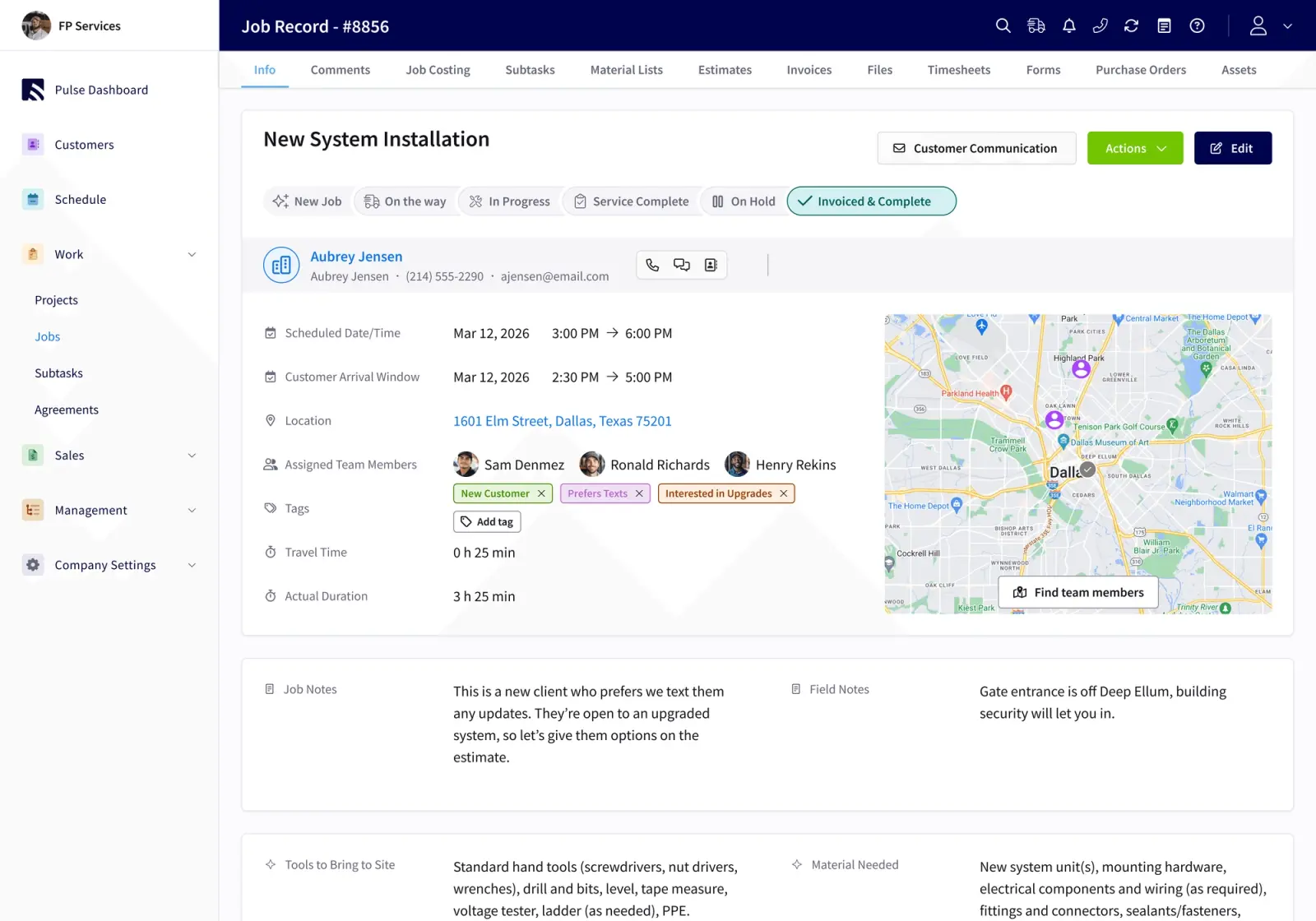
ClearPath’s Mobile Focus View, included in the core platform, ties labor hours to specific jobs. Your techs clock in against the job itself, so labor attaches to the work instead of to a weekly total. That connection is the foundation for job-level profitability. Without it, you allocate labor by guesswork. ClearPath’s Mobile Focus View also turns your process into job stages with required actions at each stage, so nothing gets skipped and the office can see job progress without calling the field.
Pricebook (an add-on) holds standard pricing for services, materials, and labor so estimates stop varying by person. Two techs quoting the same washer repair give the same number, which keeps pricing and profit margin consistent.
Two-way QuickBooks Online sync keeps your accounting and operations aligned. Customers, line items, estimates, invoices, payments, purchase orders, and vendors sync in both directions. A correction made in the books carries back into FieldPulse instead of being overwritten. Tax rates come from QuickBooks Online, and invoice numbering can follow your existing sequence.
Reporting with 60+ prebuilt reports plus custom options gives you profitability by job, job type, appliance type, or customer. You can see which repairs are actually making money and which are eating it.
RDI, a 50-year-old family business, ran on pen, paper, and Excel before implementing FieldPulse. After rollout, job-level profitability was visible for the first time in the company’s history. As Scott Bertram put it: “I wasn’t really thinking about it until we went into the data. Wow, we have really great margins on these sorts of jobs. Let’s push it more into that.” That result belongs to RDI’s specific situation, but it shows what job-level visibility can unlock when it has never existed before.
FieldPulse supports commercial work but is built primarily for residential teams. One-person operations often have simpler alternatives that fit better.
Is An Appliance Repair Business Profitable?
Appliance repair can be a profitable business when you control the cost of each call, not just the revenue per job. That means tracking labor, parts, drive time, and the return visits that erase profit. Healthy appliance repair businesses sustain gross profit margins of 45–60% and net profit margins of 15–25%, but shops with weak pricing and no job visibility often fail to clear 10%.
Three things separate profitable appliance repair operations from unprofitable ones: pricing consistency across every technician, a high first-visit completion rate, and job-level cost visibility that shows which repairs, appliance types, and techs are actually making money. Without all three, revenue can look strong while the bank account tells a different story.
Frequently Asked Questions
If you are still weighing options, these are the questions appliance repair owners ask most often.
What Software Tracks Profit Per Appliance Repair Job?
You need software with job costing and job-level profit and loss. The key requirement is that return visits link back to the original job rather than opening as separate tickets, or the combined economics of a two-trip job never appear. FieldPulse’s job costing capability is built to do exactly this, with per-job profit and loss and line-item cost, price, and profit breakdowns.
How Much Should An Appliance Repair Technician Charge Per Hour?
The right rate comes from your fully loaded labor cost, drive time, overhead per billable hour, and your target profit margin. Start with your tech’s total employment cost including payroll taxes, workers’ comp, and benefits. Divide by the hours actually billed, not hours worked, because non-billable time like driving and admin reduces your effective billable capacity. Add your overhead allocation per billable hour and your target profit margin. That calculation produces a floor rate specific to your business. National published ranges for appliance repair labor run from roughly $75 to $175 per hour depending on market and specialization, but those figures describe what others charge. Your rate needs to reflect what it actually costs you to deliver the work.
What Is The Difference Between Job Costing And Invoicing?
Invoicing records what the customer was charged. Job costing records what the job cost to deliver, including labor at what you paid your tech, parts at what you paid your supplier, drive time, return visits, and an allocated share of overhead. You can then compare the two on the same record. An invoice tells you what came in. Job costing tells you what went out and whether the difference is actually profit. A business running on invoicing alone knows its revenue but not its profit margin per job, per technician, or per appliance type, because the cost side was never captured at the job level.
How Long Does It Take To Get Job-Level Profitability Reporting Running?
The timeline depends on how quickly you can tie labor hours to specific jobs and attach parts and return visits to the job record. The data has to exist before the reports can show it. For FieldPulse, onboarding typically runs two to six weeks depending on team size, which capabilities you enable, how much data needs to migrate, and how your accounting setup is handled.
The sequence usually follows four steps:
-
Scope the work and define goals for profitability reporting.
-
Configure job stages and workflows for your office and techs.
-
Connect QuickBooks Online and align your accounting structure.
-
Train each role through working sessions using real jobs.
The profitability reporting becomes meaningful once techs are clocking in against jobs and parts attach to job records, which is why workflow setup comes before reporting.
Conclusion And Next Steps
You now have the full profit calculation and the five software criteria that follow from it. The gap between those two is where many appliance repair businesses lose money without realizing it.
Here are three concrete next steps:
-
Cost one real job from last month, including parts, labor, drive time, the diagnostic fee, any return visit, and the date the invoice went out.
-
Check whether your current tool attaches return visits to the original job record or opens them as separate tickets.
-
Take those findings into any platform demo you schedule and ask the vendor to show you how their software handles both.
If your team has outgrown a simpler tool, you are probably not short on revenue. You are short on visibility into which jobs, techs, and appliance types are actually generating profit margin. That visibility is a workflow problem before it is a reporting problem. The right FSM software solves the workflow first, and the reporting follows.
Talk to our team about your workflow, or call sales at +1 (817) 635-2218.