







Key Takeaways for Technician Mobile Apps
- A mobile app for service technicians must work offline, track jobs and time, capture photos and signatures, and show job history on arrival.
- Most technician apps fail because office teams choose them from feature lists instead of testing them in real field conditions like signal loss and customer oversight.
- ClearPath’s Mobile Focus View shows technicians only what they need at each job stage, which improves adoption and keeps new hires and veterans from feeling overwhelmed.
- FieldPulse caches recent jobs, notes, photos, and status updates so technicians can keep working when signal drops and sync automatically when reconnected.
- FieldPulse is built for service teams in the 7-to-50-technician range and delivers measurable efficiency gains through offline capability, guided workflows, and two-way QuickBooks Online sync.
See how FieldPulse supports your field team
Where Technician Apps Break Down in the Field
Picture a tech who finishes a repair in a mechanical room, taps “Complete,” and watches the app hang on a loading spinner while the homeowner waits. Or a new hire who arrives at a repeat customer’s house with no equipment history, no gate code, and no notes from the last visit. Or your office chasing the last ticket of the day because the job record never made it back.
These failures follow a pattern. Most app selection happens on office feature lists that never get tested against real field conditions. The breakdowns are predictable:
- Signal drops mid-job and the app stalls while the customer watches
- A draft disappears because it was never saved locally
- The tech arrives without the gate code, the equipment history, or the photos from last time
- The office chases the tech for parts and labor because the job record never synced
- The invoice goes out days late or not at all because the close-out happened twice
Fragmentation is the real problem. A fully digital business that still relies on manual handoffs breaks operationally in the same way a paper one does. An undefined workflow will not improve just because you add an app.
What a Service Tech Actually Does in the App, From Arrival to Close-Out
A clear sequence keeps your techs moving and your office informed. Here is the workflow, step by step.
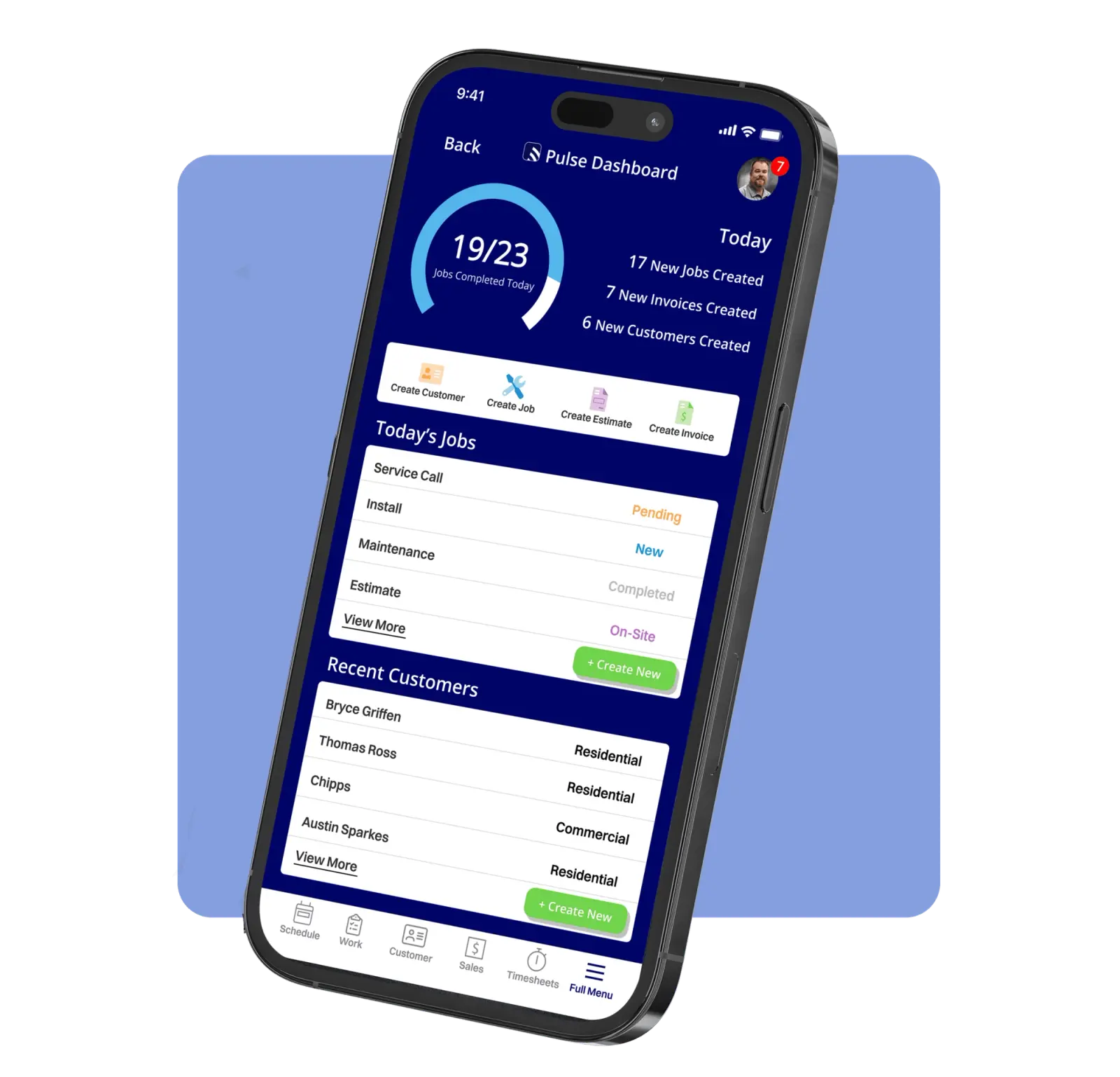
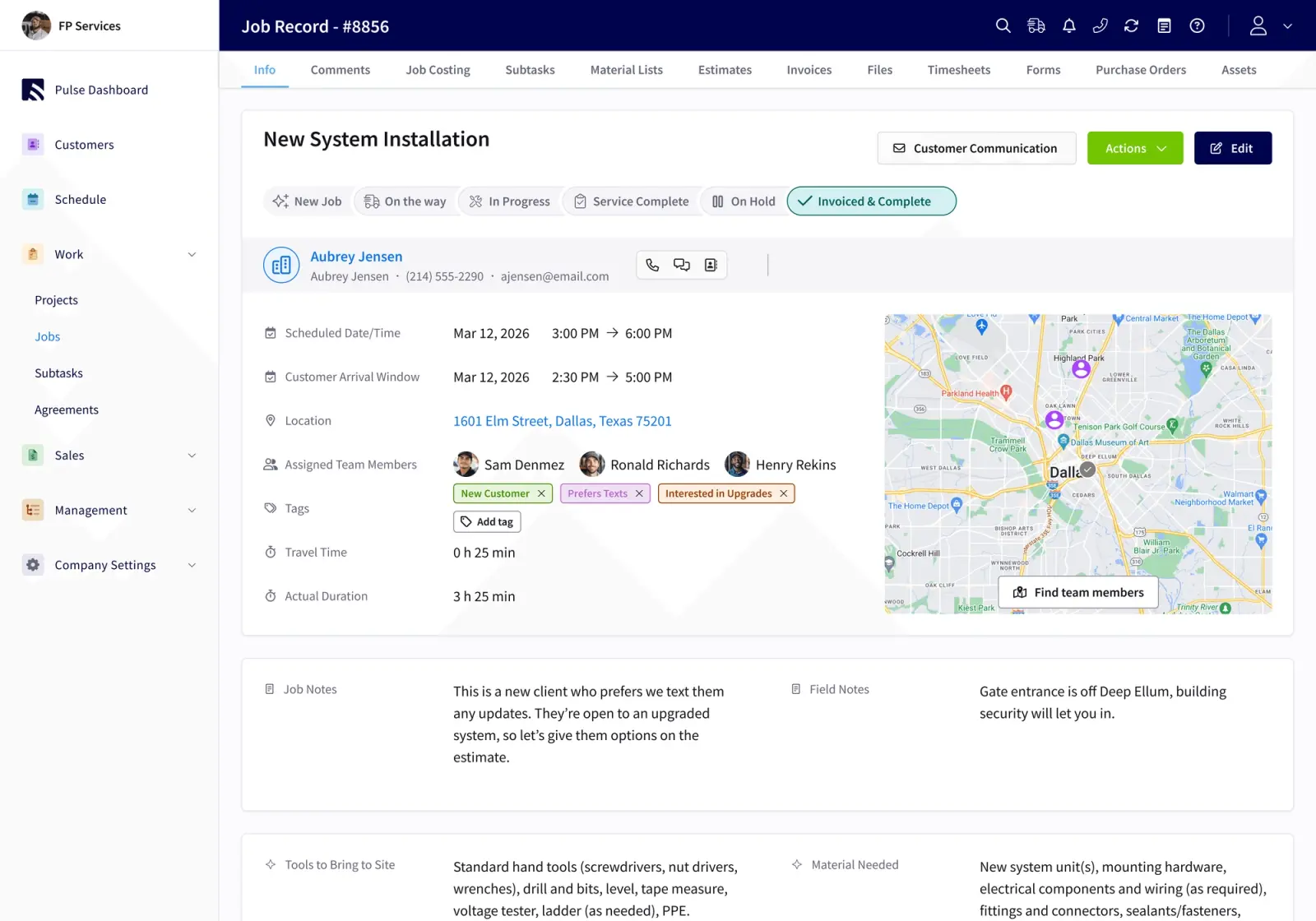
- Check-in on arrival. The tech opens the job and taps to check in. The office sees the status change immediately. The customer’s record holds service history, equipment and asset records, warranty documents, photos, and prior job notes, so a repeat visit starts with context already in hand.
- Diagnosis notes. The tech records findings, captures photos, and updates the job status. ClearPath’s Mobile Focus View shows only what the current stage requires, such as checklists, required actions, and single-tap Action Buttons. The tech does not have to dig through the full application mid-job.
- Parts and materials. The tech records parts used. If a part is not on the truck, the job record reflects it. Purchase order creation still requires a connection.
- Photos. The tech adds photos from the device. Photos attach to the job record and sync when signal returns.
- Customer signature. The tech captures a signature on site. It attaches to the job record and syncs automatically.
- Estimate or invoice. The tech builds an estimate from preset pricing, presents it, converts it to an invoice, and collects payment before leaving the driveway. Payment collection requires a connection, except for cash marked later.
- Close-out. The tech completes the job and the office sees the status change. Timesheets flow into QuickBooks Online when the tech clocks out.
Offline Behavior in Specific Terms: What Actually Works When Signal Drops
Offline access in a technician app means the app caches job data on the device so the tech can keep working when signal drops. The app then syncs when the device reconnects. This is the biggest gap in how most apps are described and the most important thing to verify before you hand a phone to your team.
Here is what FieldPulse caches on the device, which is enough for a tech to complete most of a job without signal:
- The past week of jobs, projects, customers, estimates, and invoices
- Unlimited job notes
- Photos captured during the visit
- Status updates
- Clock in and out
- Cached estimates and invoices with detailed line items
If signal drops mid-edit, the active draft transitions to an offline draft automatically. Everything entered offline saves locally and syncs the second the device is back in signal. Roughly 20% of service calls take place in areas with poor or nonexistent cellular coverage. That includes basements, mechanical rooms, rural routes, and buildings with thick concrete walls. An app that assumes a signal fails in exactly those moments.
Some actions still require a connection. Here is what does not work offline:
- Payment collection (except cash marked later)
- Purchase order creation
- Creating new customer or job records
Those limits are clear and honest. Any vendor who claims everything works offline without qualification is describing a demo environment, not a crawlspace.
See how FieldPulse handles offline work
What Your Tech Sees vs. What the Office Sees
Showing a tech the whole application is a common reason adoption fails. A 15-year veteran who opens a new app and sees a wall of buttons will find a manual workaround by the end of the first week.
ClearPath’s Mobile Focus View solves this. It is included in the core platform. Your office defines job stages and the required actions inside each stage. The mobile view then shows a tech only what the current stage needs, such as checklists, required actions, and single-tap Action Buttons. Edit rights stay controlled instead of open to the whole team.
The office sees job progress pushed automatically instead of by phone call. Customer notifications fire at the right stage without anyone remembering to send them. A tech marking themselves en route can trigger an “On the Way” text to the customer without any extra steps.
That simplicity shows up in adoption speed. RDI’s field crew had used paper time cards for thirty years. The team expected six months to get adoption and was running payroll off the app in two weeks. Then something unexpected happened: “The guys call into the office and say, ‘hey, I noticed in FieldPulse this wasn’t quite right, like, update it.’ They hold a certain level of accountability and they love it to be right from that perspective.”
The Scheduling and Dispatch Question From Your Tech’s Side
From a field perspective, the scheduling question is simple. Your tech wants to know where they are going, what the history is, and what the gate code is.
The mobile scheduling view shows the job, address, contact, and notes in one place. As described earlier, the customer’s record carries service history and prior job notes, so a repeat visit arrives with context in hand. Your techs can look at tomorrow the night before and arrive already knowing what they are walking into.
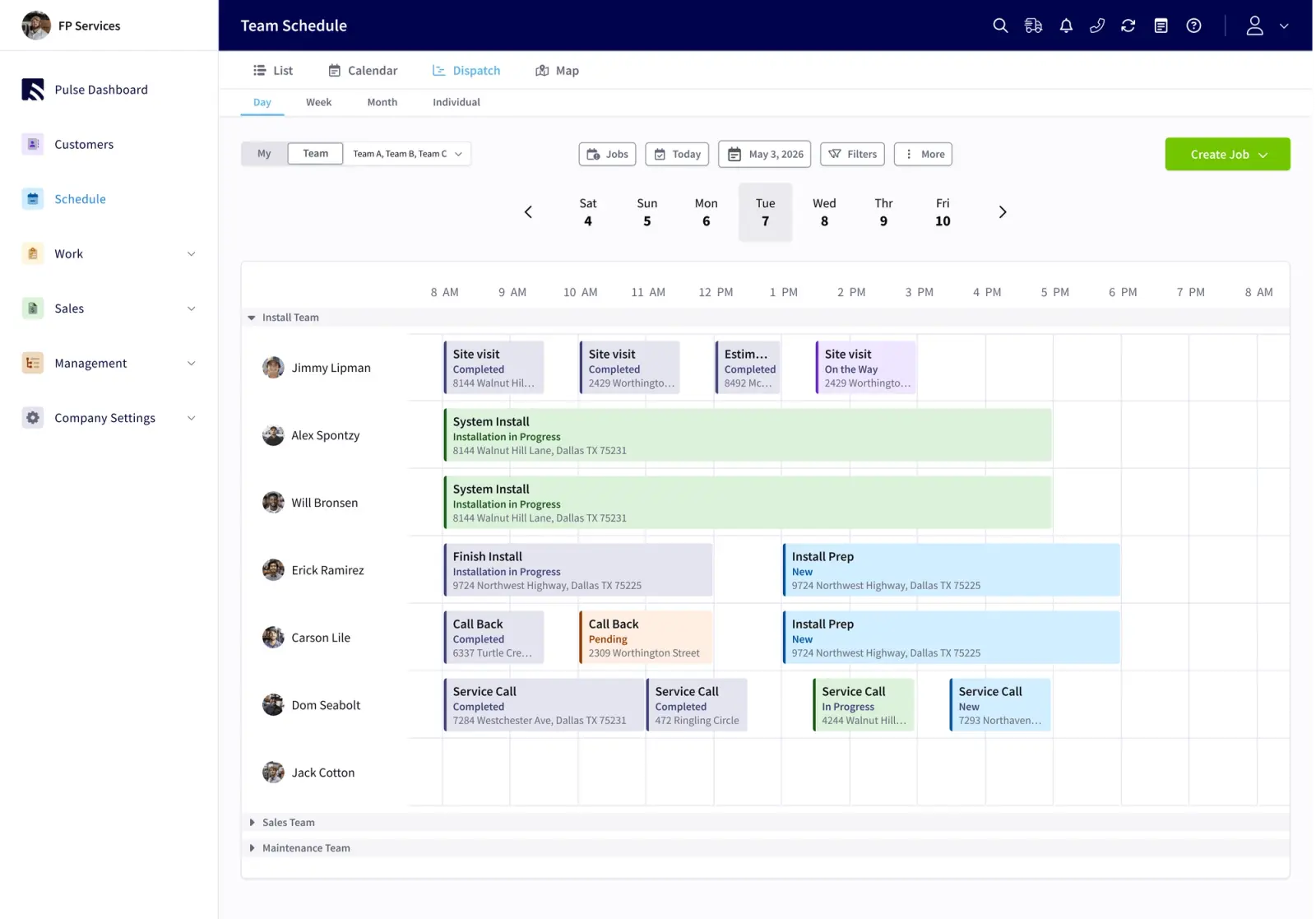
When emergency requests come in and the schedule shifts, the tech’s view updates without a phone call from the office. The dispatcher handles the rearrangement on the scheduling board, and the tech sees the change on their phone. That kind of coordination only works when the underlying workflow is defined and consistent.
How to Tell If You Need a Mobile App or a Better Workflow
Many teams blame the app when the real problem is the workflow behind it. A fully digital business running on manual handoffs still depends on people to move information, and that does not scale.
The key question is whether the workflow is defined clearly enough that the app can carry it. If your techs do not know what is expected at each stage of a job type, no mobile app changes that. You change it by defining the stages, the required actions, and the sequence. Then you let the app enforce that structure.
That is what ClearPath does. It turns your process into a guided workflow your whole team follows.
What Changes When Your Team Is Bigger Than a One-Man Shop
Solo operators have simpler needs and often have better alternatives on the market. FieldPulse is built for teams in the 7-to-50-technician range, where you care about consistency across technicians, roles and permissions, and a mobile view that does not overwhelm a new hire in their first week.
At five technicians, the owner is close enough to every job that memory covers the gaps. At fifteen, memory stops covering them. What breaks is the way information moves. Growth outpaces process development, so manual information tracking multiplies and missed handoffs become the norm rather than the exception.
One-person operations can often run on lighter tools. If you are running a team and handing a phone to a skeptical veteran tech next Monday, you need something built for that reality.
A Short, Honest Decision Framework for Evaluating Any Technician App
When you are in a demo, use these three questions to keep the conversation grounded in real work.
- What happens when signal drops? Ask specifically what is cached, what happens to a draft mid-edit, and how sync works on reconnect. Vague answers suggest no one tested the app in a basement.
- What does the tech see at each stage? Ask to see the mobile view for a specific job type. If it looks like the full application, adoption will be a problem.
- How does a correction in QuickBooks get back into the field app? This question separates one-way integrations from a real two-way sync.
On that last point, FieldPulse’s two-way QuickBooks Online sync covers customers, line items, estimates, invoices, payments, purchase orders with full line-item detail, and vendors in both directions. Timesheets flow into QuickBooks Online when a tech clocks out. It works with QuickBooks Online Essentials, Plus, and Advanced in the US, Canada, and Australia. When your admin corrects something in QuickBooks, the fix carries back into FieldPulse instead of being overwritten. That is how you actually end double entry.
On average, FieldPulse customers experience 25% gains in efficiency, office teams save 40+ hours per month, field teams see a 50% increase in on-time delivery, and businesses add 16+ customers every month.
Walk through a full job from check-in to close-out
Frequently Asked Questions
What Is the Best Mobile App for Service Technicians?
The best mobile app for service technicians is the one that survives contact with a real job, including bad signal, a customer watching, and a part that is not on the truck. The right answer depends on your team size and trade, but the criteria that matter most stay concrete and verifiable. You need to know what is cached when signal drops, what the tech sees at each job stage, and how corrections in your accounting system get back into the field app. FieldPulse is a strong fit for residential service teams in the 7-to-50-technician range, such as HVAC, plumbing, garage door, electrical, appliance repair, and locksmith, because its offline caching behavior, ClearPath’s Mobile Focus View, and two-way QuickBooks Online sync address the moments where technician apps most commonly break down.
What Happens When a Technician Loses Signal Mid-Job?
In FieldPulse, the active draft transitions to an offline draft automatically if signal drops mid-edit. The past week of jobs, projects, customers, estimates, and invoices rides along on the device. The tech can continue adding notes, capturing photos, updating statuses, and clocking in and out. Everything saved offline syncs the second the device is back in signal, with no manual upload and no re-entry. Payment collection (except cash marked later), purchase order creation, and creating new customer or job records still require a connection. Those limits are worth knowing before your tech crawls into a tight space with no signal.
How Do Technicians Check In, Track Time, and Close Out a Job From the Field?
The tech opens the job, taps to check in, and the office sees the status change. From there, the tech records diagnosis notes, captures photos, updates the job status, records parts used, captures a customer signature, builds an estimate or invoice from preset pricing, and closes out the job. Timesheets clock by job or shift and flow into QuickBooks Online when the tech clocks out. The office sees each status change as it happens, without a phone call. Customer notifications, such as an “On the Way” text, fire automatically at the right stage based on how your workflow is configured.
What Should I Look for When My Team Is Bigger Than a One-Man Shop?
Focus on roles and permissions, consistency across technicians, and a mobile view that shows a tech only what the current stage needs. When you are running a larger team, the problem is not whether the app has features. The real question is whether every tech uses it the same way, whether new hires can ramp up without months of shadowing, and whether the office can see job progress without calling the truck. FieldPulse is built for teams in the 7-to-50-technician range and is designed for that level of coordination.
Is the Real Problem the App or the Workflow Behind It?
Often the workflow creates the problem. A fully digital business running on manual handoffs still relies on people to move information, and that bottleneck does not scale. If your team does not have defined job stages, required actions at each stage, and a consistent sequence for each job type, no app fixes that. An app like FieldPulse can take the workflow you define and enforce it in the field through ClearPath’s job stages, required actions, and mobile view. The workflow has to exist first. If you are not sure whether your problem is the app or the process behind it, the fastest way to find out is to walk one real job through a demo and see where it breaks operationally.