








Key Takeaways For Electrical Contractor Software
- Electrical contractor software is business-operations software that handles scheduling, dispatch, estimating, invoicing, job costing, and accounting sync, not CAD or design tools.
- The three primary business models, residential service, commercial bidding, and mixed service-plus-project, determine which software features your team actually needs.
- Effective scheduling and dispatch with live technician locations and automatic status updates reduce manual handoffs and improve customer communication.
- Job costing that ties labor hours directly to specific jobs provides real-time visibility into per-job profitability, replacing guesswork with accurate data.
- FSM software like FieldPulse supports mixed service-plus-project workflows on a single platform and reduces fragmentation for 7-to-50-technician electrical contractors.
See how FieldPulse fits your business model
How To Use This Guide: A Decision Framework
This guide speaks to owners and operations leads in the Grow and Scale stages in the $500K to $10M revenue range who are already comparing business-operations platforms. The focus stays on how you actually run your business, not on a promotional overview.
The framework looks at six areas: workflow impact, office burden, field usability, financial visibility, implementation effort, and fit by business model and team size. Each section ties back to one or more of these areas.
Your most important decision is which of three business models you run. The right software choice flows directly from that answer.
The Three Business Models That Drive Your Software Choice
Most electrical contracting businesses fall into one of three models. Once you name yours, your software search gets much simpler.
Residential Service. Your revenue comes from service calls, repairs, panel upgrades, and repeat customers. Speed matters most. You need fast scheduling, a standard pricebook, and same-day invoicing. A tech should arrive, do the work, collect payment, and move to the next job without your office rebuilding the day by phone.
Commercial And Industrial Bidding. Your revenue comes from multi-visit projects, tenant improvements, and hard bids. You need takeoff integration, progress billing, and job-level cost tracking. Dedicated estimating tools in this category, platforms like Accubid, STACK, ConEst IntelliBid, and TurboBid, are built for counting devices and conduit runs off plan sets and applying labor units to produce commercial bids. These are estimating tools, not field service software.
Mixed Service-Plus-Project Work. This model is the hardest to support. A service call and a multi-visit project must live on the same dispatch board and the same customer record. Handoffs break when your office rebuilds the day by phone and the project’s progress billing lives in a separate spreadsheet. Many platforms handle one side cleanly and force the other into workarounds.
For teams in the 7-to-50-technician range, FieldPulse carries both job types on one workflow, with the same dispatch board, the same customer record, and the same accounting sync. That matters because growth problems are workflow problems first. The real enemy is fragmentation: a fully digital business running on manual handoffs fails the same way as one running on clipboards. FieldPulse is built for teams in the 7-to-50-technician range, so solo operators should look at other options.
See how FieldPulse fits your business model
Scheduling And Dispatch For Electrical Service Work
Scheduling breaks the moment an emergency request comes in if your team relies on manual updates. Your dispatcher has to find the right tech, move existing jobs, notify affected customers, and update everyone manually. One missed handoff in that chain becomes a customer waiting for a truck that is not coming.
The strain increases when a service call and a project share the same board. A tech assigned to a multi-day commercial job cannot absorb a residential emergency without someone rebuilding the entire day.

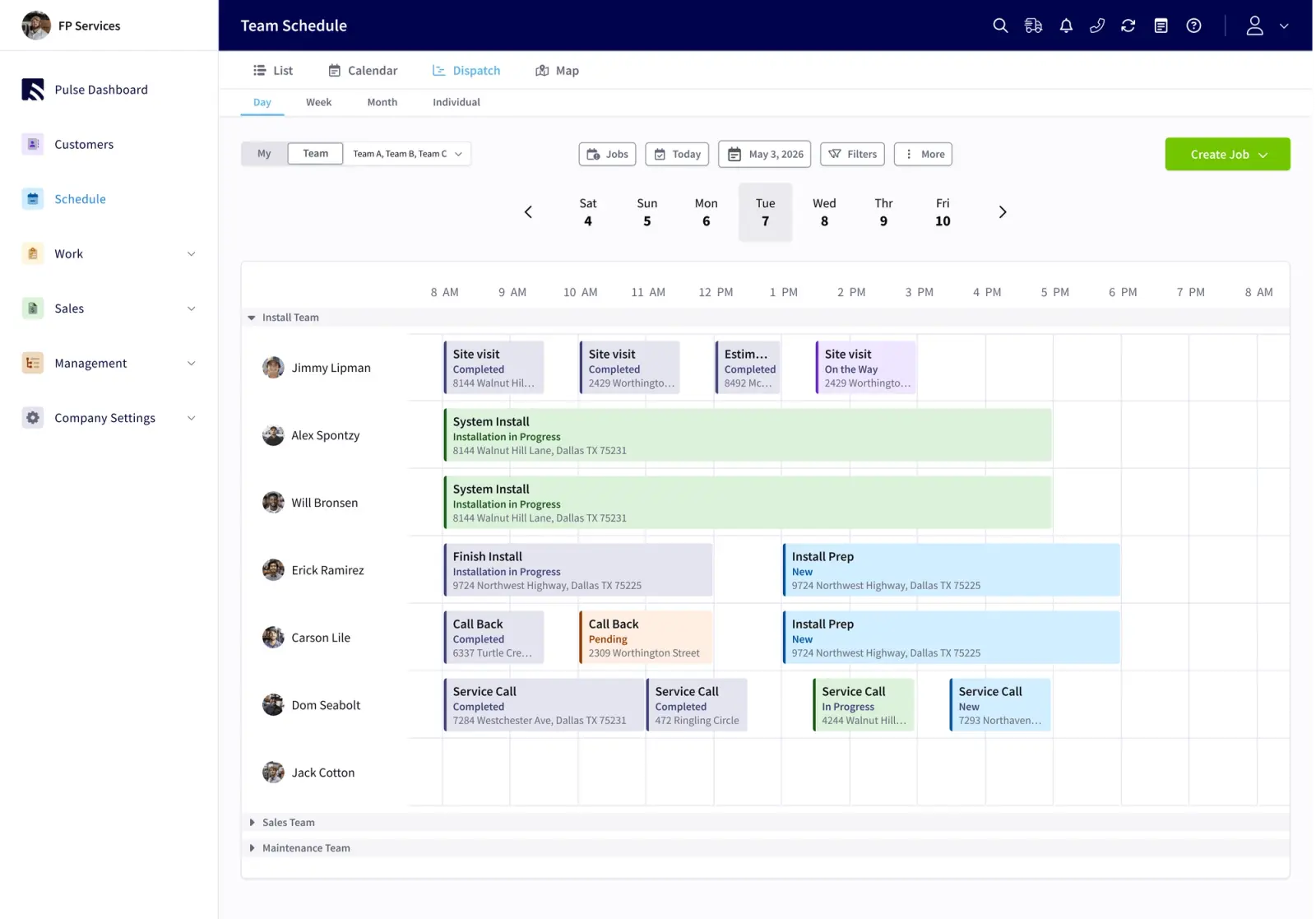
FieldPulse handles this through drag-and-drop scheduling and dispatch. Live technician locations show you where everyone is, and when you move a job, the board updates. ClearPath status workflows push job progress to your office automatically, so your dispatcher does not have to call a tech to find out where a job stands. When a tech marks themselves en route, an “On the Way” text goes to the customer automatically.
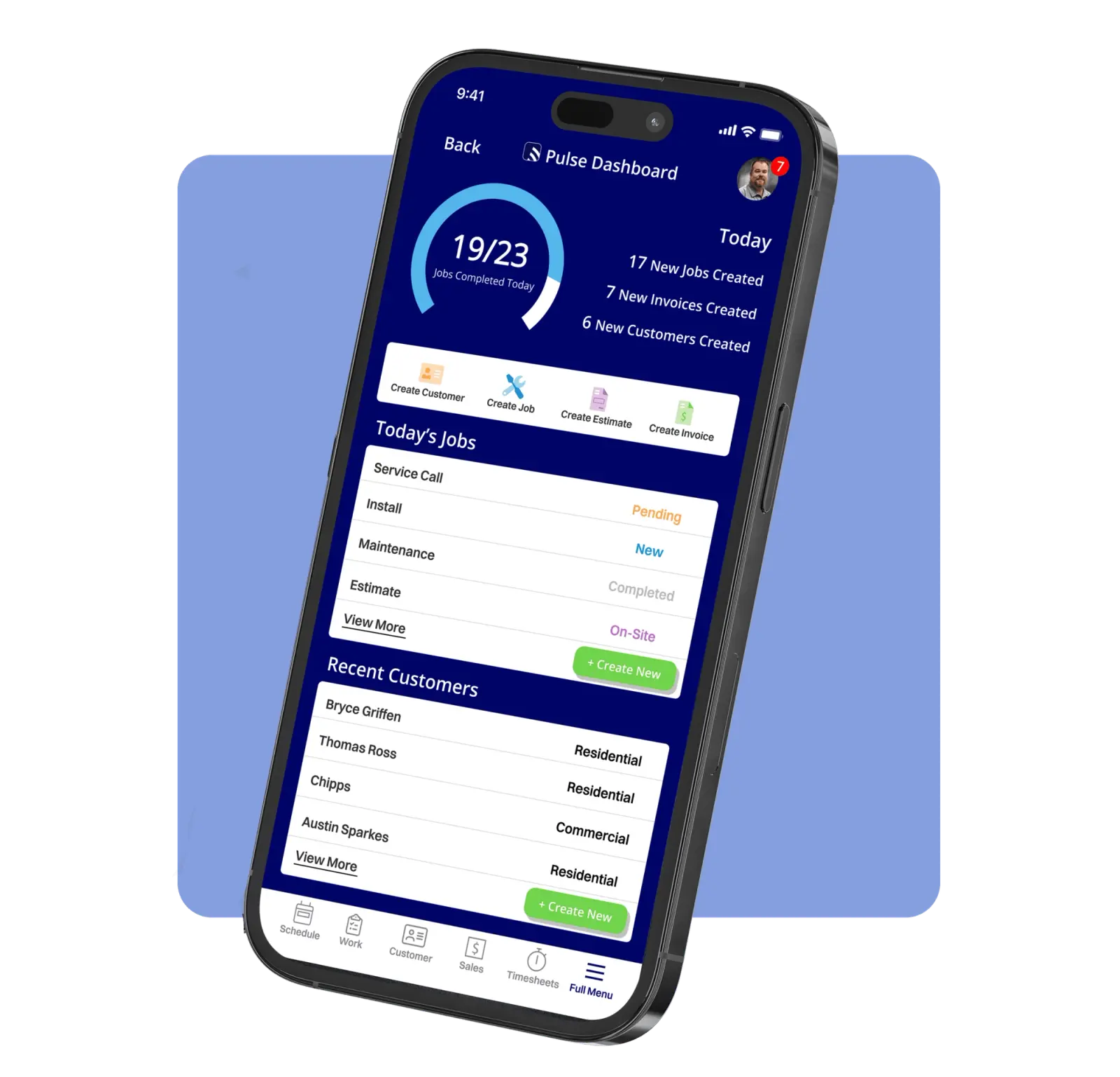
Your techs see a mobile scheduling view that shows the job, address, contact, and notes in one place. For jobs in rural service areas or buildings with poor signal, such as basements, crawlspaces, and mechanical rooms, FieldPulse caches the past week of jobs on the device. Techs can view job details, add notes and photos, update statuses, and clock in and out without a cell connection. They can complete a majority of the job, and everything syncs when signal returns.
Estimating And Takeoffs For Commercial Electrical Work
Commercial electrical bidding relies on a dedicated estimating category. Accubid, ConEst IntelliBid, TurboBid, STACK, and McCormick are built for takeoff work, such as counting devices, measuring conduit runs, applying NECA labor units, and producing hard bids from plan sets. The estimating category has increasingly moved toward cloud tools like STACK and IntelliBid. Legacy desktop databases such as Accubid, McCormick, and ConEst IntelliBid remain widely used, which matters when multiple estimators work on the same bid at once.
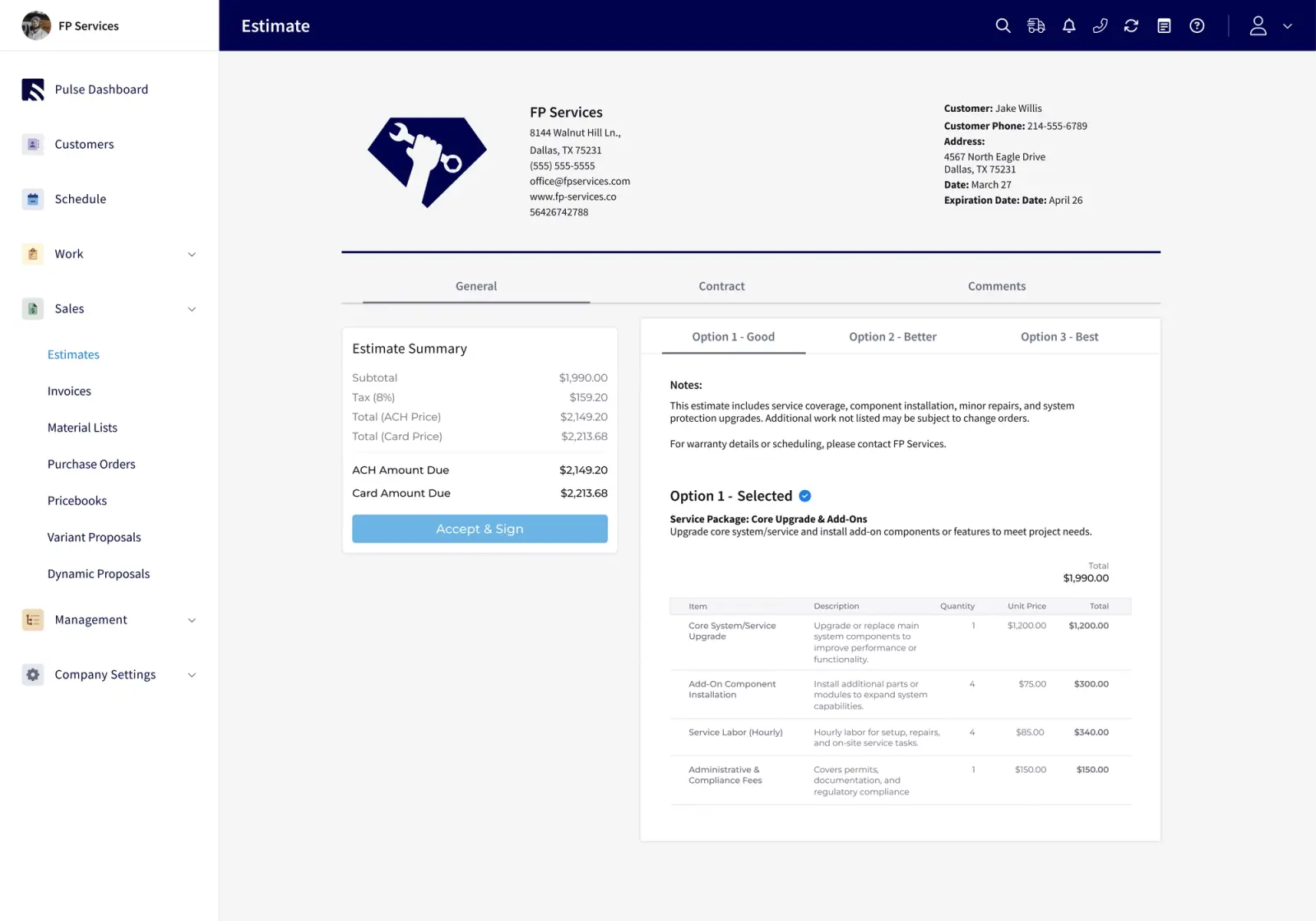
For mixed teams that bid commercial work and also run service calls, FieldPulse fits the service-and-dispatch side of your operation. The Pricebook add-on holds standard pricing for services, materials, and labor so your estimates stop varying by whoever built them. Techs and estimators build quotes from preset pricing in minutes, including good-better-best equipment options. The results show up quickly for teams that make the switch.
Fair Comfort Solutions, an HVAC business, reduced estimate creation time by 98 percent, from 4–8 hours per quote down to 4–8 minutes, after implementing FieldPulse with the Reece HVAC pricebook pre-built into the platform.
FNW Construction, an electrical contractor in California, saved 4–6 hours per week and saw a 23 percent revenue increase after adopting FieldPulse.
Job Costing And Progress Billing On Multi-Visit Projects
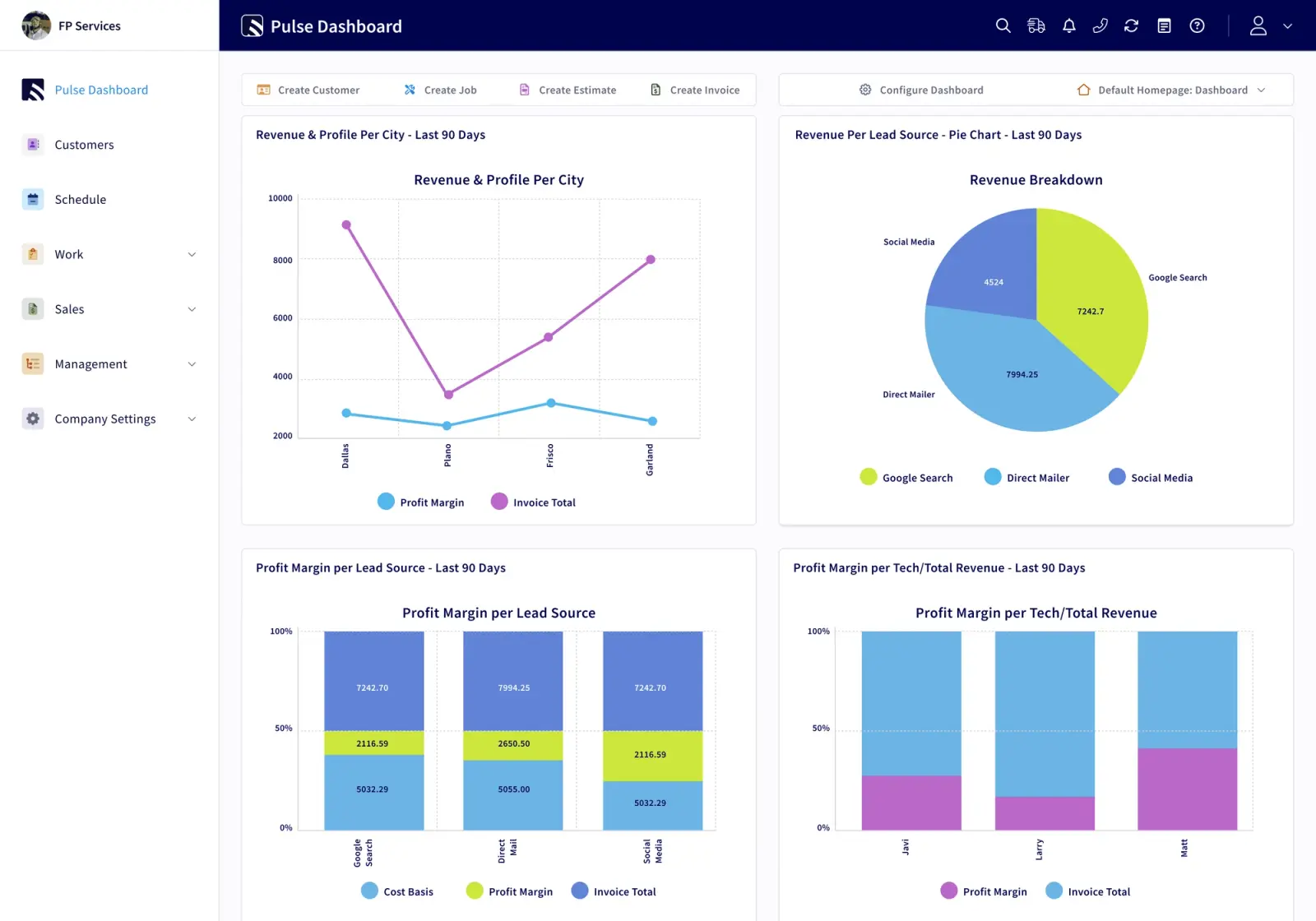
Job costing means estimating your profit margin upfront and confirming actual profit after the job closes. Without it, you find out whether a job made money weeks after the fact, if at all. With it, you see per-job profit and loss and line-item breakdowns of cost, price, and profit while the job is still open.
The key is how labor hours get tracked. When your techs clock in against the job itself, rather than only against a shift, those hours tie to specific work, which is what makes job-level profitability visible. Without that connection, labor becomes a weekly total that gets allocated by guesswork.
RDI, a commercial furniture installation business in St. Louis, ran for 50 years without job-level profitability visibility. After implementing FieldPulse and enabling ClearPath to tie labor hours to specific jobs, they saw job-level profitability for the first time. Over three years on FieldPulse, RDI doubled the business, growing from 15 to 50 employees and from 10 to 30–40 jobs per week.
See per-job profitability for yourself
Accounting Sync For Electrical Contractor Software
Many forum threads ask for “one system” or “accounting built in,” but the real problem is information scattered across disconnected places. That problem affects fully digital teams and teams using manual methods in the same way. The fix is a sync that actually works both ways, regardless of whether your team runs on paper or fully digital.
FieldPulse’s two-way QuickBooks Online sync covers several core areas so your office can trust the numbers:
- Customers, estimates, and invoices syncing in both directions
- Payments and purchase orders syncing with full line-item detail
- Vendors syncing in both directions
- Timesheets flowing into QuickBooks Online when a tech clocks out
- Tax rates coming from QuickBooks Online
- Invoice numbering that can follow your existing QuickBooks Online sequence
The diagnostic question worth asking every platform you evaluate is simple. When your admin corrects something in QuickBooks Online, how does that fix get back into your field service software? If the answer is “it does not” or “you re-enter it,” you still have double data entry, just in a different place.
FieldPulse works with QuickBooks Online Essentials, Plus, and Advanced in the US, Canada, and Australia. QuickBooks Desktop is also supported.
Design Software Versus Business Software For Electrical Work
One more distinction causes real confusion in search results: the difference between design software and business software. It is worth stating plainly.
AutoCAD Electrical and EPLAN Electric P8 are electrical CAD tools. They produce schematics, wiring diagrams, panel layouts, and technical documentation. EPLAN uses a database-driven project model. Every wire, component, and terminal lives in a relational database. AutoCAD Electrical layers electrical design tools on top of AutoCAD’s DWG drawing engine. Both are engineering tools used by designers and controls engineers, not by dispatchers or office administrators managing a service business.
Electrical contractor software runs the business: scheduling, dispatch, estimating, invoicing, job costing, and accounting sync. A shop doing industrial control panel work may need both EPLAN and a field service platform. They serve different functions, and neither replaces the other.
If you searched for “electrical contractor software” and landed on a CAD tool comparison, you were looking at the wrong category.
Implementation Reality For Growing Electrical Teams
Switching software takes real work, and owners feel that risk even when vendor pages gloss over it. The effort is manageable when you know what to expect and plan for it.
Onboarding typically runs two to six weeks, depending on your company size, which capabilities you enable, how much data has to migrate, and how your accounting setup is handled. The sequence usually looks like this:
- Scope the work, including capabilities, data, accounting requirements, and business complexity
- Begin recurring working sessions with an implementation manager after signing
- Configure the foundation, such as system preferences, templates, permissions, ClearPath, and the mobile workflow
- Move data and connect QuickBooks Online, which can extend the schedule
- Enable each role through working sessions, live classes, and self-service resources
- Transition to ongoing support
The office administrator or dispatcher acts as the adoption gatekeeper. If they are unconvinced, the rollout stalls quietly, no matter how much the owner liked the demo. Bring them into the evaluation early. Have them look at their own view: the scheduling board, the shared inbox, and what happens to duplicate entry when the books and the field service software finally agree.
RDI described their implementation approach this way: “We ripped band-aids off one at a time, instead of all at once.” They started with scheduling, then invoicing, then time tracking, then ClearPath. Their field crew had used manual time cards for thirty years. The team expected six months to get adoption. They were running payroll off the app in two weeks.
See what happens when your books and field software stay in sync
Cost Bands For Electrical Contractor Software
Once you know what implementation will demand from your team, the next question is what the software itself will cost. Electrical contractor software pricing varies widely by category and team size. General ranges, based on publicly reported figures, look like this:
- Basic Cloud Tools at the low end, where entry-level field service platforms start in the range of a few dozen dollars per month for very small plans and then scale with seat count
- Mid-Tier Takeoff And Estimating Tools in the middle, where dedicated electrical estimating platforms like STACK, ConEst IntelliBid, and TurboBid generally run from roughly $1,000 to $5,000 per user per year, depending on tier and features. Some, like TurboBid, are also offered as one-time purchases.
- Enterprise Or One-Time-License Platforms at the high end, where enterprise estimating suites and full construction management platforms can reach several thousand dollars per seat per year, with implementation costs on top
Seat-based pricing is normal in this category. What your business pays depends on how many people need access and which capabilities are turned on. The fastest way to get a real number for your specific team is a demo conversation.
Frequently Asked Questions About Electrical Contractor Software
What Is The Best App For Electrical Contractors?
The answer depends on which of the three business models you run. Residential service teams need speed, dispatch, a standard pricebook, and same-day invoicing. Commercial bidding teams need takeoff integration, progress billing, and job-level cost tracking, and dedicated estimating tools like Accubid, STACK, or ConEst IntelliBid are built for that work. Mixed service-plus-project teams need both job types on one dispatch board and one customer record. No single app is the best for all three models, so identifying your model first is the most important step in the evaluation.
What Software Is Best For Electrical Projects?
Project work needs takeoffs, progress billing, and job costing. For pure commercial bidding, dedicated electrical estimating platforms handle the takeoff and bid assembly side. For mixed teams running service calls alongside multi-visit projects, you need a platform that carries both on one workflow, with the same scheduling board, the same customer record, and job costing that ties labor hours to specific jobs rather than to a weekly total. That combination makes per-job profitability visible while a project is still open.
How Much Does Electrical Contractor Software Cost?
Basic cloud field service tools start at the low end of the market and scale with seat count. Mid-tier dedicated estimating platforms run from roughly $1,000 to $5,000 per user per year. Enterprise construction management and estimating platforms can reach several thousand dollars per seat annually, with implementation costs added on top. Seat-based pricing is standard across the category, so your actual cost depends on how many people need access and which capabilities you turn on. Get a real number by going through a demo with your specific team size and workflow in mind.
How Long Does Implementation Take?
Two to six weeks is the realistic window for most business-operations platforms. The variables that stretch it are the same ones covered above, including team size, enabled capabilities, data volume, and accounting setup. Plan against the full window. The sequence, from scoping and configuration through data migration, QuickBooks connection, role-by-role training, and transition to ongoing support, takes time to do right. Rushing the rollout often leads to problems that undermine adoption.
Will My Office Manager Actually Adopt It?
This question decides most implementations and deserves a direct test. Bring your office manager or dispatcher into the demo and have them look at their own view, including the scheduling board, the shared inbox, and what happens to duplicate entry. The two-way QuickBooks Online sync is usually the moment it lands. When the bookkeeper corrects something in QuickBooks, the fix carries back into the field service software instead of being overwritten, the same diagnostic question from the accounting section, answered live. If the person who runs your day cannot see their workload getting smaller during the demo, the rollout will not hold.
Conclusion And Next Steps For Your Electrical Business
The right electrical contractor software depends on which of three businesses you actually run. If you are a residential service team, the priority is speed and dispatch. If you bid commercial work, the focus is takeoff and progress billing. If you run both, you need a platform that carries both on one workflow, the hardest case, as covered earlier.
That fragmentation is the real problem, information moving through manual handoffs, whether those handoffs happen on paper or in a group text thread. The fix is a platform that carries both job types on one dispatch board, ties labor hours to specific jobs, and syncs both ways with your books.
Before you sign anything, take these steps:
- Document your current workflow from first call to collected payment
- Identify where handoffs break, where jobs stall, where invoices go late, and where pricing varies by person
- Decide which of the three business models you actually run
- Gather input from your office manager and at least one tech before you evaluate any platform
- In every demo, ask what happens when your admin corrects something in QuickBooks Online
The answers to those questions will tell you more than any feature comparison.
Watch a live dispatch board in action