









Key Takeaways
-
A field service CRM unifies customer records, job history, scheduling, and documentation so your office and techs work from the same live data.
-
Growth exposes broken handoffs such as late invoices, manual rescheduling, inconsistent pricing, and scattered customer history. A job-lifecycle-focused CRM removes those workflow problems.
-
Best practices follow each job stage. Define stages and ownership before you configure software, treat scheduling as a constraint problem, and close the loop from job completion to payment.
-
Successful rollouts depend on three people: the owner, the dispatcher, and the techs. Each needs to see how the system reduces their workload from day one.
-
FieldPulse delivers these outcomes for 7-to-50-technician residential teams with ClearPath workflows, two-way QuickBooks sync, job costing, and a mobile app that works in basements, rural areas, and other low-signal spots.
The Problem: Why Field Service CRM Best Practices Matter
Growth outpacing your process is the core problem. When your team was smaller, you could cover the gaps with memory and phone calls. As you add crews, those gaps turn into real costs. Here is what that looks like in practice:
-
A job gets finished in the field and the details stay there. Your office waits, then chases the tech for parts and labor. Invoices go out days late or never go out.
-
An emergency request comes in mid-day and your dispatcher has to rebuild the schedule by phone, notifying affected customers one by one. One missed handoff becomes a customer sitting at home waiting for a truck that is not coming.
-
Two techs quote the same job differently because there is no standard pricebook. Profit margin becomes something you find out about after the fact.
-
Customer history, equipment details, and gate codes are scattered across texts, access files, and separate systems. Retrieving anything is slow.
-
Administrative work spills into evenings because your process depends on re-entry and follow-up.
Effort is not the issue. The structure is. Information that moves through manual handoffs does not scale. A fully digital business that still relies on manual handoffs has the same failure as one running on paper. The fix is organizing your CRM around the job lifecycle so every stage has a clear owner, a defined action, and a record that travels with the job.
Talk through your workflow with FieldPulse
11 Field Service CRM Best Practices, Organized by Job Lifecycle
Intake
-
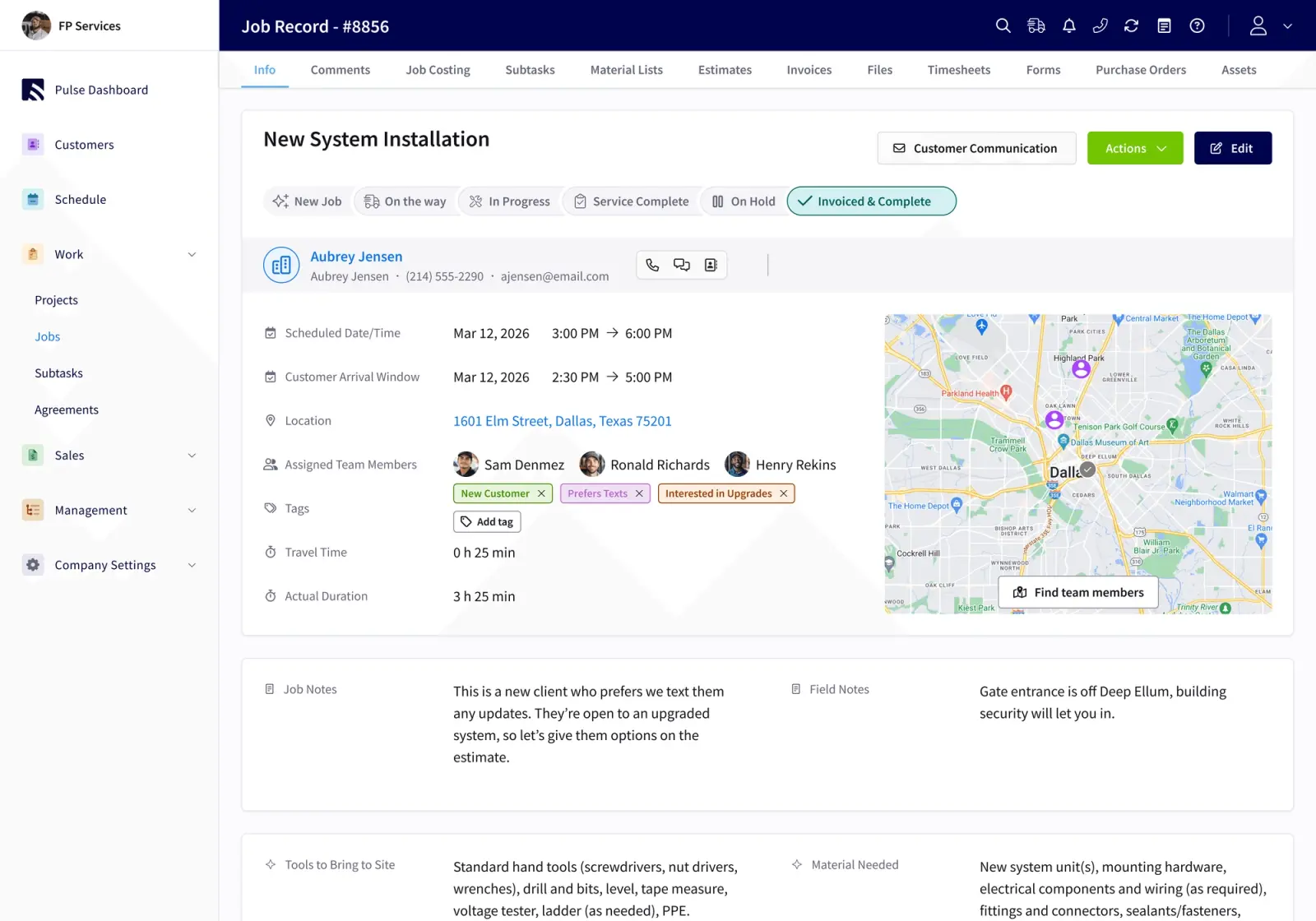
Make the Work Order the Single Source of Truth. Every job record should be the single place where the customer and site, equipment history, assigned crew, current stage, notes, photos, forms, materials, and financials all live. When that record is incomplete, your office ends up chasing the tech days later for parts and labor. The team then rebuilds the job from memory instead of from a record. That second pass is invisible on any job sheet, and it scales with volume rather than with revenue.
-
Define Your Job Stages Before You Configure Anything. Map out the stages a job moves through and name the required action and the role responsible at each one before you touch a single setting. FieldPulse’s ClearPath lets your office define custom job stages per job type, set required actions inside each stage, and give techs a mobile view that shows only what the current step needs. An HVAC install and a service call move through different stages, so you build them separately.
Schedule
-
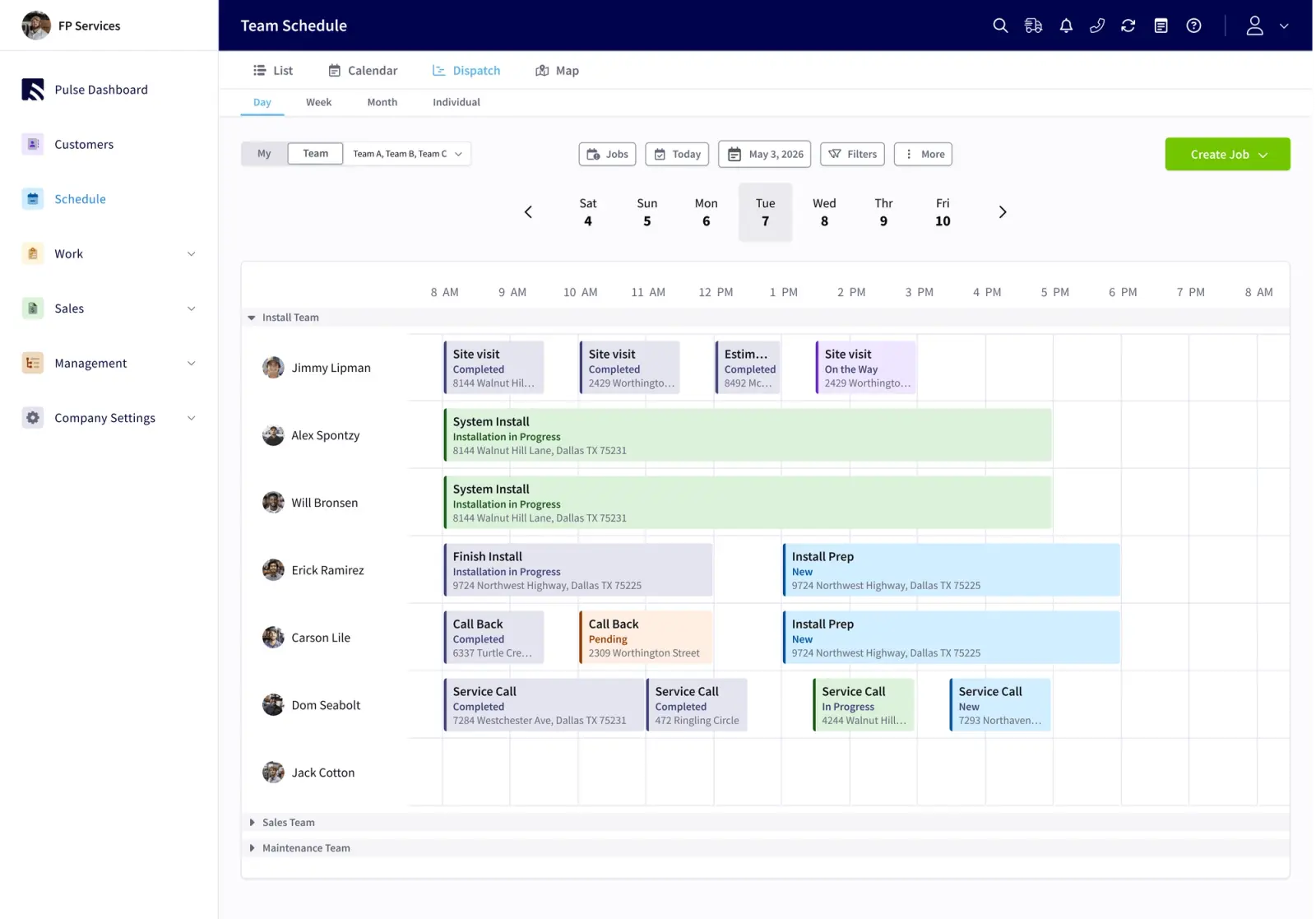
Treat Scheduling as a Constraint Problem. “Who is free?” is the wrong question. What actually matters is skill fit, drive time, job duration, and the customer’s arrival window. Get those wrong and the cost adds up: field technicians waste a good part of their workday on non-value-adding activities, including unnecessary driving. When an emergency request comes in mid-day, your dispatcher needs to rearrange the board without a call tree. FieldPulse’s drag-and-drop scheduling with live technician locations makes that possible without rebuilding the day from scratch.
-
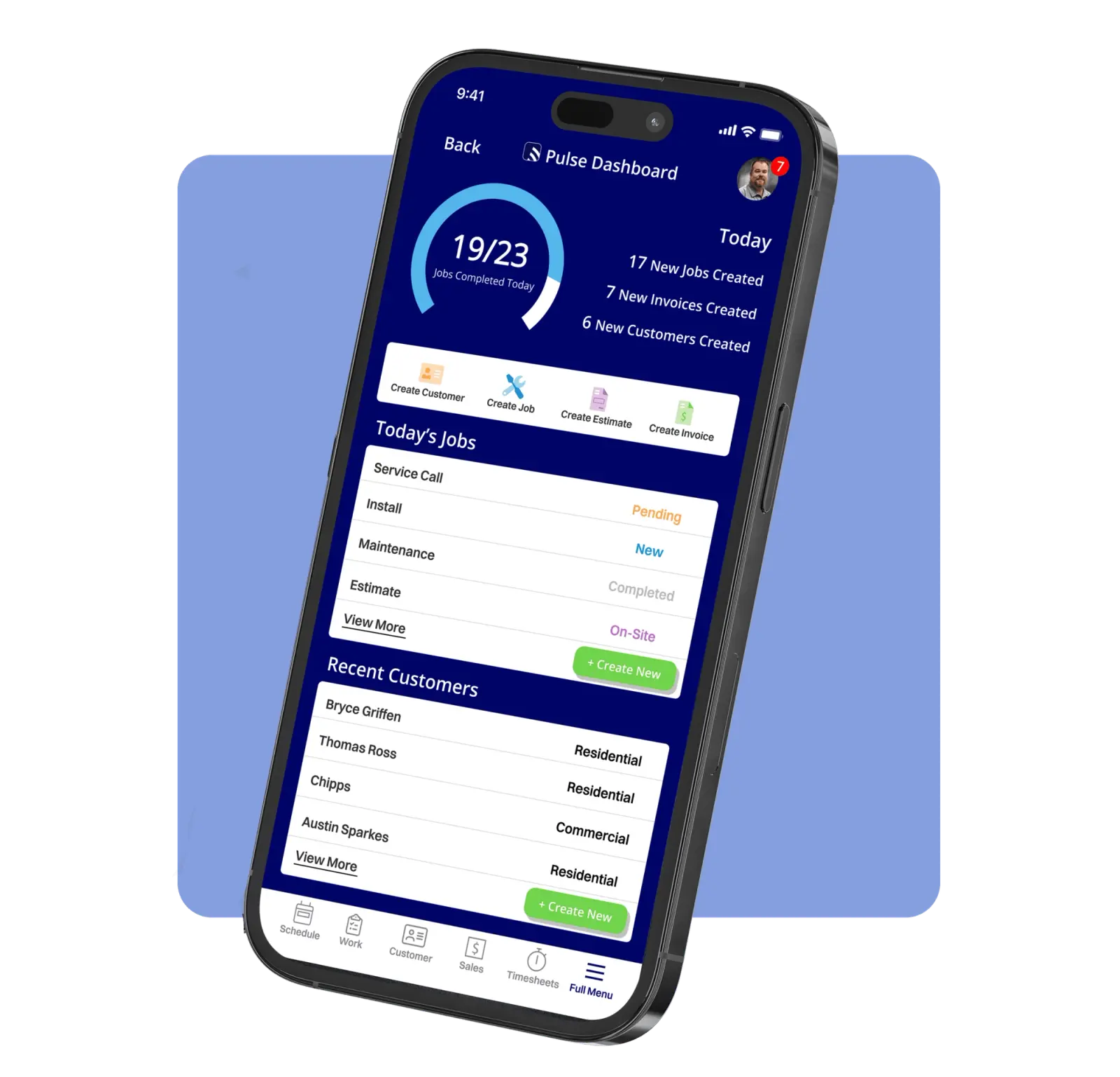
Win Your Tech’s First Week. Adoption is decided in week one. Your techs work in crawlspaces, basements, and rural areas where signal drops. Fewer taps matter more than extra features. FieldPulse caches the past week of jobs, projects, customers, estimates, and invoices on the device. If signal drops mid-edit, the active draft converts automatically to an offline draft. Techs can complete a majority of the job without cell signal and everything entered offline syncs when the device is back in signal. About 70% of field service software implementations fail due to poor user adoption, with the mobile experience as the primary culprit. Make the app easy to use in the conditions your techs actually work in.
Run the Job and the Back Office Together
-
Make Your Office Administrator the Adoption Gatekeeper. Every job effectively gets done twice when the tech does it once in the field and the office re-creates it at an office. That double-job tax scales with volume, which is why your dispatcher needs to see their workload shrink before they buy in. Show them one customer and job record the whole team works from, drag-and-drop scheduling with live technician locations, and status workflows that push job progress to the office automatically instead of by phone call. If your dispatcher is not convinced, the rollout stalls quietly no matter how much you like the demo.
-
Put Equipment and Asset History Inside the Customer Record. A customer record alone does not work for equipment-based trades. When your tech arrives at a repeat HVAC visit, they need the equipment record, serial numbers, installation history, warranty documents, and last visit’s photos already in hand. They should not need a phone call to the office to reconstruct it. FieldPulse holds all of that inside the customer’s history so your tech arrives informed.
-
Integrate with Accounting So the CRM Is the System of Record. Ask every vendor a simple question: when your admin corrects something in QuickBooks Online, how does that fix get back into your field service software? If the answer is “it does not,” you are back to double data entry. FieldPulse syncs customers, line items, estimates, invoices, payments, purchase orders with full line-item detail, and vendors both ways. Timesheets flow into QuickBooks Online when a tech clocks out. Your team avoids rekeying and avoids a month-end reconciliation project. See the full field service CRM implementation guide for how to sequence the accounting setup.
-
Price from a Standard Pricebook. When two techs quote the same job differently, profit margin erodes and you cannot predict it. FieldPulse’s Pricebook (an add-on) holds standard pricing for services, materials, and labor and updates in real time across every user and location. Fair Comfort Solutions cut estimate creation time from 4–8 hours per quote down to 4–8 minutes after switching to FieldPulse with the Reece HVAC pricebook pre-built.
-
Tie Labor Hours to Specific Jobs. When your techs clock in against the job itself, labor ties to specific work rather than a weekly total. That is the precondition for job costing that actually works. RDI ran a business for fifty years without job-level profitability visibility. Once they had it, it changed which jobs they went after.
Invoice
-
Close the Loop from Job Completion to Invoice. The lag between completed work and a sent invoice is a cash-flow problem as much as an administrative one. FieldPulse lets your techs invoice from the field, capture card or ACH payment on site, and send “Pay Now” links by text or email. Window Fix moved from a manual invoicing process where ten invoices and ten payments took an hour and a half to payment links customers could pay at any time of day. They also moved several management-company clients from net 30 to net 15.
Follow-Up
-
Run Recurring Maintenance off Contract Terms. Maintenance agreements in FieldPulse schedule visits automatically from contract terms, generate recurring invoices, and flag contracts approaching renewal. A recurring-service program that runs on memory depends on one person’s memory, and that person eventually leaves or gets busy.
-
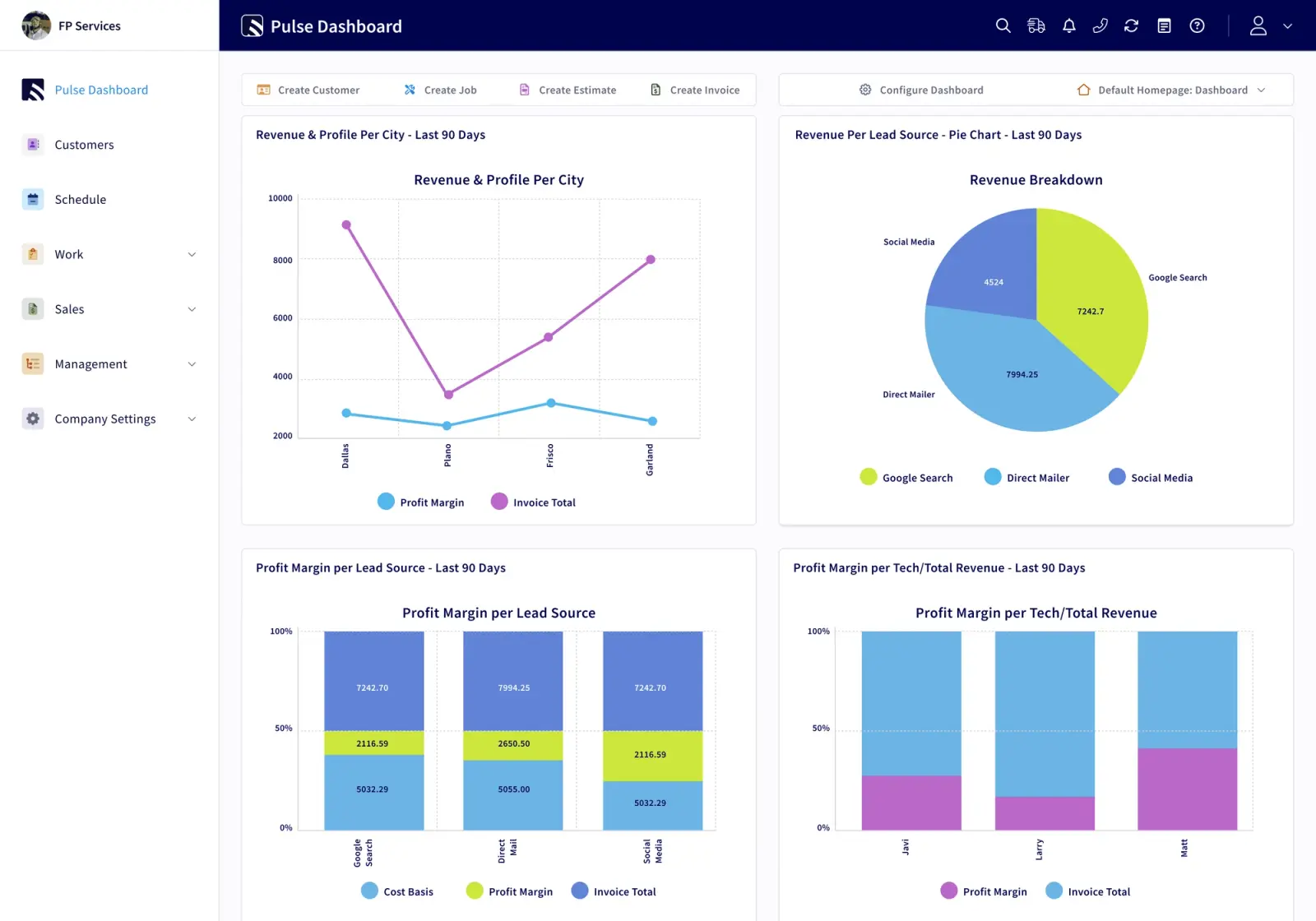
Review the Numbers Monthly. Focus on three KPIs: first-time fix rate, schedule adherence, and time-to-invoice. Aberdeen Group research found that organizations with a first-time fix rate above 70% achieve an 85% customer satisfaction rate, compared to 66% for those below that threshold. FieldPulse’s 60+ prebuilt reports and custom dashboards give you visibility into technician performance, revenue, outstanding invoices, and profitability by job, job type, or customer without an afternoon of reconstruction.
For a deeper look at how these practices apply to your specific trade, see field service software for residential technician teams and field operations best practices for residential services.
See these workflows in a live demo
Even with the right practices in place, many rollouts still struggle. Knowing why they fail helps you avoid the same traps.
Why Do So Many Field Service CRM Rollouts Fail?
Here are the real failure modes:
-
Over-customization before the process is defined. You cannot configure a workflow you have not documented. Teams that start with technology selection rather than outcomes are more likely to abandon the system because it feels too complex.
-
No documented process to configure against. A CRM exposes an undefined process. If your team does the same job type four different ways, the software shows you that immediately.
-
Skipping the office team during evaluation. Your dispatcher acts as the adoption gatekeeper. If they are not in the demo, you are making a decision without the person who will decide whether it holds.
-
Treating it as an IT project instead of an operations project. Phased rollouts hold better.
Onboarding is real work. FieldPulse’s typical window is two to six weeks depending on your team size, which capabilities you enable, how much data needs to migrate, and how your accounting setup is handled. The rollouts that hold are sequenced into phases with small tasks between sessions. RDI put it plainly: “We ripped band-aids off one at a time, instead of all at once.” That approach works.
Do You Really Need a CRM for a Field Service Business?
Some teams do not. If you are a one-person operation, other tools fit better. FieldPulse is built for teams in the 7-to-50-technician range and says so upfront so you avoid a bad fit.
If your team is in that range and your office is chasing techs for job details, invoices are going out late, and you cannot tell which jobs made money, a field service CRM organized around the job lifecycle will help. If your workflow is genuinely working and your numbers are clean, the friction of a rollout may not be worth it yet.
The fastest way to find out is simple. Take one real job you completed last month and cost it out. Include parts, labor, drive time, the change order nobody logged, and the invoice that went out eleven days later. If you cannot do that without an afternoon of reconstruction, that gap is your answer.
Once you know you need a CRM, you also need to understand the trade-offs.
What Are the Downsides of Using a CRM?
Real trade-offs exist, and they are worth naming clearly:
-
Configuration takes time. Setting up job stages, pricebooks, permissions, and accounting sync is real work. Plan for that time.
-
Your team has to change how it works. A CRM without a person responsible for it drifts. Nobody cleans duplicates, enforces the process, or notices when the data starts rotting. Assign ownership before you go live.
-
A CRM exposes an undefined process. If your intake is inconsistent, your pricing varies by person, and your job stages are not documented, the software makes all of that visible immediately. That visibility is useful, but it is not painless.
These are reasons to go in with a plan and clear ownership. They are not reasons to avoid a CRM.
Will AI Replace Field Service CRM?
AI will change how people interact with and automate work inside CRM and FSM software rather than replace those systems outright. Agents still need governed customer records, permissions, workflows, and audit history.
AI already supports field service work in specific ways. FieldPulse’s Operator AI (an add-on) answers after-hours, declined, and overflow calls and books jobs directly onto your dispatch board. It speaks English and Spanish and provides auto-translated transcripts. About 95% of callers leave the call with a job scheduled. Chat AI (an add-on) handles website conversations in 30+ languages with summaries in English. Both create the customer and job record automatically and hand off to your team. They catch the calls and conversations your team cannot get to, while your dispatcher and office administrator stay in control of operations.
Operator AI won the NECA Innovator Award in 2025.
The Three People Who Decide Whether It Sticks
Every field service CRM rollout is decided by three people. Write this down before you start:
-
You, the owner or operations lead. You own the job economics. You need to know which jobs made money, whether you can add crews without creating workflow problems, and what the business is worth if you ever want to sell it. FieldPulse’s job costing estimates your profit margin upfront and confirms actual profit after completion. Your action is to define your job stages and your pricing before the implementation starts.
-
Your office administrator or dispatcher. This person controls adoption. If they are unconvinced, the deal stalls quietly no matter how much you like the demo. Your action is to bring your dispatcher into the demo and show them their own view. Walk through the scheduling board, the shared inbox, the permissions, and exactly what happens to double data entry. The two-way QuickBooks Online sync is usually the moment it lands.
-
Your techs. They decide in week one whether the rollout holds. Your action is to show a tech a complete job end to end, including what happens when signal drops in a basement or a rural service area. ClearPath’s Mobile Focus View shows only what the current job stage requires, with single-tap Action Buttons. RDI’s field crew had used paper time cards for thirty years. The team expected six months to get adoption and was running payroll off the app in two weeks.
For more on how the office administrator role shapes a rollout, see field service management software for office managers.
Conclusion: The Right Platform For Your Team
Field service CRM best practices focus on closing the handoffs that break as your team grows. Organize your CRM around the job lifecycle from intake through follow-up, define the required action and the responsible role at each stage, and win over the three people who decide whether the rollout holds.
FieldPulse is built for teams in that range. ClearPath is included in the core platform and turns your process into a guided workflow your whole team follows. Two-way QuickBooks Online sync ends double data entry. Job costing gives you profit margin visibility at the job level, not just at month-end. The mobile app is available in Spanish for your Spanish-speaking techs.
On average, FieldPulse customers experience 25% gains in efficiency, with office teams saving 40+ hours per month and field teams seeing a 50% increase in on-time delivery. FieldPulse holds a 4.8 out of 5 rating across G2, Capterra, the App Store, the Google Play Store, and other software-review sites.
Frequently Asked Questions
What Is a Field Service CRM and How Is It Different from Regular CRM Software?
A field service CRM connects your customer records, job history, scheduling, and job documentation in one system so your office and your techs work from the same current information. A standard CRM is built around sales pipelines and contact management. A field service CRM is built around the job lifecycle: intake, scheduling, execution, invoicing, and follow-up. The difference matters because a sales CRM does not know what a work order is, cannot track equipment history, and has no concept of a tech arriving at a job site. For residential service teams in HVAC, plumbing, garage door, or electrical, you need a system that understands how a job actually moves from first call to final payment.
How Long Does It Take to Implement a Field Service CRM?
For a team in that range, plan for two to six weeks. The variables are your team size, which capabilities you turn on, how much data needs to migrate, and how your accounting setup is handled. The sequence that works is simple. First, scope the work. Second, configure your foundation such as job stages, templates, permissions, and your mobile workflow. Third, move your data and connect QuickBooks Online. Fourth, train each role through working sessions with assigned tasks between them. FieldPulse assigns an implementation manager who runs recurring sessions with your team. The rollouts that hold are phased, not all at once. Expect homework between sessions because that is what makes adoption stick.
Why Do CRM Rollouts Fail in Field Service Businesses?
The most common reasons have nothing to do with the software. Teams configure the system before they have documented their process, so they automate something that was already broken. The office administrator or dispatcher is left out of the evaluation, and since they control adoption, the rollout stalls quietly after go-live. The rollout is treated as a one-time event rather than a phased change, so all-at-once implementations fail at a much higher rate than phased ones. Often nobody is assigned ownership of the system after launch, so data quality drifts and the team stops trusting it. The fix is to define your job stages and pricing before you configure anything, bring your dispatcher into the demo, and sequence the rollout into phases with small tasks between sessions.
Do My Techs Really Need to Use the Mobile App for a CRM to Work?
They do. If your techs are not capturing job details, notes, photos, and status updates in the field, your office is still rebuilding every job at an office. That is the double-job tax that breaks operationally as you grow. The good news is that adoption is mostly a design problem, not a resistance problem. Techs adopt mobile apps when the app shows them only what they need for the current step, works in the conditions they actually work in, and makes their job easier rather than adding paperwork. ClearPath’s Mobile Focus View is built on that principle. If you have Spanish-speaking techs, the FieldPulse mobile app is available in Spanish, enabled per user by the FieldPulse team, so your crew follows the same workflow in the language they work in most comfortably.
What KPIs Should I Track Once My Field Service CRM Is Running?
Start with three: first-time fix rate, time-to-invoice, and schedule adherence. First-time fix rate tells you whether your techs are arriving with the right information, the right parts, and the right skills, and it is directly tied to customer satisfaction and repeat visit costs. Time-to-invoice tells you how long it takes from job completion to a sent invoice, which is a cash-flow metric as much as an administrative one. Schedule adherence tells you whether your dispatch process holds under real conditions, including when emergency requests come in. Once those three are stable, add job-level profitability, which requires labor hours tied to specific jobs rather than weekly totals. FieldPulse’s 60+ prebuilt reports and custom dashboards surface all of these without manual assembly.