







Key Takeaways
- Peak season exposes workflow gaps that manual processes cannot handle once your team grows past five techs.
- HVAC companies need software built for equipment tracking, refrigerant compliance, offline work, and maintenance agreement automation.
- Among the five leading platforms, FieldPulse fits growing HVAC teams of 7–20 techs that want HVAC-specific features without enterprise complexity.
- Key features to evaluate include equipment and asset tracking, true offline mobile access, smart dispatching, maintenance agreement automation, two-way QuickBooks integration, and job costing.
- FieldPulse is designed for growing HVAC teams that need HVAC-focused workflows and clear job-level profitability.
Why HVAC Companies Need Specialized Field Service Software
Generic job management tools rarely match the realities of HVAC work. Here is where they fall short for your team:
- Equipment tracking: Your techs need service history, warranty status, and model and serial information for furnaces, boilers, and AC units, not just customer-level records. Without equipment-level data, diagnostic time rises and first-time fix rates drop.
- Refrigerant compliance: EPA Section 608 requires documentation of refrigerant type, quantity added, and quantity recovered per job and per equipment unit. With R-410A production stopped and A2L refrigerants like R-454B and R-32 now standard, audit-ready records matter more than ever.
- Seasonal demand spikes: HVAC call volume in July and January can run 2–4x the shoulder-season baseline, with summer peaks sometimes reaching 3–5x during extreme heat waves. Your software needs to handle emergency dispatch, capacity planning, and maintenance scheduling across those peaks without breaking operationally.
- Offline capability: Your techs work in basements, crawl spaces, mechanical rooms, and rural areas where cell signal drops. If the app cannot work offline, techs quickly revert to manual notes and you lose the data.
- Maintenance agreements: Recurring service contracts provide your most predictable revenue. Companies deriving 30–40% of revenue from recurring maintenance contracts see 50% less revenue volatility than those relying on one-time calls.
HVAC contractors have the highest software adoption rate among trades at 61%, yet spreadsheet use remains common until teams pass roughly five people. Once your business grows past that point, spreadsheet-based processes stop scaling. Companies using comprehensive digital field service solutions see 32% higher productivity and 28% faster invoice-to-payment cycles than those relying on manual processes.
Top Field Service Apps For HVAC Companies Compared
Five platforms come up most often when HVAC owners evaluate field service software. Each one serves a different type of team.
ServiceTitan
ServiceTitan works best for enterprise HVAC operations with 20 or more techs and complex multi-location needs. It is known for advanced dispatch, flat-rate pricing, and marketing automation. Custom pricing and implementation typically run longer, often 2–12 months, and the platform’s depth comes with a significant learning curve.
Housecall Pro
Housecall Pro fits small residential teams with 1–10 techs that need straightforward scheduling, online booking, and customer communication. Pricing starts around $59 per month. Limited offline capability and lighter equipment tracking make it harder to grow into commercial or multi-site work.
Jobber
Jobber suits solo operators and small crews that want simple scheduling and invoicing. It offers a clean interface and affordable entry pricing. Per-user pricing gets expensive as teams grow, and HVAC-specific features like equipment tracking and refrigerant logs are limited.
FieldEdge
FieldEdge works well for mid-size HVAC shops with 2–10 techs that rely heavily on QuickBooks Desktop. It is known for its flat-rate pricebook and two-way QuickBooks sync. The mobile app requires more navigation than newer competitors, and per-user pricing scales directly with headcount.
FieldPulse
FieldPulse fits growing HVAC teams with 7–20 techs that have outgrown entry-level tools but do not need enterprise complexity. It offers an all-in-one platform with FieldPulse’s Mobile Focus workflow standardization, deep equipment tracking, true offline mode, maintenance agreement automation, and two-way QuickBooks Online sync. Pricing is seat-based with lower-cost field-only seats for techs.
Comparison Table: Field Service Apps For HVAC Companies
The table below summarizes each platform’s target team, key strengths, and pricing model so you can compare them quickly.
| Platform | Best For | Key Features | Pricing Model |
|---|---|---|---|
| ServiceTitan | Enterprise HVAC (20+ techs) | Advanced dispatch, flat-rate pricing, marketing automation | Custom quote, reported $245–$398 per technician/month plus implementation |
| Housecall Pro | Small residential teams (1–10 techs) | Online booking, customer communication, mobile invoicing | Published tiers from about $59/month |
| Jobber | Solo operators and small crews | Simple scheduling, invoicing, route planning | Published tiers from about $29–$49/month |
| FieldEdge | Mid-size QuickBooks shops (2–10 techs) | Flat-rate pricebook, two-way QuickBooks sync, service agreements | Custom quote per user/month |
| FieldPulse | Growing HVAC teams (7–20 techs) | FieldPulse’s Mobile Focus workflows, offline mode, equipment tracking, maintenance agreements, two-way QuickBooks Online sync | Seat-based custom quote |
Key Features To Look For In HVAC Field Service Software
Some field service apps handle HVAC work much better than others. These six features separate HVAC-ready tools from generic job management software.
Equipment And Asset Tracking
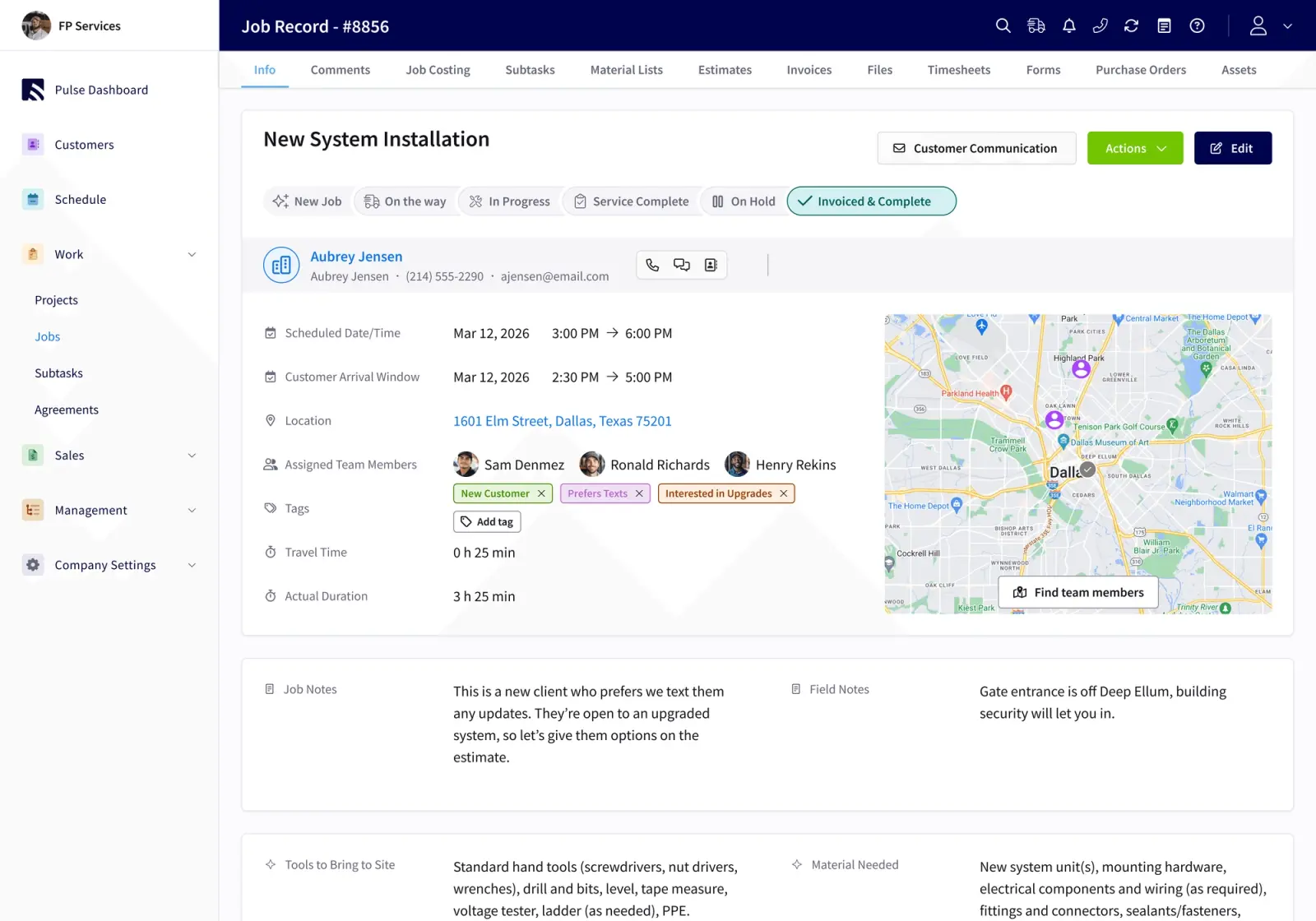
A tech arriving at a repeat service call should know what equipment is on site, its service history, warranty status, and prior repair notes before walking up to the door. Equipment-level records, not just customer-level records, cut diagnostic time and raise first-time fix rates.
FieldPulse maintains asset and equipment records with serial numbers, custom asset tagging, and installation history. Your techs access the customer’s full equipment history from the mobile app, including photos and prior job notes, before they arrive on site.
Offline Mobile App
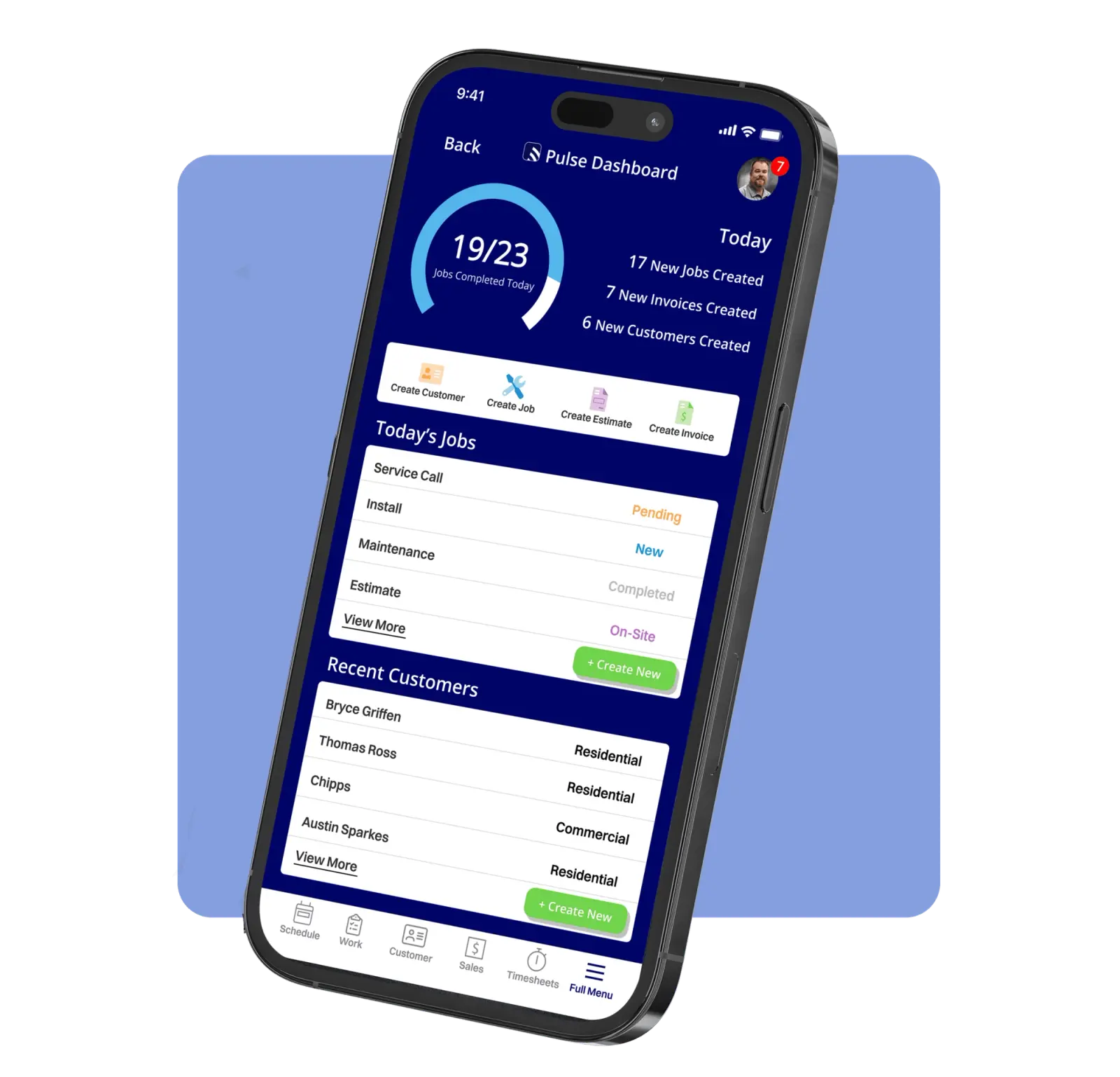
HVAC work happens in basements, crawl spaces, mechanical rooms, and rural areas where cell signal drops. If the app cannot function offline, techs fall back to manual notes and you lose reliable data.
FieldPulse’s Mobile Focus caches the past week of jobs, projects, customers, estimates, and invoices on the device. Your techs can save unlimited job notes, upload up to 50 photos at a time, and update statuses. They can also clock in and out and edit custom forms. If signal drops mid-edit, the active draft becomes an offline draft automatically and syncs when the device reconnects.
Smart Dispatching
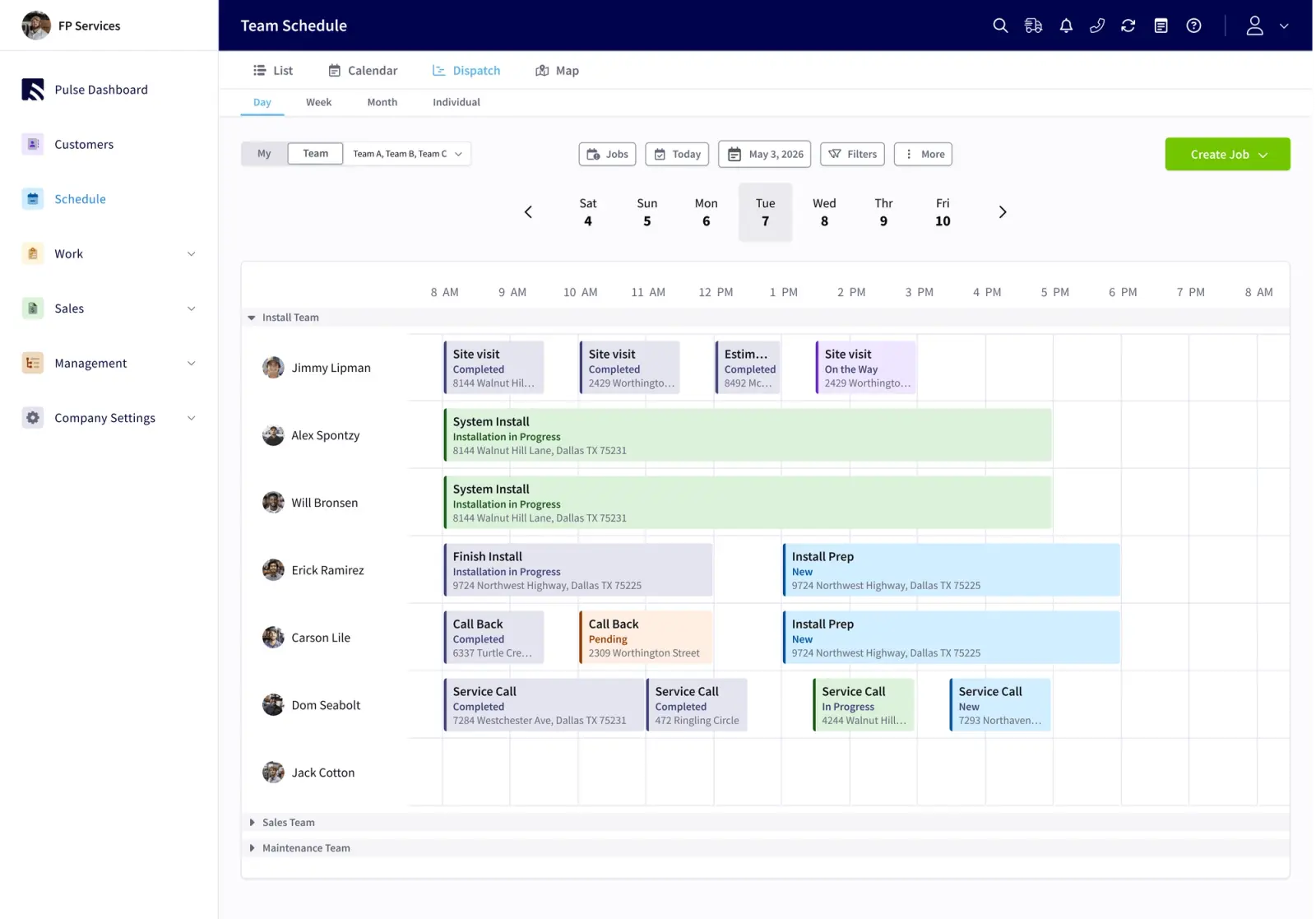
Emergency requests come in fast during peak season and can wreck the schedule if you juggle everything by phone. Your dispatcher needs live technician locations, clear visibility into who should take which call, and drag-and-drop rescheduling that updates everyone.
FieldPulse’s drag-and-drop scheduling includes live technician locations plus calendar and map views. Assignment tools put the right tech on the right call. FieldPulse’s Mobile Focus status workflows push job progress to the office automatically, so your team avoids constant phone updates.
Maintenance Agreements
HVAC maintenance contracts provide predictable recurring revenue when visits get scheduled automatically and renewals stay on track. As noted earlier, recurring maintenance contracts reduce revenue volatility significantly.
FieldPulse maintenance agreements schedule visits automatically from contract terms, keep the customer’s full service history, generate recurring invoices, send reminders to customers and techs, and flag contracts approaching renewal.
Accounting Integration (QuickBooks)
Double entry, where you key the same invoice into field software and QuickBooks, wastes hours each week and creates reconciliation headaches. The fix needs to be two-way so corrections in QuickBooks flow back into your field software.
FieldPulse offers two-way QuickBooks Online sync for customers, line items, estimates, invoices, payments, purchase orders, and vendors. Timesheets flow into QuickBooks Online when a tech clocks out. Tax rates come from QuickBooks Online, and invoice numbering can follow your existing sequence.
Job Costing
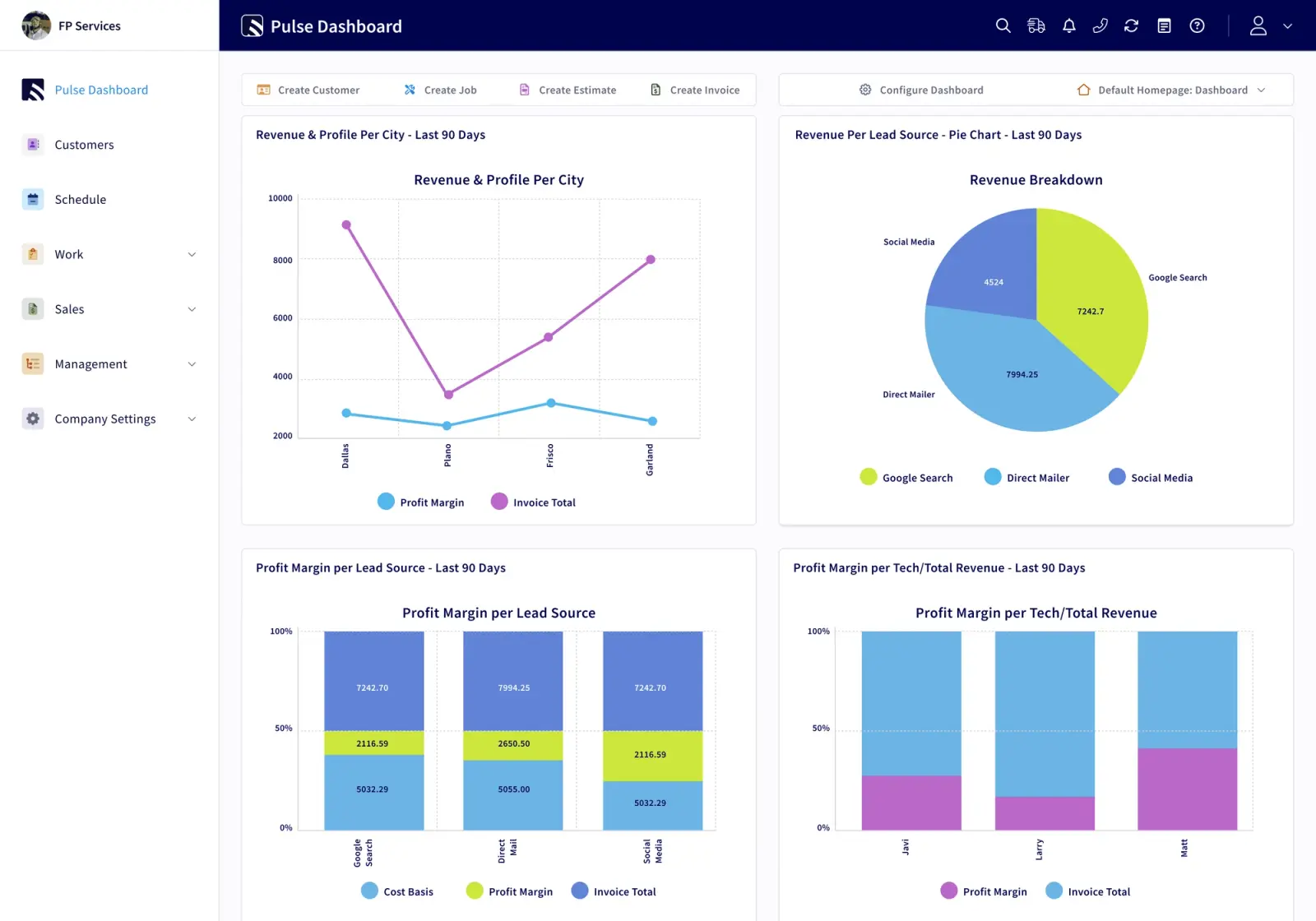
Without job-level profitability, you price work on instinct. Labor hours, materials, and overhead need to tie to specific jobs so you know which work actually made money. For a deeper look at how flat-rate pricing connects to profit margin in growing HVAC businesses, see our guide on flat-rate software.
FieldPulse job costing estimates your profit margin upfront and confirms actual profit after completion. You see per-job profit and loss plus line-item cost, price, and profit breakdowns. Because your techs clock in against the job itself, labor hours tie directly to that work.
How To Choose Based On Your Team Size And Service Mix
Now that you know which features matter, you can weigh them against your team size and service mix.
- Solo operators and crews under 5 techs: Simpler tools like Jobber or Housecall Pro may work for now. If you plan to grow, expect to switch within 12–24 months.
- Teams of 7–20 techs (residential focus): This range is the sweet spot for FieldPulse. You need HVAC-specific workflows, equipment tracking, offline capability, and job costing without enterprise pricing or complex rollouts.
- Teams of 20+ techs or multi-location operations: ServiceTitan may justify its cost and complexity. Evaluate whether you truly need its full enterprise feature set or mainly need a platform that scales.
- Residential vs. commercial mix: FieldPulse supports commercial work but is built primarily for residential service. If commercial contracts with deep multi-site equipment tracking drive most of your revenue, compare platforms with broader commercial capabilities.
About 63% of contractors now use some form of field service management software, yet only 28% have fully integrated systems. Many teams still run partial or fragmented setups, so the gap between having software and actually connecting your office and field remains wide.
Real-World Results: HVAC Companies Using FieldPulse
To see how these features translate into real outcomes, consider two HVAC businesses that switched to FieldPulse.
Fair Comfort Solutions: Owner Sal Gutierrez founded the HVAC company in 2021. Quoting used to swallow his days: “Before FieldPulse came around, a pen and paper took me about, on average, four to eight hours for one quote.” With the Reece HVAC pricebook pre-built into FieldPulse, he selects equipment, adds options, and delivers quotes in four to eight minutes. That shift cuts estimate creation time by about 98%.
Top Notch Heat And Air: This Michigan HVAC-R company moved from ServiceTitan to FieldPulse. They save 4–6 hours weekly and increased revenue 15%. IT Director Jamisen Both shares: “FieldPulse has made our day to day operations much more organized and thorough. It enables our techs and office staff to communicate better with each other and with our customers.”
On average, FieldPulse customers experience 25% gains in efficiency, with office teams saving 40 or more hours per month and field teams seeing a 50% increase in on-time delivery.
To see how these gains could look in your business, schedule a personalized walkthrough.
Implementation And Onboarding: What To Expect
Once you understand the results other teams see, the next step is knowing what switching involves. Implementation and onboarding are where many teams stumble, so it helps to know the path upfront.
FieldPulse onboarding typically runs 2 to 6 weeks, depending on your team size, which capabilities you enable, how much data migrates, and your accounting setup.
Here is how the process works:
- Scope the work, including capabilities, data, accounting requirements, and your business complexity.
- Meet your implementation manager and begin recurring working sessions after signing.
- Configure the foundation, including system preferences, templates, permissions, FieldPulse’s Mobile Focus, and the mobile workflow.
- Move your data and connect QuickBooks Online.
- Enable each role through working sessions, live classes, and self-service resources.
- Transition to ongoing support.
Your existing QuickBooks Online customers and records come with you rather than being rebuilt. The rollout is phased, with small tasks between sessions so your team can practice.
Bring your office manager into the demo. The two-way QuickBooks Online sync often becomes the turning point, because when your bookkeeper corrects something in QuickBooks, the fix carries back into FieldPulse instead of being overwritten. For techs, FieldPulse’s Mobile Focus shows only what the current job stage requires, with checklists and single-tap Action Buttons. RDI’s field crew, which used manual time cards for thirty years, was running payroll off the app within two weeks.
Frequently Asked Questions
What Is The Best Field Service App For HVAC Businesses?
The best field service app depends on your team size and service mix. For growing HVAC teams of 7–20 techs, FieldPulse offers deep HVAC-specific functionality, including equipment tracking, offline mode, maintenance agreements, and job costing, without enterprise complexity. Smaller teams might start with simpler tools like Jobber or Housecall Pro, while operations with 20 or more techs may need ServiceTitan’s enterprise depth.
Can Technicians Use The App Offline?
Yes, if you choose software with true offline capability. FieldPulse caches the past week of jobs, projects, customers, estimates, and invoices on the device. Your techs can save notes, upload photos, update statuses, clock in and out, and edit forms without a connection. Everything syncs automatically when the device reconnects. This matters most for HVAC work in basements, crawl spaces, and rural service areas where signal often drops mid-job.
Does FieldPulse Integrate With QuickBooks?
Yes. FieldPulse offers two-way QuickBooks Online sync for customers, line items, estimates, invoices, payments, purchase orders, and vendors. Timesheets flow into QuickBooks Online when a tech clocks out. Tax rates come from QuickBooks Online, and invoice numbering can follow your existing sequence. QuickBooks Desktop is also supported. The key difference from one-way integrations is that when your admin corrects something in QuickBooks, that fix carries back into FieldPulse instead of being overwritten.
What Features Matter Most For HVAC Companies?
The six features that matter most are equipment and asset tracking, an offline-capable mobile app, smart dispatching, maintenance agreement automation, two-way accounting integration, and job costing. Generic field service tools often lack HVAC-specific depth in equipment tracking and refrigerant compliance documentation, two areas where gaps create real compliance and cash flow risk.
How Long Does Implementation Take?
FieldPulse onboarding typically runs 2 to 6 weeks, depending on your team size, which capabilities you enable, how much data migrates, and your accounting setup. An implementation manager runs recurring working sessions, and the rollout is phased with small tasks between sessions. The fastest launches happen when workflows are already documented and data is clean before migration begins.
Make The Decision That Scales With You
Peak season chaos is a sign that your workflows have not grown with your business. Growth breaks operationally when information moves through manual steps instead of through a dependable process, and every new crew adds another place for work to break.
If you run 7–20 techs, you need software built for HVAC workflows, including equipment tracking, offline capability, maintenance agreements, and job costing, without enterprise complexity. FieldPulse connects your office and your field on one workflow so your team can standardize processes, protect revenue, and scale with control.
Start by documenting your current workflows. Identify where information breaks down, such as the invoice that did not follow the job, the maintenance agreement that lapsed, or the estimate that took eight hours. Then see FieldPulse in action.
See what your jobs are actually earning. Schedule a FieldPulse demo, or call sales at +1 (817) 635-2218.