








Key Takeaways
-
Your HVAC field service CRM needs customer records, equipment, service history, quotes, schedules, and invoicing in one connected system.
-
Techs need instant access to equipment details, prior service notes, photos, and job history on arrival so they avoid delays and missed warranty or renewal work.
-
HVAC workflows usually break at handoffs between your office and your field, and FieldPulse closes these gaps with ClearPath status workflows, required actions, and two-way QuickBooks sync.
-
Maintenance agreements and tune-ups drive recurring revenue when scheduling, reminders, and renewals run automatically instead of depending on manual follow-up.
-
FieldPulse fits 7-to-50-technician residential and light-commercial HVAC teams that need job costing, maintenance agreements, and mobile-first workflows without enterprise complexity.
What an HVAC CRM Has to Hold
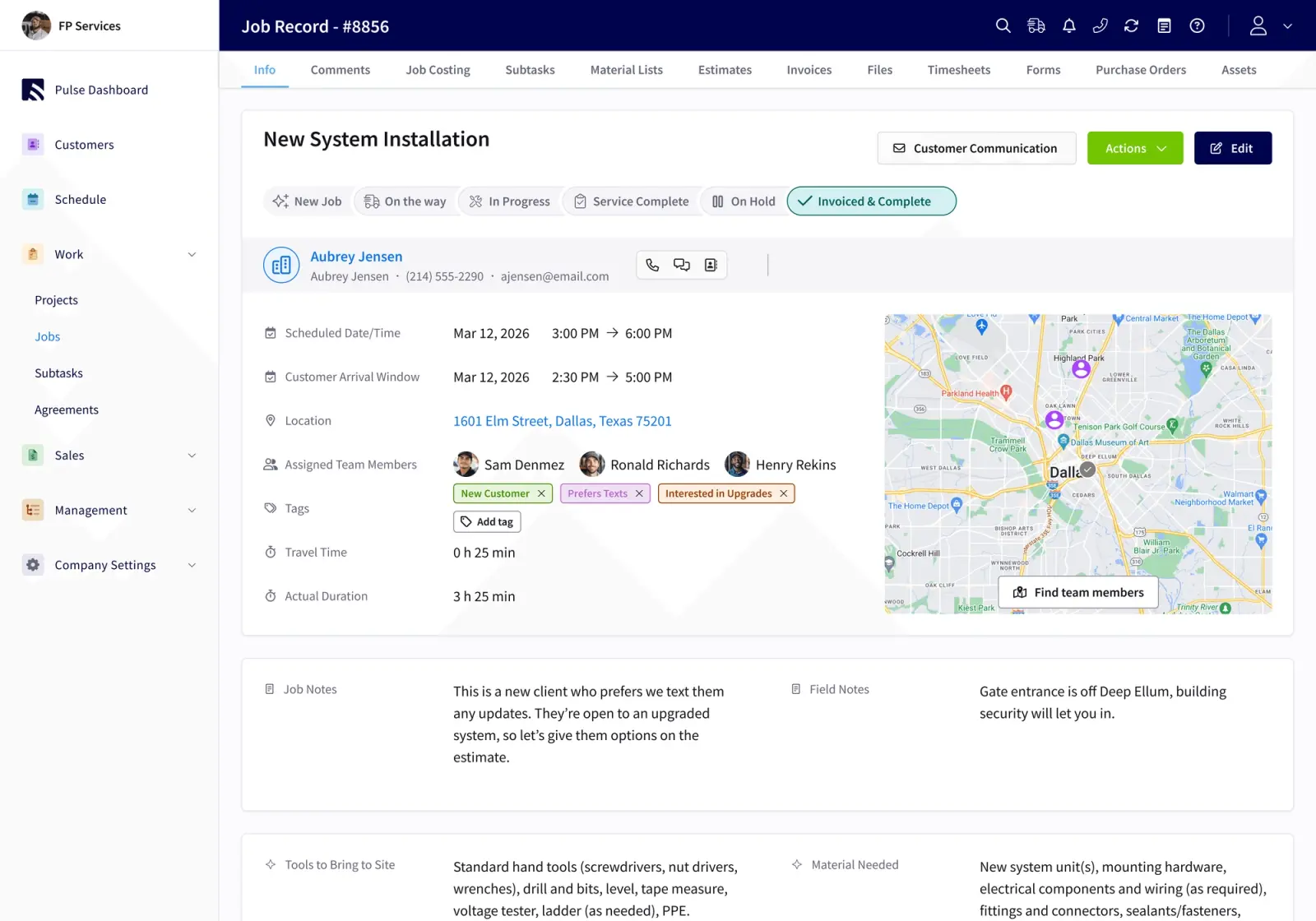
A generic sales CRM tracks leads, contacts, and deal stages. An HVAC field service management platform has to carry a different set of records entirely, including equipment history, service notes, and warranty details that a sales CRM was never built to hold. On a repeat visit, your tech should arrive with the prior job notes, the equipment record, and last visit’s photos already in hand, before they knock on the door.
The platform needs to hold all of the following per customer and per site:
-
Customer contact details and service location
-
Equipment records with model, serial number, install date, and warranty status
-
Full service history per unit, including prior repairs and parts used
-
Photos and documents attached to each job
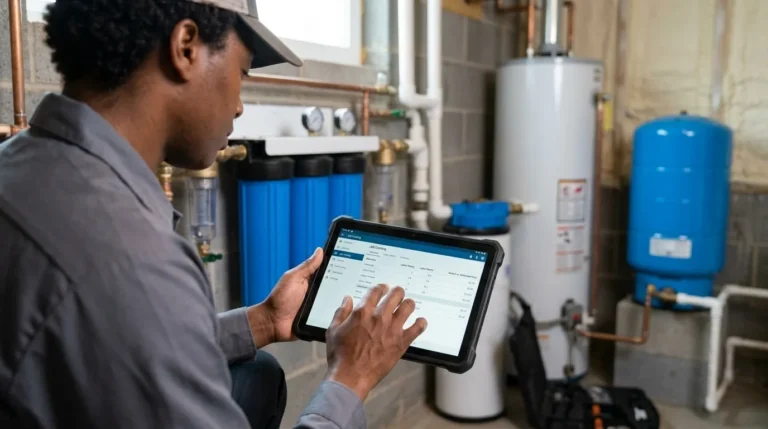
When a technician arrives for a compressor replacement, they should be able to see the equipment model, warranty notes, prior photos, and the last service visit in the mobile app before the job starts. If that information lives somewhere else or nowhere at all, the tech calls the office, the office digs through files, and the job starts late.
This is where a generic sales CRM stops and an HVAC field service management platform has to start.
How an HVAC Job Actually Moves
The breakdown in many HVAC businesses does not happen during the work itself. It happens at the handoff. That is where the office and the field lose sync, where one job stage bleeds into the next, and where what the tech knows never makes it onto the invoice. Here is how each of the four core HVAC job types moves, where it breaks, and what closes the gap.
Service Call Workflow
A service call moves through these stages, with a clear owner at each step:
-
Intake and booking, office administrator takes the call and creates the job record
-
Dispatch and arrival, dispatcher assigns the tech and the tech gets job details on the mobile app
-
Diagnosis and estimate in the field, tech assesses the issue and builds an estimate
-
Repair and closeout, tech records parts, labor, notes, and photos, then captures the customer signature
-
Invoice and payment, office administrator or tech sends the invoice and collects payment
Where it breaks: The job finishes in the field and the details stay there. The office chases the tech for parts and labor, and the invoice goes out days later or not at all.
What closes it: ClearPath custom status workflows and status action flows move the job through defined stages with required actions at each step. ClearPath’s Mobile Focus View shows your tech only what the current stage requires. Two-way QuickBooks Online sync sends the invoice to the books without re-entry.
Seasonal Tune-Up and Maintenance Agreement Workflow
A tune-up visit under a maintenance agreement moves through these stages:
-
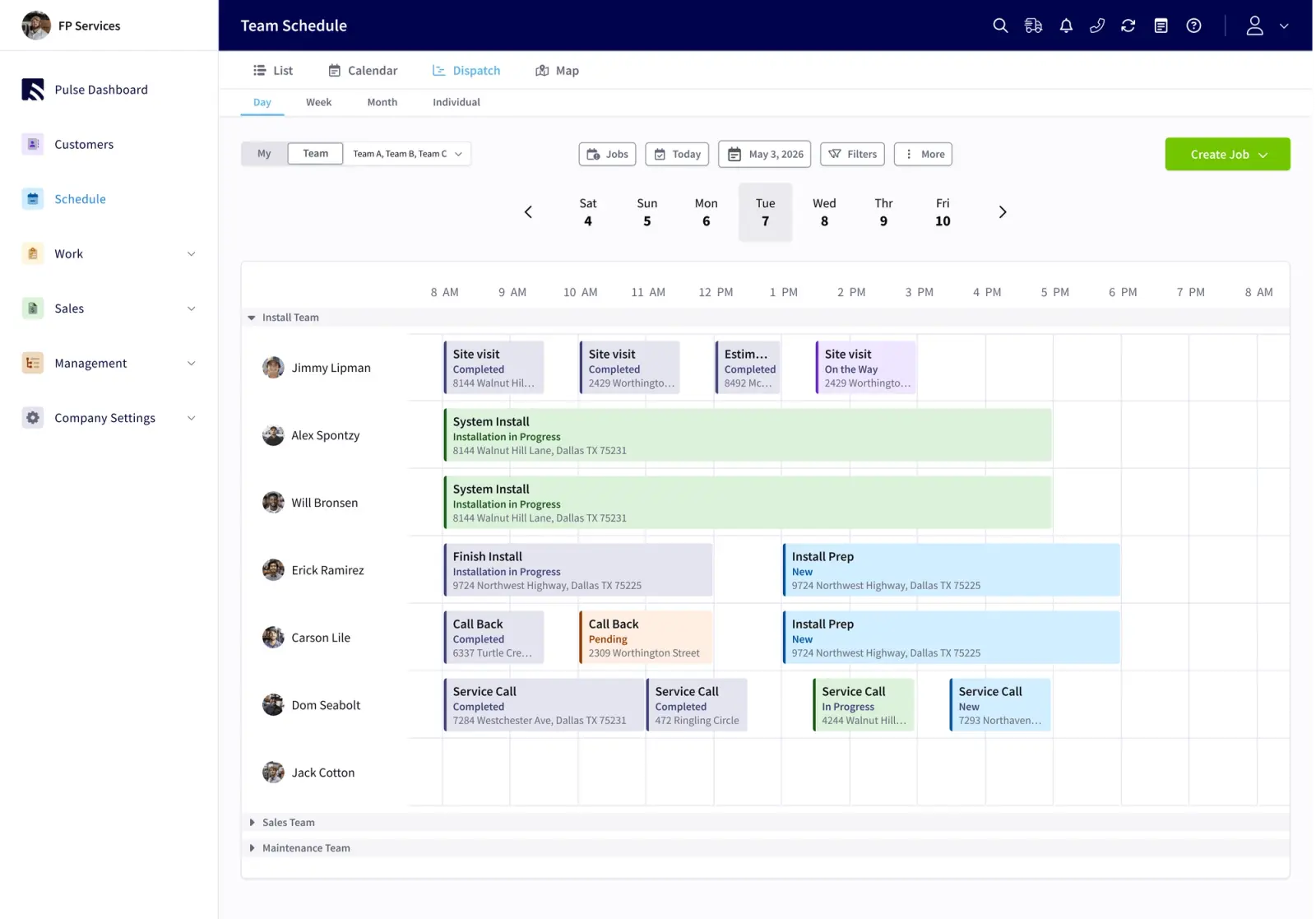
Agreement terms drive the visit schedule, office administrator sets up the contract
-
Reminder sent to customer and tech ahead of the visit, handled automatically
-
Tune-up performed and documented against the equipment record, handled by the tech
-
Findings and recommended work presented, handled by the tech
-
Renewal flagged before the contract lapses, handled by the office administrator
Where it breaks: Recurring maintenance depends on someone remembering. Customers can slip away because of your filing system, not a competitor’s offer.
What closes it: FieldPulse Maintenance Agreements schedule visits automatically from contract terms, send reminders to customers and techs ahead of each visit, generate recurring invoices without manual effort, and flag contracts approaching renewal.
Install Workflow
An install job follows a clear sequence so your pricing, work quality, and customer experience stay consistent:
-
Site assessment and good-better-best options built from preset pricing, handled by a tech or estimator
-
Proposal presented and approved, handled by the tech and customer
-
Install preparation, tech confirms materials, protects floors, and stages the job
-
System install and customer sign-off, tech completes the work, documents it, and captures customer approval before leaving
-
Progress or final invoice, office administrator sends the invoice
Where it breaks: Every estimator prices differently, quotes take hours, and profit margin shows up only after the job. Fair Comfort Solutions described it plainly. Before FieldPulse, a single quote took four to eight hours. With FieldPulse and the pre-built Reece HVAC pricebook, the same quote takes four to eight minutes, a 98% reduction in estimate creation time.
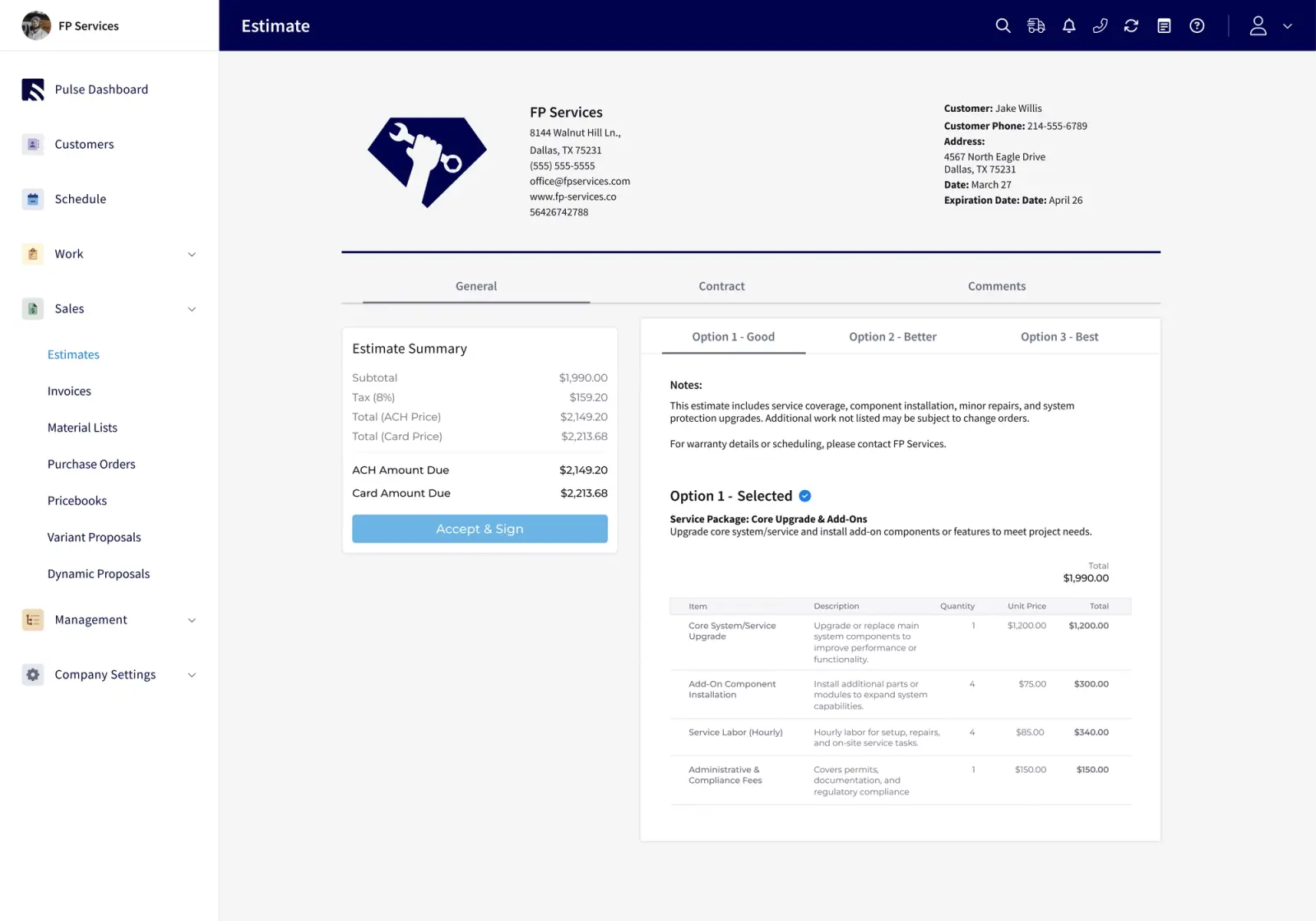
What closes it: The Pricebook add-on holds standard pricing for services, materials, and labor. ClearPath status action flows enforce required steps at each install stage, such as floor protection before work begins and customer sign-off before the tech leaves. Job costing shows your expected profit margin before you dispatch and confirms actual profit at completion.
Commercial Planned Maintenance Workflow
Commercial planned maintenance adds more locations and assets, so structure matters even more:
-
Multi-site account with equipment records per site, set up by the office administrator
-
Scheduled visits across sites, managed by the dispatcher
-
Deficiency reporting and warranty tracking per unit, handled by the tech
-
Consolidated reporting back to the account, handled by the owner or operations lead
Where it breaks: The party paying the invoice is not the party on site. Asset records do not fit a one-customer-one-home model, and deficiency reporting has nowhere to live.
What closes it: FieldPulse asset and equipment records tie service history to individual units. Parent-child customer relationships keep the paying account and the job-site contact separate but linked. ClearPath workflows define what the tech must document at each stage of the visit.
See what your jobs are actually earning. Get a demo of FieldPulse.
Residential vs. Commercial HVAC: What Changes in Your CRM
The four job types above all depend on how well your CRM handles the relationship between the payer and the site. That relationship looks very different when you compare residential and commercial work.
Residential HVAC usually means one customer, one home, and one or two systems. The homeowner is both the payer and the person on site. Your CRM needs to hold the equipment record, the service history, and the agreement, and surface all of it when the tech arrives.
Commercial HVAC follows a different structure. One corporate account can cover multiple sites, rooftops, chillers, and units. The payer and the site contact are different people. Warranty terms vary by unit. Commercial HVAC CRM software must support parent-child account structures that connect organizations to individual sites, assets, warranties, and reporting that rolls up to the organization while preserving site-level detail for scheduling and service.
FieldPulse supports commercial work with multi-site asset records and parent-child customer relationships. Its depth skews residential. Teams running primarily residential HVAC, or a residential-commercial mix, will find the platform fits well. Heavy commercial operations managing large equipment portfolios across many sites may need a platform built specifically for that model.
What HVAC Technicians Need from the Mobile App
Your techs judge the software in the first week. If the app fights them, adoption stalls and your whole rollout slows down. The mobile experience needs to deliver a few basics every day:
-
The day’s jobs with address, contact, notes, and the customer’s history
-
The equipment record and prior service history on arrival
-
A guided view that shows only what the current job stage requires, with checklists and single-tap actions
-
Job-specific forms and customer signatures
-
Estimates built from preset pricing and converted to invoices on site
-
Payment capture before leaving the driveway
ClearPath’s Mobile Focus View handles the guided experience. Your tech sees a short, ordered list of what the current stage requires, not the whole platform. That keeps the learning curve low and helps crews with no software history get comfortable fast.
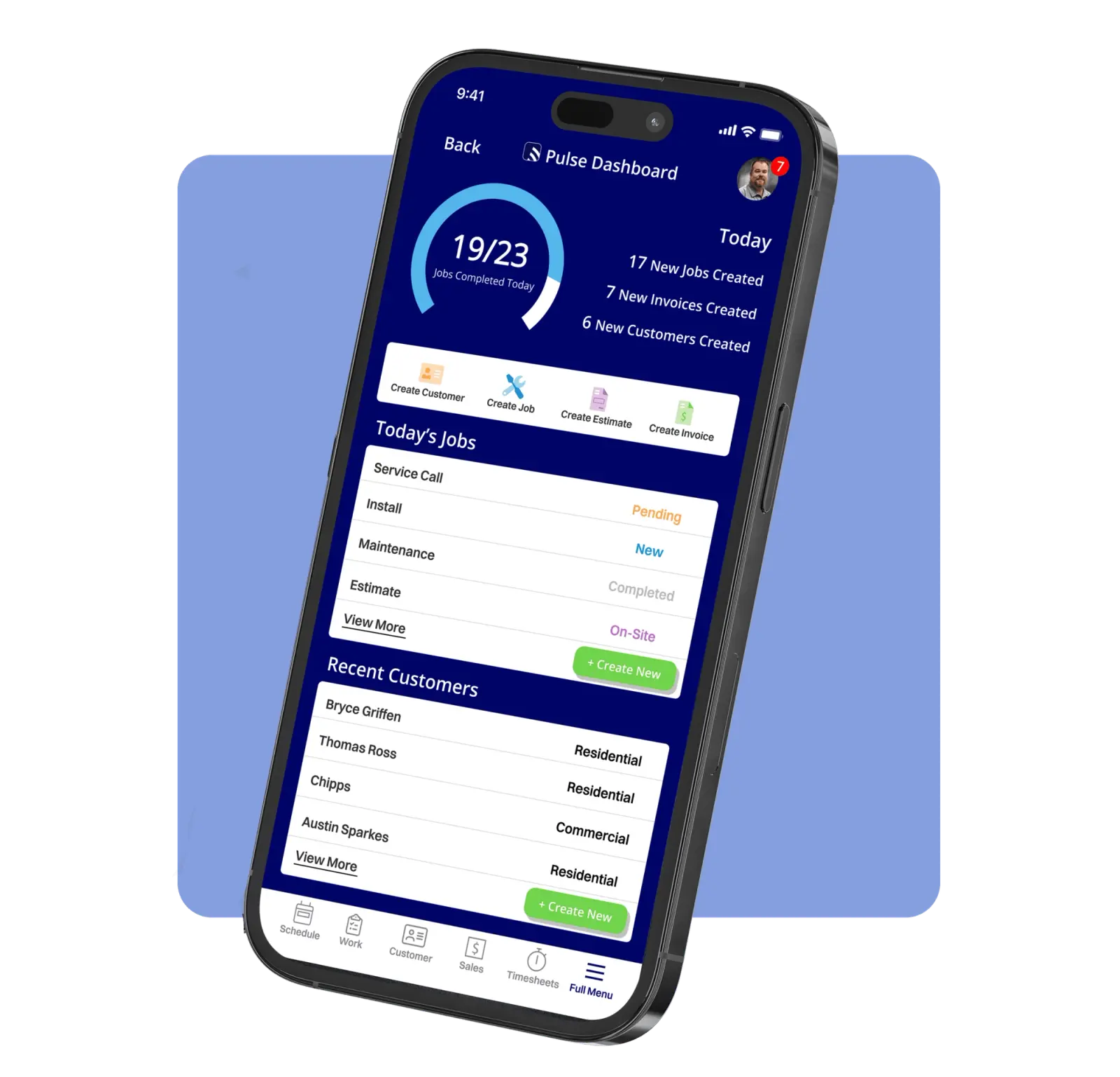
Offline access matters when techs work in basements, crawlspaces, or rural areas. FieldPulse caches the past week of jobs, projects, customers, estimates, and invoices on the device. Your techs can view cached jobs, add unlimited notes, upload up to 50 photos at a time, change job status, clock in and out, and update cached estimates and invoices while signal is down. If signal drops mid-edit, the active draft becomes an offline draft automatically. Everything syncs when signal returns.
ClearPath’s Mobile Focus View does not display while offline. Offline payment collection, purchase order creation, and creating new customer or job records require a signal. FieldPulse caches recent data so your techs can complete a majority of the job without cell signal in scenarios like rural areas or mechanical rooms.
Maintenance Agreements and Tune-Up Reminders
Recurring revenue keeps many HVAC businesses stable through the year. HVAC agreement customers often spend more per year than non-agreement customers once repairs and replacements pulled through by maintenance visits are counted. That revenue appears only when the agreement program actually runs, and many programs stall because they depend on someone remembering.
FieldPulse Maintenance Agreements handle the operational side of a recurring service program so your team does not chase dates on a spreadsheet. The feature supports you with:
-
Automatic visit scheduling from contract terms, with no manual calendar entries
-
Reminders sent to customers and techs ahead of each scheduled visit
-
Recurring invoicing generated without manual effort
-
Full service history per customer, tied to the equipment record
-
Renewal alerts on contracts approaching expiration
Bayou South Mechanical, a four-person HVAC team in Baton Rouge, used FieldPulse to replace manual processes, launch a recurring maintenance program, and build a scalable foundation with a lean team. The agreement program now runs on the contract terms instead of someone’s memory.
Reaching a healthy range of healthy HVAC maintenance agreement renewal targets requires a system that flags renewals before they lapse, not a spreadsheet someone checks occasionally.
QuickBooks and Your HVAC CRM: What Two-Way Sync Actually Means
Your books stay clean when your field service software and QuickBooks stay in sync. Many platforms push data into QuickBooks Online and stop listening. That one-way push means a bookkeeper can rename a vendor or fix a journal entry in QuickBooks, but the change never flows back, so the two systems drift apart.
FieldPulse syncs both ways. In practice, that means:
-
Customers and line items, estimates and invoices, payments, purchase orders with full line-item detail, and vendors sync in both directions
-
Timesheets flow into QuickBooks Online when a tech clocks out
-
Tax rates come from QuickBooks Online
-
Invoice numbering can follow your existing QuickBooks sequence
-
When your bookkeeper corrects something in QuickBooks Online, the fix carries back into FieldPulse instead of being overwritten
That last point matters most to the person keeping your books. Ask every platform you evaluate how a correction in QuickBooks Online makes its way back into your field service software.
FieldPulse works with QuickBooks Online Essentials, Plus, and Advanced in the US, Canada, and Australia. QuickBooks Desktop is also supported.
What Is the Best Field Service Management Software for HVAC?
Your best fit depends on your team size and service model. For established residential HVAC teams in the 7-to-50-technician range, FieldPulse is built for that gap, serving teams that have outgrown simpler tools and do not need enterprise-oriented complexity.
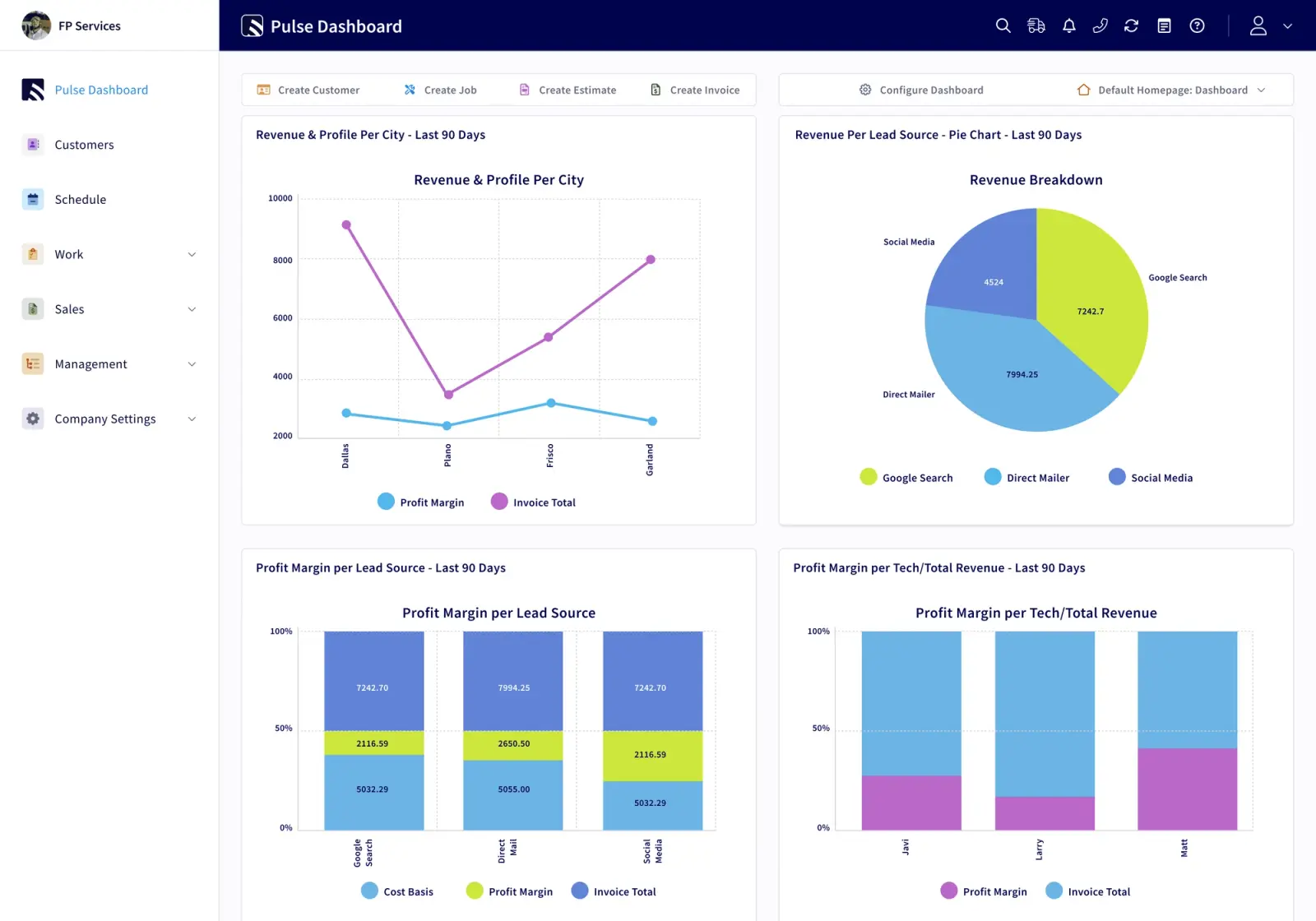
The table below maps team size and service model to the best-fit platform so you can see where your operation lands.
|
Company Size |
Service Model |
Best Fit |
|---|---|---|
|
7–15 technicians |
Residential |
FieldPulse, for teams that have outgrown a simpler tool and need inventory, permissions, and multi-stage workflows |
|
15–50 technicians |
Residential |
FieldPulse, for teams that need job costing, Pricebook discipline, Maintenance Agreements, and reporting |
|
Any size |
Commercial |
FieldPulse supports commercial work with multi-site asset records and parent-child customer relationships, and its depth skews residential |
Top Notch Heat and Air, an HVAC-R business in Michigan, saved 4–6 hours weekly and saw a 15% revenue increase after switching to FieldPulse (a figure asterisked on the published case study). Their IT Director put it directly: “Field Pulse has made our day to day operations much more organized and thorough. It enables our techs and office staff to communicate better with each other and with our customers.”
CSS Mechanical, an HVAC team of 11–20 techs, described the shift plainly: “We [came] from pen/paper and spreadsheets to FieldPulse so it [was] a big improvement and has given us visibility into our Business we didn’t have before, like profitability by customer.”
See how FieldPulse connects your office and your field on one workflow. Get a demo.
Frequently Asked Questions
What CRM Do HVAC Companies Actually Use?
Most HVAC companies use a platform that combines CRM and field service management in one system instead of a standalone sales CRM. Your customer record, equipment history, and job workflow need to live together. A sales CRM handles leads and contacts but does not understand service agreements, equipment tracking, or technician notes. For residential HVAC teams, the CRM capability usually lives inside an FSM software platform so the customer record connects directly to the dispatch board and the invoice.
What Is the Best Field Service Software for HVAC?
The strongest HVAC field service software lets you connect customer records, equipment, and job workflows, while giving techs a simple mobile app and your office a clean handoff into QuickBooks. FieldPulse focuses on residential and mixed residential-commercial teams that want ClearPath workflows, Maintenance Agreements, two-way QuickBooks sync, and job costing in one platform.
What Are the Best Apps for HVAC Technicians?
The best apps show your tech the day’s jobs, the equipment record, and the customer’s prior service history on arrival, before the job starts. A guided view that shows only what the current job stage requires reduces the learning curve for new hires and keeps experienced techs from skipping steps on busy days. Offline access also matters. Techs working in basements, crawlspaces, or rural areas need to add notes, update job status, and work from cached job data when signal drops, with everything syncing automatically when they are back in range.
How Do I Track HVAC Equipment and Service History?
A field service CRM for HVAC should hold each unit’s model, serial number, install date, warranty status, prior repairs, parts used, and photos on the equipment record, tied to the customer and the service location. When a tech arrives on a repeat visit, that history should already be in hand. The same record supports warranty tracking and deficiency reporting on commercial accounts with multiple units across multiple sites.
One System for Every Job Type
The customer record, the equipment record, and the job record living in three different places is a structural problem, and it gets worse with every crew you add. Tune-ups do not renew because nobody flagged the expiring agreement, warranties get missed because the equipment record lives somewhere else, and invoices go out late because the job details stayed in the field, all symptoms of the same structural problem.
FieldPulse connects your office and your field on one workflow. ClearPath is included in the core platform and turns your process into defined job stages, required actions at each step, and a mobile view that shows your tech exactly what the current stage needs. Maintenance Agreements, two-way QuickBooks Online sync, job costing, and the Pricebook add-on close the handoff at every stage, including service calls, tune-ups, installs, and commercial planned maintenance.
On average, FieldPulse customers experience 25% gains in efficiency, with office teams saving more than 40 hours per month and field teams seeing a 50% increase in on-time delivery. FieldPulse holds a 4.8 out of 5 rating across G2, Capterra, the App Store, the Google Play Store, and other software-review sites.
See how FieldPulse keeps every job type on one workflow. Book your demo.