









Key Takeaways For Growing Service Teams
- Workflow breakdowns like missed invoices, scheduling chaos, and lost job details usually come from disconnected systems, not staffing levels.
- Field service management software brings scheduling, dispatching, mobile job tracking, invoicing, and payments into one real-time platform.
- Teams with 7 to 20 techs get the most value from offline mobile apps, job costing, two-way QuickBooks sync, and on-site payment capture.
- Most growing trades pay $100 to $300 per user each month, and choosing a scalable platform early helps you avoid painful migrations later.
- Book a demo to see how FieldPulse streamlines your office-to-field workflow and protects your profit margin.
Why Growing Trades Turn To Field Service Management Software
Field service management (FSM) software helps your service business manage jobs from scheduling to payment. It connects your office and your field with tools for dispatching, job tracking, invoicing, and customer management.
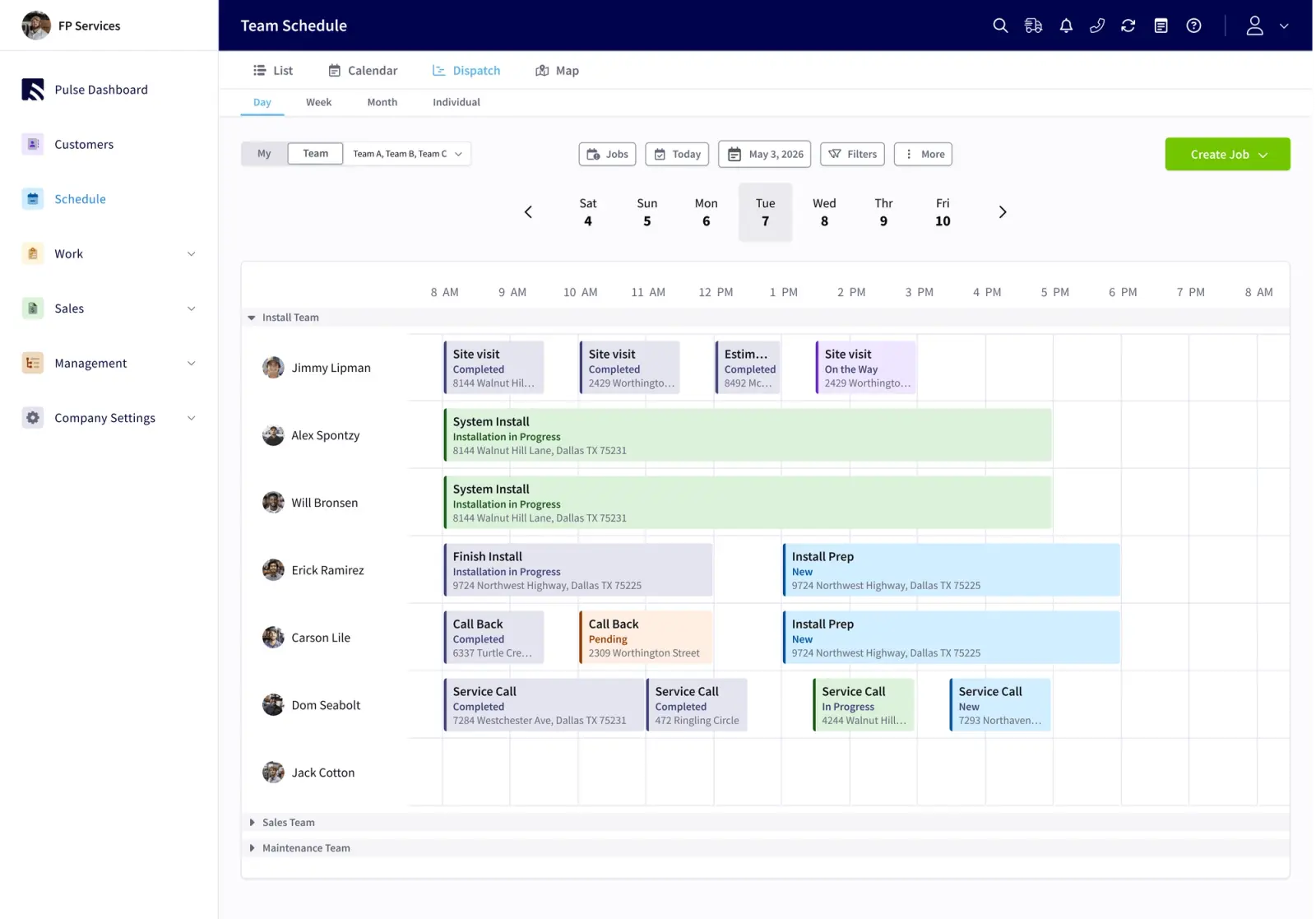
For a growing trade business, FSM software becomes the single place where job details, a customer's history, tech schedules, and financials all live together. Information moves through a shared system your whole team can see and act on in real time, instead of through manual handoffs like texts, phone calls, and sticky notes.
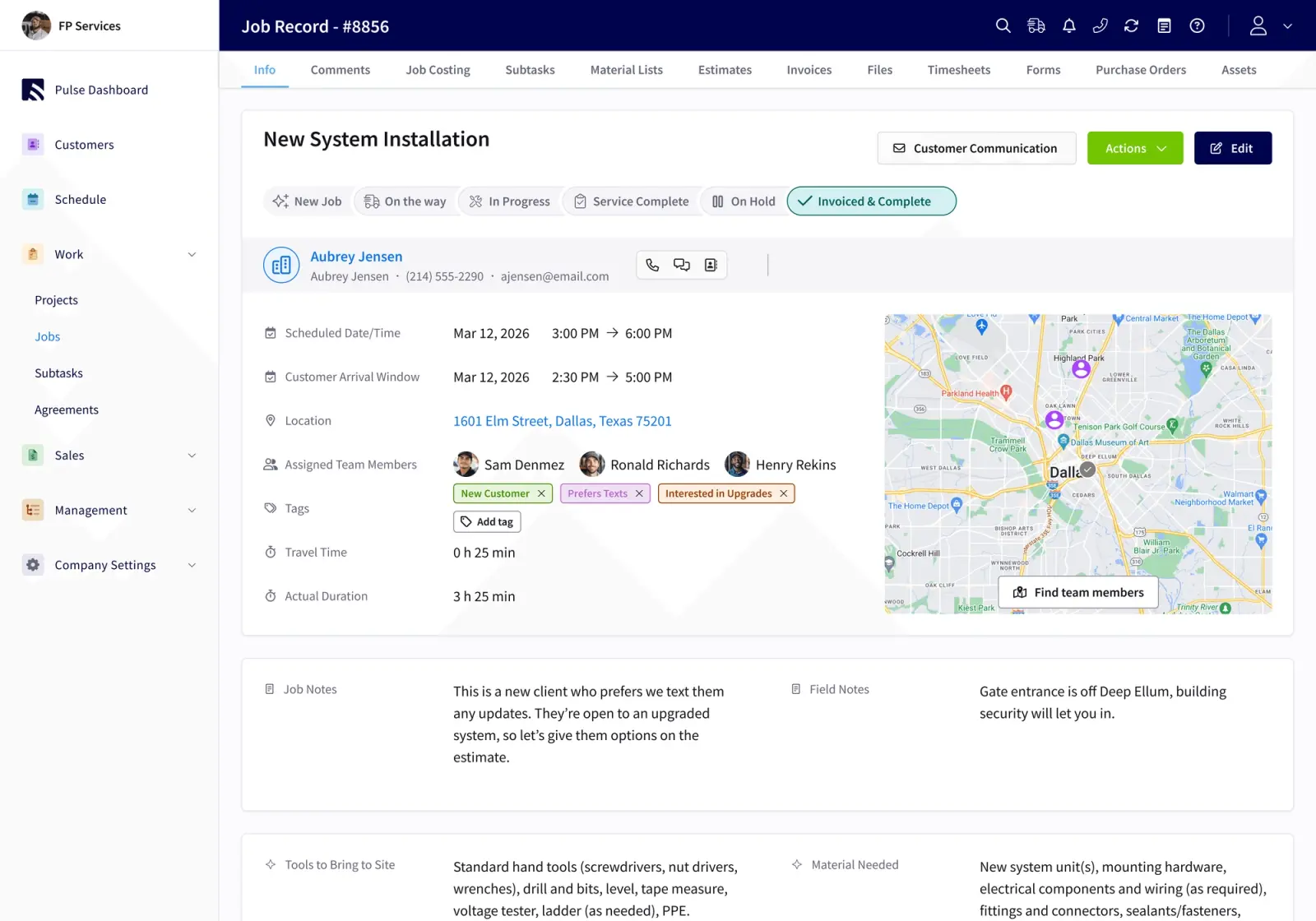
FSM software covers more than a basic invoicing tool or a standalone scheduling app. Those tools handle one piece of the job. FSM software manages the whole lifecycle from the first call to the final payment. It also covers what happens in between when a tech is on-site, a customer reschedules, or a part needs to be ordered.
The global FSM market grew from $5.12 billion in 2025 to $5.88 billion in 2026, driven by demand for real-time field visibility, mobile workforce tools, and integrated service platforms. North America holds the largest share of that market, and mid-market residential trades are one of the fastest-growing segments.
Core FSM Features That Matter For 7–20 Tech Teams
Some features matter more once your team reaches 7 to 20 techs. These capabilities usually make the biggest difference.
- Scheduling and dispatch. A drag-and-drop board shows where your techs are so your office can handle emergency requests without rebuilding the day by phone.
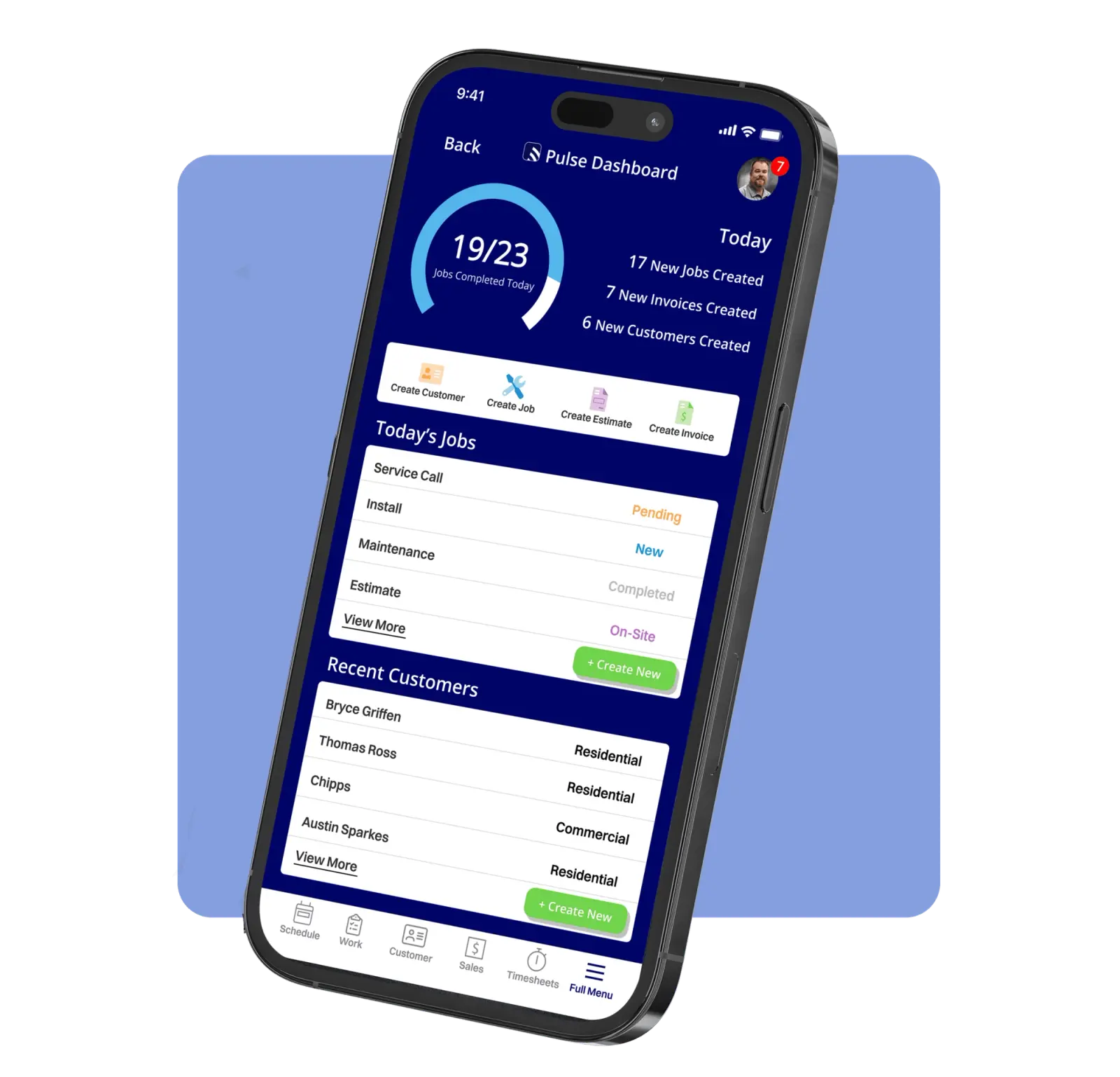
- Mobile app for techs. Your techs need job details, a customer's history, forms, and payment capture on their phones, even when signal drops. Offline capability matters for teams working in basements, crawlspaces, or rural areas.
- Job and customer management. One record holds the customer's history, equipment details, photos, and notes. A tech arrives informed, and your office can answer questions without calling the truck.
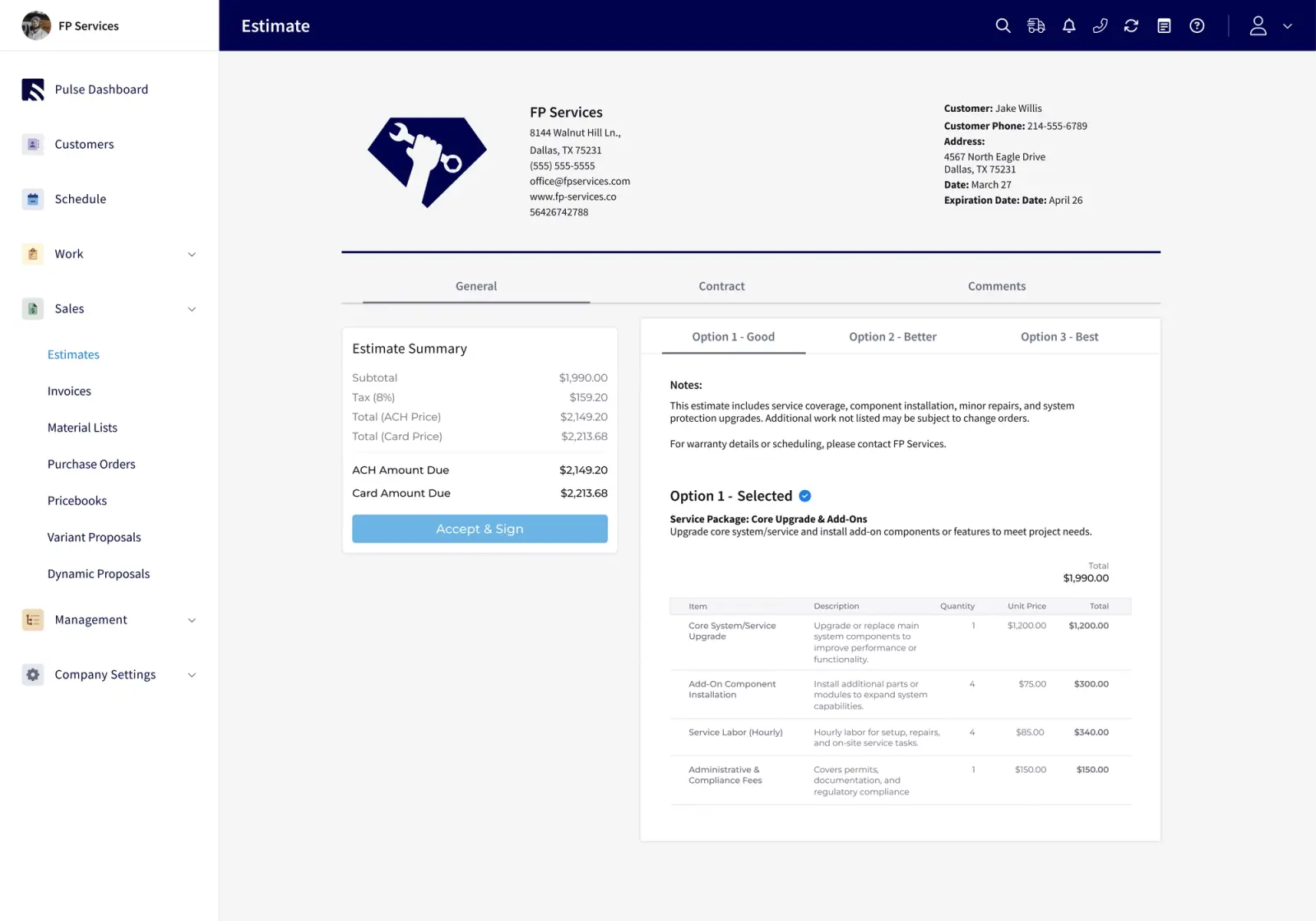
- Estimating and invoicing. Your team builds quotes from preset pricing, converts them to invoices without re-entry, and collects payment before the tech leaves the driveway.
- Job costing and profit margin tracking. You see whether each job made money by tracking labor, materials, and overhead against revenue. This visibility turns every job into a clear profit or loss instead of a guess at month end.
- Payments and collection. Online payment links, on-site card and ACH capture, and fast funding shorten the path from completed work to cash in the bank. Businesses that invoice on-site collect payment 11 days faster on average than those that invoice from the office.
- Reporting and dashboards. You get visibility into tech performance, revenue, outstanding invoices, and profitability by job type or customer.
- Integrations. Two-way QuickBooks sync removes double entry and month-end reconciliation. A correction made in QuickBooks should carry back into your field software so your team does not repeat work.
As your team grows past 10 techs, you also feel the need for custom workflows, inventory tracking, and roles and permissions. These controls let you decide who sees what without routing every decision through one person.
What Field Service Management Software Typically Costs
Most small to mid-size field service businesses pay between $30 and $300 per user per month for FSM software, and enterprise platforms can cost more. According to Capterra's 2026 benchmarks, entry-level FSM plans generally start around $100 per month, and premium tiers with advanced features run $450 or more per month.
Several factors influence your total cost. These include the number of techs and office staff who need access, the features you require such as job costing, inventory, or custom workflows, and any add-ons like pricebooks, AI tools, or advanced reporting. Payment processing fees also affect your monthly bill.
Implementation and training costs vary widely by platform and complexity. They range from $0 for self-service entry-level setups to over $100,000 for enterprise deployments. Mid-market implementations typically cost $5,000 to $25,000.
Capterra's 2026 field service software benchmarks confirm that entry-level plans generally start around $100 per month, while premium subscriptions run $450 or more. Mid-range platforms typically run $100 to $300 per month for small to mid-size operations, which is where most growing residential trade businesses land.
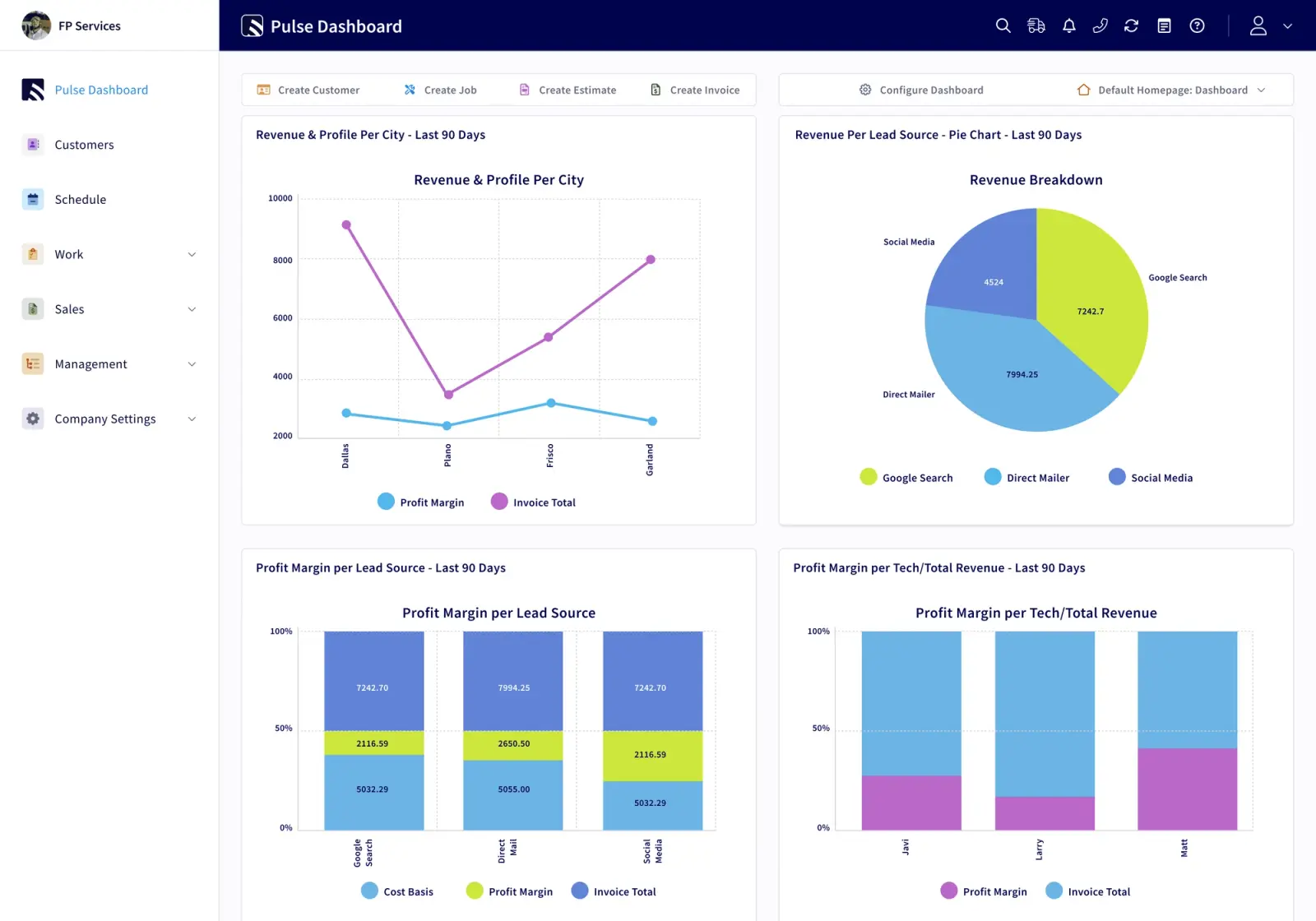
A low sticker price does not always create the best value. A tool that works at 5 techs may not scale to 15, and switching later costs time and productivity. If a platform lacks job costing, two-way QuickBooks sync, or the workflow flexibility your team needs, you pay for that gap through lost profit margin and extra admin work.
How FSM Software Differs From CRM Software
CRM (customer relationship management) software focuses on the sales side of your business, such as lead tracking, sales pipelines, and communication history. FSM software manages the operational side, including scheduling, dispatch, job execution, and invoicing.
Here is a quick comparison.
| Category | CRM | FSM |
|---|---|---|
| Primary focus | Customer relationships and sales pipeline | Job lifecycle from scheduling to payment |
| Primary users | Sales and marketing teams | Dispatchers, techs, and operations leads |
| Key features | Lead management, pipeline tracking, follow-up automation | Scheduling, dispatch, mobile app, invoicing, job costing |
FSM software includes CRM-like customer's history such as service records, equipment details, and prior jobs. It also adds what a residential trade business needs most: job scheduling, mobile access for techs, job costing, and payment collection. For your business, the "deal" is a booked job, and the "pipeline" is your dispatch board. Generic CRM software was designed for B2B sales teams managing leads through a pipeline, which is a different workflow from field service.
For most residential trade businesses, FSM software gives you a more complete solution. If you have a dedicated inside sales team managing complex multi-touchpoint pipelines, a standalone CRM may add value alongside your FSM. Otherwise, an FSM platform with built-in customer management usually covers what you need.
How To Choose Field Service Management Software For Your Business
Use this simple selection process before you compare platforms.
- Assess your workflow bottlenecks. Identify where information breaks down, such as late invoices, scheduling chaos, or invisible profit margin. Document your current process from first call to final payment and mark the handoffs that fail most often.
- Define your must-have features. Base this list on your trade, team size, and bottlenecks. A 15-tech HVAC company may treat job costing and equipment history as essential. A 7-person garage door team may prioritize scheduling and mobile access.
- Verify your accounting integration. If you run QuickBooks, confirm the sync is two-way. A change made in QuickBooks should carry back into your field software instead of getting overwritten on the next sync.
- Evaluate implementation and support. Ask about onboarding timelines, training, and ongoing support. A platform that takes 3 to 6 months to implement often adds more complexity than a 12-tech team needs.
- Involve your office manager and techs in the demo. Your office administrator runs the system daily, and your techs use the mobile app on every job. When they see their workload getting easier, adoption moves faster.
Fit matters more than a long feature list. A tool built for a solo operator rarely scales to 15 techs, and an enterprise platform often brings complexity and cost a growing residential team does not need. FieldPulse is built for teams like yours and offers custom workflows, job costing, and two-way QuickBooks sync without enterprise complexity.
See what your jobs are actually earning. Get a demo of FieldPulse.
Implementation And Adoption: What To Expect
Implementation and adoption shape how quickly you see value from FSM software. Most teams also want a clear picture of timing and buy-in.
Typical onboarding for FSM software runs 2 to 6 weeks. The exact window depends on your team size, how much data you migrate, and how your accounting setup works. Faster launches happen, but you protect your schedule when you plan for the full range.
Successful adoption starts when you involve your office administrator and techs early. Your office manager often acts as the adoption gatekeeper, and if they stay unconvinced, the rollout stalls no matter how much you like the demo. Your techs need to see that the mobile app makes their jobs easier and reduces paperwork.
FieldPulse provides guided implementation with an implementation manager, a phased rollout, and training sessions with homework between each one so your team can practice. The process is structured so the office sees duplicate entry disappear when your books and your field software finally agree. That moment is usually when the value clicks.
Common Pitfalls To Avoid When Buying FSM Software
These mistakes cost growing trade businesses the most time and money during FSM evaluations.
- Choosing software without job costing. If you cannot see whether each job made money, you guess at your profit margin instead of managing it.
- Ignoring tech usability. A powerful desktop platform with a clunky mobile app creates constant phone calls back to the office.
- Underestimating data migration. Moving a customer's history, equipment records, and open jobs takes planning. Ask what transfers and what stays behind.
- Overlooking QuickBooks sync depth. A one-way push creates double entry. Verify that the sync truly runs in both directions.
- Picking a tool that cannot scale. A platform that works for 5 techs may struggle with 15. Choose based on where your business is going over the next few years.
Avoid these pitfalls with a platform that keeps your office and field in sync. Book a demo.
Frequently Asked Questions
What Is The Best Field Service Management Software?
For growing residential trade businesses with 7 to 20 techs, the best FSM software fits how your team actually works. FieldPulse is built specifically for teams in this range. It combines workflow standardization, job costing, two-way QuickBooks sync, and a mobile app your techs will use, without the implementation complexity or cost of enterprise platforms. It holds a 4.8 out of 5 aggregate rating across G2, Capterra, the App Store, the Google Play Store, and other software-review sites.
How Much Does Field Service Management Software Cost?
As covered above, most small to mid-size field service businesses pay $30 to $300 per user per month for FSM software. Entry-level plans usually start around $100 per month, and premium tiers with advanced features often reach $450 or more. Your total cost depends on team size, required features, add-ons, payment processing fees, and implementation support.
What Features Are Essential In FSM Software?
For a team of 7 to 20 techs, focus on scheduling and dispatch, a mobile app for techs with offline capability, job and customer management, estimating and invoicing, job costing, payment collection, reporting, and two-way accounting integration. As your team grows, you also benefit from custom workflows, inventory tracking, and roles and permissions.
How Long Does FSM Software Implementation Take?
Most implementations take 2 to 6 weeks. Timing depends on your team size, which capabilities you enable, how much data you migrate, and your accounting setup. The process works best when you phase it: configure the foundation first, then move data, then train each role. Involving your office administrator and techs from the start helps adoption stick.
Can FSM Software Integrate With QuickBooks?
Yes, many FSM platforms integrate with QuickBooks, but the quality of that integration varies. Look for two-way sync so a correction made in QuickBooks carries back into your field software automatically. One-way push creates double entry and causes your books and your field software to drift apart. FieldPulse's two-way QuickBooks Online sync keeps customers, invoices, payments, purchase orders, and vendors in sync in both directions, with timesheets flowing into QuickBooks when a tech clocks out.
Next Steps For Your FSM Evaluation
The right FSM software fixes how information moves between your office and your field. It standardizes your process, protects your profit margin, and scales with your team.
Before you evaluate any platform, document your current workflow from first call to final payment and mark where the handoffs break down. That exercise gives you a clear checklist of what your next system must handle.
FieldPulse customers often see about 25 percent gains in efficiency, with office teams saving more than 40 hours per month and field teams seeing a 50 percent increase in on-time delivery. FieldPulse helps growing teams standardize workflows and protect profit margins without adding complexity your business does not need.
Ready to standardize your workflow and protect your profit margin? Schedule a FieldPulse demo.