









Key Takeaways
- Mid-sized field service teams with 7 to 20 techs often hit operational breakdowns as growth outpaces process development. Late invoices, inconsistent pricing, and poor visibility into profitability become common.
- Features that matter most at this size include job costing with profit tracking, inventory management, customizable workflows by job type, roles and permissions, strong reporting, two-way QuickBooks sync, and a mobile app that works offline.
- Clear signs you have outgrown basic tools include delayed invoicing, inconsistent estimates, separate spreadsheets for scheduling, limited visibility into profitable jobs, and emergency dispatch that still relies on phone calls.
- Evaluating FSM software works best when you score each option on workflow fit, office workload, field usability, financial visibility, implementation effort, and scalability.
- FieldPulse is purpose-built for mid-sized residential service teams. It gives you operational depth without enterprise complexity. Book a personalized demo to see how it keeps your office and field teams in sync.
The Mid-Sized FSM Dilemma
Smaller teams can rely on memory and quick conversations to keep jobs moving. Once you reach 15 techs, that approach stops working. Every missing detail turns into a phone call, a missed invoice, or a job stuck in “on hold” for weeks with no clear owner.
Growth usually outpaces process development. As your team grows, manual information tracking increases and handoffs get missed more often. What worked for a team of 10 techs rarely holds up with 20 or more. The breakdown usually shows up in four places:
- Jobs finish in the field but the details stay there, so invoices go out late or never go out
- Emergency requests come in and the dispatcher rebuilds the day through a chain of phone calls
- Pricing varies by whoever built the estimate, so you only see profit margin after the job closes
- A customer’s history is scattered across texts, access files, and separate systems nobody can search quickly
The field service management software market is growing fast. It is projected to reach nearly $10 billion globally by 2031. Most of that growth comes from teams like yours that have outgrown basic tools and now need more depth. This guide walks you from recognizing that pain to choosing and rolling out a better platform.
What Defines “Mid-Sized” In Field Service Management?
In FSM terms, “mid-sized” describes a level of operational complexity, not just a headcount. A mid-sized field service business typically runs 7 to 20 techs, handles multiple job types, and needs the office and field to stay in sync across all of them. Job volume is high enough that manual coordination breaks operationally, but not so high that you need a dedicated IT team to manage operations.
Simple tools fit smaller residential teams that only need scheduling and invoicing. Their per-seat costs climb quickly, and they lack support for multi-stage workflows once your operation adds inventory, permissions, job costing, or multiple job types. At the other end, enterprise platforms serve large operations with dedicated implementation teams and budgets to match. For a 12-person HVAC or plumbing company, that level of complexity and cost usually exceeds what you need.
The sweet spot is a platform that gives you operational depth with job costing, inventory, customizable workflows, and real reporting, while still feeling manageable to roll out and run. This guide focuses on that middle ground.
Key Features To Prioritize For Mid-Sized Teams
Certain features matter much more once you reach 7 to 20 techs. Focus on these first and make sure each one fits how your team actually works.
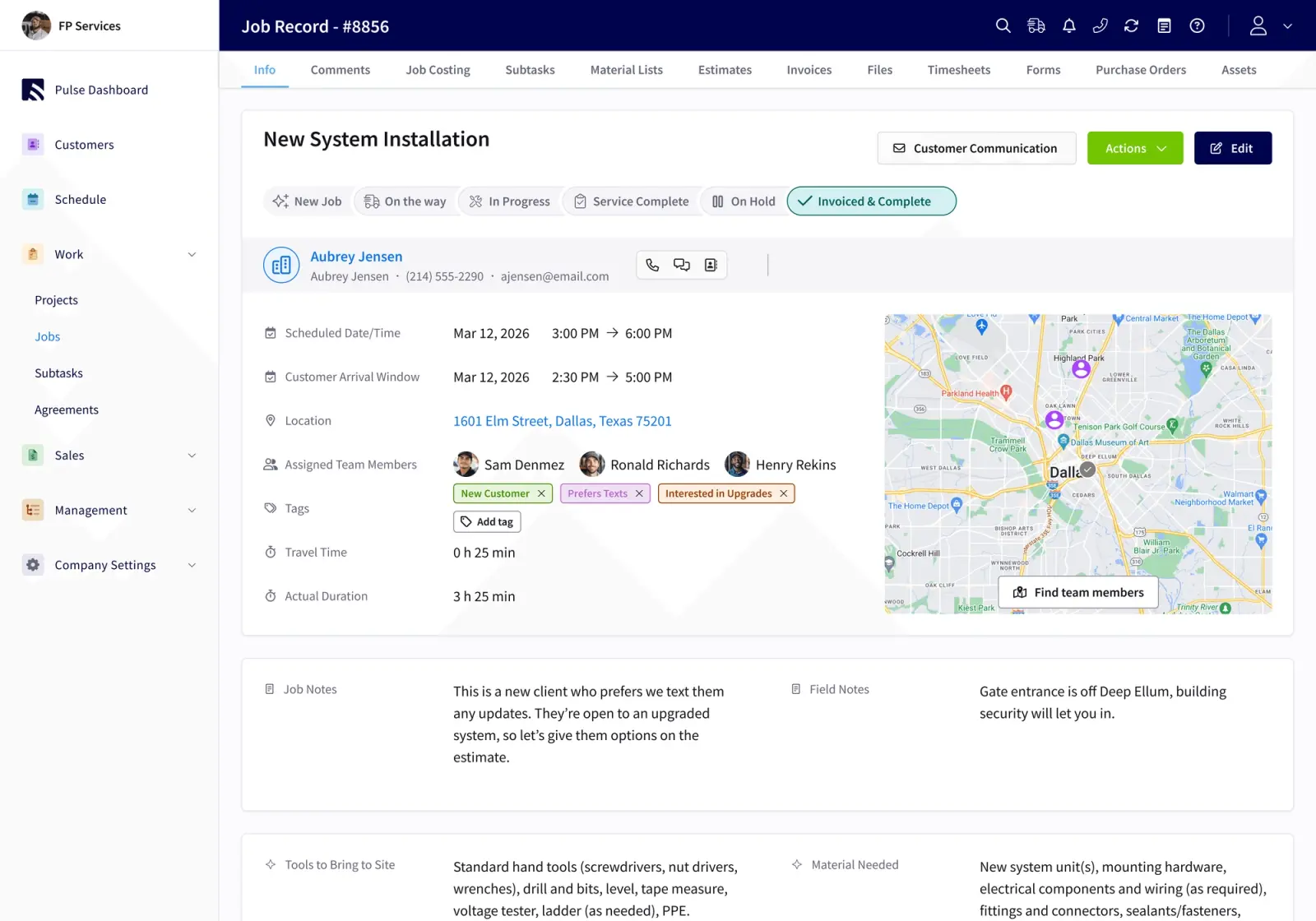
Job costing and profit tracking. You need to know your expected profit margin before you dispatch a job and confirm actual profit after it finishes. That requires tracking labor, materials, and overhead against the quoted price on every job. Job costing replaces guesswork with real data, so you can adjust pricing on job types that consistently run over on labor or materials. Learn more about how flat-rate pricing connects to profit margin visibility.
Inventory management. When a tech pulls a part from van stock, that cost should hit the job record automatically and update your inventory count. Manual tracking at this scale creates return visits and profit leaks. Strong inventory management connects directly to job costing so parts usage updates both stock counts and job profitability in one workflow.
Customizable workflows by job type. Installs and service calls follow different steps. Your software should let you define stages for each job type and require techs to complete specific actions before moving on. This keeps quality consistent across your whole team and makes training new techs easier.
Roles and permissions. Each role needs a focused view. Your office administrator does not need every financial report. Your techs do not need to edit customer billing details. Permissions let you give each person what they need without routing everything through one gatekeeper.
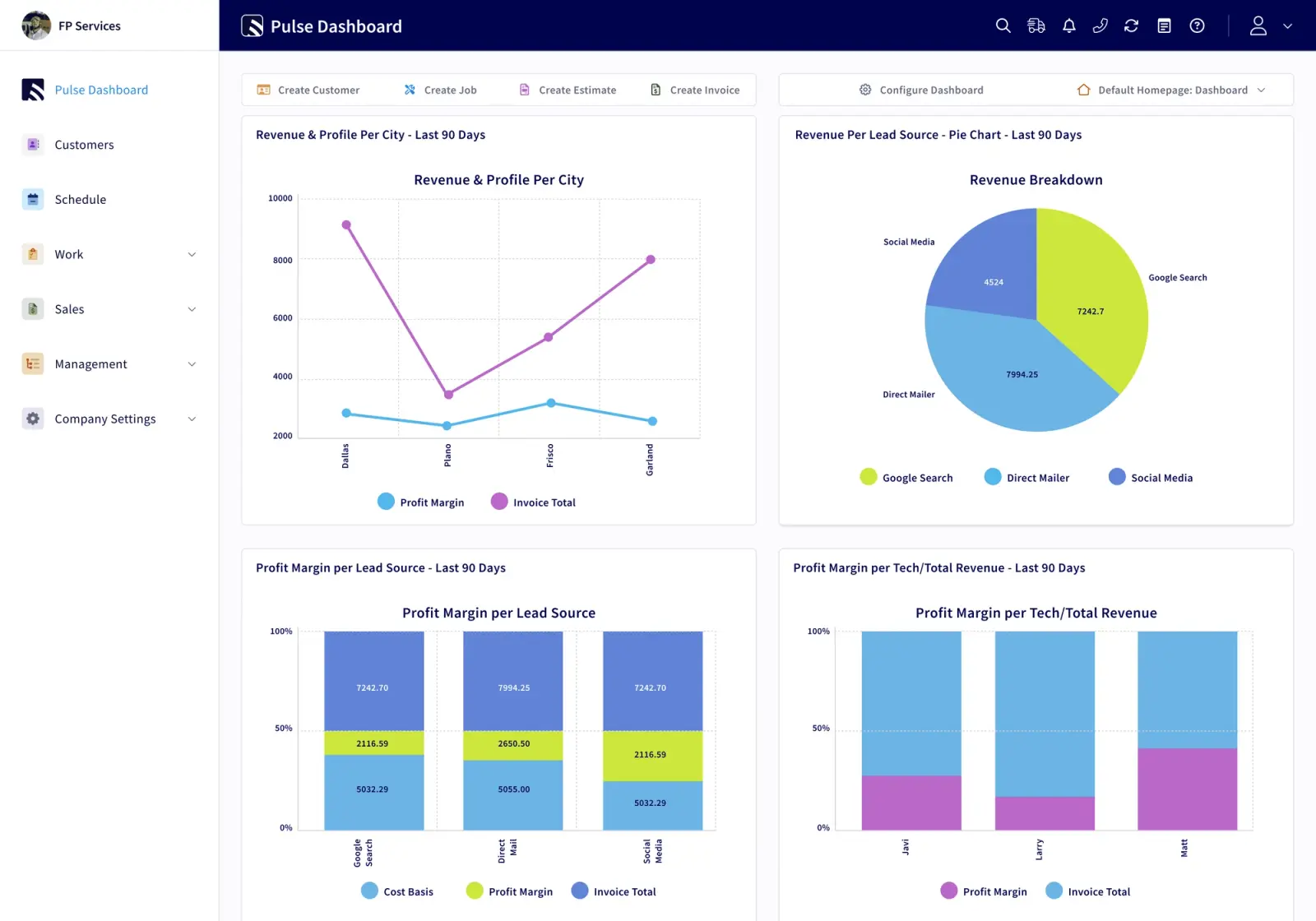
Reporting and dashboards. At 7 to 20 techs, gut feel no longer gives you enough visibility. You need clear views into technician performance, revenue by job type, outstanding invoices, and profit margin by job. Look for useful prebuilt reports plus the option to build custom ones.
Two-way QuickBooks sync. One-way data pushes create double entry. When your bookkeeper corrects something in QuickBooks, that fix should flow back into your field software instead of getting overwritten. A true two-way sync removes the reconciliation work that often eats your office team’s evenings.
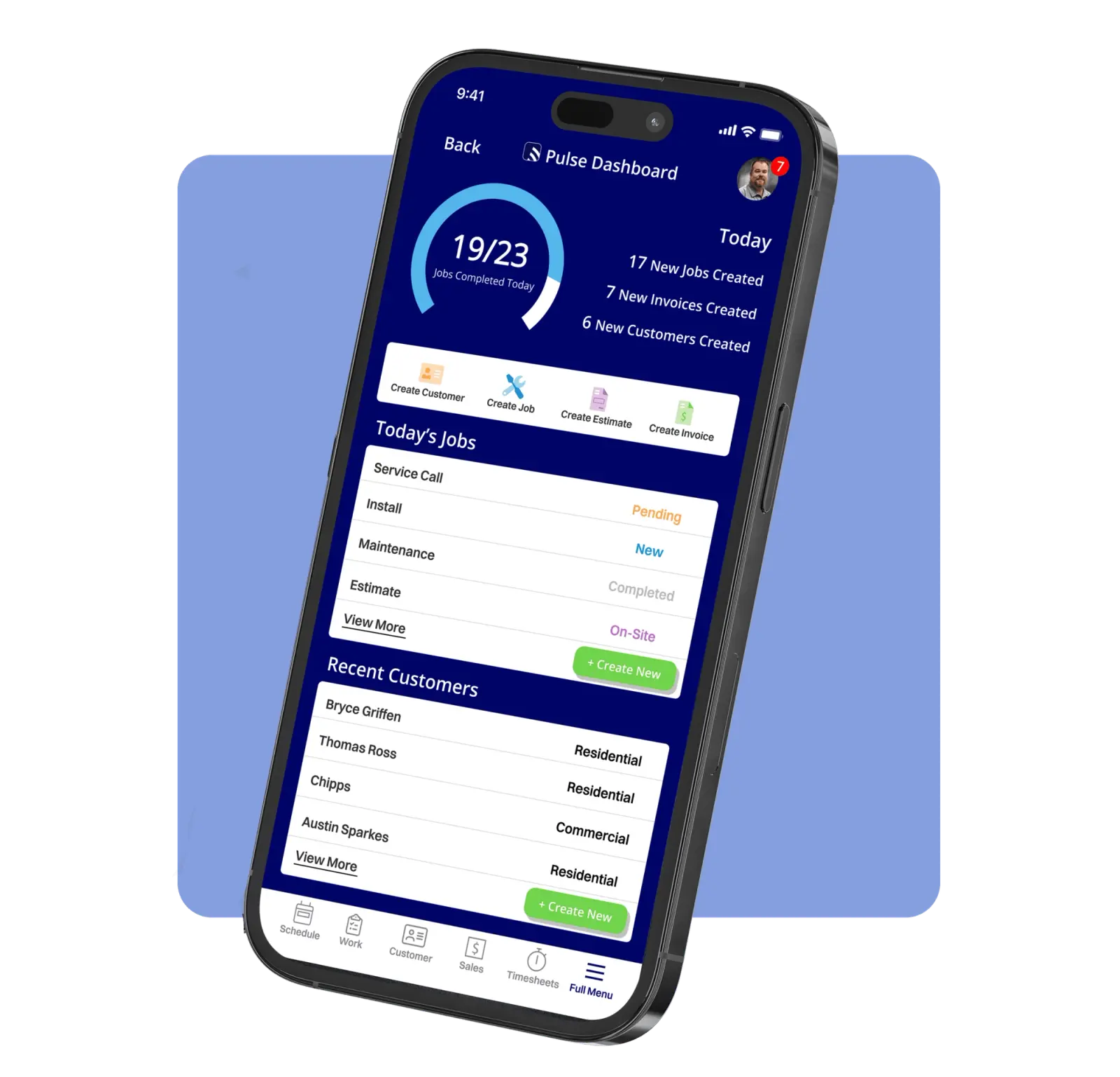
Mobile app with offline capability. Techs work in basements, crawl spaces, and rural areas. If the app fails when signal drops, they lose work and redo it later. Choose a platform that caches jobs on the device and syncs automatically when signal returns.
Signs You’ve Outgrown Your Current Software
Most owners decide to switch after a pattern of operational pain builds up. A setup that works at eight techs can feel strained at twenty-five. Watch for these warning signs.
- Invoices go out days after job completion or never get sent
- Two estimators quote the same job at different prices
- Your office team maintains separate spreadsheets to manage the schedule
- You cannot see which jobs, job types, or customers are actually profitable
- Emergency requests come in and the dispatcher rebuilds the day through phone calls
- Reconstructing a customer’s history requires interrupting a tech
- New hires take months to get up to speed because nothing is documented
The cost of staying in this state is significant. Delayed invoicing slows cash flow. Inconsistent pricing erodes profit margin. Evening administrative work burns out your office team. For a 15-truck HVAC company with $2M in annual revenue, these issues can conservatively cost over $170,000 per year. Faster invoicing, fewer unbilled hours, and better technician utilization can recover much of that.
Once you recognize these patterns, the next step is to evaluate replacements with a clear structure instead of reacting to the loudest sales pitch.
How To Evaluate FSM Software: A Practical Framework
A simple evaluation framework keeps every demo focused on what matters to your operation. Score each platform across these six areas.
- Workflow fit. The platform should match how your jobs move from intake through dispatch, field work, invoicing, and payment. It needs to support your job types instead of forcing a rigid process.
- Office burden. The right software reduces your office team’s workload. Watch for duplicate entry, manual follow-up, and how schedule changes reach techs.
- Field usability. Techs should find the mobile app simple and reliable. Test it on a real device, including what happens when signal drops.
- Financial visibility. You should see profit margin by job, job type, and technician. Job costing needs to connect to your accounting system without manual re-entry.
- Implementation effort. Ask what onboarding looks like in detail. Clarify who runs it, how long it takes, and what your team must handle between sessions.
- Scalability. The platform should still fit when you add more techs or a second location.
FSM Software Evaluation Checklist
Use this checklist in every demo and ask vendors to show each item live.
- Reschedule an emergency job and show how affected customers receive updates
- Build an estimate from preset pricing and convert it to an invoice without re-entry
- Display job-level profit margin after job completion
- Demonstrate what happens when a tech loses signal mid-job
- Show a correction made in QuickBooks flowing back into the field software
- Pull a report showing revenue and profit margin by job type
- Create a new job type with its own workflow stages and required actions
- Demonstrate roles and permissions for a tech view versus an office view
Field Service Management Software Options To Consider (With Fit Notes For Mid-Sized Teams)
Several platforms serve field service businesses, but they fit different stages of growth. Use the framework above to compare each option against your priorities.
FieldPulse — Best Overall For Mid-Sized Teams
FieldPulse is built for established, team-based residential service businesses. Its core strength is keeping your office and field aligned around one current set of job, customer, workflow, and payment information, without enterprise-level complexity.
The spine of the platform is FieldPulse’s Mobile Focus, included in the core product. FieldPulse’s Mobile Focus lets you define the stages each job type moves through and the required actions at each stage. It also gives techs a mobile view that only shows what the current step needs. For an HVAC install, that might mean a floor-protection checklist before work starts and a customer sign-off before the tech leaves. For a service call, the sequence is shorter. Every tech follows the same process, and the office sees job progress in real time without calling the truck.
Key capabilities for mid-sized teams include:
- Job costing that estimates profit margin upfront and confirms actual profit at completion. It also provides per-job profit and loss and line-item breakdowns.
- Inventory management that tracks parts from van stock to job site.
- A true two-way QuickBooks Online sync where corrections made in QuickBooks flow back into FieldPulse.
- Roles and permissions so techs and office staff each see what they need.
- More than 60 prebuilt reports plus custom dashboards.
- Offline mode that caches the past week of jobs on the device and syncs automatically when signal returns.
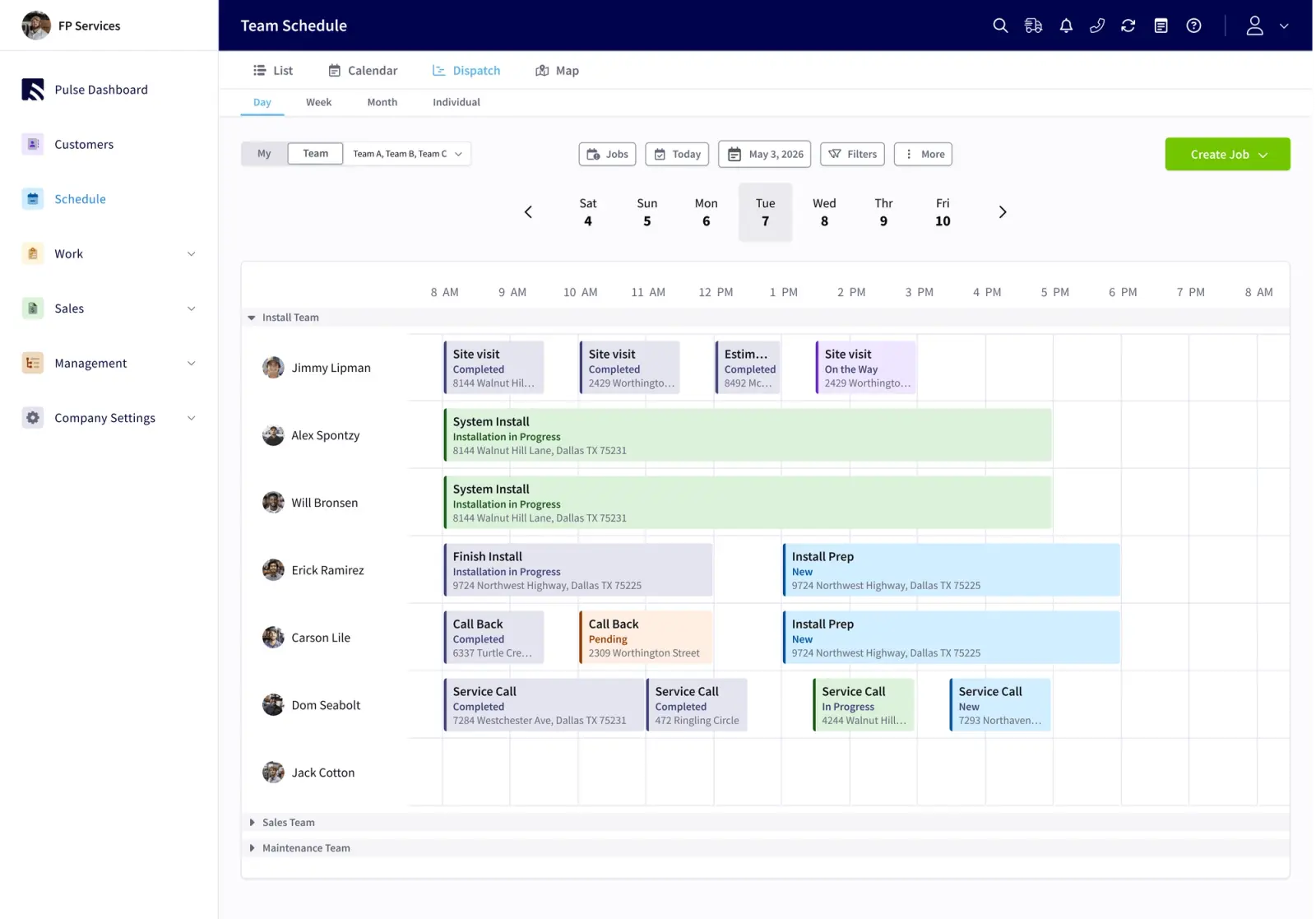
- Drag-and-drop scheduling with live technician locations.
FieldPulse customers report, on average, 25% gains in efficiency. Office teams save 40+ hours per month, and field teams see a 50% increase in on-time delivery. Fair Comfort Solutions cut estimate creation time by 98%, moving from 4 to 8 hours per quote down to 4 to 8 minutes after the Reece HVAC pricebook came pre-built in FieldPulse. RDI doubled their business in 12 months, growing from 15 to 50 employees, with job-level profitability visible for the first time in 50 years. Window Fix recovered 15 to 20 hours per week and expanded from one location to a franchise model built on FieldPulse.
FieldPulse uses seat-based pricing across three packages: Essentials, Professional, and Enterprise. Lower-priced field-only seats support techs who only need the mobile app. Several capabilities, including the Pricebook, Custom Forms, and Engage (VoIP and messaging), are available as add-ons. Onboarding typically runs 2 to 6 weeks, guided by an implementation manager who leads recurring working sessions.
FieldPulse holds a 4.8 out of 5 aggregate rating across G2, Capterra, the App Store, the Google Play Store, and other software-review sites.
ServiceTitan — Best For Teams Planning Aggressive Scaling
ServiceTitan is an enterprise-oriented platform with deep dispatch capabilities, supplier pricebook integration, and multi-zone capacity planning. Large residential service businesses with call centers and complex operations often choose it. For a team of 7 to 20 techs, the implementation complexity and cost are significant. Expect a longer onboarding timeline and a steeper learning curve. Teams planning to grow to 50 or more techs soon may want to evaluate it as an enterprise foundation. Teams focused on the 7 to 20 tech range usually find it heavier than they need.
Housecall Pro — Best For Smaller Teams Still Growing Into Their First FSM Tool
Housecall Pro is a clean, well-rated platform for residential home service businesses. It handles scheduling, invoicing, online booking, and customer communication well. Many growing service businesses eventually outgrow Housecall Pro because it lacks depth for job costing, inventory, and multi-stage workflows. Teams at 5 to 7 techs still building their operation may find it a reasonable starting point. Teams already running 10 or more techs and feeling the pain described in this guide have usually moved past it.
Jobber — Best For Small Teams That Need Simple Scheduling And Invoicing
Jobber is the most widely recommended FSM platform for small service businesses. It covers scheduling, quoting, invoicing, and basic client management at a low entry price. Jobber and Housecall Pro work best for single-visit residential service under ten techs. Their per-seat costs climb as you grow, and they lack support for multi-stage projects. Teams under 7 techs with straightforward workflows often find Jobber a solid fit. Teams that need job costing, inventory, or customizable multi-stage workflows usually need more depth.
Service Fusion — Best For Growing Teams That Want Flat-Rate Pricing
Service Fusion stands out with flat-rate pricing that includes unlimited users. That model can be more cost-effective than per-seat tools as your headcount grows. It covers scheduling, dispatch, quoting, invoicing, and QuickBooks integration. Service Fusion’s technician mobile workflow has been noted for limited offline capability, which you should test carefully if your techs work in low-connectivity areas. Inventory and job costing are available on higher tiers.
Simpro — Best For Trade Businesses Needing Project And Asset Management
Simpro serves trade contractors with complex project costing, purchase order management, and multi-stage quoting needs. It fits businesses doing significant commercial work with detailed asset management requirements. The platform is more complex to implement and configure than mid-market tools, and module pricing can increase significantly beyond the base plan.
To see how a mid-market platform can support your workflows, schedule a walkthrough tailored to your trade and team size.
Cost Considerations And ROI For Mid-Sized Teams
FSM software pricing usually follows a few models. Per-user pricing charges a monthly rate for each person who needs a login, so costs rise with every tech you add. Flat-rate pricing charges a single monthly fee regardless of headcount, which can feel more predictable as you grow. Some platforms use tiered plans where key features like job costing or inventory only appear on higher tiers.
FieldPulse uses seat-based pricing, quoted per business based on your team size and the capabilities you need. There are three packages, plus several add-ons priced separately. The fastest way to get an accurate number for your operation is a demo that covers your team size, trade, and what you need running on day one.
When you compare costs, focus on ROI rather than just the subscription line. FieldPulse customers see an average 25% efficiency gain and office teams save 40+ hours per month. Businesses add 16+ customers every month. Companies that invoice on-site collect payment 11 days faster on average than those that invoice from the office. For a business with meaningful monthly volume, that shift creates a real cash flow improvement. The administrative hours your office team gets back, the invoices that go out the same day, and the jobs you keep by quoting faster all carry dollar values. Build those into your comparison.
Implementation And Onboarding Realities
Once you weigh costs and ROI, the next hurdle is implementation. Switching FSM software takes real work, especially for mid-sized teams. A typical rollout runs 2 to 6 weeks, depending on your size, which capabilities you enable, how much data you migrate, and how your accounting is set up.
The sequence usually looks like this:
- Scope the work, including capabilities, data, accounting requirements, and your business complexity.
- Get assigned an implementation manager who runs recurring working sessions.
- Configure the foundation, including preferences, templates, permissions, FieldPulse’s Mobile Focus workflows, and the mobile experience.
- Move data and connect QuickBooks Online.
- Train each role through working sessions, live classes, and self-service resources.
- Transition to ongoing support.
RDI, a commercial interiors business that came from pen, paper, and Excel, described their rollout this way: “We ripped band-aids off one at a time, instead of all at once.” They started with scheduling, then added invoicing, then time tracking, then Mobile Focus workflows. Their time-tracking rollout, with a field crew that had used paper time cards for 30 years, was expected to take six months. They were running payroll off the app in two weeks.
The structure of the rollout matters more than raw speed. Short tasks between sessions, each session starting with questions from the last one, and role-based training all help adoption stick.
How To Choose: A Step-By-Step Decision Guide
When you are ready to choose a platform, move through these steps in order.
- Document your current workflows and the specific handoffs where things break most often.
- Identify must-have features based on your trade, team size, and the problems you want to solve.
- Shortlist three to four platforms that fit your size and operational complexity.
- Request demos and include your office manager and at least one tech.
- Ask focused questions about job costing, inventory, and QuickBooks sync in every demo.
- Review references or case studies from businesses similar to yours in size and trade.
Involve your office administrator early. They manage operations day to day, and their workload needs to get lighter, not heavier. The two-way QuickBooks sync often becomes the turning point for bookkeepers, especially when they see a correction made in QuickBooks flow back into the field software instead of getting overwritten.
Common Pitfalls To Avoid When Choosing FSM Software
Most FSM implementations fail because of evaluation and rollout mistakes, not software quality. Watch for these common issues.
- Choosing a tool that is too simple. Teams that need job costing, inventory, and multi-stage workflows will not fix their problems with a scheduling-and-invoicing tool.
- Choosing an enterprise platform that is too complex. A platform built for 200-tech operations with a dedicated IT team will overwhelm a 12-person shop and add unnecessary cost.
- Ignoring your office administrator’s needs. If the person who runs your day does not see clear benefits, the implementation stalls. Make sure they see their own view in the demo.
- Underestimating implementation effort. Plan for 2 to 6 weeks. Budget time for data migration, training, and a short productivity dip while everyone learns the new system.
- Skipping offline testing. Ask vendors to show what happens when signal drops mid-job. If they cannot demo it, assume it will not work the way you need.
- Overlooking accounting integration depth. A one-way push into QuickBooks still leaves your bookkeeper doing manual corrections. Ask exactly how a fix in QuickBooks flows back into the field software.
Frequently Asked Questions
What Is The Best Field Service Management Software For Mid-Sized Companies?
Teams of 7 to 20 techs need a balance of operational depth and usability. You need job costing, inventory, customizable workflows, roles and permissions, and strong reporting without enterprise-level complexity. FieldPulse is designed for this segment. It gives your office and field teams one shared operating system, with Mobile Focus workflows that standardize how jobs move through your business and job costing that shows profit margin at the job level. HVAC, plumbing, garage door, electrical, and other residential service businesses in this size range use it today.
How Much Does Field Service Management Software Cost?
Pricing varies by model and platform. Per-user tools charge a monthly rate per person, so costs rise as you add techs. Flat-rate tools charge a single monthly fee regardless of headcount. Some platforms place key features like job costing or inventory on higher tiers, so the base price does not always show the full cost. FieldPulse uses seat-based pricing, quoted per business based on your team size and the capabilities you need. The fastest way to get a real number is a demo. When you compare options, factor in ROI. Time saved on admin work, faster invoicing, reduced double entry, and fewer lost jobs from slow quoting usually outweigh the subscription cost.
What Features Do Mid-Sized Field Service Companies Need?
Beyond basic scheduling and invoicing, mid-sized teams need job costing to track profit margin at the job level, inventory management to connect parts usage to job records, customizable workflows to standardize how each job type moves through your business, roles and permissions to control what each person can see and do, and reporting dashboards to give owners visibility into performance and finances. A true two-way QuickBooks sync is also critical, so corrections made in QuickBooks flow back into your field software. A mobile app with real offline capability matters for techs working in basements, crawl spaces, and rural areas.
How Long Does It Take To Implement FSM Software?
For a mid-sized team, a typical implementation takes 2 to 6 weeks. Timing depends on your team size, which capabilities you enable, how much data you migrate, and how your accounting is set up. The process includes scoping the work, configuring the platform, moving data and connecting QuickBooks, training each role, and transitioning to ongoing support. Faster launches happen, but they are exceptions. Plan around the realistic window. A phased rollout with small tasks between sessions and role-based training helps adoption stick.
Can FSM Software Integrate With QuickBooks?
Most modern FSM tools integrate with QuickBooks, but quality varies. Look for a true two-way sync, where changes in either system update the other. FieldPulse offers a two-way sync with QuickBooks Online. Customers, line items, estimates, invoices, payments, purchase orders, and vendors sync in both directions, and timesheets flow into QuickBooks when a tech clocks out. Tax rates come from QuickBooks Online, and invoice numbering can follow your existing sequence. Ask every vendor how a correction in QuickBooks flows back into the field software.
What’s The Difference Between Small-Business And Mid-Market FSM Tools?
Small-business tools focus on scheduling and invoicing for smaller teams. They are clean, easy to set up, and work well until your operation adds inventory, job costing, multi-stage workflows, or permissions requirements. Mid-market tools add that depth without the cost and complexity of enterprise platforms. The difference shows up in specific features. Mid-market tools let you define different workflow stages for an install versus a service call, see profit margin by job, and track parts from van stock to job record. If those capabilities matter to your operation, you need a mid-market tool.
How Do I Get My Technicians To Adopt New Software?
Involve techs early and show them clear benefits. They care about less paperwork, clear job details before they arrive, and avoiding rework at the end of the day. A simple mobile experience matters more than any other factor. FieldPulse’s Mobile Focus shows techs only what the current job stage requires, as a short, ordered list with single-tap Action Buttons instead of a full application to navigate. RDI’s field crew had used paper time cards for 30 years. The team expected six months to reach adoption and was running payroll off the app in two weeks. Offline capability also builds trust. Techs who know their work will not disappear when signal drops are far more willing to use the app.
What Is Job Costing And Why Does It Matter?
Job costing tracks the actual labor, materials, and overhead for each job against what you quoted. It shows which jobs are profitable and which lose money at the job level. Without it, pricing decisions rely on instinct and you discover profit margin problems after the fact. With it, you can see which job types consistently run over on labor, which customers generate the strongest profit margin, and where to focus your sales effort. FieldPulse’s job costing estimates profit margin upfront and confirms actual profit at completion. It provides per-job profit and loss and line-item breakdowns by category. Because techs clock in against the job itself, labor hours tie to specific work, which makes job-level profitability visible. Learn more about how flat-rate pricing connects to profit margin visibility.
The Right Fit For Your Size
Mid-sized field service teams need enough operational capability to manage job costs, inventory, and multi-stage workflows, while still keeping software usable for everyday work. You want depth without turning implementation into a six-month project or daily use into a training exercise.
The evaluation framework in this guide gives you a practical way to compare platforms on workflow fit, office workload, field usability, financial visibility, implementation effort, and scalability. Use the checklist in every demo. Bring your office manager and a tech. Ask vendors to show what happens when signal drops and when your bookkeeper corrects something in QuickBooks.
FieldPulse is built for established, team-based residential service businesses with 7 to 20 techs that have outgrown simple tools and do not need enterprise complexity. It connects your office and field teams in one system, with job costing, inventory, Mobile Focus workflows, and a two-way QuickBooks sync included.
To see how this can work for your team, schedule a tailored demo or call sales at +1 (817) 635-2218.