








Key Takeaways
- Most mobile work order apps create double-entry because they were built for the office first and then squeezed onto phones, so techs end up doing the same job twice.
- Technicians need apps that support arrival, job execution, closeout, and signal drops without forcing your office to re-enter data.
- Offline functionality is critical. Apps must cache jobs, notes, photos, and estimates so work continues in basements or rural areas without data loss.
- Native apps usually outperform mobile web versions because they provide reliable camera access, push notifications, and background uploads that field work depends on.
- FieldPulse addresses these field-first needs with ClearPath workflow views, documented offline caching, and closeout in the field that removes double-entry for service teams.
See how FieldPulse eliminates double-entry for your techs
What a Tech Actually Needs From a Mobile Work Order App
Before you evaluate any platform, define the four moments where a mobile work order app either earns its place or gets abandoned. These moments matter because a mobile app cannot simply reproduce the office interface on a smaller screen. Your office works with filters and dashboards. Your tech needs today’s jobs, the address, equipment history, a checklist, and a fast way to record what happened.
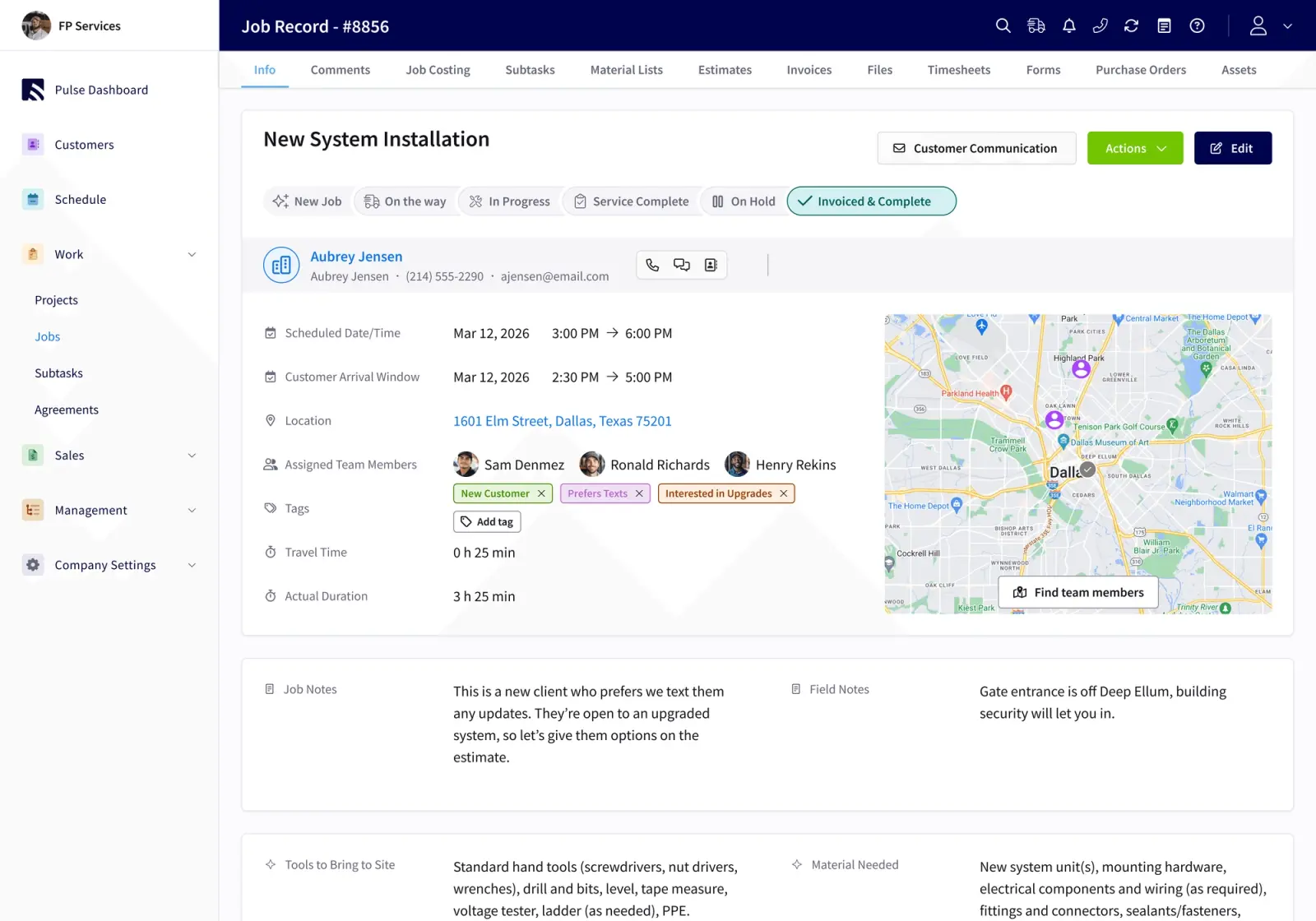
Here is what each moment requires:
- Arrival: Your tech should walk in already knowing the address, the contact, the customer’s history, the equipment record, the prior job notes, and the gate code. The app should provide all necessary information upfront so your tech never needs to call the office.
- The job itself: Checklists, job-specific forms, photos, and signatures should attach directly to the job record. Your tech should see only what the current stage requires. They should not have to navigate a full application.
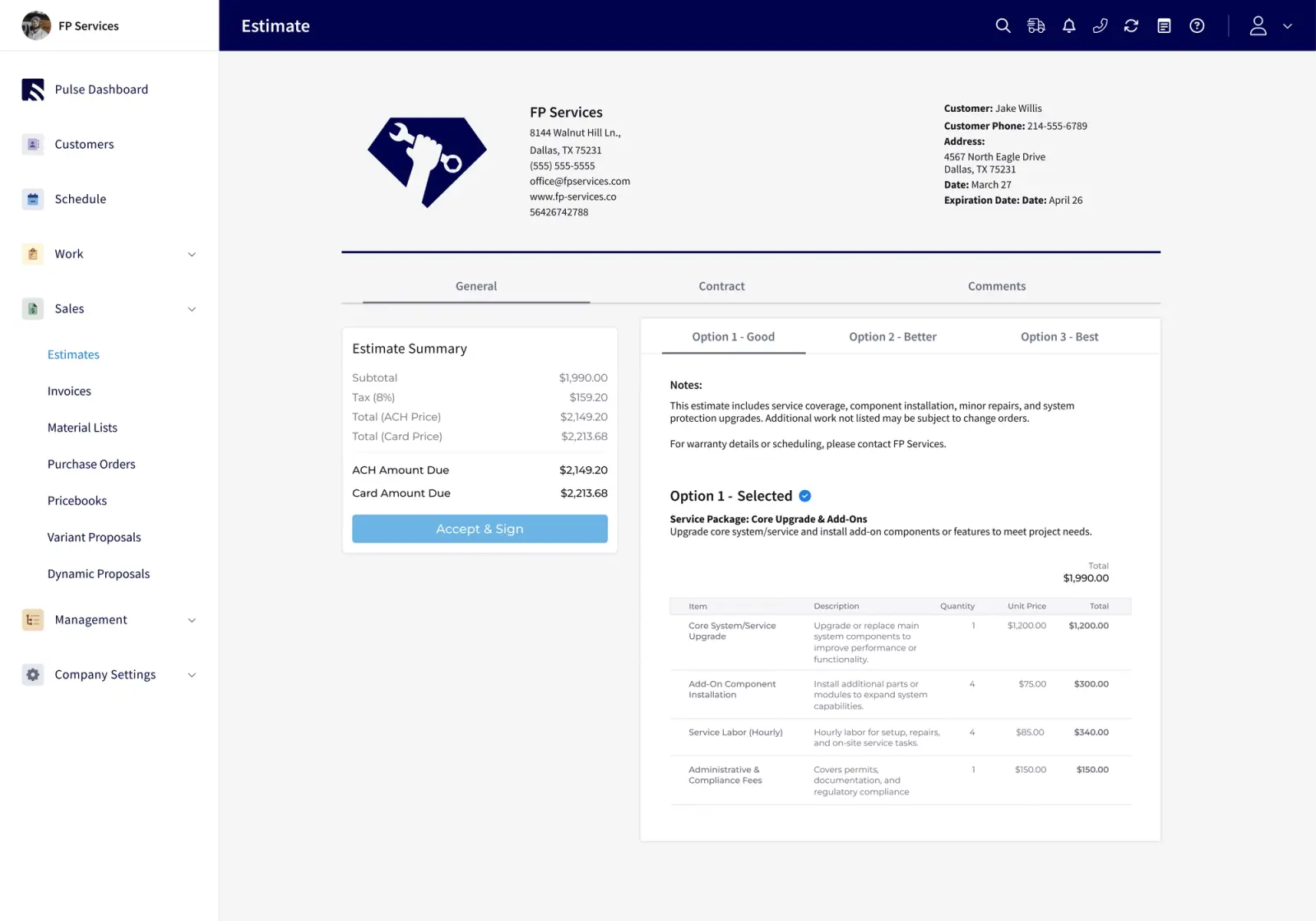
- The closeout: Your tech should build an estimate in the field from your preset pricing, convert it straight to an invoice, and capture card or ACH payment before leaving the driveway. Your office should not repeat that work later.
- The signal drop: When your tech walks into a basement, a crawlspace, or a rural service area with no bars, the app should keep the job moving. This is where many apps fail silently.
A mobile work order app for field technicians is judged on these four moments, not on your office dashboard view.
Does the App Work Without Signal?
Offline capability often decides whether your team actually uses a new app. When techs discover the app does not work where they spend their day, they resist adoption and invent workarounds. Vendors frequently claim offline support but rarely explain the details.
Use these questions to check offline behavior in any mobile work order app:
- What data actually caches to the device, and for how long
- What happens to an in-progress draft when signal drops mid-edit
- What syncs automatically when the device is back in signal
- Whether the app can create new records offline or only edit cached ones
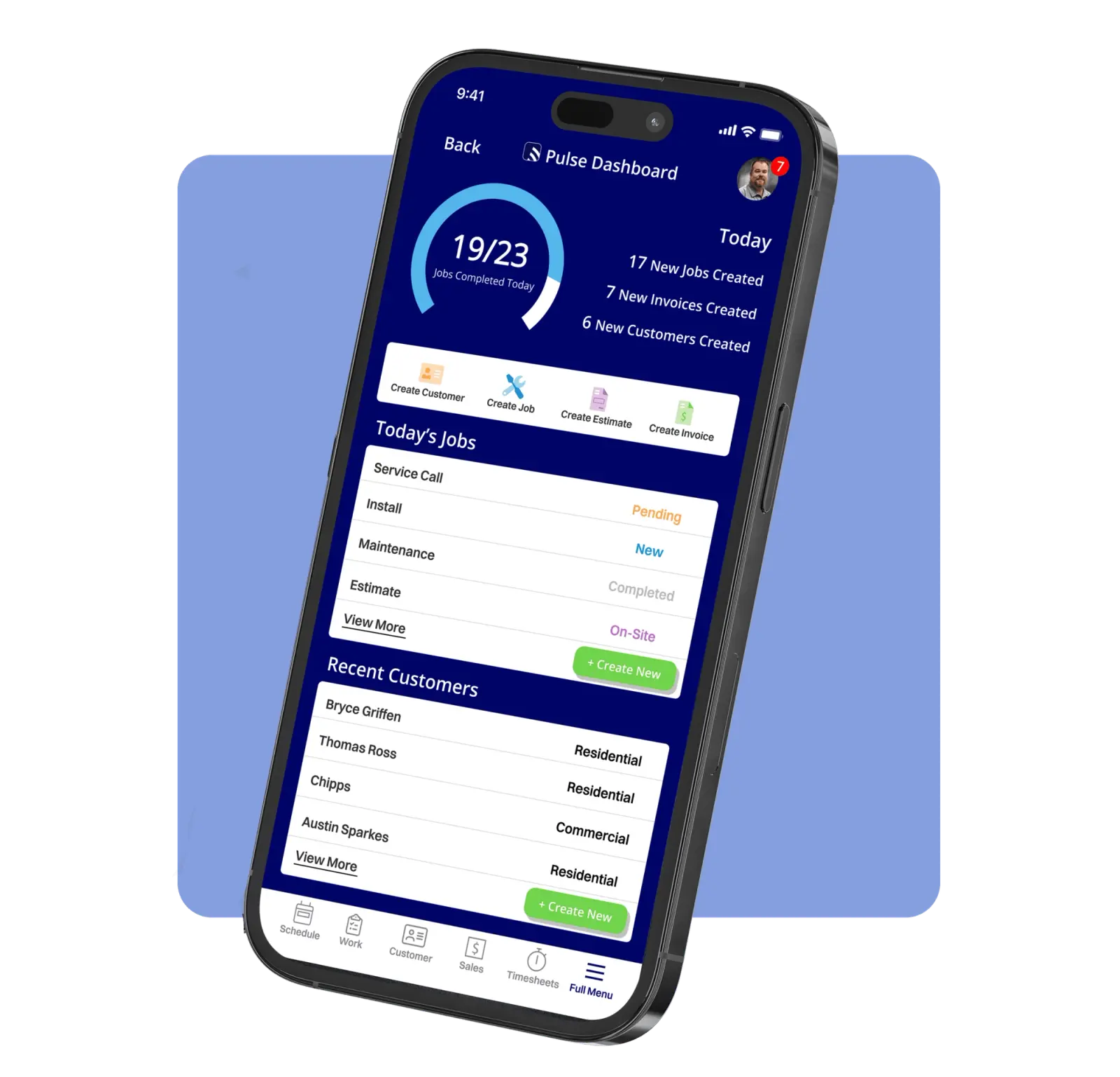
FieldPulse’s caching behavior for offline access is documented and specific. FieldPulse caches jobs and projects for one week offline, with the past week of jobs, projects, customers, estimates, and invoices stored on the device. Your techs can save job notes, upload batches of photos, update statuses, and clock in and out while offline. If signal drops mid-edit, the active draft transitions to an offline draft automatically. Anything entered offline saves locally and syncs as soon as the device is back in signal.
FieldPulse supports most standard job tasks offline. Your tech can view cached jobs, add notes and photos, change status, clock in and out, and update cached estimates and invoices, then sync on reconnect. Offline payment collection (except cash marked later), purchase order creation, and new customer and job record creation require a connection. Many tools that claim offline support limit what techs can actually do without internet, so test this behavior before you sign.
The Double-Entry Problem
Techs resist new software because they are asked to do the same work twice.
Every job effectively gets done twice. Your tech does it once in the field. They write the notes, record the parts and labor, take the photos, and get the signature. Then your office does it again. They read the ticket, retype the parts and labor into an estimate or invoice, re-enter the customer into the accounting system, and store the photos somewhere findable. The work is finished, but it is not done until someone in your office has re-created it in a second place.
That second pass is invisible on any job sheet. It scales with volume rather than with revenue. It is also the first thing that breaks operationally when you add crews, which is why your office becomes the bottleneck long before your field does.
At its root, double data entry is caused by information living in too many disconnected places. This affects fully digital businesses and businesses running on paper equally. A business can be completely digital and still rely on manual handoffs. Paper-based systems force double data entry, where techs write notes in the field and then return to the office to transcribe information into computer systems. That process takes time and invites errors. Mobile work orders fix this by letting techs enter data once directly into the system while details are fresh.
FieldPulse closes the double-entry problem at the structural level. One customer and job record carries parts, labor, notes, photos, and signatures from the field to your office as the work happens. That same record converts to an invoice without re-entry. A two-way QuickBooks Online sync means a correction made in the books carries back into FieldPulse instead of being overwritten. That is what actually ends duplicate entry between your field service software and your accounting system.
Native App Versus Mobile Web
A native app matters in the field for two practical reasons: push notifications and camera access. A real native app has direct access to the camera with full metadata, reliable background uploads, and push notifications that work even when the app is closed. Mobile web apps often cannot match that behavior, especially on iOS.
A native app can fire an arrival alert or a job completion alert directly from the job’s status change. It can attach job photos directly to the job record instead of a phone gallery or a shared folder. Web-based Progressive Web Apps usually offer limited offline functionality and still need internet for many actions. That gap matters for techs working in basements, rural service areas, or buildings with thick walls. FieldPulse runs on native iOS and Android apps.
Why FieldPulse Is the Best Mobile Work Order Software for Technicians
FieldPulse is built for established, team-based residential service businesses, with particular strength in HVAC, plumbing, and garage door service, and strong secondary verticals in electrical, appliance repair, and locksmith. It supports commercial work, though its depth skews residential. One-person operations often find lighter tools a better fit.
Here is what makes FieldPulse a strong choice when you judge software on the technician’s day:
- ClearPath is included in the core platform. It turns your process into job stages, required actions at each stage, and a mobile view that shows your tech only what the current step needs. Your office or operations lead defines the job stages and the required actions inside each stage. Your tech completes those required actions on their phone. Your tech follows a clear sequence without guesswork or missed steps.
- ClearPath’s Mobile Focus View shows your tech a clean, modular view of only what matters at the current stage, with checklists and Action Buttons that complete common tasks in a single tap. Because your tech sees a short, ordered list rather than a full application, new hires ramp up faster and adoption often moves faster than teams expect, even for crews with no history of using software.
- Offline caching behavior holds up in a basement or a rural service area. The past week of jobs, projects, customers, estimates, and invoices ride along on the device. If signal drops mid-edit, the active draft becomes an offline draft automatically, and everything syncs as soon as the device is back in signal.
- The closeout happens in the field. Estimates built from your preset pricing convert straight to invoices, with card and ACH payment captured on site. Your office does not redo that work later.
- One customer result worth naming: RDI, a commercial furniture installation business in St. Louis, had a long-tenured field crew that had used paper time cards for thirty years. They rolled out time tracking on December 15 and expected a six-month transition. They were running payroll off FieldPulse within two weeks.
FieldPulse holds a 4.8 out of 5 rating across G2, Capterra, the App Store, the Google Play Store, and other software-review sites. On average, FieldPulse customers report 25% gains in efficiency, with office teams saving more than 40 hours per month and field teams seeing a 50% increase in on-time delivery.
Connect your office and field with FieldPulse
How to Evaluate a Mobile Work Order App in a Demo
The demo often steers buyers in the wrong direction. Many teams bring the owner and the office manager, watch a polished walkthrough, and sign based on the office view. You get a clearer picture when you test the technician’s day.
Bring a tech to the demo. Walk one real job end to end: arrival, execution, and closeout. Ask specifically what happens when signal drops mid-job. Then ask to see each role in its actual interface:
- The owner’s reporting view
- Your office administrator’s scheduling and inbox view
- Your tech’s mobile view
Ask how information moves between them. Ask the vendor to demonstrate the full disconnect-to-reconnect sequence for offline work rather than accepting a slide labeled “offline”. Offline capability is easy to claim and easy to test. If the vendor cannot show you what the technician actually sees on screen at each stage of a job, that tells you what you need to know.
Give one or two techs access to the mobile app on their own phones and have them find their next job, review its history, record work, and close it out while you watch for hesitation or requests for help. That test reveals more than any claim and is worth insisting on with every vendor you evaluate.
Why Spreadsheets and Free Tools Break Down
If you are still considering spreadsheets or free tools as a stopgap, here is why they break down as you grow. Spreadsheets and free work order tools work for a handful of techs and stop working when your business needs inventory, permissions, multi-stage workflows, or real job economics. The problem is structural. These methods carry information manually, and manual handoffs do not scale. Every new crew adds another place for work to break operationally. FSM software addresses the structural cause of disconnected systems in a way that spreadsheets and free tools cannot.
The Final Pitch: Judge the App on the Technician’s Day
A mobile work order app designed for the office and squeezed onto a phone usually forces a second pass through your office on every job. Your tech does the work. Your office re-creates it. As we saw earlier, that second pass is invisible on any job sheet, scales with volume rather than with revenue, and is the first thing that breaks operationally when you add crews.
FieldPulse is built for teams that want the job done once. ClearPath’s Mobile Focus View shows your tech only what the current stage requires. Documented caching behavior for offline access holds up in a basement or a rural service area. The closeout happens in the field. One customer and job record carries everything from the field to your office without re-entry.
If your techs have been handed a clunky app, or if your team tells you the current system is unusable, the right next step is to see a complete technician workflow, including what happens when the signal drops.
See a complete technician workflow in action