








Key Takeaways
- Workflow gaps between your office, field, and accounting systems cost your residential service business time and money every week.
- The four leading field service platforms for residential teams of 7–20 techs are Jobber, Housecall Pro, ServiceTitan, and FieldPulse.
- Key features that matter most for residential services include scheduling and dispatch, mobile work orders with offline capability, job costing, recurring maintenance agreements, and two-way QuickBooks sync.
- Jobber and Housecall Pro suit smaller teams, ServiceTitan targets large operations, and FieldPulse is designed for established residential teams that have outgrown simpler tools.
What to Look for in a Field Service App for Residential Services
A field service app for residential services is software that connects your office and field operations in one shared system. It brings together scheduling, dispatch, mobile work orders, customer history, invoicing, payments, and job costing. When everyone works from the same data, your office knows what is happening in the field without calling anyone, your techs arrive with the right information, and invoices go out the same day jobs close.
Residential teams have different needs than commercial or enterprise operations. Your work involves recurring maintenance agreements, homeowner communication, and trade-specific workflows. Your techs work in basements, crawl spaces, and attics where signal drops. Your office administrator often acts as the one person holding everything together.
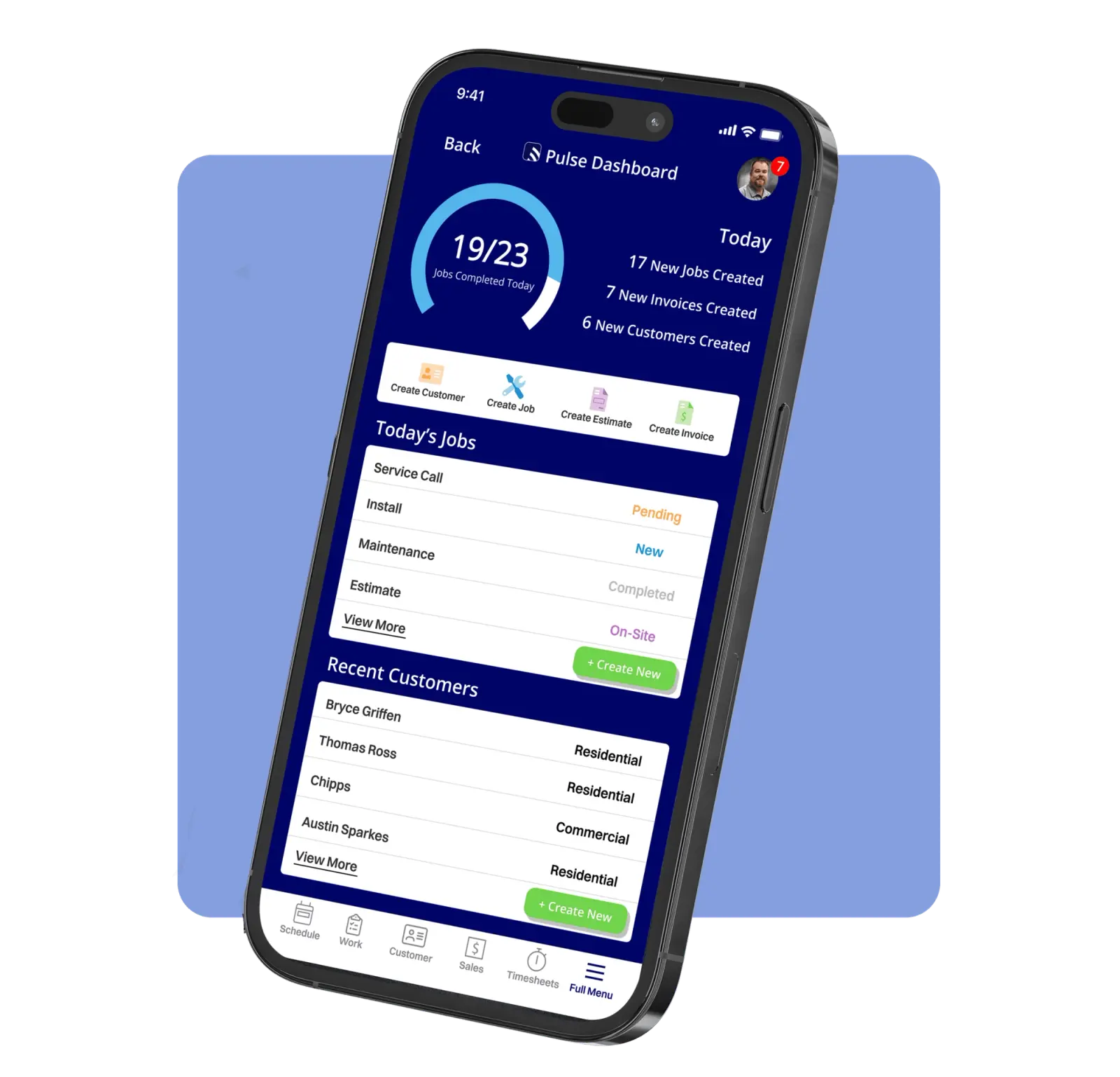
For a team of 7–20 techs, these features matter most:
- Scheduling and dispatch with live visibility
- Mobile work orders with offline capability
- Customer history and equipment records
- Invoicing and payment collection from the field
- Job costing to track profit margin per job
- Recurring maintenance agreements
- Two-way QuickBooks sync
Top Field Service Apps Compared
Here is how the four leading platforms stack up for residential teams of 7–20 techs. Each assessment focuses on operational fit, not a ranked score.
| Platform | Best For | Key Strength | Watch Out For |
|---|---|---|---|
| Jobber | Smaller teams and generalist trades up to ~$2M revenue | Clean interface, fast setup, straightforward scheduling and invoicing | Basic inventory tracking, can feel limiting for multi-stage workflows or deeper job costing |
| Housecall Pro | Residential HVAC, plumbing, and electrical teams of 3–10 techs | Strong customer communication tools and online booking | Mobile app weaker than the web interface, costs stack as you add seats and modules |
| ServiceTitan | Large operations with 15–20+ techs and $3M+ revenue | Enterprise-grade dispatching, reporting, and marketing automation | Implementation runs 4–12 weeks with significant fees, price and complexity are hard to justify below ~15–20 techs |
| FieldPulse | Established residential teams of 7–20 techs that have outgrown simpler tools | Workflow-first approach with ClearPath, includes job costing, inventory, roles and permissions, and two-way QuickBooks Online sync | Requires more initial configuration than entry-level tools, delivers the most value when you use the workflow depth |
Jobber
Jobber is a solid choice for smaller teams and generalist trades. The interface is clean, setup is fast, and the core scheduling and invoicing workflow is easy to learn. It works well for businesses in the $250K–$2M revenue range that do not need deep job costing or multi-stage workflows. Once your team grows past that point, or you need inventory tracking, detailed permissions, or job-level profitability, Jobber can start to feel limiting.
Housecall Pro
Housecall Pro is popular with residential HVAC, plumbing, and electrical teams. Its customer communication tools are strong, with online booking, automated reminders, and review requests built in. Some users report the mobile app is weaker than the website, and the platform’s add-on model means costs can climb quickly as your team and feature needs grow.
ServiceTitan
ServiceTitan suits large operations. Its dispatching, reporting, and marketing automation are powerful, and the implementation effort matches that level of complexity. Implementation typically runs 4–12 weeks with significant fees, and the total cost of ownership is substantially higher than other platforms. For most residential teams under 15–20 techs, the platform delivers more complexity and cost than you can realistically use.
FieldPulse
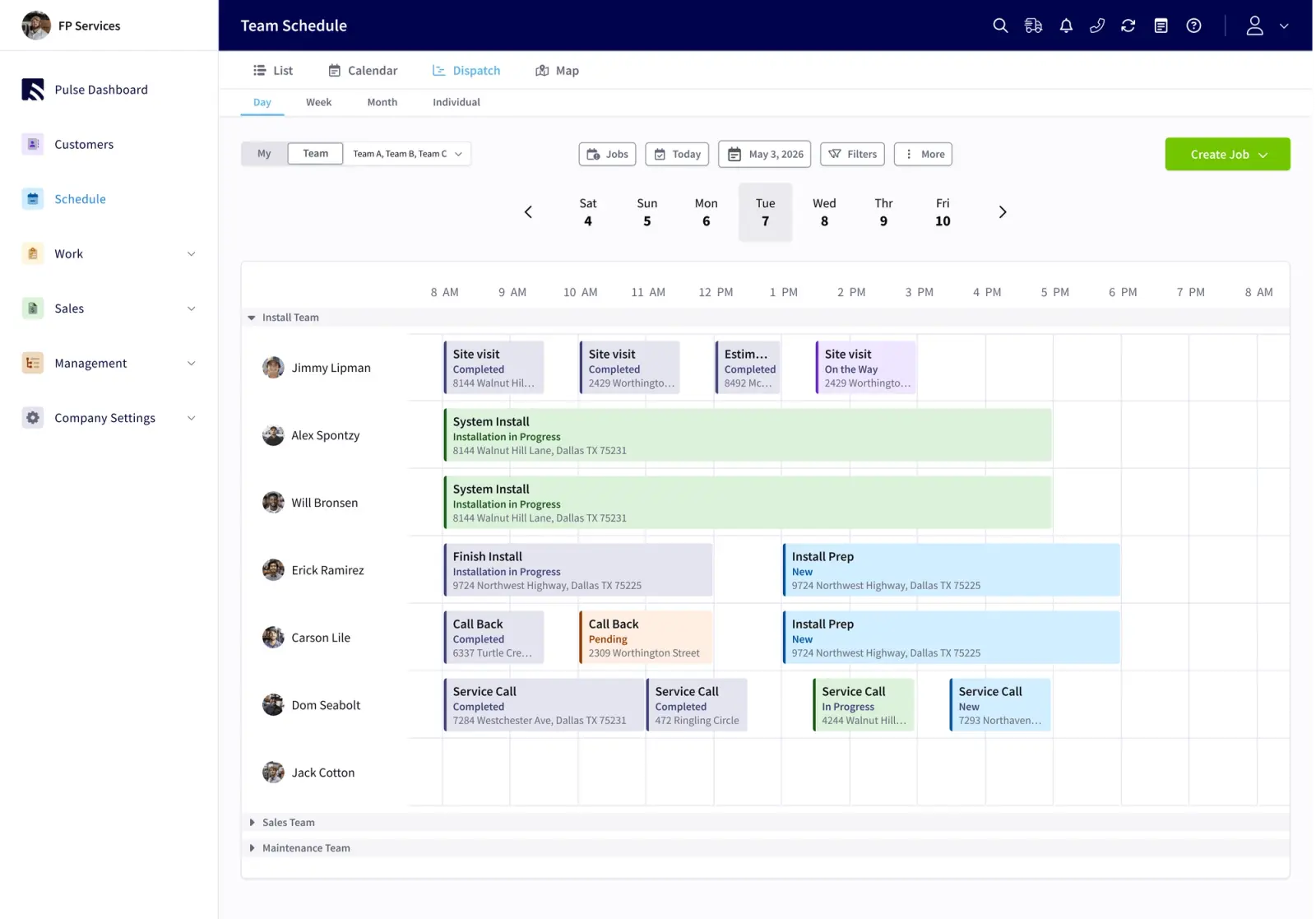
FieldPulse is built for established residential teams that have outgrown simpler tools. The core of the platform is ClearPath, which turns your own process into guided job stages. Your office defines the stages, and your techs follow them on their phones. Around that sits the full job lifecycle with scheduling and dispatch, job costing, inventory, roles and permissions, estimates, and invoicing. A two-way QuickBooks Online sync keeps your accounting aligned with your jobs.
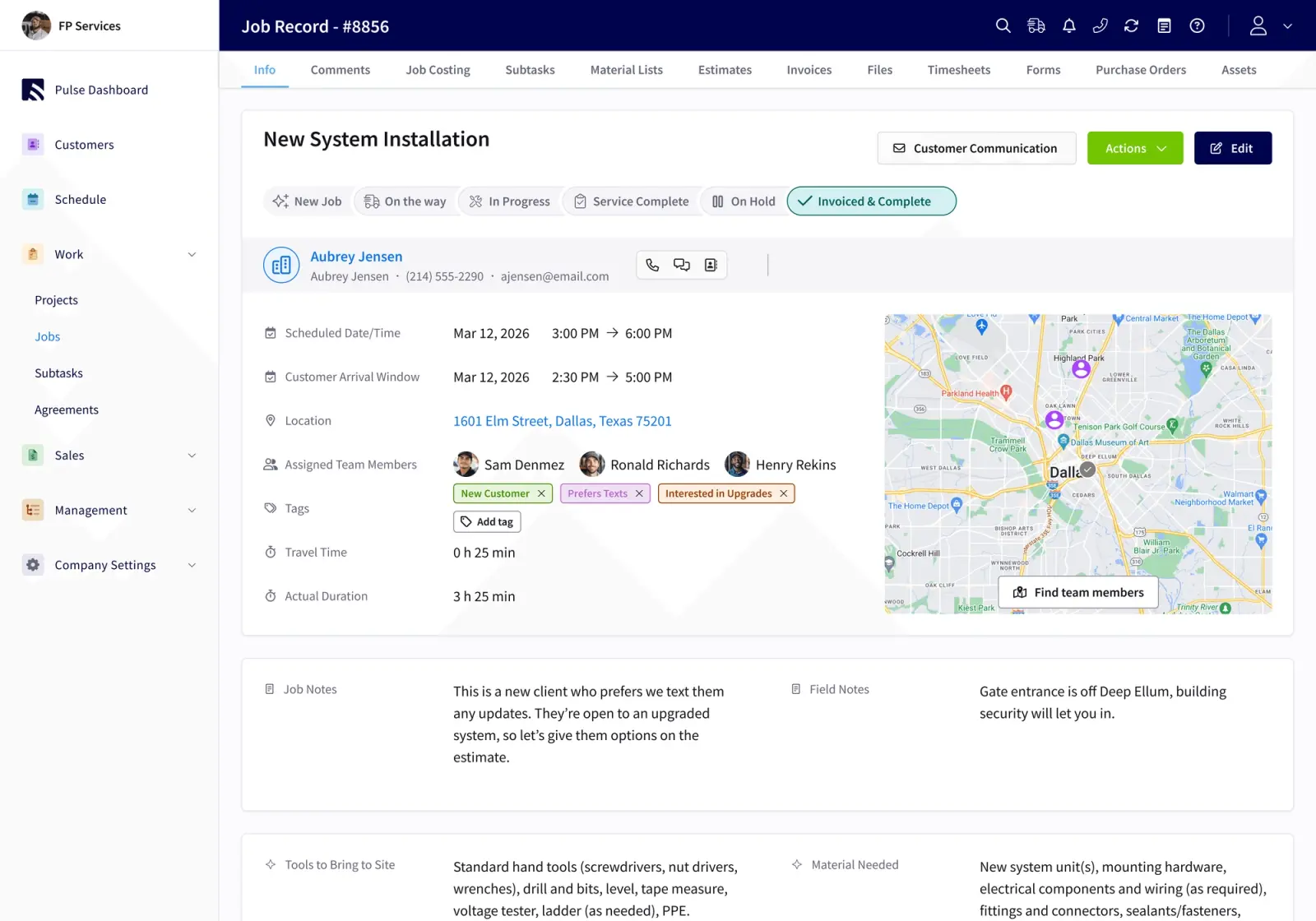
FieldPulse holds a 4.8 out of 5 aggregate rating across G2, Capterra, the App Store, the Google Play Store, and other software-review sites.
See how FieldPulse keeps your office and techs in sync on one workflow—book a demo today.
Trade-Specific Priorities for Residential Teams
Beyond platform fit, your trade shapes which features matter most. Here is what to prioritize by vertical.
HVAC
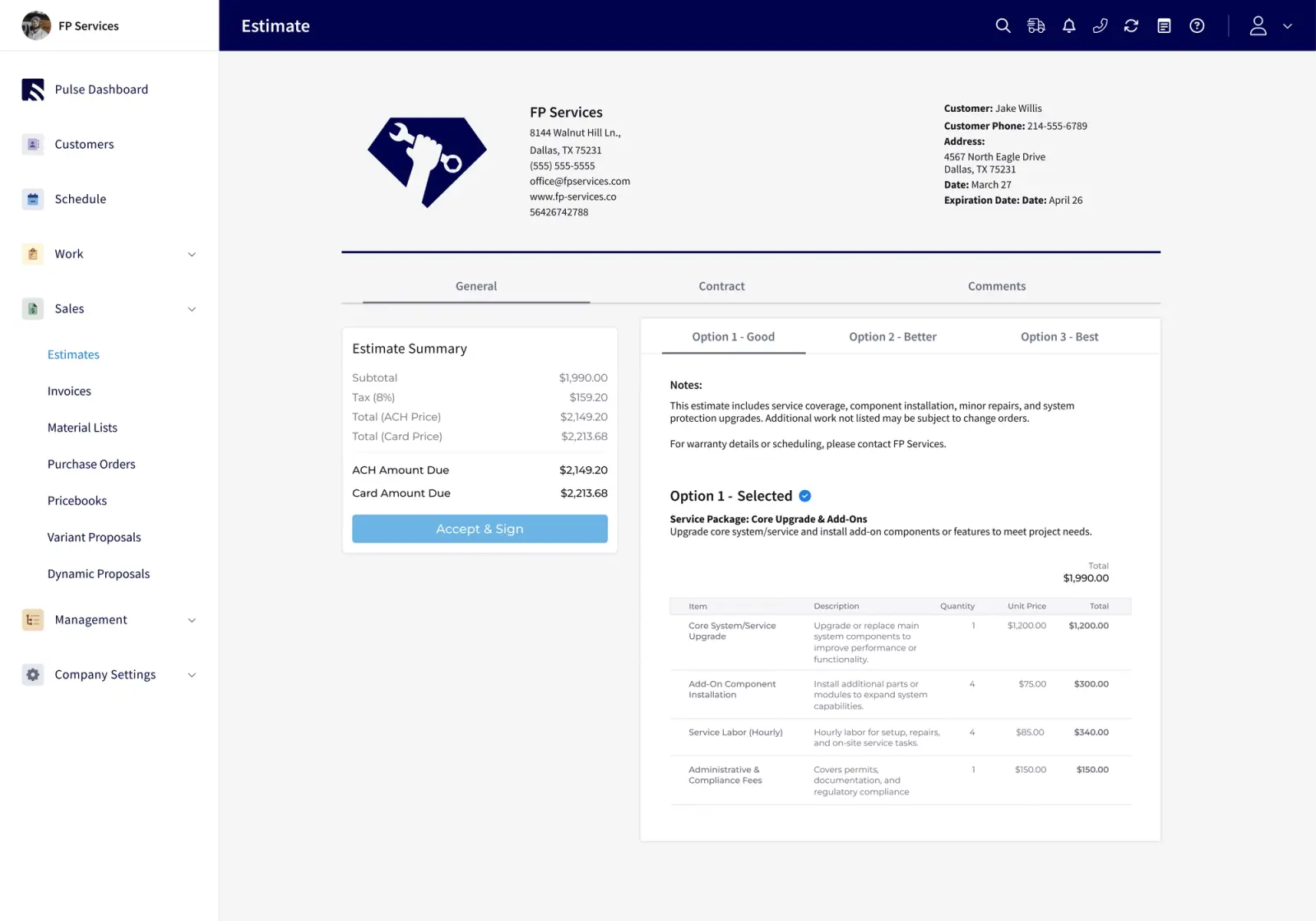
Quoting speed drives wins. When a homeowner waits on a system replacement quote, four hours feels too long. The Reece HVAC pricebook integration in FieldPulse lets your techs pull pre-built equipment pricing and build estimates in minutes instead of hours. Look for supplier catalog integrations that remove manual price lookups.
Plumbing
Job costing and maintenance agreements sit at the center of your work. You need to know which jobs made money on a per-job basis. Customers on recurring service contracts also need automatic scheduling so your team does not rely on someone remembering to call.
Electrical
Every job has a different material load, so line-item cost tracking matters. Because electrical work often spans multiple days, you also need multi-visit project management that tracks progress and costs across the whole job.
Garage Door
Install, service, and repair jobs each need their own stages and checklists. Custom workflows help your techs move between job types throughout the day without missing steps.
Pricing and Cost Considerations
Field service apps typically charge per seat with different tiers and add-ons. Most small businesses pay $49–$149 per month at entry level, while enterprise platforms run significantly higher. Jobber and Housecall Pro publish tiered pricing that scales with users and features. ServiceTitan uses custom quote-based pricing that owners report commonly running $1,700–$2,000+ per month.
FieldPulse offers three packages, Essentials, Professional, and Enterprise. Lower-priced field-only seats support techs who only need the mobile app. Add-ons like the Pricebook, Custom Forms, and AI features are priced separately. The fastest way to get an accurate quote for your team size is a demo, since pricing depends on how many people need access and which capabilities you turn on.
One more cost factor deserves attention. The average productivity cost of a full platform migration for a 10-technician team is $18,000–$45,000 in lost productivity and staff overtime. The monthly subscription rarely represents the biggest cost. Implementation, training, and the disruption of switching all add up, which makes choosing the right platform the first time even more important.
Implementation and Onboarding
Switching field service software takes real work. Typical onboarding runs 2 to 6 weeks depending on your team size, which capabilities you enable, how much data migrates, and how your accounting is set up.
The FieldPulse onboarding sequence follows a clear path:
- Scope the work, including capabilities, data, accounting requirements, and your business complexity.
- Assign an implementation manager who runs recurring working sessions.
- Configure the foundation, including system preferences, templates, permissions, ClearPath, and the mobile workflow.
- Move data and connect QuickBooks Online.
- Train each role through working sessions, live classes, and self-service resources.
- Transition to ongoing support.
RDI, a commercial interiors business in St. Louis, described their approach as “ripping band-aids off one at a time, instead of all at once.” They started with scheduling, then invoicing, then time tracking, then ClearPath. Their field crew, who had used paper time cards for 30 years, was running payroll off the app within two weeks of rollout. These outcomes show how a workflow-first approach can pay off once your team commits to the change.
Real-World Results With FieldPulse
The following customer outcomes show the range of efficiency gains possible with FieldPulse, from time saved to revenue growth:
- RDI: 100% business growth in 12 months, time-to-invoice dropped from 3 weeks to 5 days
- Window Fix: 15–20 hours saved weekly, built a franchise model on FieldPulse with three parallel accounts
- Fair Comfort Solutions: 98% reduction in estimate creation time, from 4–8 hours per quote to 4–8 minutes
- Qualified Plumbing: 7–9 hours saved weekly, 23% revenue increase
- Hearth & Home Specialties: 13+ hours saved weekly, 16–30% revenue boost
On average, FieldPulse customers experience 25% gains in efficiency. Office teams often save 40+ hours per month, and field teams see a 50% increase in on-time delivery. FieldPulse’s Operator AI won the NECA Innovator Award in 2025.
Decision Framework: Matching Apps to Your Business
Use these questions to match platforms to your needs:
- Do you need multi-stage workflows that match how your business actually runs instead of a generic template?
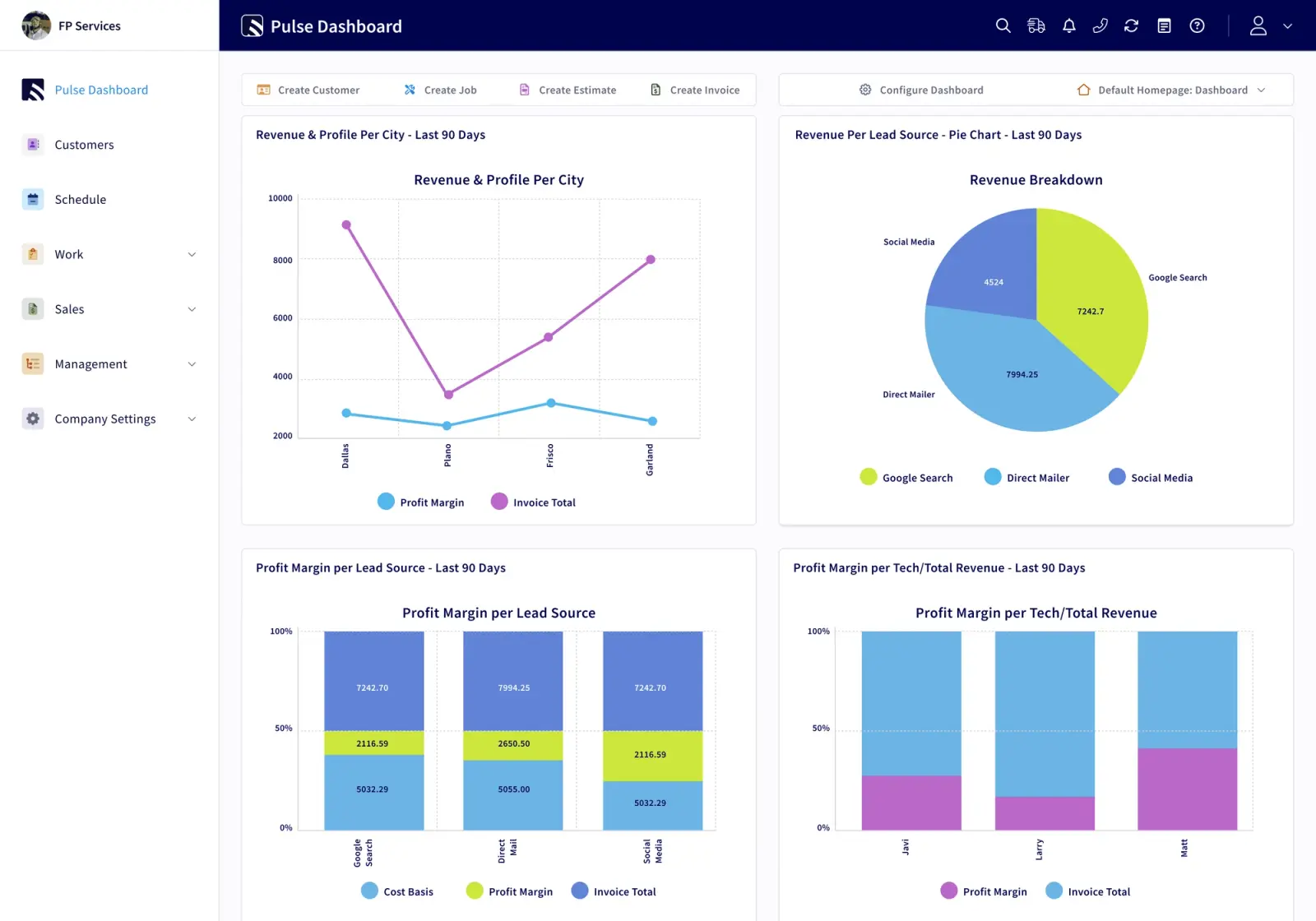
- Do you need job-level profitability so you can see which work makes money?
- Do you need recurring maintenance agreements that schedule themselves?
- Do you need a two-way QuickBooks sync so your books and your field software stay aligned?
If your answers are yes, Jobber and Housecall Pro may not carry the workflow depth you need. ServiceTitan covers those needs, but the price and implementation complexity are hard to justify for most teams under 15–20 techs. For established residential teams of 7–20 techs that have outgrown simpler tools and need workflow standardization, job costing, and real support, FieldPulse’s workflow-first approach fits that operational gap.
Common Pitfalls and How to Avoid Them
Most failed implementations start with mistakes made before the first invoice goes out. These pitfalls come up most often:
- Focusing only on price. The cheapest option often lacks the workflow depth you need, and you pay for that gap in manual workarounds. The monthly subscription is the smallest cost of adopting new software, while implementation, training, and lost productivity add up fast.
- Ignoring technician adoption. If your techs will not use the app, the implementation fails. Bring a lead tech into the demo and ask to see the mobile workflow end to end, including what happens when signal drops.
- Underestimating implementation effort. Switching takes 2–6 weeks of real work. Plan for it, assign an owner, and budget time between sessions for your team to practice.
- Overlooking job costing. If you cannot see which jobs made money, you price on instinct. Make sure the platform tracks labor and materials against each job, not just totals at the end of the month.
- Skipping a QuickBooks integration check. Confirm that the sync is two-way. When your admin corrects something in QuickBooks, the fix should carry back into the field software so you avoid double entry.
Frequently Asked Questions
What Is a Field Service App for Residential Services?
This type of app connects your office and field operations in one system built for home-based trade businesses. It combines scheduling, dispatch, mobile work orders, customer history, invoicing, and payments. The goal is to replace manual handoffs with consistent processes so your office knows what is happening in the field without calling anyone, and your techs arrive with everything they need.
How Much Does Field Service Software Cost?
Most platforms charge per seat with tiered plans. Costs vary by team size and features. Entry-level plans typically start around $49–$149 per month, while enterprise platforms run significantly higher. The monthly subscription rarely represents the full cost, since implementation, training, and the disruption of switching all factor into the real number. The fastest way to get an accurate figure for your business is a demo.
Which Field Service App Is Best for HVAC?
The best fit depends on your size and complexity. For established residential HVAC teams, look for supplier pricebook integrations, such as the Reece HVAC pricebook, along with job costing and maintenance agreement tools. Housecall Pro works well for smaller HVAC shops. FieldPulse fits teams that have grown past the point where a simpler tool can handle multi-stage install workflows, job-level profitability, and recurring service contracts.
How Long Does Implementation Take?
As noted in the implementation section, onboarding typically takes 2–6 weeks. The exact timeline depends on your team size, how much data needs to migrate, which capabilities you enable, and how your accounting is set up. A dedicated implementation manager guides the process through recurring working sessions, and your team completes work between sessions so the change sticks.
Can My Techs Use the App Offline?
FieldPulse caches the past week of jobs, customers, estimates, and invoices on the device. Your techs can update job statuses, add notes, upload photos, clock in and out, and work from cached estimates and invoices without a signal. If signal drops mid-edit, the draft saves automatically and syncs when the device is back online. This support matters in basements, crawl spaces, and rural service areas where connectivity is unreliable.
Conclusion and Next Steps
The right field service app for your residential business fits how your jobs actually move from scheduling to payment. For growing residential teams that need workflow standardization, job-level profitability, and real implementation support, FieldPulse is built for that gap between simple tools and heavy enterprise systems.
If your team has outgrown simpler tools and needs stronger workflows, job costing, and support, FieldPulse is worth a close look. Book a demo to see how it handles your specific job types, with your office manager and a lead tech in the room.
Book a demo to see FieldPulse handle your specific job types.