








Key Takeaways For Your Next Work Order System
-
Work order software, CMMS, and FSM software solve different problems. Choosing the wrong category creates expensive workflow problems.
-
Spreadsheets break down once teams need automated scheduling, real-time inventory, job-level profitability, and consistent workflows. Most teams outgrow Excel as they scale past a handful of techs.
-
Residential service businesses sending techs to customer sites need FSM software that owns the full job lifecycle from scheduling through invoicing and payment.
-
Internal facility and maintenance teams should evaluate CMMS platforms such as MaintainX, UpKeep, Limble, Fiix, and eMaint instead of field service software.
-
FieldPulse delivers two-way QuickBooks Online sync, ClearPath workflow automation, and full job costing visibility so growing residential service teams can eliminate double data entry and speed onboarding.
Work Order Software Vs. CMMS Vs. Field Service Management: Key Differences
These three categories solve different problems, even though buyers often treat them as interchangeable. Buying the wrong category becomes a costly mistake.
Work order software handles reactive task tracking and assignment. It centers on creating, assigning, and tracking maintenance tasks or individual jobs, essentially a digital replacement for a job ticket. It tells you what needs to be done and who is doing it. It does not manage the customer relationship, the invoice, or the full schedule.
A CMMS (computerized maintenance management system) goes further. Every CMMS includes work order software, but not all work order software qualifies as a CMMS. A CMMS adds asset lifecycle management, preventive maintenance scheduling, parts inventory, and compliance reporting. It is the system of record for maintenance work, including work orders, preventive schedules, asset repair history, and parts inventory. It is built for internal operations teams maintaining their own equipment.
Field service management (FSM) software carries a job from first call through scheduling, dispatch, field execution, invoicing, and payment. It gives office and field teams a single shared live job record and manages the customer relationship, the schedule, and the revenue cycle. It fits businesses where the office and the field must stay in sync across multiple job types.
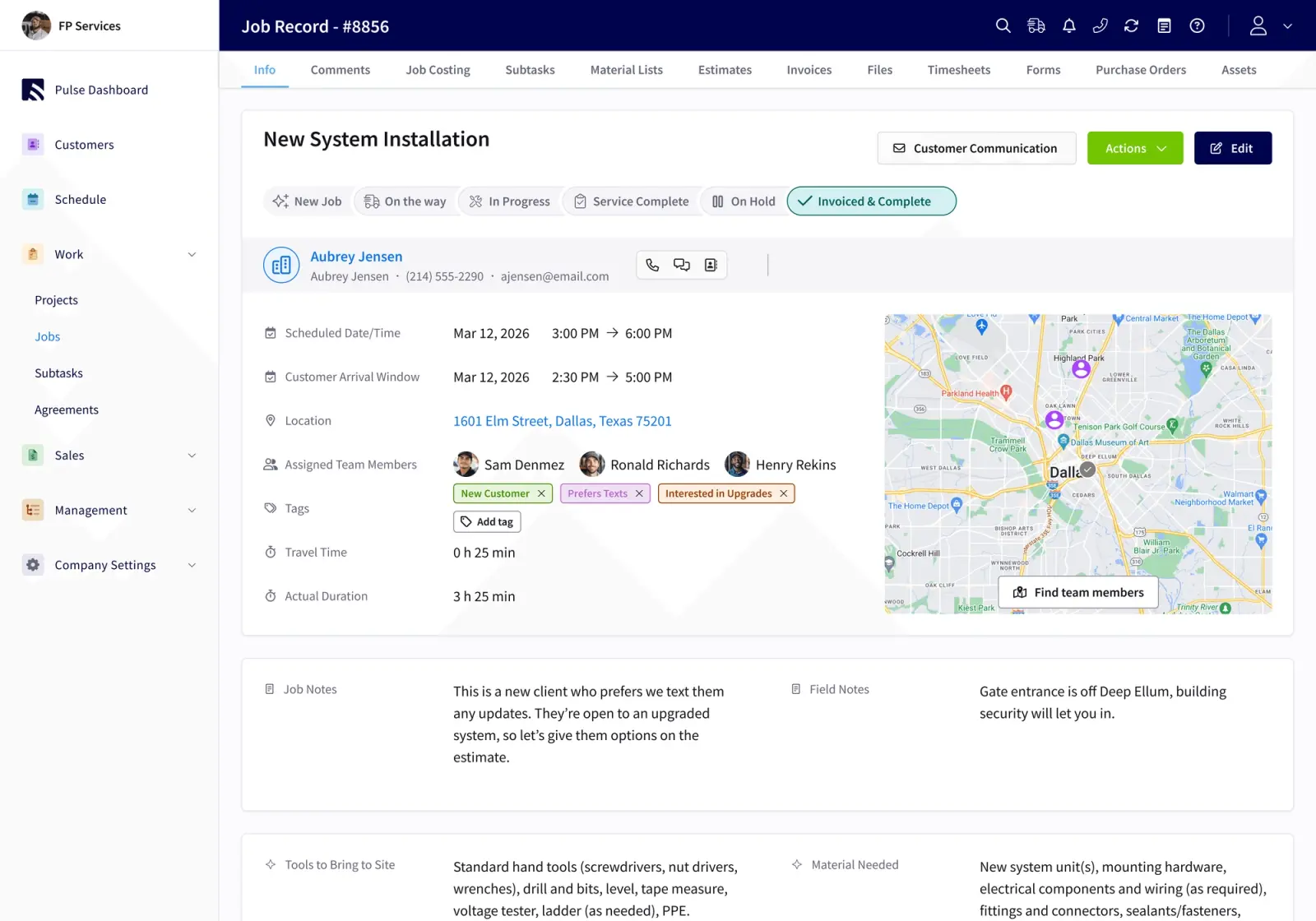
Decide on the category before you look at products. If your team maintains internal assets, focus on CMMS options. If you send techs to customer locations and need each job to become an invoice, you need FSM software.
When A Spreadsheet Stops Being Enough
Excel is not a CMMS. A spreadsheet can store dates and task lists, but it cannot automate preventive maintenance schedules, enforce required actions at each job stage, track parts inventory in real time, or give your whole team a live view of job status. A spreadsheet can list work but does not naturally manage the surrounding process. Assignment, escalation, approval, and closeout still depend on someone remembering each step.
Excel sticks around because it feels familiar and free. The hidden cost builds quietly. Maintenance managers can spend hours per week maintaining Excel logs, and version control becomes a breaking point as copies and emailed files multiply.
Residential service teams replace Excel with FSM software. The breaking points usually arrive together. Inventory tracking, roles and permissions, multi-stage job workflows, and profit margin visibility all become necessary as your team grows beyond what one person can track alone.
Use this quick check to see if you have outgrown your current setup:
-
Schedule changes trigger a round of calls or texts to notify everyone.
-
Completed jobs do not reliably become invoices.
-
You cannot see which jobs made money without rebuilding the numbers.
-
New hires take months to learn the process because it lives in people’s heads.
-
Your office team repeats work, once from the field and again in the office.
A business can run on digital tools and still break operationally. Fragmented information creates the problem. Manual handoffs cause the same failures whether they happen in access files, emails, or text threads.
Work Order Software Alternatives By Operation Type
The right alternative depends on how your team works day to day. These recommendations map options to common operation types.
Field Service Teams Running Residential Trade Work
FieldPulse is built specifically for this segment. It is all-in-one field service software for growing residential service teams, especially HVAC, plumbing, and garage door service, with strong fits for electrical, appliance repair, and locksmith work as well.
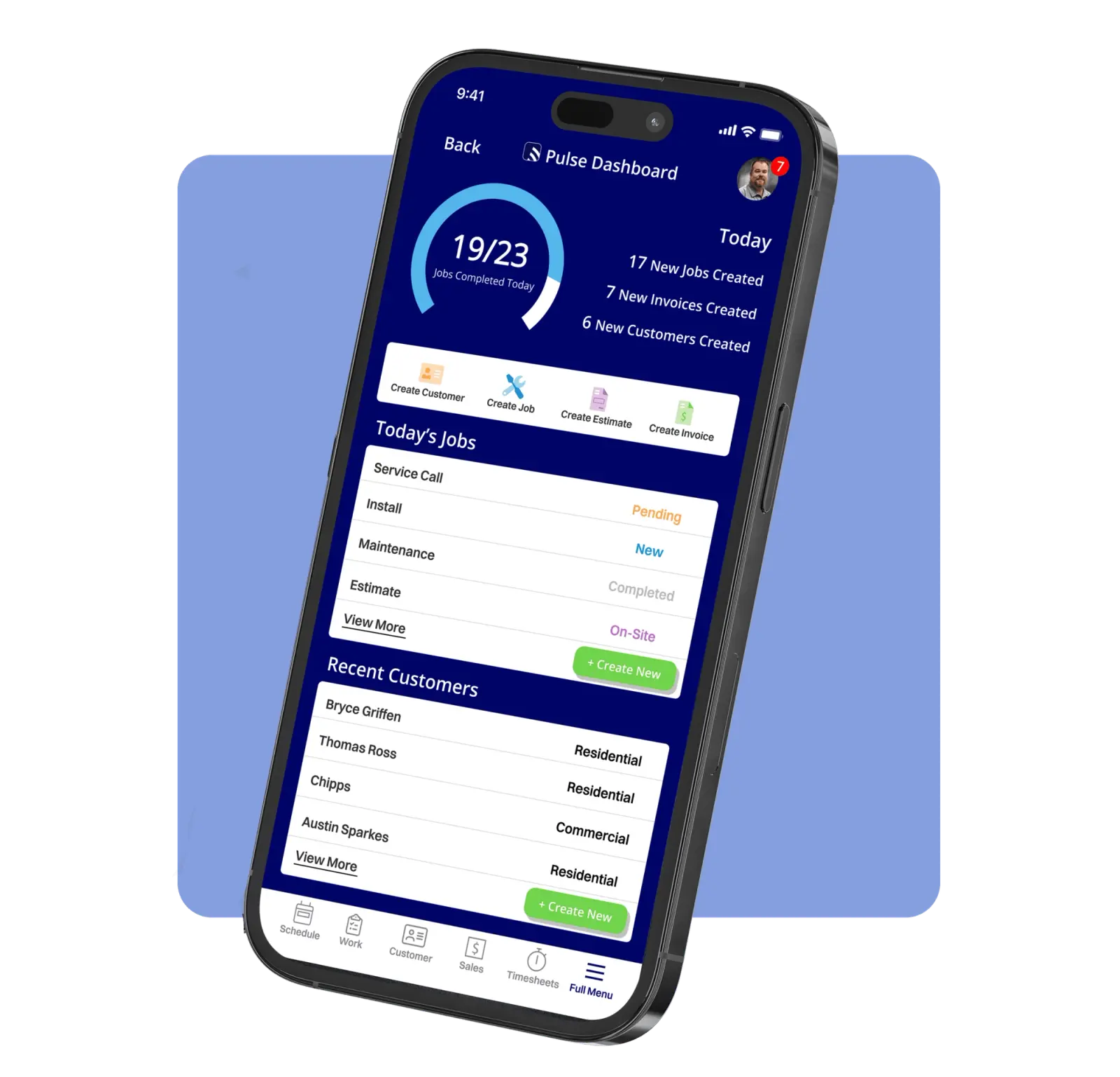
Two capabilities stand out when you compare alternatives. The first is ClearPath, included in the core platform. ClearPath turns your process into your team’s workflow. You define the job stages, the required actions at each stage, and what the tech sees on their phone at each step. ClearPath’s Mobile Focus View shows a tech only what the current stage requires, so they avoid hunting through screens or guessing what comes next. This creates consistent work quality and faster ramp-up for new hires.
The second is the two-way QuickBooks Online sync. Many field service platforms push data into QuickBooks Online and stop listening. FieldPulse syncs both ways, so a correction your admin makes in QuickBooks carries back into FieldPulse. That setup actually ends double data entry.
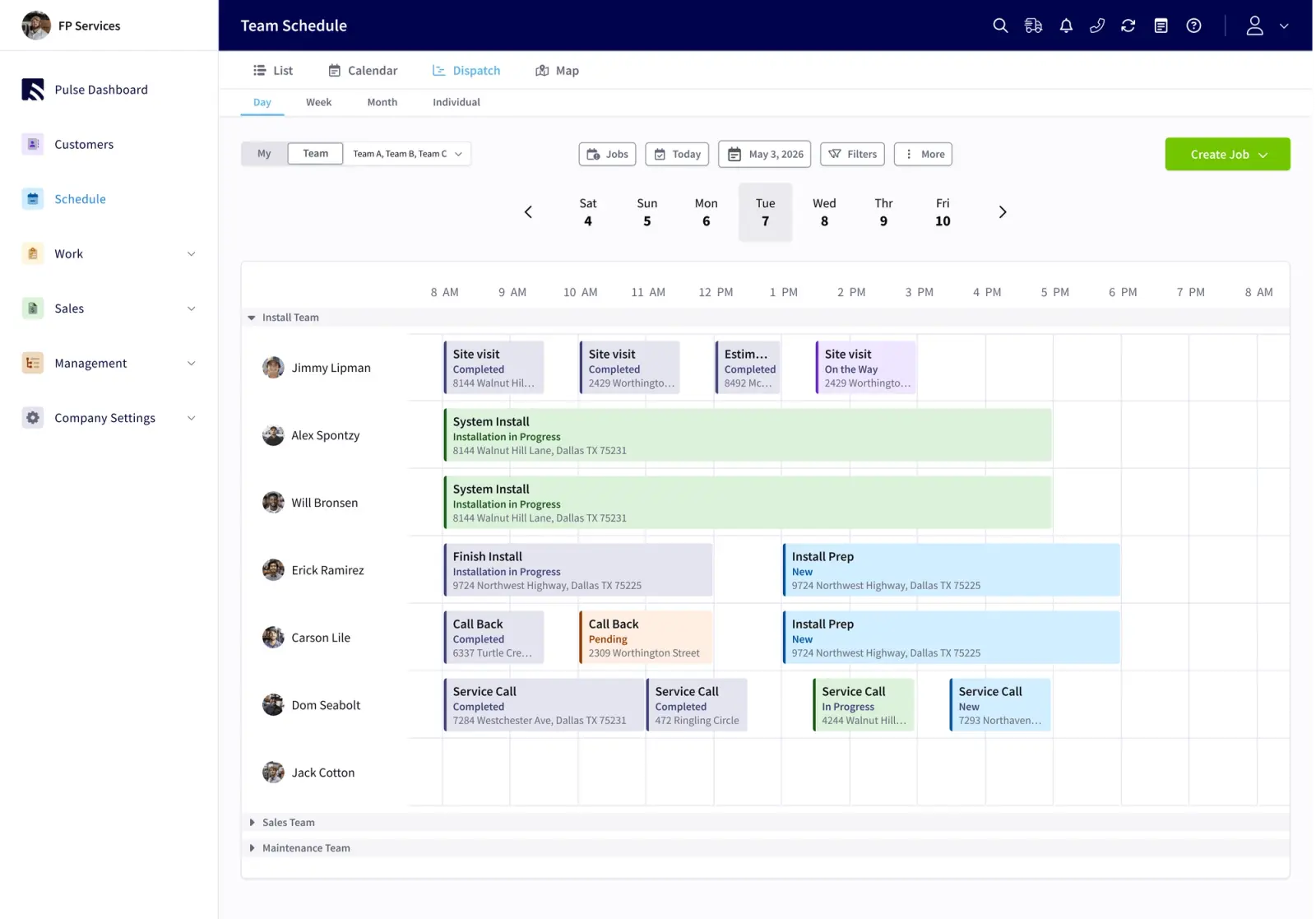
FieldPulse also covers the full job lifecycle: scheduling and dispatch, job costing, estimates and invoices, payments, customer communication, inventory, and reporting.
Teams often compare FieldPulse with two other platforms in this space. Jobber fits many smaller service businesses that want simple scheduling and invoicing. ServiceTitan focuses on larger operations that need more complex, enterprise-style setups.
Internal Facility And Maintenance Teams Focused On Asset Uptime
If your main goal is keeping your own assets running instead of dispatching techs to customer sites, a CMMS fits better than FSM software. If that describes your team, you will see these CMMS platforms most often in buyer shortlists. Pay attention to which strength matters most for your operation:
-
MaintainX – best when your techs live on their phones, with strong digital work orders and built-in team messaging.
-
UpKeep – best when ease of use is your top priority, with a cloud-based CMMS suited to asset-heavy industries.
-
Limble CMMS – best for mid-sized maintenance teams that need strong preventive maintenance scheduling.
-
Fiix – best for teams that care most about data analysis and predictive maintenance, as an AI-powered CMMS owned by Rockwell Automation.
-
eMaint and FMX – appear in many CMMS shortlists, with eMaint oriented toward mid-market and enterprise maintenance operations.
Asset-Heavy Operations With Complex Portfolios
Organizations with large, complex asset portfolios, such as manufacturing plants, utilities, and multi-site industrial operations, often need deeper asset capabilities than a standard CMMS provides. At this scale, buyers usually compare platforms in terms of asset depth and broader system integration.
-
MaintainX and Limble CMMS – serve the upper end of the mid-market with stronger asset management depth.
-
Fiix – fits manufacturing teams that prioritize predictive maintenance and data analysis.
-
Odoo – an open-source ERP with maintenance modules for organizations that want tighter links between maintenance and the rest of the business.
-
ServiceTitan – appears in shortlists for larger commercial service operations that still dispatch techs to external sites.
What Switching Actually Costs
Once you choose a category, the next step is understanding what switching really costs. Switching always takes real work.
Data migration is where most implementations run over schedule. Data migration often accounts for 40–60% of total implementation effort and is the most common failure point. The technical transfer usually works. The real problem hides in data quality. Inconsistent customer names, jobs in unclear statuses, and invoices that never closed all need cleanup before you move them.
For FieldPulse, your existing QuickBooks Online customers and records come with you when you connect. You avoid rebuilding that history from scratch.
Onboarding time typically takes two to six weeks. The timeline depends on your team size, which capabilities you enable, how much data has to migrate, and how your accounting is set up. The sequence usually looks like this:
-
Scope the work: capabilities, data, accounting requirements, and business complexity.
-
Get an implementation manager and set a recurring session cadence.
-
Configure the foundation: preferences, templates, permissions, ClearPath, and the mobile workflow.
-
Move data and connect QuickBooks Online. This step often extends the schedule.
-
Train each role through working sessions and small tasks between sessions.
-
Transition to ongoing support.
Office adoption often decides whether the rollout holds. The office administrator or dispatcher usually becomes the gatekeeper. If they remain unconvinced, the rollout stalls quietly, even when the owner liked the demo. The two-way QuickBooks Online sync mentioned earlier often becomes the turning point for the person keeping the books.
Rollouts work best in phases with small tasks between sessions so your team can practice. Each session should open with questions from the previous week. A good implementation assumes owners run trucks and manage operations, not IT projects.
Questions To Ask Every Vendor Before You Sign
Use these questions with every platform you evaluate so you see how each one handles the real work your office and techs do.
“When your admin corrects something in QuickBooks Online, how does that fix get back into your field software?” Many field service platforms push data into QuickBooks Online and stop listening. If the answer involves re-entering changes, you are looking at a one-way sync, and double data entry continues. FieldPulse syncs both ways, so a change in either system appears in the other.
“What happens when signal drops in the field?” Techs work in basements, attics, rural areas, and mechanical rooms. Ask what they can do without cell signal, such as viewing cached jobs, adding notes and photos, updating job status, and clocking in and out. Confirm that data entered offline syncs automatically when signal returns.
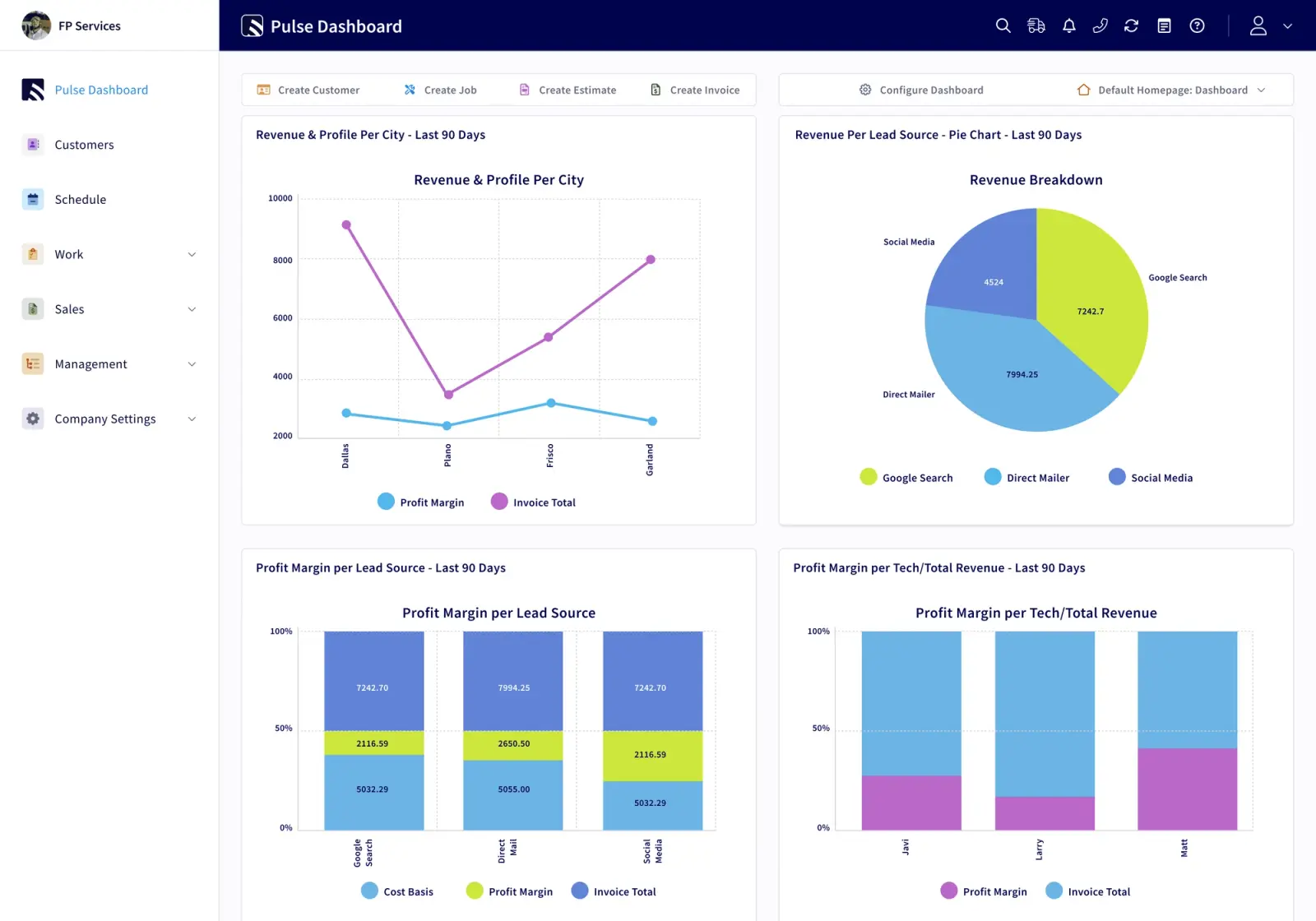
“How do I see job-level profitability?” You need to see profit margin per job, not just revenue. If the answer requires a spreadsheet or a report that takes hours to pull, expect extra work. You should see what a job cost versus what it earned without rebuilding the numbers later.
“What does the rollout look like week by week?” Ask for a specific sequence instead of a general promise. If the vendor cannot describe what happens in weeks one through four, their implementation process is likely loose.
Plan to catch sync errors early. It is far easier to untangle them once dozens of invoices are affected than to untangle them after they spread across your full job history.
What To Do In The First Two Weeks After Choosing
Going live on everything at once overwhelms your team. Sequence the rollout in phases, such as scheduling first, then invoicing, then time tracking, then ClearPath. This approach helps your team build muscle memory before the next layer arrives.
RDI, a commercial interiors business that moved from pen, paper, and Excel, described it this way: “We ripped band-aids off one at a time, instead of all at once.” Their time-tracking rollout, which they expected to take six months, was running payroll within two weeks.
Short tasks between sessions matter more than long training days. Each session should open with questions that surfaced since the last one. In the first two weeks, the goal is not full adoption. The goal is enough momentum that your team sees the system working while interest is still high.
If your office administrator feels overwhelmed by the scope of change, address that before go-live. Take the three-minute Admin Workload Assessment to see where administrative burden is heaviest across intake, field visibility, and invoicing.
Frequently Asked Questions: Quick Recap
What Is The Best Work Order Management Software?
The best work order management software depends on your operation. Internal facility and maintenance teams usually choose CMMS platforms such as MaintainX, UpKeep, Limble CMMS, and Fiix. Residential service businesses sending techs to customer sites benefit more from field service management platforms like FieldPulse that support the full job lifecycle instead of focusing only on asset uptime.
Is Excel A CMMS?
Excel is not a CMMS. It can store maintenance dates and task lists, but it cannot automate preventive maintenance schedules, enforce required actions at each job stage, track parts inventory in real time, or provide a live view of job status to your whole team. A CMMS acts as a system of record for maintenance work. It generates work orders automatically, tracks asset history, and produces compliance documentation. Excel always depends on someone remembering to update it.
How Long Does It Take To Switch Work Order Software?
For a residential service business moving to field service management software, onboarding usually takes two to six weeks. Your team size, enabled capabilities, data volume, and accounting setup all affect the timeline. Data migration, including customer records, job history, and accounting connections, often takes the most effort. Teams with clean, organized data and a phased rollout reach productive use faster than teams that try to configure everything before going live.
Conclusion: Choose The Right Category, Then The Platform
The category decision comes before the product decision. Work order software, a CMMS, and field service management software each solve specific problems. For established residential service teams that have outgrown spreadsheets or simple tools, the right category is FSM software. Switching takes real work, done in phases, with your office team fully on board.
Talk With FieldPulse About Your Workflow