








Key Takeaways for Growing Service Teams
-
FieldPulse is an all-in-one FSM software platform for established residential service businesses with 7–50 techs. It offers drag-and-drop scheduling, live GPS tracking, recurring jobs, automated notifications, and a mobile app.
-
The platform covers core scheduling and dispatch needs for growing teams, with a clean interface and a well-rated mobile app your techs can rely on.
-
As you grow, five operational requirements usually arrive together: inventory tracking, role-based permissions, multi-stage workflows, job-level costing, and two-way QuickBooks sync.
-
FieldPulse addresses these needs with barcode inventory, ClearPath workflows, job costing, and two-way QuickBooks Online integration.
-
FieldPulse connects your office and field teams in one system, which helps cut admin workload and improve efficiency when your team is in the 7–50 tech range.
See how FieldPulse keeps your office and field on the same page. Book a demo.
Where FieldPulse’s Scheduling Fits Today
FieldPulse’s scheduling handles the day-to-day work for a growing residential service business. For a dispatcher managing a growing team, the core tools are in place.
-
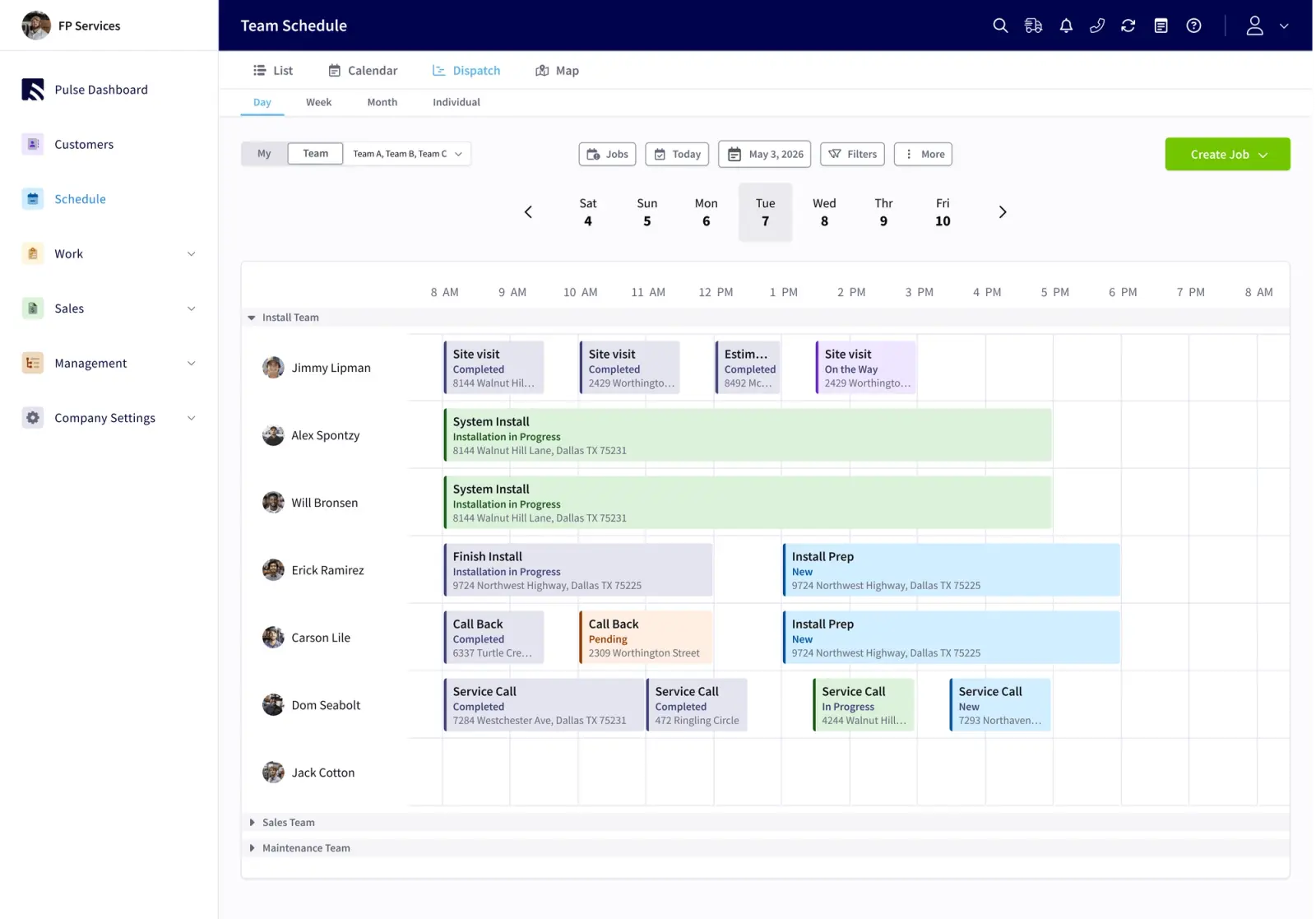
Drag-and-drop calendar: FieldPulse’s schedule is the central hub for managing jobs, visits, tasks, and appointments. Dispatchers can switch between list view, calendars, Gantt charts, and maps with live GPS-based tracking. Color-coded tags and Google Calendar integration keep the day easy to scan.
-
Crew availability: Dispatchers see who is free, choose an open time slot, and assign work by crew, skill, or location.
-
Dispatch with map and GPS: FieldPulse’s GPS Tracking feature lets dispatchers plan routes, assign jobs, and see team members’ last known locations on a map. GPS locations refresh periodically rather than continuously.
-
Route planning: Dispatchers plan routes with the platform’s routing tools and keep the day organized across the whole team.
-
Recurring jobs: The platform supports one-off jobs and recurring visits, which works well for maintenance contracts.
-
Automated customer notifications: Appointment reminders, on-my-way texts, and follow-up messages send automatically at the right stage.
-
Online booking: FieldPulse’s Booking Portal lets customers self-schedule with instant confirmation and the option to collect a service call fee upfront.
-
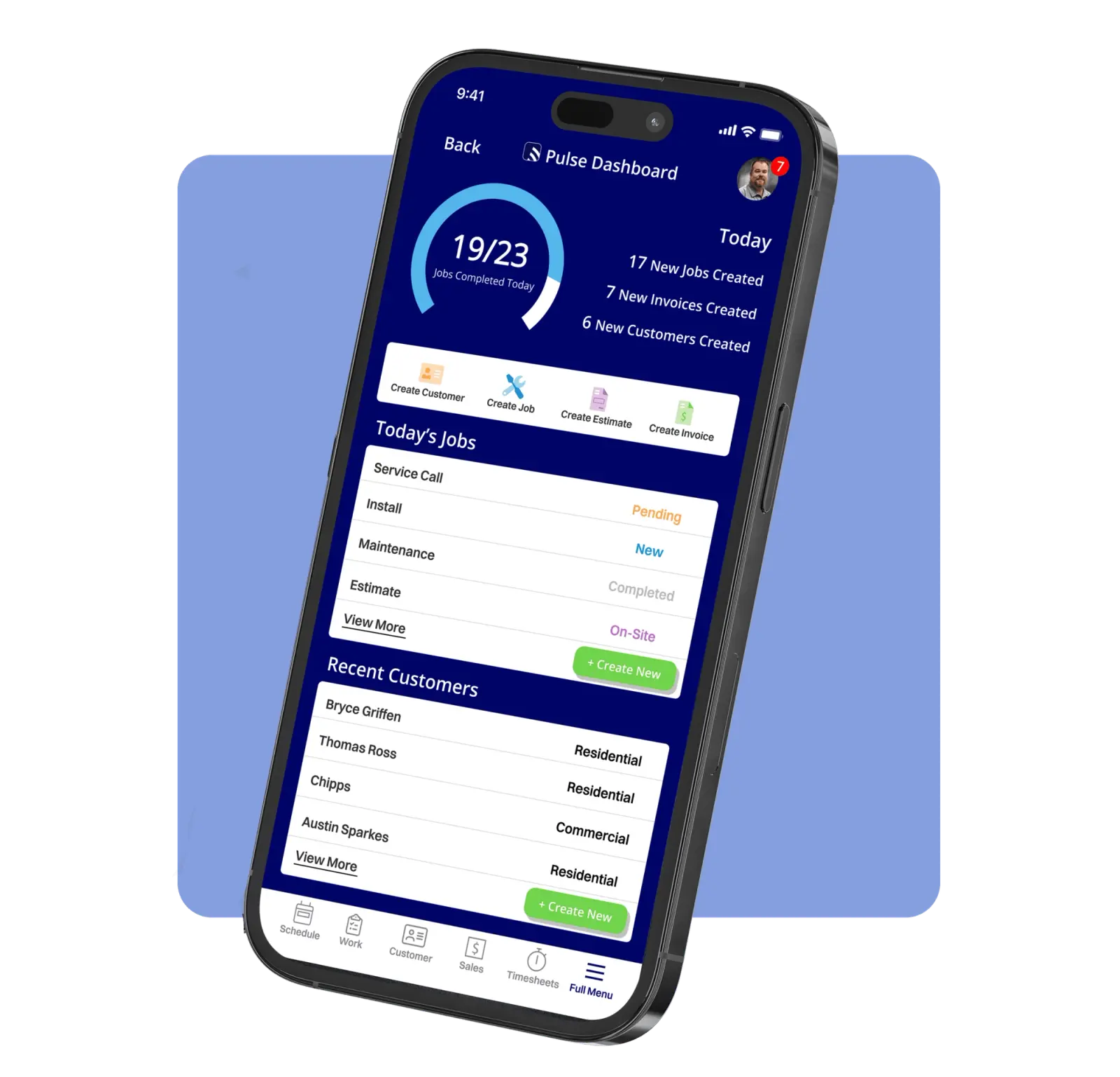
Mobile app: Techs update job details, track time, message customers, and stay current on schedule changes from the field.
For a team running a handful of techs on straightforward residential work, this creates a solid base. The scheduling interface is clean, the mobile app is well-rated, and automation reduces manual follow-up for your office.

FieldPulse’s scheduling works well for smaller teams. The real test comes when your team grows and your jobs get more complex.
Where Scheduling Starts To Strain as Your Team Scales
Growth does not weaken your trade skills or customer demand. What breaks operationally is how information moves between your office and your field. At five techs, your memory and quick calls cover gaps. At fifteen or twenty, those same gaps turn into extra phone calls, missed invoices, and stalled jobs with no clear next step.
Five operational requirements usually arrive together as your team grows. Each one is a normal part of scaling and reflects growth outpacing process development. They also require structure that simpler scheduling tools rarely provide.
Inventory and Serialized Parts Tracking
Small teams often manage parts informally. A tech grabs what they need, notes it somewhere, and your office sorts it out later. As you add trucks and job volume, that informal system breaks operationally.
Because nobody knows what sits on which truck, parts get bought twice. That same blind spot sends techs to jobs without the right component. When the part finally gets used, it may never reach the record, so invoices go out missing line items.
A growing team needs parts and materials tracked across warehouse, truck, and storage locations. Barcode scanning, low-stock alerts, and serialized inventory for equipment with serial numbers and installation history keep that under control. FieldPulse offers Inventory Management and Asset Management with these capabilities, and the value rises as your job volume increases.
Role-Based Permissions
When everyone can see everything, sensitive financial information spreads further than it should. A tech does not need to see your pricing strategy or profit numbers to complete a job. Your office administrator does not need edit rights on owner-level financial records.
Your team needs access controlled by role. Techs see what they need for the job. Your office sees what they need to manage scheduling and billing. Financial data stays with the people who own those decisions.
Multi-Stage Workflows Per Job Type
A service call, an installation, and a maintenance visit are different jobs. Each one has its own steps and its own required actions at every stage. Different people are responsible for moving each type forward.
When your team is small, the owner keeps that in their head. With fifteen techs running several job types at once, that knowledge has to live in your system.
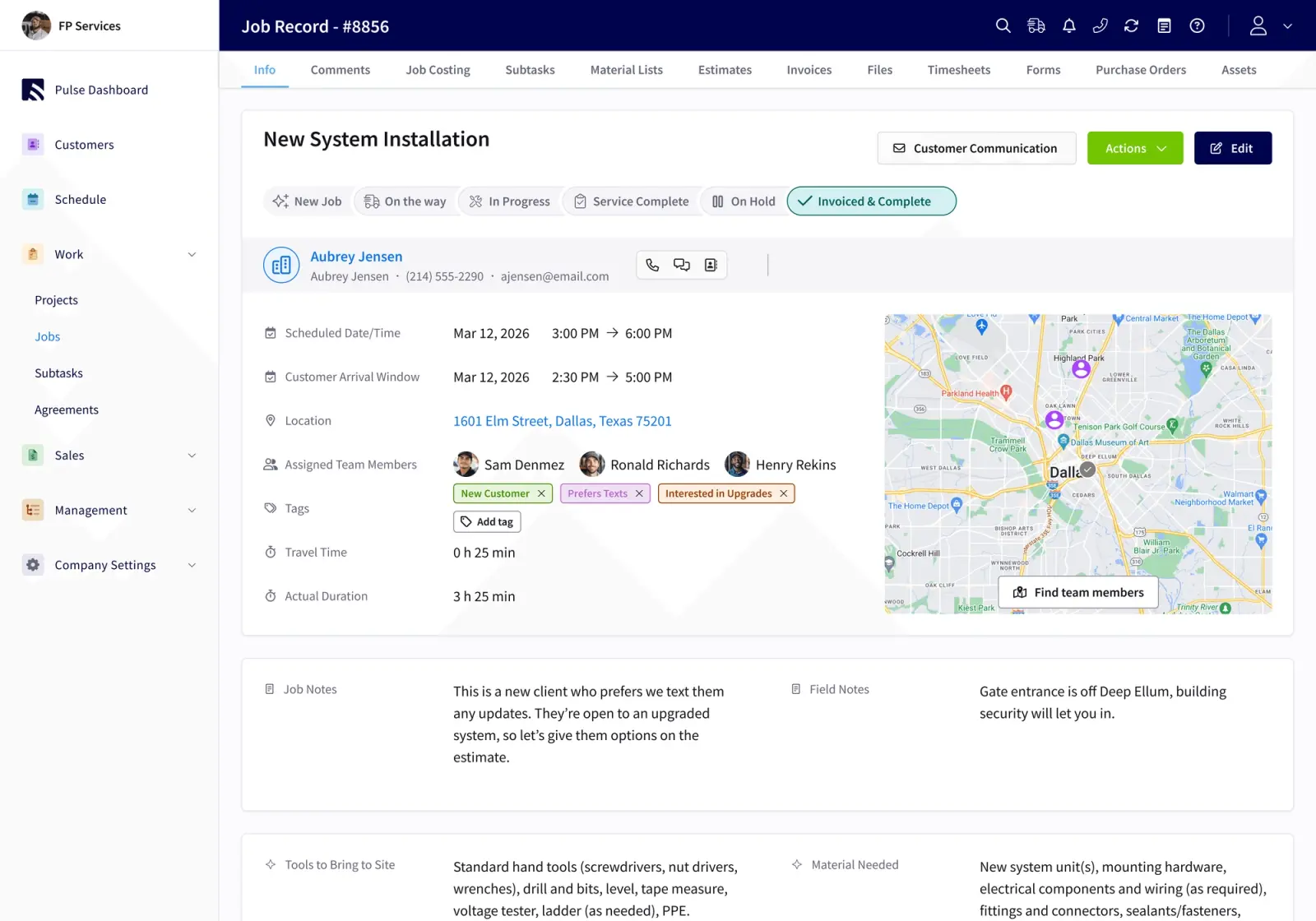
Your office defines the stages a job moves through and the required action at each stage so responsibility stays clear. Your techs then see only the current step on their phones, not the entire application. When a tech marks a job “on site,” the office sees that automatically. When the job is complete, the invoice trigger fires without anyone remembering to send it.
FieldPulse offers job checklists and custom forms as an add-on module, and workflow automation is included in the Essentials tier. The deeper need is structural control: office-defined stages with required actions and a mobile view that reflects only the current step.
Job-Level Costing and Profitability
Many owners at fifteen techs still do not know which jobs actually made money. Labor hours are not tied to specific jobs. Costs live in one place and revenue in another. Profit margin becomes something you discover later, if at all.
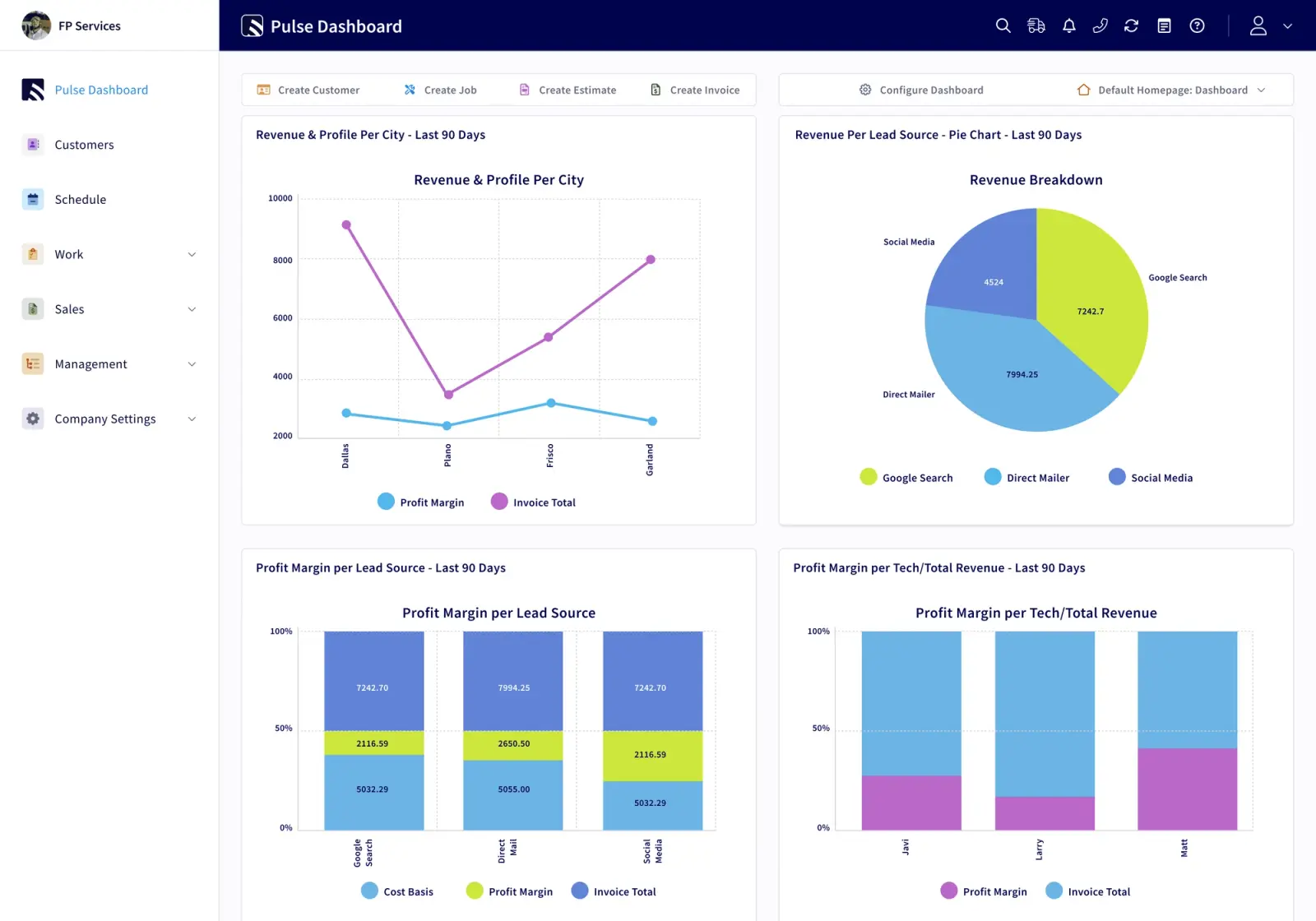
A growing team needs labor hours tied to specific jobs, per-job profit and loss, and line-item breakdowns of cost, price, and profit. FieldPulse’s job costing feature is available on the Grow and Plus plans and tracks profit margin, profit, and total price on jobs. If you plan to make pricing decisions from job economics, confirm with FieldPulse how costs and expenses count against profitability on the same job.
Two-Way Accounting Sync
The most common accounting problem in growing service businesses is disagreement between your field service software and QuickBooks. Your bookkeeper fixes something in QuickBooks, then the next sync overwrites that correction.
A true two-way sync keeps customers, line items, estimates, invoices, payments, purchase orders with full line-item detail, and vendors aligned in both directions. Timesheets flow into QuickBooks Online when a tech clocks out. Corrections made in QuickBooks carry back into your field service software. Tax rates come from QuickBooks Online, and invoice numbering follows your existing sequence.
FieldPulse syncs customer, invoice, and payment information with QuickBooks Online, and FieldPulse’s newer QuickBooks Online integration initially syncs costs from QuickBooks into FieldPulse, then treats FieldPulse as the source of truth for costs. FieldPulse’s two-way sync works with QuickBooks Online Essentials, Plus, and Advanced in the US, Canada, and Australia.
See how FieldPulse handles two-way QuickBooks sync. Book a demo.
FieldPulse Pricing Model: What To Clarify
FieldPulse uses tiered pricing organized into user-count bands, so you can match the plan to your team size. Several capabilities sit on higher tiers, including job costing on the Grow and Plus plans and QuickBooks Online sync on the Professional plan and above. Add-on modules such as Operator AI, Chat AI, Engage VoIP, Fleet Tracking, Sales Suite, and 24/7 Dispatcher are available separately.
For a twenty-tech team, the real question is what the platform delivers once you turn on everything that team actually needs. That includes the right tier for your user count, the add-ons your office relies on, and the third-party tools you can retire because FieldPulse covers them.
FieldPulse bundles scheduling, dispatch, job management, invoicing, and two-way QuickBooks Online sync in one platform, which means fewer tools to buy and fewer systems to keep in sync.
How To Evaluate Scheduling Software as You Outgrow a Simpler Tool
A feature checklist rarely tells you how a platform will feel in daily use. A short set of questions, asked of every vendor, gives you a clearer picture.
-
See each role in its actual interface. Ask to see the owner’s reporting view, your office administrator’s scheduling and inbox view, and your tech’s mobile view.
-
Trace a QuickBooks correction. Ask how a correction in QuickBooks flows back into the field service software and what happens if it does not.
-
Test what happens when signal drops. Your techs work in basements, rural areas, and mechanical rooms. Ask what they can still do without cell signal and what syncs when it returns.
-
Check whether your office admin’s workload shrinks. Ask how scheduling, shared inbox work, permissions, and duplicate entry change after rollout.
These questions apply to every platform you evaluate. The answers tell you more than any demo slide. If you want a structured way to run that evaluation, the FieldPulse Business Playbook walks through it step by step.
Get the FieldPulse Business Playbook.
FieldPulse: Fit and Features
FieldPulse is built for established, team-based residential service businesses in the 7-to-50-tech range, with particular strength in HVAC, plumbing, and garage door service. It also serves electrical, appliance repair, locksmith, property management, commercial equipment, fire and security, septic, A/V installation, and general contracting teams.
FieldPulse supports commercial work, but its depth leans on residential services. Likewise, one-person operations usually have simpler options.
The spine of the platform is ClearPath, included in the core product. ClearPath turns your process into a shared workflow. Your office defines the stages each job type moves through, such as installs, service calls, maintenance visits, and emergencies, along with the required action at each stage.
A tech completing an HVAC install might need to confirm floor protection before starting. At each stage, they capture a photo, and before leaving they get a customer signature. Your office defines those requirements once. The tech sees only what the current stage needs on their phone, and your office sees job progress update automatically without a call.
That structure also makes job costing work. When techs clock in against the job itself, labor hours tie to specific work. That connection is what makes per-job profit margin visible.
FieldPulse connects the full job lifecycle: lead capture, scheduling and dispatch, job and project management, pricing, estimates and invoices, job costing, payments and collection, customer communication, and reporting, plus a two-way QuickBooks Online sync so your office and your books stay aligned.
FieldPulse customers report 25% efficiency gains on average. Office teams save over 40 hours a month, field teams deliver about 50% more jobs on time, and businesses add roughly 16 customers a month while gaining 25% capacity. The platform holds a 4.8 out of 5 aggregate rating across G2, Capterra, the App Store, and the Google Play Store.
Qualified Plumbing LLC in Hawaii evaluated Jobber, ServiceTitan, and Housecall Pro before choosing FieldPulse. Their office secretary Heather Aila said, “You folks had everything in one bundle for a great price. Competitors wanted you to add items à la carte for an additional price.” They saved 7–9 hours per week and increased revenue 23%.
Window Fix, a glass and window business in Brooklyn that came from ServiceTitan, saved 15–20 hours per week and used FieldPulse to build a franchise model across multiple locations. Owner Ernie Cappello put it simply: “I wasn’t able to do that cleanly with ServiceTitan.”
Frequently Asked Questions
What Does FieldPulse’s Scheduling Software Do?
FieldPulse’s scheduling software provides a central hub for managing jobs, visits, and appointments. It includes a drag-and-drop calendar, live technician locations, recurring job support, automated customer notifications, a Booking Portal, and a mobile app for techs. It covers the core needs of a dispatcher supporting a growing residential team.
Who Is FieldPulse Best For?
FieldPulse fits established, team-based residential service businesses of roughly 7 to 50 techs running straightforward residential work where scheduling, invoicing, and customer communication are the main needs. It works well when job types are relatively uniform and QuickBooks Online covers your accounting sync needs. As your workflows, inventory, accounting, permissions, or job economics become more demanding, you should verify that FieldPulse’s structure still fits.
When Does a Growing Team Outgrow a Simpler Scheduling Tool?
The turning point usually arrives when growth outpaces the processes you built for a smaller team. The five requirements covered earlier — inventory and serialized parts tracking, role-based permissions, multi-stage workflows per job type, job-level costing and profitability, and two-way accounting sync — tend to arrive together. When any one becomes a daily problem, you have likely outgrown a simpler tool.
How Long Does Implementation Take?
A typical FieldPulse implementation runs two to six weeks, depending on team size, enabled capabilities, data migration, and accounting setup. The sequence usually follows these steps:
-
Scope the work with FieldPulse.
-
Get an implementation manager and a recurring session cadence.
-
Configure the foundation, including preferences, templates, permissions, ClearPath, and the mobile workflow.
-
Move data and connect QuickBooks Online.
-
Train each role.
-
Transition to ongoing support.
Your team will have homework between sessions, which helps the rollout stick. Faster launches happen, but planning for the full window is safer.
What Happens to Our QuickBooks Data If We Switch?
Your existing QuickBooks Online customers and records come with you when you connect, so you are not rebuilding your customer list. From there, the two-way sync described earlier keeps customers, invoices, payments, and purchase orders aligned in both directions. FieldPulse works with QuickBooks Online Essentials, Plus, and Advanced in the US, Canada, and Australia, and QuickBooks Desktop is also supported.
Does FieldPulse Work for My Trade?
Most FieldPulse customers work in residential or mixed HVAC, plumbing, and garage door service, followed by electrical, appliance repair, and locksmith. FieldPulse also serves property management, commercial equipment, fire and security, septic, A/V installation, general contracting, handyman, roofing, landscaping, glass and window, and specialty trades. FieldPulse supports commercial work as well as residential, though depth leans residential. If you are a team-based business where your office and field must stay in sync across multiple job types, it likely fits. Solo operators usually have leaner options.
What Questions Should We Ask FieldPulse During a Demo?
Use the same four questions from the evaluation framework above:
-
See each role in its actual interface.
-
Ask how a QuickBooks correction flows back into FieldPulse.
-
Test what happens when signal drops mid-job.
-
Confirm that your office administrator’s workload shrinks after rollout.
These answers will tell you more than any feature list.
Conclusion: How To Use This Evaluation
Growth problems are workflow problems first. Fragmentation, not your effort or intelligence, is what breaks operations. A fully digital business that relies on manual handoffs runs into the same issues as one using clipboards.
FieldPulse’s scheduling does real work for businesses in the early stages of growth. Those strengths hold as long as your team stays within the range FieldPulse serves best.
When you evaluate any platform, use the same framework: see each role in its interface, trace how accounting corrections flow, test offline behavior, and check whether your office admin’s workload shrinks.
FieldPulse covers the core scheduling and workflow needs of many 7-to-50-tech residential teams. The questions above are what to verify before you commit.
Ready to see the workflow in action? Book your demo.