









Key Takeaways
-
Work order software pricing depends heavily on the model. Per-user plans typically run $50–$200 per user per month, while flat-rate plans for growing teams often run $200–$650 per month.
-
Three pricing models dominate the market: per-user (scales with every seat), flat-rate (fixed monthly fee with possible usage caps), and custom quote (no published pricing).
-
Hidden costs such as payment processing fees, add-ons, implementation, and data migration often exceed the advertised subscription price.
-
Per-user pricing scales directly with your team, while flat-rate pricing keeps the bill steady as you add techs if the plan’s limits and features match your needs.
-
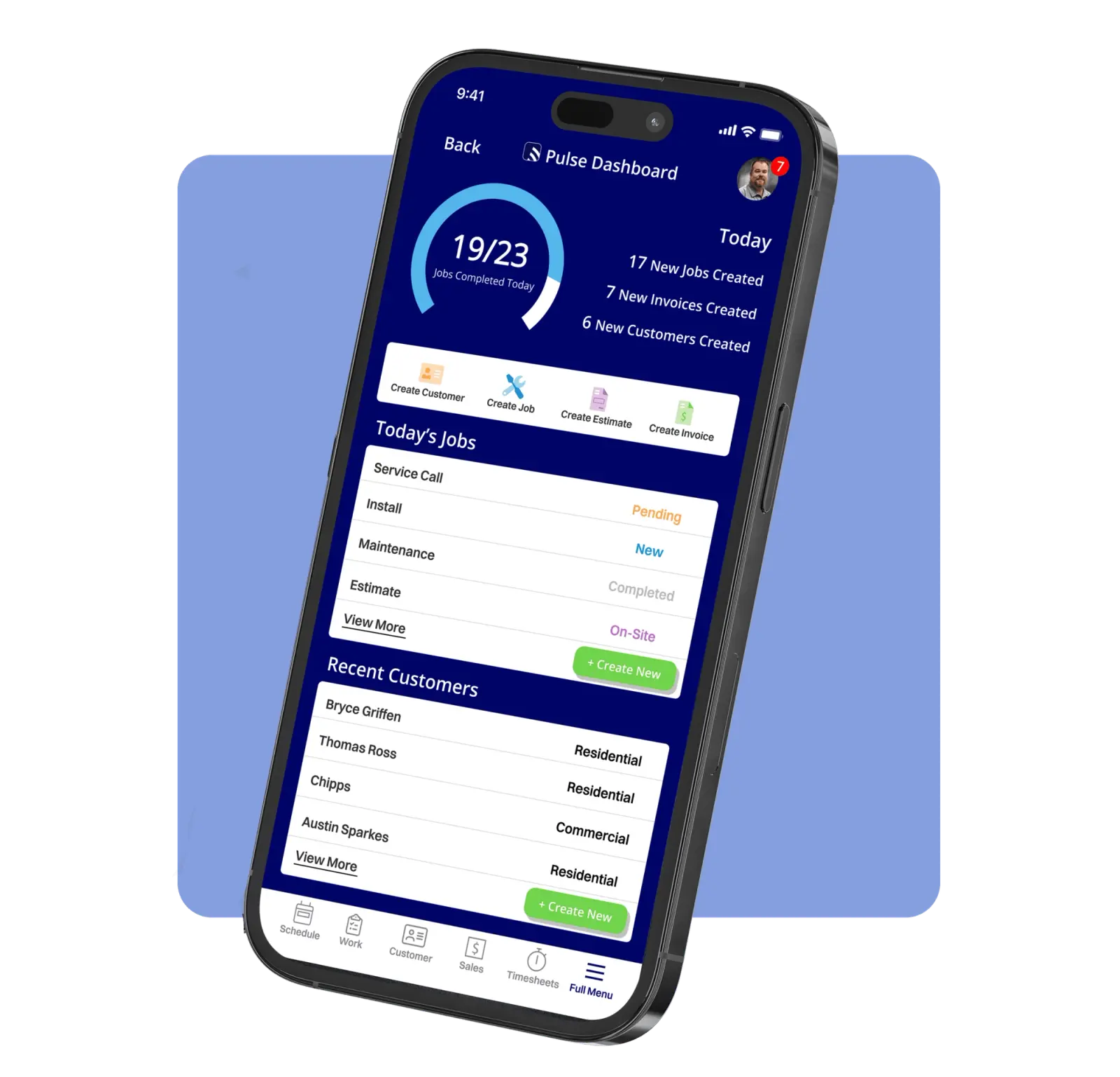
FieldPulse helps established residential service teams of 7–50 technicians avoid pricing surprises with transparent options and workflow tools that connect office and field teams.
Why Work Order Software Pricing Is Hard to Pin Down
You have three quotes on your office, a spreadsheet open, and no clear sense of the real monthly bill once your full team is on the platform. That gap between the advertised price and the real price is where budgets break.
This guide is for established residential service teams running HVAC, plumbing, garage door, electrical, or similar trades that have outgrown simpler tools and need a real work order software pricing comparison before signing anything.
The advertised price is almost never the real price. Payment processing, add-ons, implementation effort, and per-seat scaling all change the math. This guide walks through each of them.
See How FieldPulse Connects Your Office And Field
The Three Pricing Models And How They Scale As You Add Techs
You can compare work order software pricing only when you understand how each model scales with your team.
Per-user pricing charges a monthly rate for every named seat. The cost tracks your team size directly, so the bill grows in step with the people you add. That predictability works well for teams that want to pay only for the seats they use.
Flat-rate pricing charges one monthly fee regardless of how many people use the platform. The math looks expensive at two techs and very favorable at fifteen. Watch for usage caps, because some flat-rate plans limit monthly jobs, visits, or storage even when they advertise unlimited users.
Custom quote pricing means the vendor does not publish prices. You need a sales call to get a number. This model usually signals enterprise-oriented complexity.
What “Free” Actually Includes And Where The Paywall Sits
Free work order software can help you test the concept, but it rarely supports a growing team for long.
Most free CMMS plans cap users, with some platforms allowing up to 5, and block custom reporting, API integrations, and automated preventive maintenance work order generation. Mobile app access varies by platform and is available on some free tiers. Most small field service businesses hit a coordination wall between 2 and 5 technicians. By the time you have 4 or 5 techs, dispatch coordination usually becomes a real job that requires paid field service software, though some free or low-cost tiers can still serve very small teams.
The specific features that tend to sit behind the paywall on free tiers include:
-
Mobile app access for techs in the field
-
Inventory and parts tracking
-
Roles and permissions so not everyone can edit everything
-
Job costing and profit margin reporting
-
Accounting integrations
-
Advanced reporting and analytics
Free plans often hit feature limits within a few months. At that point you either upgrade or switch platforms. That switch carries its own cost in time and data migration. If you are evaluating free tools, document what you will need in six months, not just today.
The Costs That Do Not Appear On The Pricing Page
Every quote you receive has a visible number and an invisible one. These categories shape that hidden total.
Payment processing. If you collect payment through the platform, you pay a percentage of every transaction. Credit card processing fees typically run 1.5% to 3.5% of each transaction, with in-person transactions near the lower end and online or card-not-present transactions near the top of that range. A team doing $100,000 per month in revenue pays $1,500–$3,500 per month in processing fees. That amount is often higher than the software subscription itself. Ask every vendor for their full processing fee schedule, including ACH rates, payout timing, and any dispute or chargeback fees.
Add-ons. Features that look included often are not. Module-based add-ons such as inventory, customer portal, advanced analytics, and AI capabilities are frequently sold separately. A buyer who needs several of them can easily double the base subscription cost. Common add-ons across platforms include GPS fleet tracking, VoIP and messaging, AI dispatching, pricebooks, and custom forms.
Implementation and data migration. Some field service software providers charge a one-time onboarding fee. Data migration, which moves your customer’s history, job history, and equipment data from a legacy system, is almost always larger than your first estimate. Even for mid-market teams, you should budget for internal labor. The hours your office manager and operations lead spend in setup calls, training sessions, and data cleanup are real costs that do not appear on any vendor invoice.
Extra seats. Per-technician pricing only stays predictable if you know who the vendor counts as a technician. Ask specifically about temporary workers, subcontractors, supervisors, and part-time field staff. Some platforms even count office staff as billable users, so a dispatcher who never opens the mobile app can still add to your bill.
Annual billing and contract terms. Annual billing typically saves 15–20% versus month-to-month, with the average annual discount around 17% across the most common SaaS tools. Discounts range from 0% to about 33% depending on the vendor, and the full amount is typically charged upfront. Before signing, confirm the minimum contract length, automatic renewal terms, required cancellation notice, and what happens to your data if you leave.
Find Out What Your Jobs Are Really Earning
When A Spreadsheet Stops Being The Cheaper Option
Spreadsheets are a legitimate way to run a service business, and for a long time they were the only way. The structural problem appears when growth outpaces your process. Spreadsheets depend on people to move information, and that dependence turns into a bottleneck as your team expands.
The specific failures that make Excel more expensive than software tend to arrive in a predictable order as your team grows:
-
Concurrency breaks. For shared spreadsheet editing, the practical limit is far higher than two people: Google Sheets supports up to 100 simultaneous editors, while Microsoft’s recommended best practice for Excel co-authoring is fewer than 15 people at a time. In real life, one person has the file open and another works from a copy. The two versions quietly diverge, and you end up with two truths and no clear way to tell which is current.
-
Invoicing lags. Job details stay with the tech in the field. The office waits, then chases. The gap between finishing work and raising an invoice compounds across multiple jobs. Cash you have already earned sits uncollected.
-
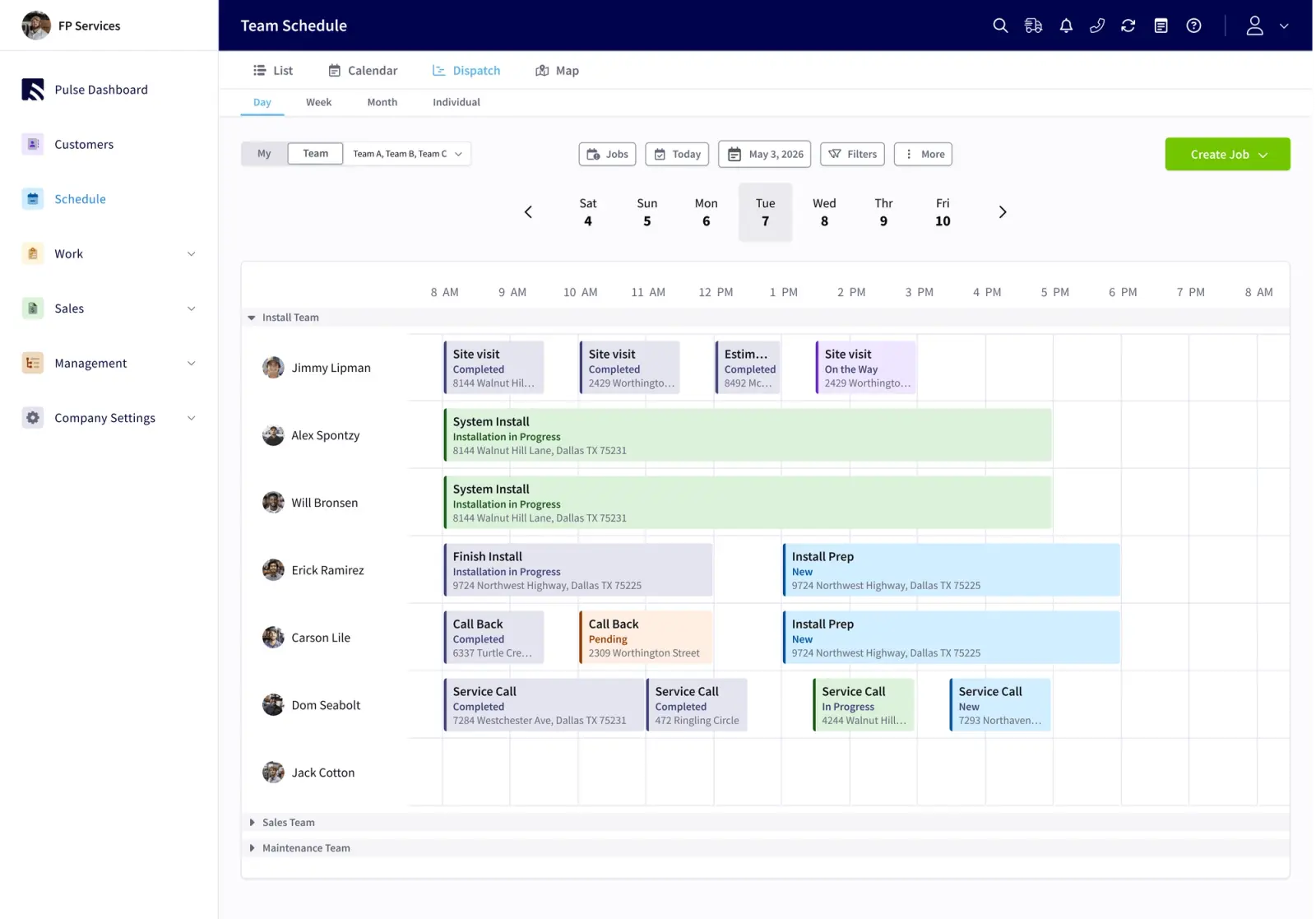
Scheduling breaks operationally. When emergency requests come in, the dispatcher rebuilds the day manually. They find the right tech, move jobs, and notify customers. One missed handoff becomes a customer waiting for a truck that is not coming.
-
Profit margin disappears. Without job-level cost tracking, profit margin becomes something you discover after the fact, if at all. Two techs quote the same job differently. Estimates take hours. The number that comes out depends on who built it.
How To Compare Two Quotes Apples-To-Apples
Before you sign anything, ask every vendor the same set of questions. Consistent questions make the real differences much easier to see.
-
What happens to the price when you add five techs?
-
What is included in the base package versus priced as an add-on?
-
How does payment processing work, and what does it cost per transaction, including ACH, chargebacks, and payout timing?
-
What does implementation and data migration require from your team, and is it included in the quoted price?
-
When your office corrects something in your accounting system, how does that fix get back into the field service software?
-
What are the contract terms, including minimum length, renewal conditions, cancellation notice, and data export rights?
-
What happens when you exceed a plan limit, such as an upgrade requirement, overage fee, or temporary restriction?
Build two numbers for every vendor: first-year cost, including implementation, migration, and any promotional pricing, and expected annual cost once those one-time expenses are gone. The difference between those two numbers is where budget surprises live. If you run those numbers on FieldPulse, here is what you will find.
Where FieldPulse Fits In Your Pricing Comparison
FieldPulse is built for established residential service teams of roughly 7 to 50 technicians in HVAC, plumbing, garage door, electrical, and similar trades that have outgrown simpler tools and do not need enterprise complexity. It holds a 4.8 out of 5 rating across G2, Capterra, the App Store, the Google Play Store, and other software-review sites.
FieldPulse prices by business rather than by seat, so adding techs does not automatically multiply your bill. You choose from three packages, Essentials, Professional, and Enterprise, and can add lower-priced field-only seats for techs who only need the mobile app. A few capabilities are priced as add-ons, including Pricebook, Custom Forms, Engage, Operator AI, Chat AI, and Fleet Tracking, so it pays to confirm which ones your process actually needs before you compare totals.

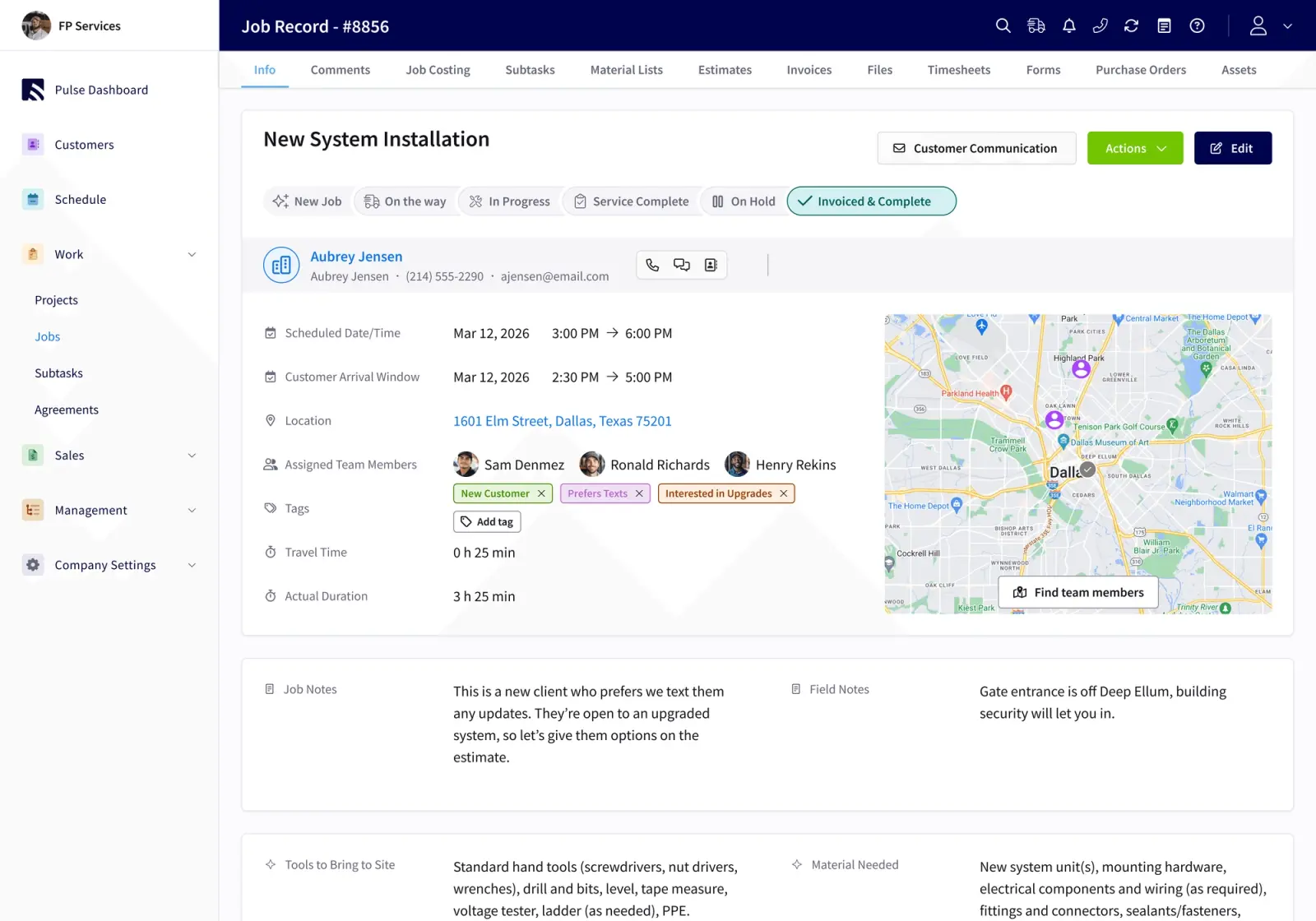
The spine of the platform is ClearPath, included in the core product. It turns your process into a guided workflow. You define the stages a job moves through and the required actions at each stage. ClearPath’s Mobile Focus View then shows your techs only what the current step needs. For an HVAC install, that might mean a required floor-protection checklist before work starts and a customer sign-off before the tech leaves. Your office sees job progress in real time without a phone call.
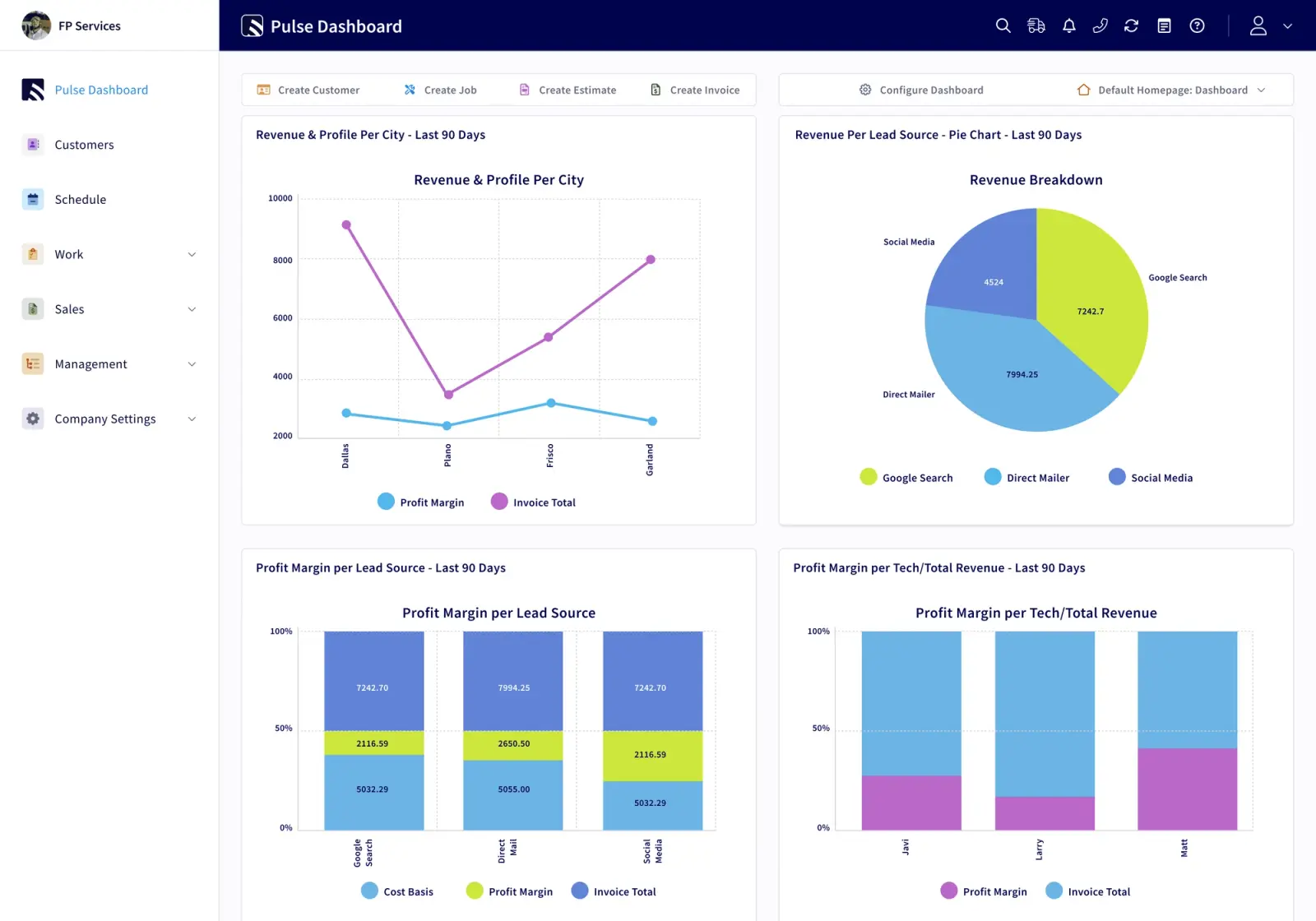
Job costing in FieldPulse lets you see expected profit margin before you dispatch and confirms actual profit after completion, with line-item breakdowns by labor, materials, and overhead. Because techs clock in against the job itself, labor hours tie to specific work. That connection makes job-level profitability visible.
The two-way QuickBooks Online sync means corrections made in your books carry back into FieldPulse instead of being overwritten. That structure actually ends double data entry because it creates a genuine two-way connection rather than a one-way push. The result is less time spent re-entering the same information. On average, FieldPulse customers see 25% efficiency gains, with office teams saving 40+ hours per month.
Watch FieldPulse Connect Your Office And Field In One Workflow
Common Pitfalls When Budgeting For Work Order Software
Growing service teams tend to run into the same budgeting mistakes. You can avoid them by watching for these patterns.
-
Assuming the advertised price is the real price. It rarely is. Payment processing, add-ons, and per-seat scaling all change the number. Build your budget from the all-in cost, including hidden items.
-
Forgetting payment processing. At volume, transaction fees can exceed the subscription cost. Ask for the full fee schedule, including card rates, ACH rates, payout timing, and dispute fees, before you compare quotes.
-
Underestimating implementation effort. Data migration, configuration, and training take real time from your team. Budget for that work, and ask vendors what they include versus what they bill separately.
-
Choosing a tool that cannot grow with your team. A platform that works at five techs may not hold inventory, permissions, multi-stage workflows, or real job costing at fifteen. The cost of switching again in time, data migration, and team disruption is real. Evaluate where you will be in two years, not just today.
-
Skipping the office administrator in the decision. The person who runs your day is the adoption gatekeeper. If they cannot see their workload getting smaller in the demo, the rollout usually stalls. Bring them into the conversation before you sign.
-
Ignoring contract terms. Automatic renewal clauses, downgrade restrictions, and cancellation notice requirements can lock you into a tool longer than you planned. Read the terms before you commit.
Frequently Asked Questions
What Is A Good Free App For Managing Work Orders?
Several platforms offer free tiers, including tools built on general project management software and entry-level CMMS products. Free tiers typically cover basic work order creation, status tracking, and technician assignment for very small teams. The limitation is almost always team size, because most free plans cap users at one to three seats, and feature depth. Mobile access, inventory tracking, job costing, and accounting integrations are commonly paywalled. A free tool can be a legitimate starting point for a team testing the concept, but it rarely supports a team of five or more technicians that needs coordination across the office and the field.
How Much Does Work Order Software Cost For A Small Business?
For a team of five to ten technicians, expect to pay roughly $100–$400 per month for a capable field service platform. The exact number depends on whether the vendor charges per user or flat-rate, the models compared earlier in this guide. That figure covers the subscription only. You still need to add payment processing, any add-ons your workflow requires, and the internal time your team spends on implementation and training. Annual billing usually saves money but often requires upfront payment, so build your budget from the all-in first-year cost and then calculate the expected annual cost once one-time expenses are gone.
Is Excel Good Enough To Manage Work Orders?
For a single-person operation with a small, stable job volume, a spreadsheet can work. The structural problem arrives when more than one or two people need to work from the same information at the same time, when recurring jobs need automatic scheduling, or when you need job-level profit margin visibility. As explained above, spreadsheets depend on people to carry information between steps, and that approach does not scale. Diverging file versions, late invoices, and inconsistent pricing tend to appear quietly and compound before they become obvious. The moment two people need to be certain they are looking at the same truth at the same time is usually the moment a spreadsheet stops being sufficient.
What Costs More Than The Subscription?
Payment processing is usually the biggest surprise. At volume, transaction fees on card payments can exceed the monthly subscription cost. Implementation and data migration follow close behind, because moving customer records, job history, equipment data, and accounting mappings from a legacy system takes more time and internal effort than most buyers plan for. Add-ons are another source of extra cost, since features like GPS fleet tracking, VoIP and messaging, AI dispatching, pricebooks, and custom forms are frequently priced separately from the base platform. Finally, internal labor, including the hours your office manager, dispatcher, and operations lead spend in setup calls, training, and configuration, is a real cost that never appears on a vendor invoice.
What Should I Ask A Vendor Before Signing?
You get the clearest comparison when you ask each vendor the same questions. Focus on how the price changes as you add techs, what is included in the base package versus priced as an add-on, the full payment processing fee schedule, what implementation and data migration require from your team, how corrections in your accounting system sync back into the field service software, and the contract terms. Then apply the same scenarios with every vendor so you are comparing answers on equal footing.
How Long Does Implementation Take?
For a growing residential service team, a realistic implementation window is two to six weeks. The exact timing depends on team size, which capabilities you are enabling, how much data needs to migrate, and how your accounting is set up. Faster launches happen, but they are exceptions. The work that determines whether an implementation succeeds happens before go-live. That work includes cleaning and organizing your customer records, agreeing on naming conventions, and mapping your actual job workflows into the new system. You should budget for a short period of parallel running, where you pay for both the old system and the new one, and plan for your team to have homework between training sessions so adoption sticks.
Conclusion And Practical Next Steps
The advertised price is rarely the real price. Work order software costs are shaped by the pricing model, the hidden costs that do not appear on the pricing page, and whether the platform can grow with your team. Per-user pricing scales with every seat you add. Flat-rate pricing keeps the bill steady as your team grows when the plan includes the features you actually need. Custom quote pricing often signals complexity that most growing residential service teams do not need.
Before you sign anything, take these steps:
-
Document your current workflows, including where jobs stall, where invoices go late, and where information gets lost between the field and the office.
-
Identify your actual bottlenecks, not just the ones that are loudest today.
-
Gather quotes from multiple vendors and ask the apples-to-apples questions about add-on pricing, payment processing fees, implementation scope, and contract terms.
-
Build two cost numbers for each vendor, first-year all-in cost and expected annual cost after one-time expenses are gone.
-
Bring your office administrator into the evaluation. If they can see their workload getting smaller, the rollout has a much better chance of success.
The right platform for a 7-to-50-technician residential service team connects your office and your field around one current set of job, customer, and payment information without forcing you into enterprise-level complexity.
See How FieldPulse Prices And Connects Your Team