









Key Takeaways For Electrical Teams
- Electrical service software pricing stays hard to pin down because most vendors require a demo before sharing numbers, and your total cost depends on seat count, package tier, and add-ons.
- Entry-level tools start at $25–$60 per month while mid-market platforms run $100–$200 per user per month, and hidden costs such as onboarding ($500–$2,500 one-time), payment processing, and SMS add-ons often exceed the subscription price.
- Estimating software and full field service platforms solve different problems, because estimating tools focus on bids while service platforms handle scheduling, dispatch, invoicing, and job costing.
- Most vendors keep pricing quote-only because seat count, implementation scope, and add-ons vary widely between businesses, so a single published number would mislead many buyers.
- FieldPulse offers seat-based pricing with three packages, lower-priced field-only seats, and separately priced add-ons so established electrical teams can calculate real monthly costs accurately.
How Much Does Electrical Service Software Cost?
Entry-level field service software typically runs about $25–$60 per month, often priced flat per account rather than per user. Mid-market platforms run $100–$200 per user per month. Enterprise field service systems typically run about $200–$500+ per user per month, or require a custom quote. Your total cost then shifts based on onboarding, add-ons, and payment processing.
The three tiers differ less in features than in who they are built for. Entry-level tools usually cap out at solo or two-person teams, while mid-market and enterprise platforms price per user and add the operational depth multi-crew businesses need. Here is how they compare:
| Tier | Per-User Range (Monthly) | What It Includes | Who It Fits |
|---|---|---|---|
| Entry-Level | ~$25–$60/mo (often flat per account) | Basic scheduling, invoicing, customer records | Solo or two-person teams; not built for multi-crew operations |
| Mid-Market | $100–$200/user/mo | CRM, accounting integrations, job costing, inventory, workflow customization | Teams that have outgrown spreadsheets or basic invoicing tools |
| Enterprise | $200–$500+/user/mo or custom quote | Multi-location management, advanced permissions, project management, deep reporting | Large operations with dedicated implementation resources |
FieldPulse fits established, team-based residential service businesses in the roughly 7-to-50-technician range, positioned between enterprise platforms and simpler tools. Pricing is seat-based across three packages: Essentials, Professional, and Enterprise. Lower-priced field-only seats are available for techs who need the mobile app alone. Pricing is quoted per business based on your team size, trade, and which capabilities you turn on, so a quick demo gives you a real number.
Hidden Costs Electrical Contractors Should Expect
Your subscription price is only the starting point. The costs that show up in month two often blow up the budget. Before you sign anything, account for each of the following:
- Onboarding and data migration: Implementation typically runs two to six weeks and may include guided setup, data import, and accounting configuration. Ask what is included and what is billed separately. Onboarding fees, when charged separately, commonly run $500 to $2,500 one-time for electrical service businesses.
- SMS and email add-ons: Automated customer notifications, appointment reminders, and on-the-way texts may be metered or bundled into a communication add-on. SMS usage is often metered or capped, so heavy dispatching and customer follow-up can create overage charges beyond the base plan.
- Payment processing rates: Card and ACH processing carry per-transaction fees, and on high volume those fees can rival your subscription cost. Ask whether the platform offers a dual pricing program to help offset them. FieldPulse Payments includes Card Fee Recovery (CFR), a compliant dual pricing program that is legal in all 50 states. It reduces your processing cost to 1%, or to 0% if the remaining 1% is also passed on.
- Pricebook and material database subscriptions: Pre-built supplier catalogs and pricing databases may be add-ons rather than included in the core platform. For electrical work this matters more than in many other trades because of the complexity of load calculations, service upgrades, and panel replacements. FieldPulse Pricebook is a separately priced add-on.
- Additional user seats: Seat-based pricing means adding techs increases your monthly bill. Ask whether field-only seats are priced lower than full-access seats. FieldPulse offers lower-priced field-only seats for techs who need the mobile app alone.
- Training and support tiers: Premium support, live training, and coaching sessions may be upgrades rather than standard. FieldPulse Premium Support adds priority phone access, extended hours, FieldPulse360 live training, and three one-hour personal coaching sessions per quarter.
FieldPulse prices several capabilities as add-ons on top of the platform, including Pricebook, Custom Forms, Engage, Operator AI, Chat AI, and Fleet Tracking. Payment processing is an opt-in commercial program with its own rates. ClearPath, the workflow engine that turns your process into guided job stages, is included in the core platform.
Start Your Pricing Conversation
Estimating Software vs. Service Software: Different Tools, Different Pricing
Two main software categories show up when you research electrical tools, and many pricing guides mix them together. You get a clearer budget when you separate them.
Estimating software is built for takeoffs, bids, and material pricing. Service software is built for scheduling, dispatch, job management, invoicing, payment collection, and job costing. Each category uses different pricing models and solves different problems for your team.
How Much Does Electrical Estimating Software Cost?
Electrical estimating tools usually follow one of two pricing models:
- One-time license: Best Bid uses a one-time purchase model starting at $1,999.95 for Hybrid Pro, with no ongoing subscription. Power! Estimator is sold as a perpetual license at $999 for the base software. These tools keep costs predictable if you stick with one platform, but they do not cover scheduling, dispatch, or invoicing.
- Annual subscription: PlanSwift Professional starts at $2,000 per year, billed annually, including software updates and two hours of training. STACK’s Takeoff and Estimate Premium starts at $249 per user per month, billed annually. Trimble Accubid Anywhere and Procore are quote-only.
An electrical contractor running a service business often needs both estimating and service software, one to win the job and one to run it. A full field service platform that includes estimates and invoices can replace the estimating-only tool plus the invoicing tool plus the spreadsheet. FieldPulse includes estimates and invoices in the core platform, with the Pricebook add-on providing pre-set pricing for services, materials, and labor rates. Knowing which category you need solves only half the budgeting problem. The other half is getting a straight answer on what any of these platforms actually charge.
Why Most Electrical Software Vendors Do Not Publish Pricing
Many buyers want a real number on the website, and quote-only pricing feels like a runaround. Several moving parts sit behind that choice.
Seat count, package tier, add-ons, implementation scope, data migration, and accounting setup all vary by business. Quote-only pricing lets vendors factor in your company size, urgency, and available alternatives. A single published number would mislead many buyers. That is the structural reason. The practical consequence is that you need a framework for evaluating any quote you receive.
When you get a quote, ask these questions so you can compare vendors on equal footing:
- What is included in the base package, and what is an add-on?
- What does onboarding cover, and what is billed separately?
- What does payment processing cost, and is a dual pricing program available?
- What happens to the bill when you add a technician?
- Is there a cap on annual renewal increases?
- What does data export look like if you ever leave?
FieldPulse uses seat-based pricing, three packages, add-ons priced separately, and a demo to give you a quote tailored to your business.
How To Calculate Your Real Monthly Cost
You can build a simple number to take to your bookkeeper. Use this formula:
(Full-access seats × package rate) + (field-only seats × field-only rate) + add-ons + onboarding + payment processing = real monthly cost
Work through it in this order so each step builds on the last:
- Count your full-access seats, such as owners, office administrators, and dispatchers, and your field-only seats, meaning techs who need the mobile app alone. This seat count drives almost every other cost because per-seat pricing scales with each hire.
- Once you know your seat count, identify which capabilities are must-have on day one versus which can wait. Pricebook, Custom Forms, Engage, Operator AI, Chat AI, and Fleet Tracking are all add-ons in FieldPulse.
- Then add onboarding and data migration if billed separately. Budget $500 to $2,500 one-time when charged separately so you are not surprised later.
- Estimate your payment processing volume and the applicable rates. On high card volume, processing fees can rival the subscription cost itself.
- Finally, add SMS, Pricebook, and any other add-ons you need from day one so your first-year number is realistic.
The cheapest subscription rarely delivers the lowest total cost if it requires three other tools to cover scheduling, invoicing, and job costing. The lowest sticker price and the lowest total cost of ownership usually come from different platforms. Model the cost at your 12-month headcount rather than your headcount today.
When It Is Time To Move Off Estimating-Only Or Basic Invoicing Tools
Most electrical service businesses start shopping for new software when a turning point makes the cost of staying visible. The trigger is usually a pattern of small failures, not a single dramatic event.
The operational breakdowns that show up when you run on estimating-only software plus spreadsheets plus a basic invoicing tool are predictable:
- Job completion that never becomes an invoice, because the tech holds the parts and labor details, the office waits, and cash sits uncollected.
- Schedule changes that turn into a call tree, because one emergency request comes in and the dispatcher rebuilds the day manually.
- Pricing that varies by person, because without a standard pricebook, two techs quote the same panel upgrade differently, and your profit margin becomes something you find out about later.
- Customer context that fragments, because the customer’s history, equipment records, and gate codes split across access files, text threads, and separate systems.
- Administrative work that eats personal time, because the office finishes the paperwork after the operational day ends when the system depends on re-entry.
These are workflow problems that come from how information moves between your office and your field, not from how well your techs do their jobs. They get worse as your team grows from five techs to fifteen. Growth outpaces your process, manual information tracking multiplies, and missed handoffs become common.
FieldPulse serves established, team-based residential service businesses in the 7-to-50-technician range, with particular strength in HVAC, plumbing, and garage door service, and strong secondary support for electrical. FNW Construction, an electrical business in California, saved 4–6 hours weekly and saw a 23% revenue increase after moving to FieldPulse. Stewart Electrical Contracting’s Operations Manager Colby Bruce reported 30% fewer missed appointments and more than five hours saved on admin work weekly.
How FieldPulse Fits Electrical Teams
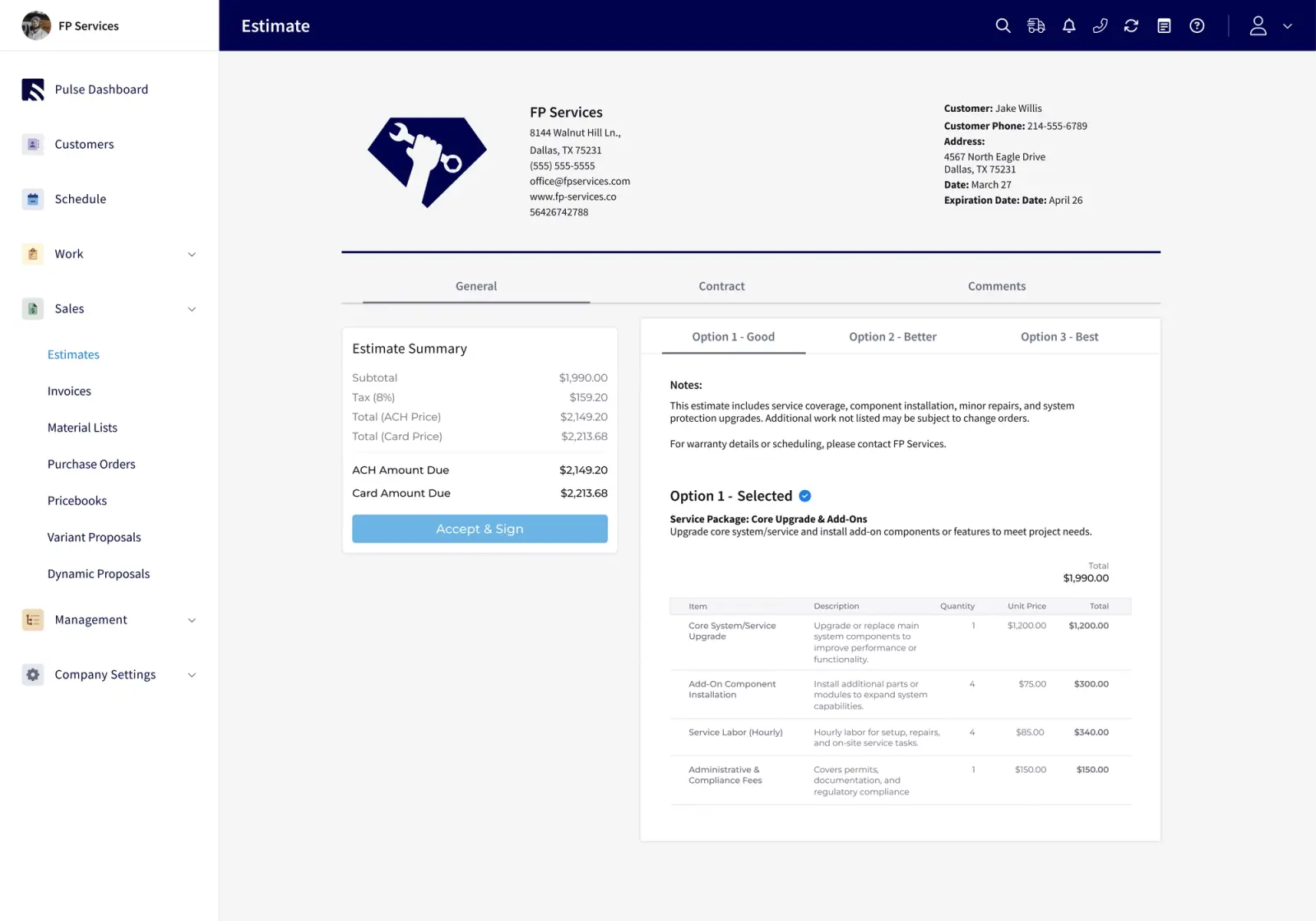
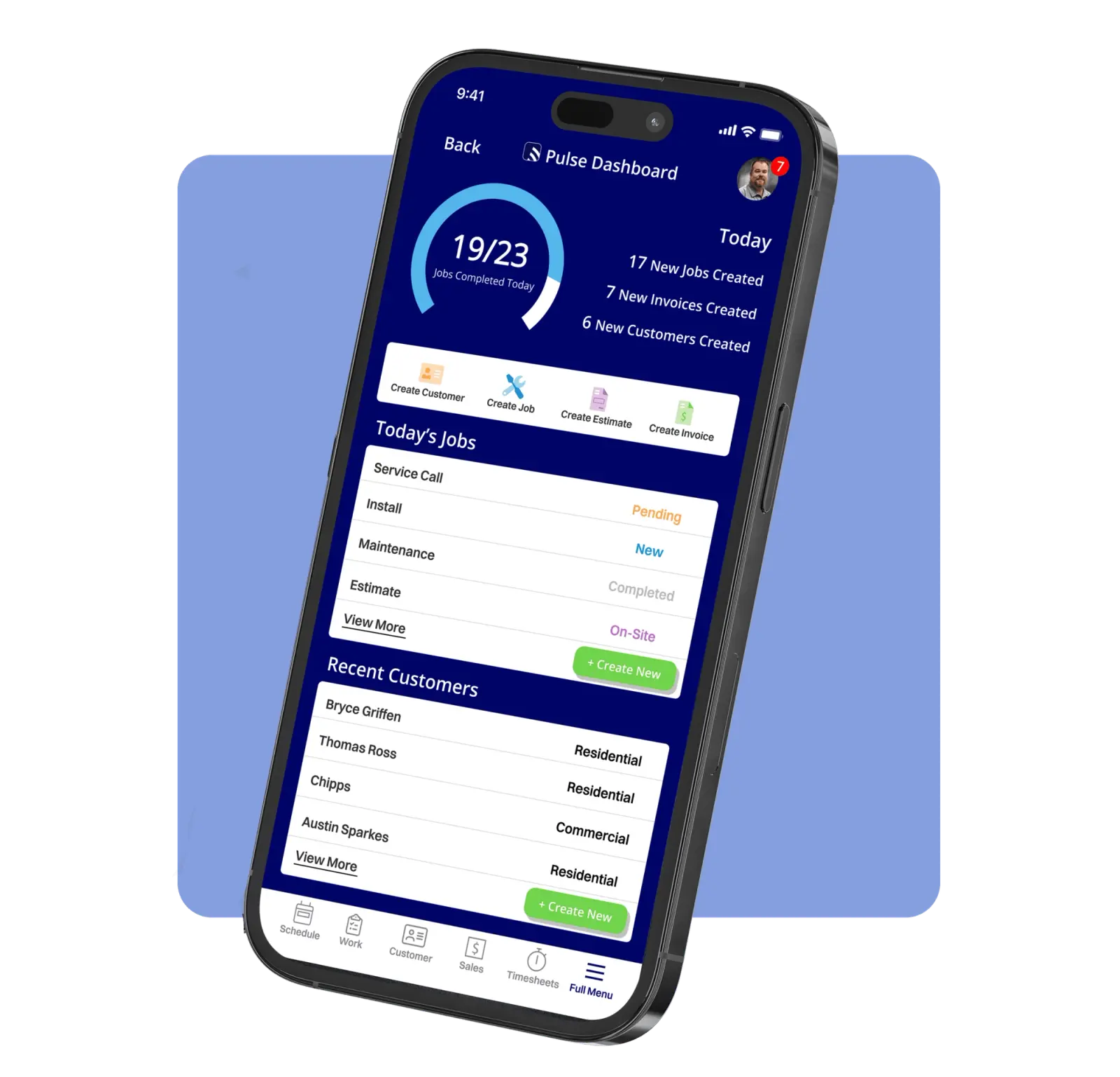
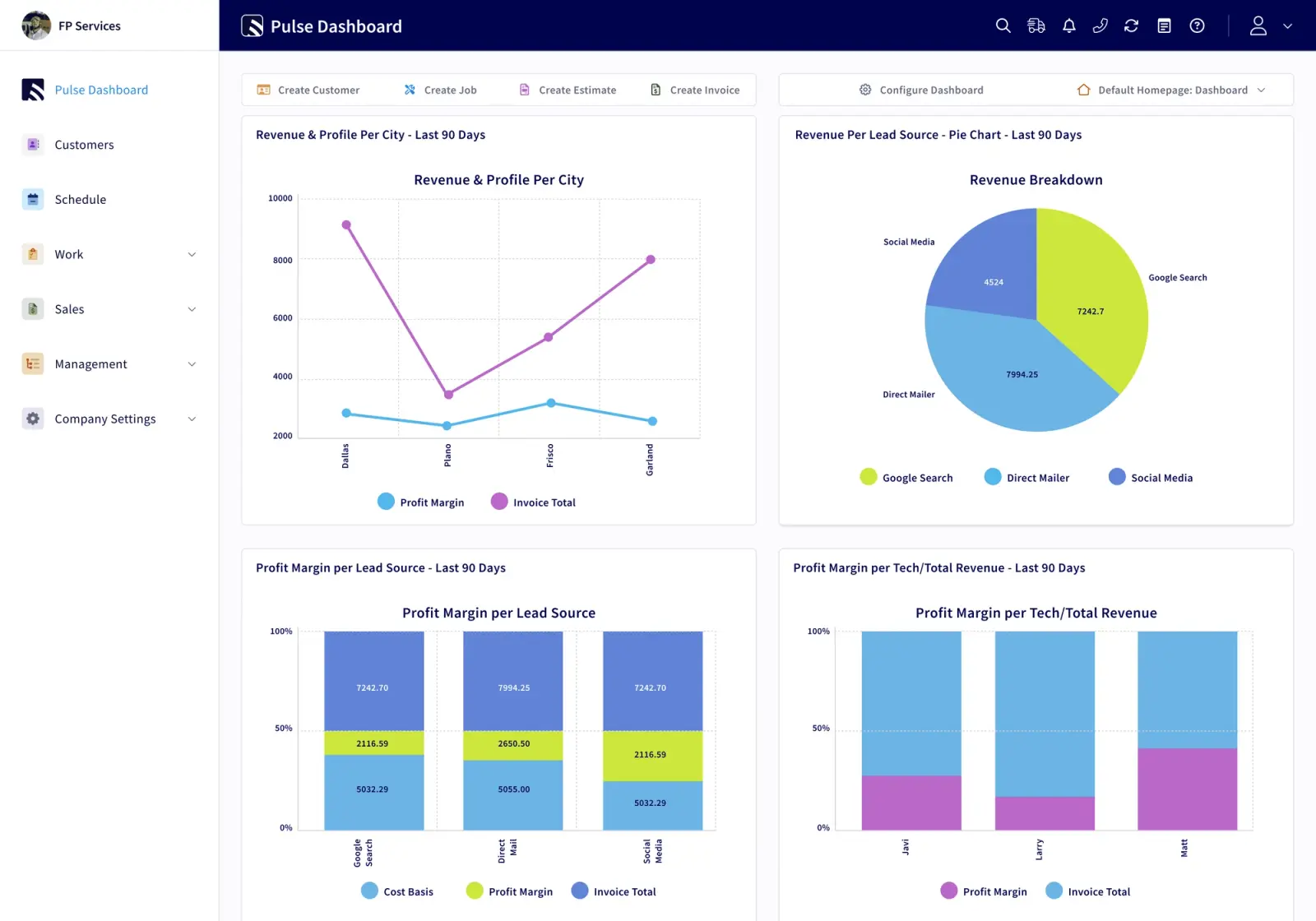
FieldPulse is an all-in-one FSM software platform that replaces the fragmented stack driving hidden costs. One system covers scheduling, dispatch, job management, estimates, invoices, job costing, payments, customer communication, and reporting. It also syncs two ways with QuickBooks Online, so your office and your books stop disagreeing.
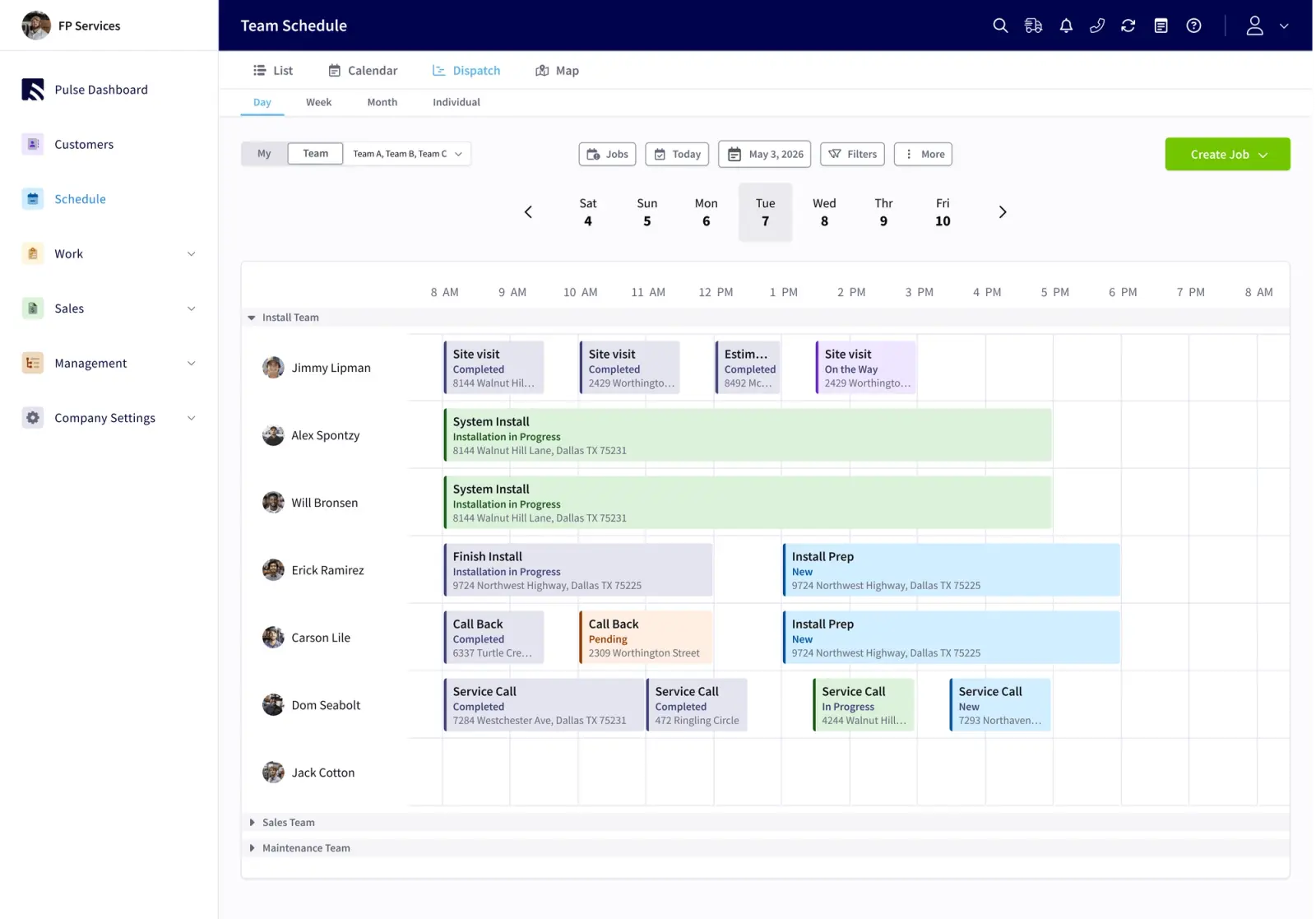
The pricing model works like this:
- Three packages: Essentials, Professional, and Enterprise, priced by seat.
- Two seat types: Full-access seats for owners, office administrators, and dispatchers, and lower-priced field-only seats for techs who need the mobile app alone.
- Add-ons priced separately: Pricebook, Custom Forms, Engage, Operator AI, Chat AI, and Fleet Tracking.
- ClearPath included in core: ClearPath turns your process into guided job stages, required actions at each stage, and ClearPath’s Mobile Focus View shows your tech only what the current step needs.
FieldPulse holds a 4.8 out of 5 aggregate rating across G2, Capterra, the App Store, the Google Play Store, and other software-review sites. On average, FieldPulse customers experience 25% gains in efficiency, with office teams saving more than 40 hours per month, field teams seeing a 50% increase in on-time delivery, and businesses adding over 16 customers every month.
The fastest way to get a real number for your electrical business is a demo that covers your team size, your trade, and what needs to be running on day one. You can see how FieldPulse connects your office and your field in one workflow, or call sales at +1 (817) 635-2218.
Walk Through Your Workflow With Us
FAQ
How Much Does Electrical Service Software Cost Per User Per Month?
As covered above, entry-level tools run about $25–$60 per month, mid-market platforms run $100–$200 per user per month, and enterprise systems run $200–$500+ per user per month or use custom quotes. The per-user figure matters most for electrical teams because it scales with every hire, so use the tier table above to see what each range includes.
What Hidden Costs Should Electrical Contractors Expect Beyond The Subscription?
Most electrical teams see extra costs from onboarding and data migration, SMS and email messaging, payment processing, pricebook and material databases, added user seats, and premium support or training. The earlier “Hidden Costs” section breaks down each category so you can build them into your first-year budget.
How Much Does Electrical Estimating Software Cost, And How Is It Different From Service Software?
Estimating tools often use one-time licenses in the $1,000–$2,500 range or annual subscriptions in the $2,000–$3,600 range for common tools. Service software prices per user per month and runs your day-to-day operations. The “Estimating Software vs. Service Software” section above explains how they work together in a typical electrical service business.
Why Do Most Electrical Software Vendors Use Quote-Only Pricing?
Vendors adjust pricing for seat count, package tier, add-ons, implementation scope, and accounting setup, so one public number would not match most buyers. Use the question list in the pricing section above to unpack any quote you receive and compare vendors fairly.
How Do I Calculate The Real Monthly Cost For A 15-Technician Electrical Business?
Use the same formula described earlier, and plug in your own seat counts, add-ons, onboarding, and payment processing volume. The “How To Calculate Your Real Monthly Cost” section walks through each step in order.
What Is Included In FieldPulse Packages, And What Counts As An Add-On?
FieldPulse packages include ClearPath, scheduling and dispatch, job management, estimates and invoices, customer management, project management, QuickBooks Online sync, the mobile app, and job costing. Add-ons such as Pricebook, Custom Forms, Engage, Operator AI, Chat AI, and Fleet Tracking sit on top of that core. The FieldPulse section above explains how packages and seat types work together.
How Long Does Onboarding Take, And Is It Included In The Price?
Onboarding usually takes two to six weeks, depending on team size, enabled features, data volume, and accounting setup. Some packages include it, while others bill it separately, so always ask for a line-item breakdown in your quote.
When Is It Time To Move Off Estimating-Only Or Basic Invoicing Tools?
Common signals include missed invoices, schedule chaos when emergency requests come in, inconsistent pricing, and customer details scattered across systems. The “When It Is Time To Move Off Estimating-Only Or Basic Invoicing Tools” section gives concrete examples you can compare to your own process.
Conclusion And Practical Next Steps
Your subscription price is not the number you end up paying. Your real monthly cost comes from your 12-month seat count, package tier, day-one add-ons, onboarding and data migration, and payment processing volume.
Before you commit to any platform, take these steps so your choice holds up in year one:
- Document your current workflows, including how a job moves from first call to collected payment today and where it breaks operationally.
- Identify the bottlenecks your office administrator and a tech experience every week. Both roles need to see clear wins before a rollout sticks.
- Calculate your real monthly cost using the formula above at your projected 12-month headcount.
- Ask every vendor the same six questions: (1) what is in the base package, (2) what is an add-on, (3) what onboarding covers, (4) what payment processing costs, (5) what happens when you add a tech, and (6) whether there is a cap on renewal increases.
- Schedule a demo with your office administrator and a tech in the room, not only the owner.
The goal is the lowest total cost of ownership for a platform that connects your office and your field around one current way of working, not simply the lowest subscription price. That means a completed job becomes an invoice, a schedule change does not become a call tree, and your profit margin is something you know before the job is done.
For more on evaluating electrical service software, see Best Electrical Contractor Software for Growing Teams, Electrical Contractor Software: A Decision Framework, and Electrical Contractor Invoicing Software: Close the Gap. If you are comparing pricing across trades, see HVAC Software Cost: Full Pricing Breakdown 2026 and Plumbing Software Pricing: What a Growing Company Pays.