








Key Takeaways
-
Field operations reporting tools replace manual paperwork with digital forms, GPS tagging, and automated dashboards that connect field activity directly to office decisions.
-
Disconnected data between field and office creates revenue leakage, and paper tickets and manual handoffs can extend billing cycles by more than a week while hiding true job profitability.
-
The most effective tools connect reporting to job costing, invoicing, and scheduling so the report reflects the same record the office already uses.
-
Key capabilities to evaluate include offline data capture, photo and signature attachments, GPS tagging, real-time dashboards, and two-way accounting integration.
-
FieldPulse delivers 60+ prebuilt reports, two-way QuickBooks Online sync, offline caching, ClearPath-guided workflows, and a mobile app available in Spanish for 7–50 technician residential service teams.
The Reporting Breakdown In Field Operations
Many residential service owners recognize this scenario. A tech finishes a job, writes notes on a clipboard, records parts on a ticket, and gets a customer signature. The ticket rides in the truck for two days. Your office chases it down, rebuilds the invoice by hand, and sends it out eleven days after the work was done. You still cannot say whether that job made money.
A fully digital business running on manual handoffs has exactly the same failure as a paper-based one. The tech finishes the job, texts the office the parts list, drops photos in a shared folder, and the invoice still gets built somewhere else by someone who was not there. The data exists, but it never turns into a clear decision.
That gap between field activity and office action is where revenue leaks. Analysts estimate that field service revenue leakage can reach 5% of annual revenue, driven by unrecorded labor and forgotten material markups. Paper job tickets create a lag between service completion and invoice generation that often extends billing cycles to 7–14 days, during which completed work sits unbilled while your business continues covering payroll, materials, and overhead.
This guide helps owners and operations leads at 7–50 technician residential service businesses choose field operations reporting tools that turn field data into decisions instead of static records.
Get a Demo of Field Operations Reporting Tools Built for Service Teams
What Are Field Operations Reporting Tools?
Field operations reporting tools capture data in the field, centralize it, and generate reports that inform scheduling, pricing, job costing, and cash flow decisions. The category includes everything from standalone form-capture apps to full FSM software platforms with reporting built into every workflow stage.
That distinction matters. Standalone reporting tools still leave your data fragmented. A form app captures the inspection, but the invoice gets built somewhere else. The report and the job record live in separate places, maintained by different people, and they rarely agree by month-end.
An all-in-one platform like FieldPulse connects reporting to job costing, invoicing, and scheduling so the report reflects the same record your office already uses. There is no second system to reconcile. The data your tech captures on-site is the data your report runs on.
Types Of Field Operations Reports That Matter
Most service businesses rely on four categories of operational reports. Each one answers a different question and supports a different decision.
Knowing which report type you need, and when you need it, helps you see whether a tool truly supports your workflow or only looks polished in a demo.
-
Summary reports show daily or weekly job completion and revenue. An HVAC company reviewing Friday’s completed service calls and total revenue before the weekend is running a summary report. It answers a simple question: did we do what we planned to do this week.
-
Exception reports flag missed appointments, overdue invoices, and low stock. A plumbing business identifying jobs sitting in a generic “on hold” status with no sub-category is using an exception report. It answers what is stuck and why it is stuck.
-
On-demand reports cover job profitability and tech performance. A garage door company pulling profit margin on a specific install before quoting the next one is running an on-demand report. It answers whether that job made money.
-
Recurring reports track maintenance agreement renewals and monthly financials. An HVAC company monitoring which service contracts are approaching renewal is running a recurring report. It answers what is coming up that your team needs to act on.
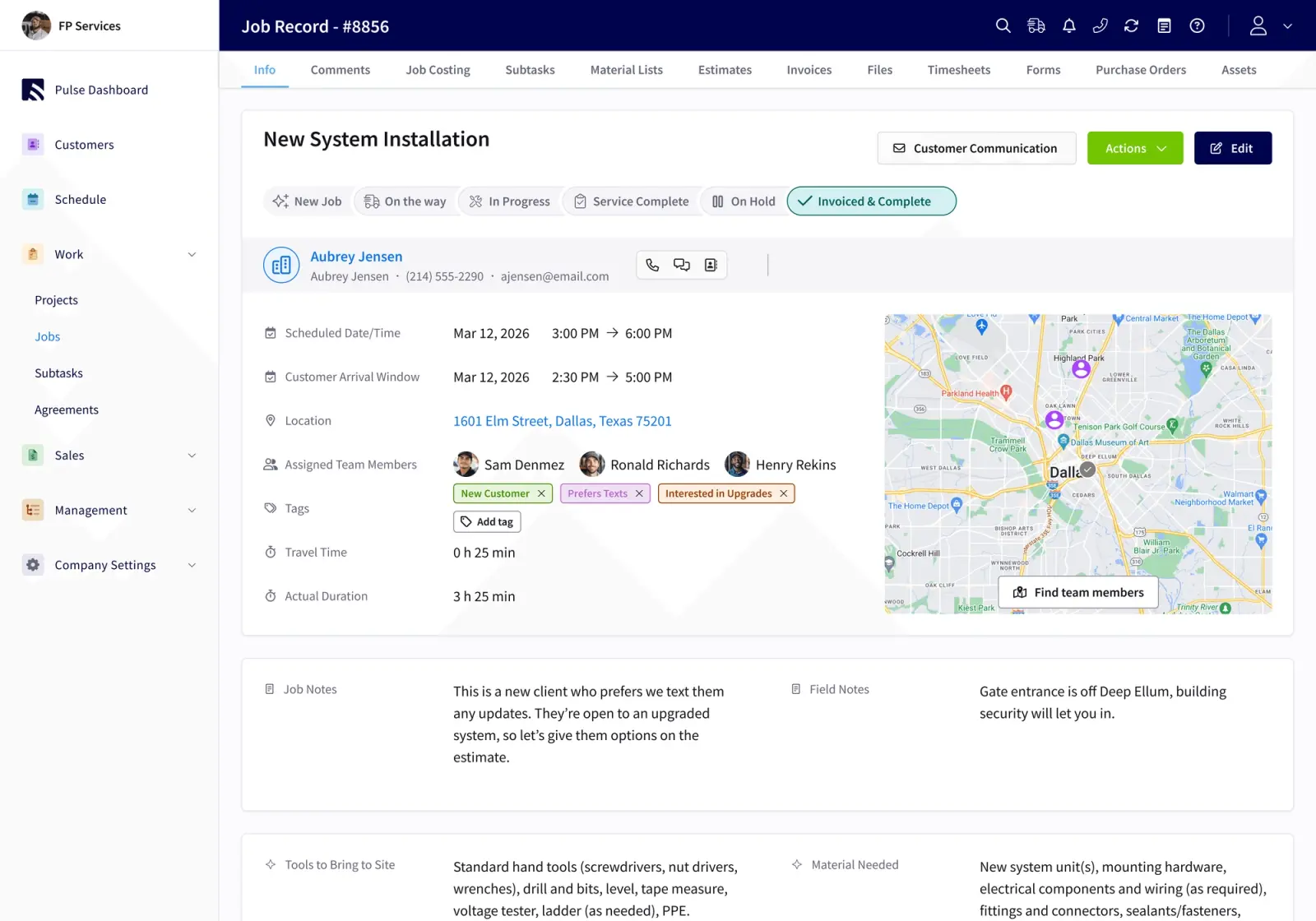
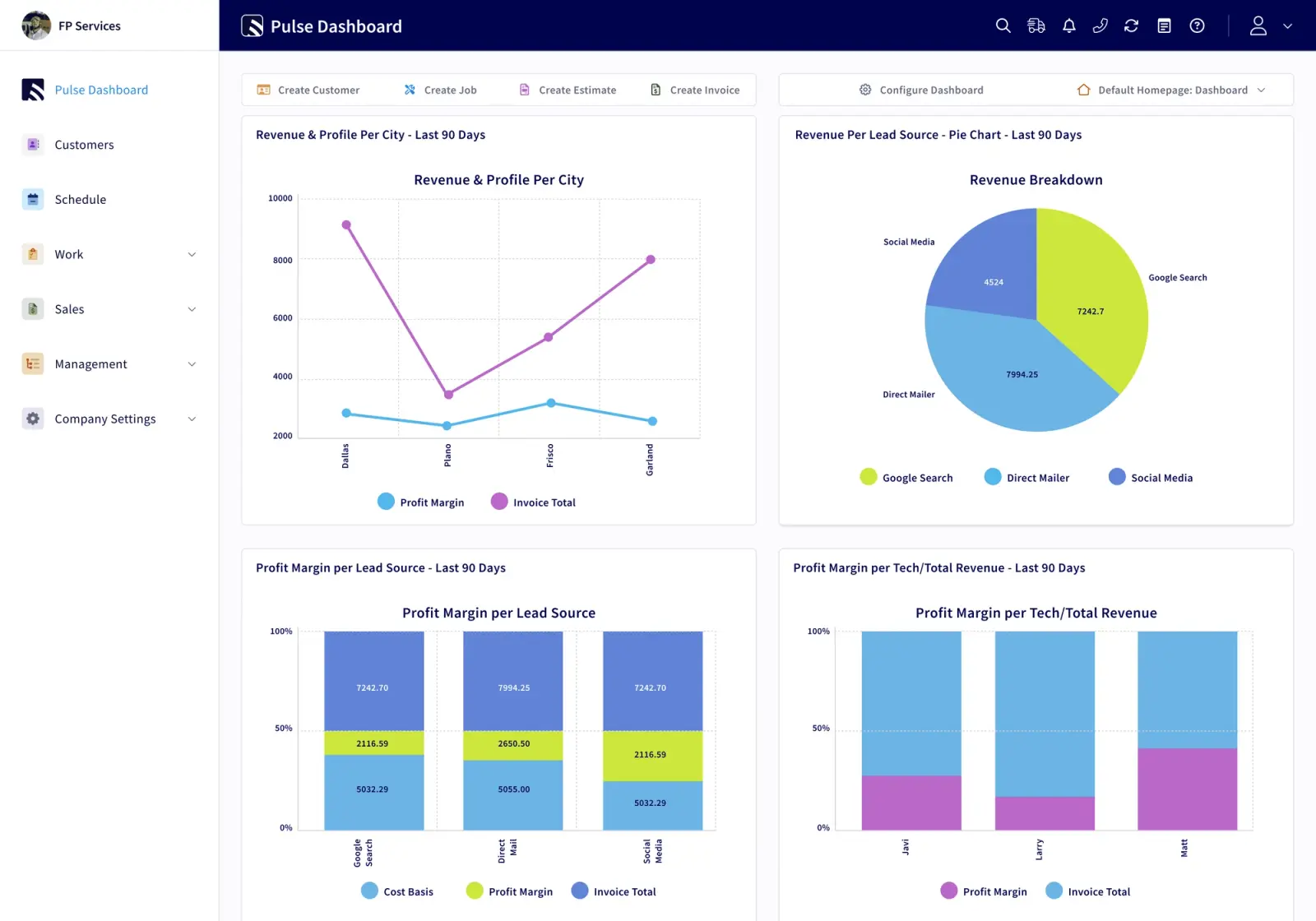
FieldPulse’s 60+ prebuilt reports and custom dashboards cover all four categories. Job costing ties labor and materials to specific jobs, so your on-demand profitability reports reflect what actually happened instead of what you estimated.
See How FieldPulse Reports On Every Job
Key Features To Evaluate In Field Operations Reporting Tools
When you evaluate a reporting tool for a 7–50 technician service business, focus on the capabilities that work in the field and in the office, not just in a demo room.
-
Offline data capture: Your tech documents a job in a crawlspace or a rural service area and syncs when signal returns, so your office is not waiting for paperwork. FieldPulse caches the past week of jobs, projects, customers, estimates, invoices, line items, forms, and templates on the device. Techs can then save unlimited job notes, upload up to 50 photos at a time, update statuses, and clock in and out offline. Everything syncs the moment they reconnect.
-
Photo and signature attachments: Evidence travels with the job record. When a customer questions whether work was completed, you settle it with a timestamped photo and a signature, not a memory.
-
GPS tagging: Accurate arrival and departure timestamps give your techs a clear record of their time on-site. This supports both payroll accuracy and job-level labor costing.
-
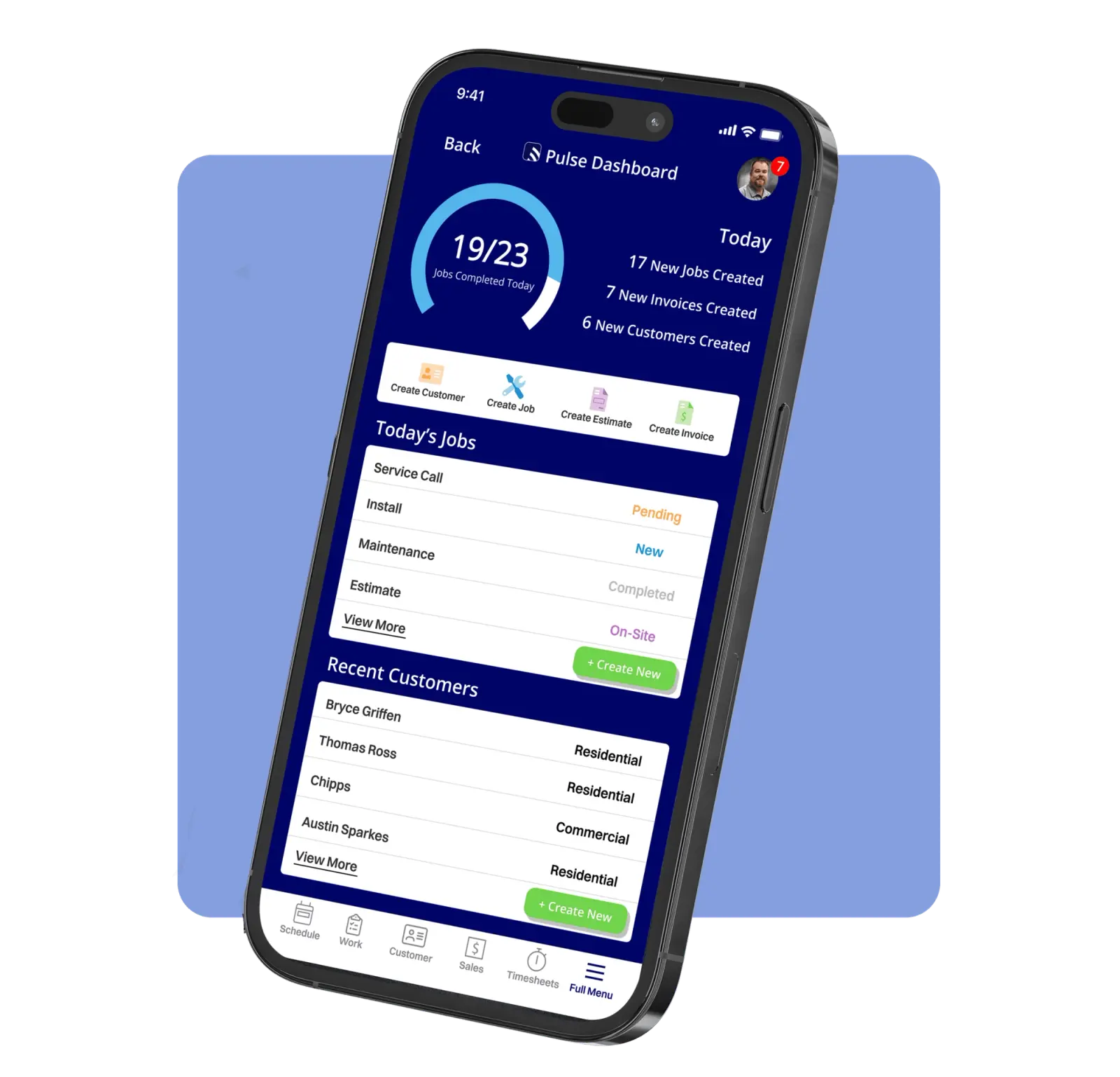
Real-time dashboards: Your office sees job progress without calling a truck. FieldPulse’s dashboards surface tech performance, revenue, outstanding invoices, and job profitability in one view.
-
Two-way accounting integration: FieldPulse’s two-way QuickBooks Online sync keeps reporting aligned with your books. A correction made in QuickBooks carries back into FieldPulse instead of being overwritten, which is what actually ends double data entry.
FieldPulse’s ClearPath-guided workflows ensure required actions are completed at each job stage before the job moves forward. For businesses with bilingual crews, the FieldPulse mobile app is available in Spanish, enabled per user by the FieldPulse team, so Spanish-speaking techs follow the same workflow in the language they use most comfortably.

How Reporting Connects To Job Costing And Invoicing
Reporting only works when the data feeding it stays accurate from the field to job costing to invoicing. That flow has to happen without re-entry. When it breaks, your reports show numbers nobody can trust, because the numbers do not match what actually happened.
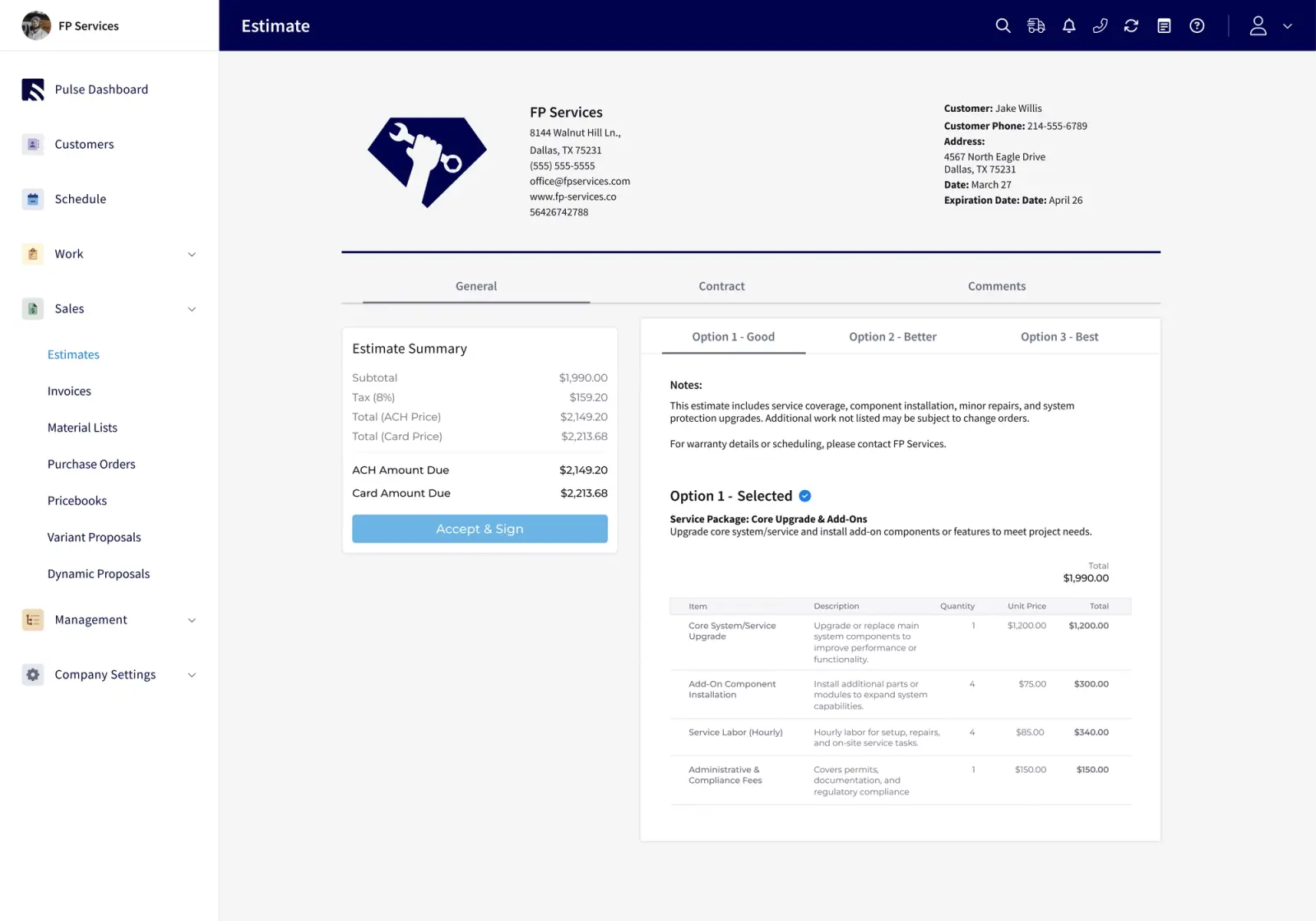
Here is what the connected workflow looks like in FieldPulse:
-
Your tech completes the job and records parts and labor in the mobile app.
-
They capture a customer signature and convert the estimate to an invoice on-site.
-
The office sees job profitability in real time, without re-entry or chasing the ticket.
-
Job costing estimates the expected profit margin upfront and confirms actual profit after completion, with per-job profit and loss and line-item breakdowns of cost, price, and profit.
-
Timesheets clock in by job, so labor ties to specific work rather than a weekly total.
RDI, a commercial furniture installer in St. Louis, is a 50-year-old family business that ran on pen, paper, and Excel before adopting FieldPulse. After implementing FieldPulse, they went from three-week invoicing to five days. They also saw job-level profitability for the first time in the company’s history. As owner Scott Bertram put it: “I wasn’t really thinking about it until we went into the data. Wow, we have really great margins on these sorts of jobs. Let’s push it more into that.” That is the kind of turning point connected reporting creates.
See How Workflow Automation Connects Each Stage Of The Job Lifecycle
Field Operations Reporting Tools Comparison: What To Look For
Not every tool is built for a growing residential service team. The table below highlights the difference that matters most: whether reporting connects to job costing and invoicing or stops at data capture. Notice that only the all-in-one column links the report to the same record your office already uses.
|
Evaluation Area |
Standalone Data Collection Tools |
Enterprise Field Service Platforms |
All-in-One Field Service Software (FieldPulse) |
|---|---|---|---|
|
Reporting connection |
Forms and inspections only, no job costing link |
Reporting tied to ERP, heavy configuration |
60+ prebuilt reports connected to job costing, invoicing, and scheduling |
|
Offline capability |
Varies, often form-only |
Varies, may require middleware |
Caches last week of jobs, notes, photos, estimates, and invoices |
|
Accounting integration |
Rarely native |
Native to ERP, complex setup |
Two-way QuickBooks Online sync |
Standalone data collection tools work well for inspections and form capture but do not connect to job costing or invoicing. Enterprise platforms are built for large operations, priced and implemented accordingly, and usually feel too complex for most growing teams. All-in-one FSM software like FieldPulse is built for the 7–50 technician range. ClearPath standardizes workflows, job costing ties labor and materials to each job, and two-way QuickBooks sync keeps the report and the books aligned. It also includes 60+ reports, a mobile app available in Spanish, and offline caching.
The key question is which tool connects field data to the office decisions your team needs to make every day.
How To Choose The Right Field Operations Reporting Tool
Before you evaluate any platform, walk through this simple process with your team so you know what you actually need.
-
Map your current workflow and identify where data gets lost. Look at what happens when the tech leaves the job site, when the ticket reaches the office, and when the invoice gets built.
-
List the reports you actually need, such as job profitability, tech performance, and outstanding invoices. Once you can name them, you can check whether a tool delivers them without custom builds.
-
Test offline capability and mobile usability with a tech. Have them use the app in a basement or a rural service area. A tool that fails there will fail on your busiest day.
-
Verify integration with your accounting system. Ask the vendor how corrections made in QuickBooks flow back into the field service software so your reports and books stay aligned.
-
Assess implementation effort and support. FieldPulse onboarding typically runs two to six weeks, depending on team size, which capabilities you enable, how much data migrates, and how the accounting setup is handled.
A quick readiness check helps you see if change is urgent. Can you cost out a job from last month without an afternoon of reconstruction. Is your office team spending evenings on paperwork. Are invoices going out more than a week after the work is done. If any of those are true, your reporting system needs an upgrade, and the fix is connecting field data to job costing and invoicing in one workflow.
Get A Demo Of FieldPulse Reporting Tools
Common Pitfalls And How To Avoid Them
Most reporting rollouts fail for predictable reasons. These are the issues that show up most often in growing service businesses.
-
Choosing a tool that does not integrate with your accounting system. The report and the books disagree, and month-end turns into a reconciliation project. Watch for one-way sync that overwrites corrections made in QuickBooks.
-
Ignoring offline capability. A process that assumes constant signal does not fit field work. Test in a basement or a rural service area before you commit.
-
Underestimating office adoption. If your office administrator cannot see their workload getting smaller, the rollout stalls. Bring them into the demo and have them look at the scheduling board, the shared inbox, and what happens to double data entry.
-
Treating reporting as a standalone feature. Reporting that is not connected to job costing and invoicing produces numbers nobody can act on. The report has to reflect the same record the office already uses.
-
Overbuilding the mobile form. Required fields that do not match the work are the most common reporting failure on the tech side. Keep the mobile view focused on what the current job stage needs, which is exactly what ClearPath’s Mobile Focus View is designed to do.
Frequently Asked Questions
What Are Field Operations Reporting Tools?
Field operations reporting tools are software applications that let your field team capture data on-site and send it to the office for timely reporting and analysis. They replace manual paperwork with digital forms, GPS tagging, and automated dashboards. The most useful versions connect that captured data directly to job costing, invoicing, and scheduling so the report reflects what actually happened on the job instead of a later reconstruction.
How Do Reporting Tools Connect To Job Costing?
When your techs clock in by job and record parts and labor on the job record, labor hours tie to specific work rather than a weekly total. That creates the base for job-level profitability. FieldPulse’s job costing estimates the expected profit margin upfront and confirms actual profit after completion, with per-job profit and loss and line-item breakdowns of cost, price, and profit by category. Because the job record, the timesheet, and the invoice all live in one system, the report reflects the same data the office already used to run the job.
Can Field Operations Reporting Tools Work Offline?
Field operations reporting tools can work offline when they cache data on the device. FieldPulse caches the last week of jobs, projects, customers, estimates, and invoices. Techs can complete most standard job tasks without cell signal in places like rural areas, basements, crawlspaces, and attics. They can add notes, update job status, clock in and out, edit cached estimates and invoices, and upload photos. Everything saved offline syncs as soon as the device is back in signal.
What Is The Difference Between A Reporting Tool And A Full Field Service Platform?
A standalone reporting tool captures and displays data. A full platform like FieldPulse connects reporting to job costing, invoicing, scheduling, and payments so the report reflects the same record the office already uses. The practical difference shows up at month-end. With a standalone tool, your office still has to reconcile the report against the books. With a connected platform, the report and the books agree because they draw from the same source.
Conclusion And Next Steps
Reporting breaks operationally when field data and office systems stay disconnected. The fix is a workflow where data capture, job costing, and invoicing live in one system, and reporting becomes a byproduct of the work rather than a separate task.
Start by documenting your current reporting process and identifying where data breaks down. Ask whether you can cost out a job from last month, whether invoices go out within 48 hours of job completion, and whether your office team spends evenings rebuilding what your techs already captured in the field.
For 7–50 technician residential service businesses in HVAC, plumbing, garage door service, and related trades, FieldPulse connects field capture to job costing and invoicing in one workflow. Customers see gains in efficiency and real savings in office hours because reporting, scheduling, and billing all pull from the same record.
Get A Demo And Turn Field Data Into Decisions